

Dry skin usually does not need more steps. It needs fewer opportunities to lose moisture and a better balance between cleansing, treatment, moisturization, and protection. A complicated routine can actually make dryness harder to manage when several cleansers, exfoliants, or strong actives repeatedly disturb an already uncomfortable skin surface.
The best routine therefore starts by identifying what is making your skin dry, then building around a moisturizer you can use consistently. Serums, oils, masks, and treatment actives can be useful, but they are secondary to the basic job of restoring and maintaining the skin’s moisture barrier.
What Does Dry Skin Actually Need?
Dry skin, also called xerosis, develops when the outer skin does not retain enough water and its barrier function becomes less effective. Common signs include tightness, rough texture, flaking, itching, and increased sensitivity. More severe dryness can lead to cracking, burning, or bleeding.[2][3]
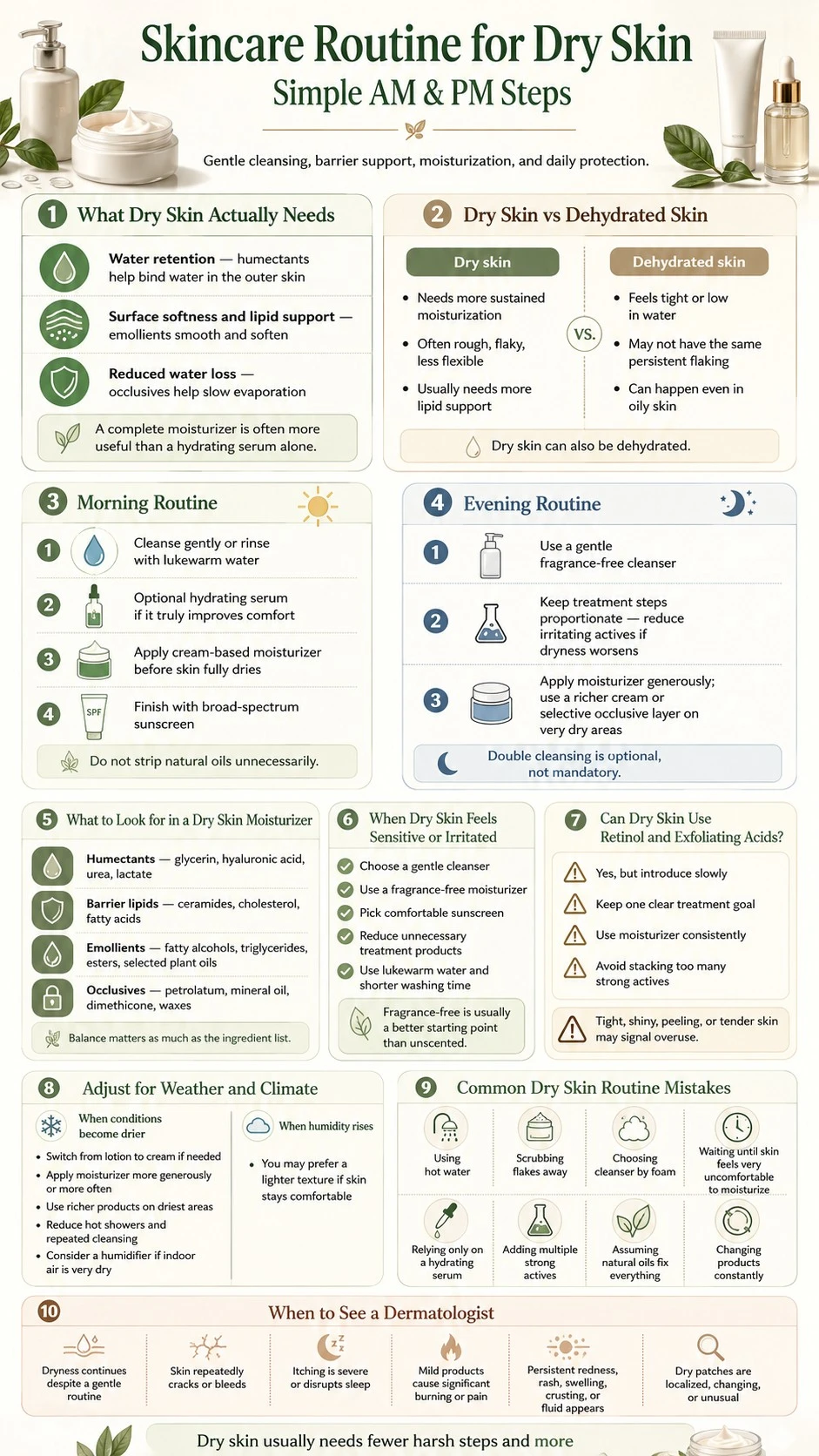
A useful dry-skin routine addresses three related needs:
- Water retention: humectant ingredients help increase or retain water in the stratum corneum.
- Surface softness and lipid support: emollient materials help smooth rough skin and improve flexibility.
- Reduced water loss: occlusive ingredients create a more water-resistant surface layer that slows evaporation.[4][5]
This is why a complete moisturizer is often more useful for dry skin than relying on a hydrating serum alone. Many effective moisturizers combine ingredients that address several of these functions in the same formula.[4]
Dry Skin vs Dehydrated Skin
The terms are often used interchangeably, but they are useful for describing different patterns. Dry skin tends to need more sustained moisturizing and lipid support, while skin that mainly feels dehydrated may show tightness or low water content without the same degree of persistent roughness, flaking, or oil deficiency.
The distinction is not always clean-cut. Dry skin can also be dehydrated, and oily skin can temporarily feel dehydrated. What matters is the pattern: persistent roughness and flaking usually call for more than simply adding a lightweight water-binding serum.
If you are not sure which pattern better describes your skin, Dehydrated vs Dry Skin: Signs, Causes & Best Routine explains the difference and how it changes product selection.
Morning Skincare Routine for Dry Skin
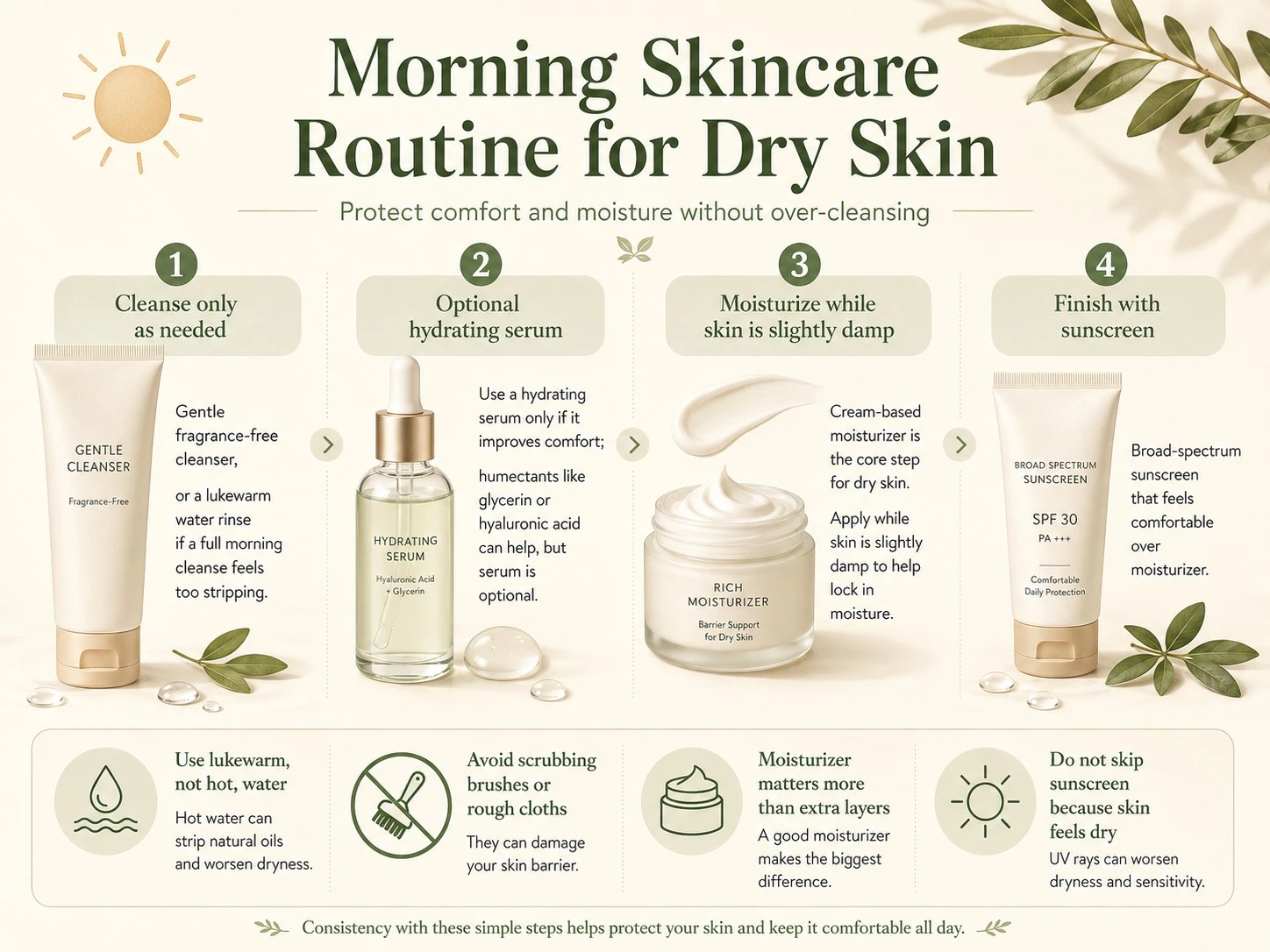
The morning routine should preserve comfort while preparing the skin for environmental exposure. You do not need to remove every trace of natural oil before applying the rest of your products.
1. Cleanse Only as Much as Your Skin Needs
Use a gentle, fragrance-free cleanser if you wake up feeling oily, need to remove an overnight product, or simply prefer cleansing in the morning. If cleansing twice daily consistently leaves your face tight or uncomfortable, some people with dry or sensitive skin can use a simple water rinse in the morning and reserve cleanser for the evening.[1][6]
Use lukewarm rather than hot water and avoid scrubbing with cleansing brushes, rough cloths, or abrasive tools. Hot water and prolonged washing can remove more of the skin’s natural surface lipids and worsen dryness.[1]
2. Add a Hydrating Serum Only if You Need One
A serum is optional. Humectant ingredients such as glycerin or hyaluronic acid can add useful hydration, but they do not automatically replace the broader moisturizing functions of a cream.[1][4][5]
If your moisturizer already keeps the skin comfortable throughout the day, there is no requirement to add a separate hydration serum. Add one when it solves a clear problem rather than because a dry-skin routine is expected to contain several hydration layers.
3. Apply Moisturizer Before the Skin Fully Dries
Moisturizer is the core step. Applying it after washing while the skin remains slightly damp helps retain water that would otherwise evaporate from the surface.[1]
For persistent facial dryness, a cream often provides more substantial moisturizing support than a very light lotion or gel. The right texture should still feel comfortable enough that you will use it consistently.
4. Finish With Sunscreen
Dry skin still needs daily photoprotection. Use a broad-spectrum sunscreen that is comfortable over your moisturizer and does not leave the skin feeling increasingly tight during the day. Dryness is not a reason to skip sunscreen; instead, adjust the moisturizer or sunscreen texture until the combination works comfortably.[1]
Evening Skincare Routine for Dry Skin
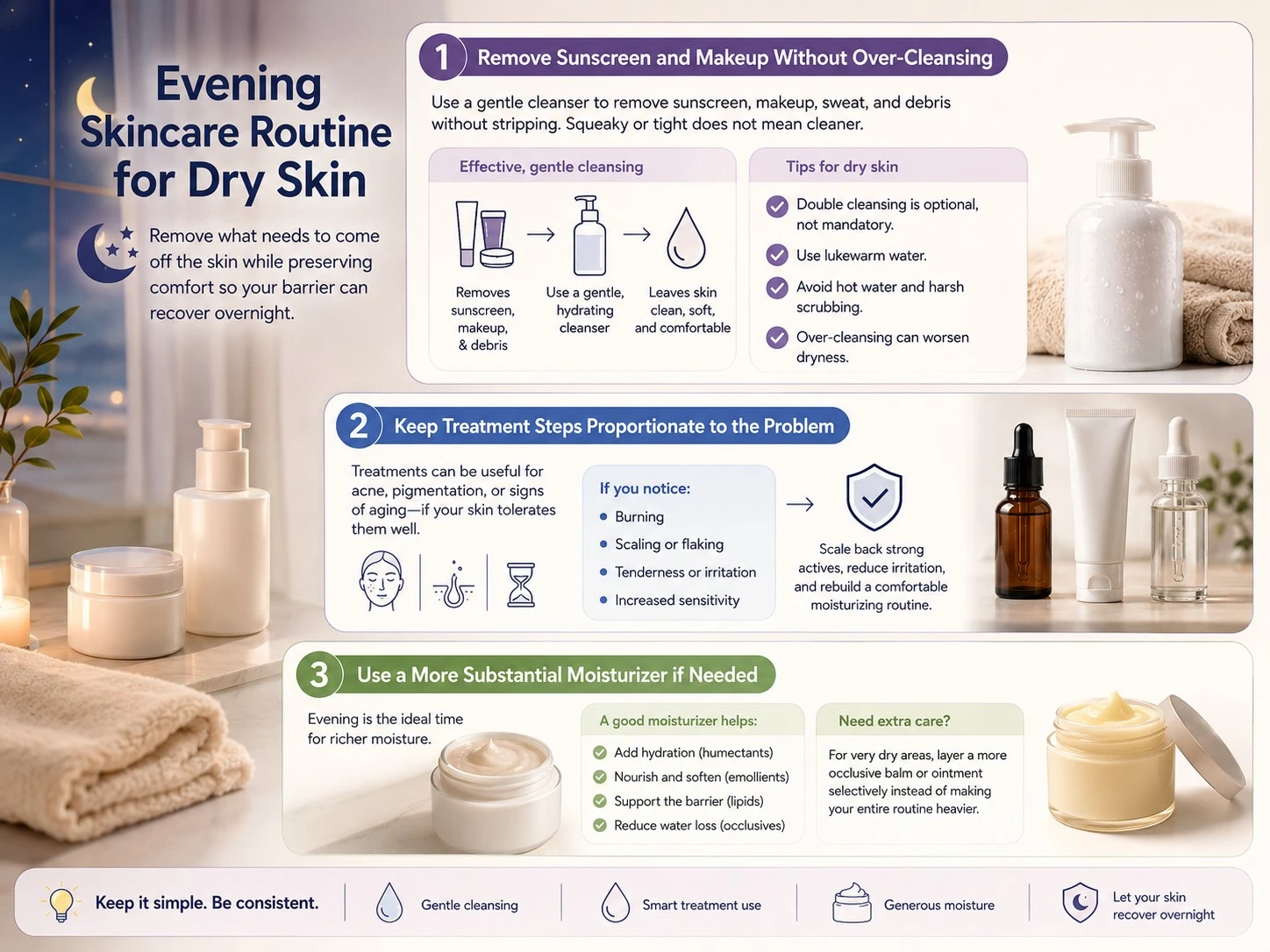
The evening routine has a different priority: remove what needs to come off the skin while preserving enough comfort for the barrier to recover overnight.
1. Remove Sunscreen and Makeup Without Over-Cleansing
Use enough cleanser to remove sunscreen, makeup, sweat, and debris, but do not equate a squeaky or tight feeling with better cleansing. A gentle hydrating cleanser is usually more appropriate than repeatedly using strong foaming or exfoliating cleansers when dryness is already present.[1]
Double cleansing is optional rather than mandatory. It can be useful when one cleanser does not adequately remove heavy or water-resistant products, but adding another cleansing step when the first one already works can create unnecessary exposure for dry skin.
2. Keep Treatment Steps Proportionate to the Problem
Dry skin can still have acne, pigmentation, or signs of aging, so treatment ingredients do not always need to be removed. The important question is whether the treatment remains tolerable.
If retinoids, exfoliating acids, or multiple treatment products are causing persistent burning, scaling, or tenderness, increasing treatment intensity is unlikely to solve the problem. Reduce unnecessary irritation and rebuild a comfortable moisturizing routine before adding more actives.[1]
3. Use a More Substantial Moisturizer if Needed
Evening is a practical time to use a richer moisturizer because cosmetic finish is usually less important than during the day. A cream that contains complementary humectant, emollient, lipid, and occlusive components can help improve hydration while reducing moisture loss.[4][5]
If one area remains much drier than the rest of your face, you can also use a more occlusive product selectively rather than making the entire routine heavier.
What Ingredients Should You Look for in a Dry-Skin Moisturizer?
Do not judge a moisturizer by one hero ingredient. Dry skin often benefits from ingredients performing complementary jobs within the same finished formula.[4][5]
| Ingredient Direction | Examples | Why It Can Help Dry Skin |
|---|---|---|
| Humectants | Glycerin, hyaluronic acid, urea, lactate | Help increase water retention in the outer skin |
| Barrier lipids | Ceramides, cholesterol, fatty acids | Support the lipid environment of the stratum corneum |
| Emollients | Fatty alcohols, triglycerides, esters, selected plant oils | Improve surface softness, flexibility, and smoothness |
| Occlusives | Petrolatum, mineral oil, dimethicone, waxes | Help slow water evaporation from the skin surface |
The amount and balance of these materials affect texture as well as moisturizing performance. A formula can contain excellent ingredients yet still be too light, too heavy, or otherwise uncomfortable for your particular skin.
If choosing between lotions, gels, creams, and richer formats is the difficult part, How to Choose a Moisturizer for Your Skin Type provides a more detailed product-selection framework.
When Dry Skin Also Feels Sensitive or Irritated
Dryness and irritation often reinforce each other. When the skin becomes rough, cracked, or inflamed, products that normally feel comfortable may begin to sting. At that point, reducing routine complexity can be more useful than adding another treatment serum.
Prioritize:
- a gentle cleanser;
- a fragrance-free moisturizer;
- comfortable sunscreen;
- fewer unnecessary treatment products;
- lukewarm water and shorter washing time.
Also distinguish fragrance-free from unscented. Unscented products can still contain materials used to mask odor, while fragrance-free labeling is generally the more useful starting point when fragrance is aggravating dry or sensitive skin.[1]
If burning, persistent redness, or cracking suggests that the problem has moved beyond ordinary dryness, Skin Barrier: Signs of Damage and How to Repair It can help you evaluate whether barrier disruption is now the more important issue.
Can Dry Skin Use Retinol and Exfoliating Acids?
Yes, but dry skin does not automatically tolerate every treatment at the same frequency as more resilient skin. Retinoids and exfoliating acids can be useful for acne, pigmentation, and signs of aging, yet they can also increase dryness and irritation when introduced too aggressively.[1]
A practical approach is to keep one clear treatment goal, introduce strong actives gradually, and use moisturizer consistently. You do not need a retinoid, an AHA, a BHA, and an exfoliating toner in the same routine simply because each ingredient has an evidence-based use.
If your skin has already become tight, tender, shiny, peeling, or unusually reactive after frequent exfoliation, Over-Exfoliated Skin: Signs, Healing & Safe Routine addresses that problem more directly.
How Should You Adjust a Dry-Skin Routine for Weather and Climate?
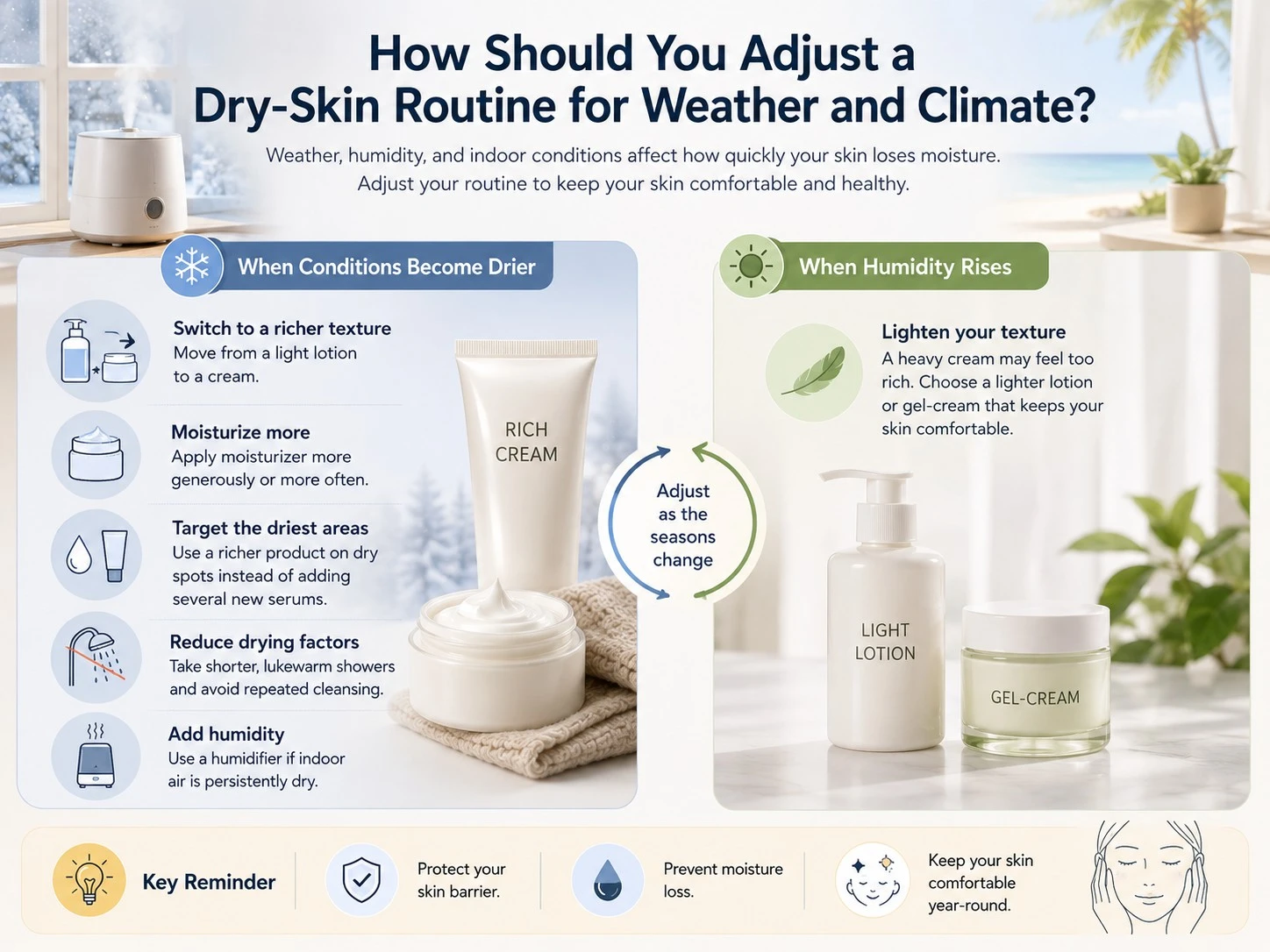
Your moisturizer does not need to remain identical all year. Low humidity, cold air, wind, indoor heating, air conditioning, travel, and changes in cleansing frequency can alter how quickly the skin loses moisture.[1][2]
When conditions become drier:
- switch from a light lotion to a cream if your current product no longer lasts;
- apply moisturizer more generously or more often;
- use a richer product on the driest areas rather than adding several new serums;
- reduce long, hot showers and repeated cleansing;
- consider a humidifier if indoor air is persistently dry.[1]
When humidity rises, you may find that the same heavy cream becomes uncomfortable. Reducing texture richness is reasonable as long as the skin remains comfortable and free from persistent flaking or tightness.
Common Dry-Skin Routine Mistakes
- Using hot water because it feels soothing. Repeated hot washing can worsen moisture loss and dryness.[1]
- Trying to scrub flakes away. Rough cloths, brushes, and aggressive exfoliation can add irritation to an already dry surface.
- Choosing a cleanser by how much it foams. A tight post-cleansing feeling is not evidence that the skin is cleaner.
- Applying moisturizer only after the skin already feels uncomfortable. Regular use, especially after washing, is more useful than waiting for severe tightness.[1][4]
- Relying on a hydrating serum as the entire moisturizing routine. Humectancy is only one part of controlling dry skin.
- Adding multiple strong actives to fix rough texture. Roughness caused by dryness is not always a signal that the skin needs more exfoliation.
- Assuming natural oils automatically repair every form of dryness. Oils vary substantially in composition and do not replace every function of a complete moisturizer.
- Changing products constantly. A simple routine used consistently is easier to evaluate than frequent ingredient switching.
When Should You See a Dermatologist for Dry Skin?
Ordinary environmental dryness often improves with gentler washing and regular moisturization. Persistent or worsening dryness deserves more attention because conditions such as atopic dermatitis, psoriasis, contact dermatitis, medications, or other health factors can produce dry, itchy, or inflamed skin.[2][3]
Consider professional evaluation when:
- dryness continues despite a consistent gentle routine;
- the skin repeatedly cracks or bleeds;
- itching is severe or affects sleep;
- products that normally feel mild cause significant burning or pain;
- you develop persistent redness, a rash, swelling, crusting, or fluid;
- dry patches are localized, changing, or otherwise unusual.[2][3]
At that point, adding a richer cosmetic is not necessarily the right next step. Identifying the cause becomes more important than continuing to experiment with skincare.
Final Thoughts
A dry-skin routine works best when it protects the skin from unnecessary moisture loss and gives the barrier enough support to stay comfortable. That usually means gentle cleansing, consistent moisturization, sensible treatment use, and daytime sun protection rather than a large collection of hydrating products.
If you change only one part of the routine, make it the moisturizer. Choose a texture substantial enough for your level of dryness, apply it consistently—especially after washing—and then add serums, oils, or treatment actives only when they solve a separate problem.
FAQs About a Skincare Routine for Dry Skin
Should Dry Skin Wash Its Face Twice a Day?
Not everyone needs to. If twice-daily cleansing leaves the skin tight or uncomfortable, a water rinse in the morning and a gentle cleanse in the evening may be enough for some people with dry or sensitive skin.[6] The evening cleanse remains useful for removing sunscreen, makeup, and daily buildup.
Is a Cream or Lotion Better for Dry Skin?
Creams generally provide more moisturizing support than light lotions, and ointments can hold even more moisture for very dry areas.[1][3] Facial comfort, climate, acne tendency, and how well the product layers with sunscreen should still influence the final choice.
Should I Apply Moisturizer to Wet or Dry Skin?
Apply moisturizer after gently patting the skin so it remains slightly damp rather than waiting until all surface water has evaporated. This helps retain water from washing within the moisturizing routine.[1]
Does Dry Skin Need Hyaluronic Acid?
Not necessarily. Hyaluronic acid is a useful humectant, but dry skin can also need emollient, lipid, and occlusive support. If your moisturizer already keeps your skin comfortable, a separate hyaluronic acid serum is optional rather than essential.
Can Dry Skin Use Face Oil Instead of Moisturizer?
A face oil can provide emollient and some water-loss support, but it does not reproduce every function of a moisturizer containing water-binding and barrier-supporting ingredients. For many people with dry skin, oil works better as an optional complement than as the only moisturizing step.
Why Is My Skin Still Dry Even Though I Moisturize?
Possible reasons include a moisturizer that is too light, repeated hot washing, harsh cleansing, over-exfoliation, low humidity, irritating treatments, or an underlying skin condition. If changing the routine does not improve persistent dryness, professional evaluation can help identify the cause.[1][2][3]
Sources
[1] American Academy of Dermatology. Dermatologists’ Top Tips for Relieving Dry Skin
[2] American Academy of Dermatology. Dry Skin: Overview
[3] American Academy of Dermatology. Dry Skin: Signs and Symptoms
[4] Szepietowski JC, Tadini G. Basic Emollients for Xerosis Cutis Not Associated With Atopic Dermatitis: A Review of Clinical Studies
[5] Wollenberg A et al. Restoring Skin Hydration and Barrier Function: Mechanistic Insights Into Basic Emollients for Xerosis Cutis
[6] American Academy of Dermatology. A Dermatologist’s Guide to Skincare From Growing Up to Glowing Up


