


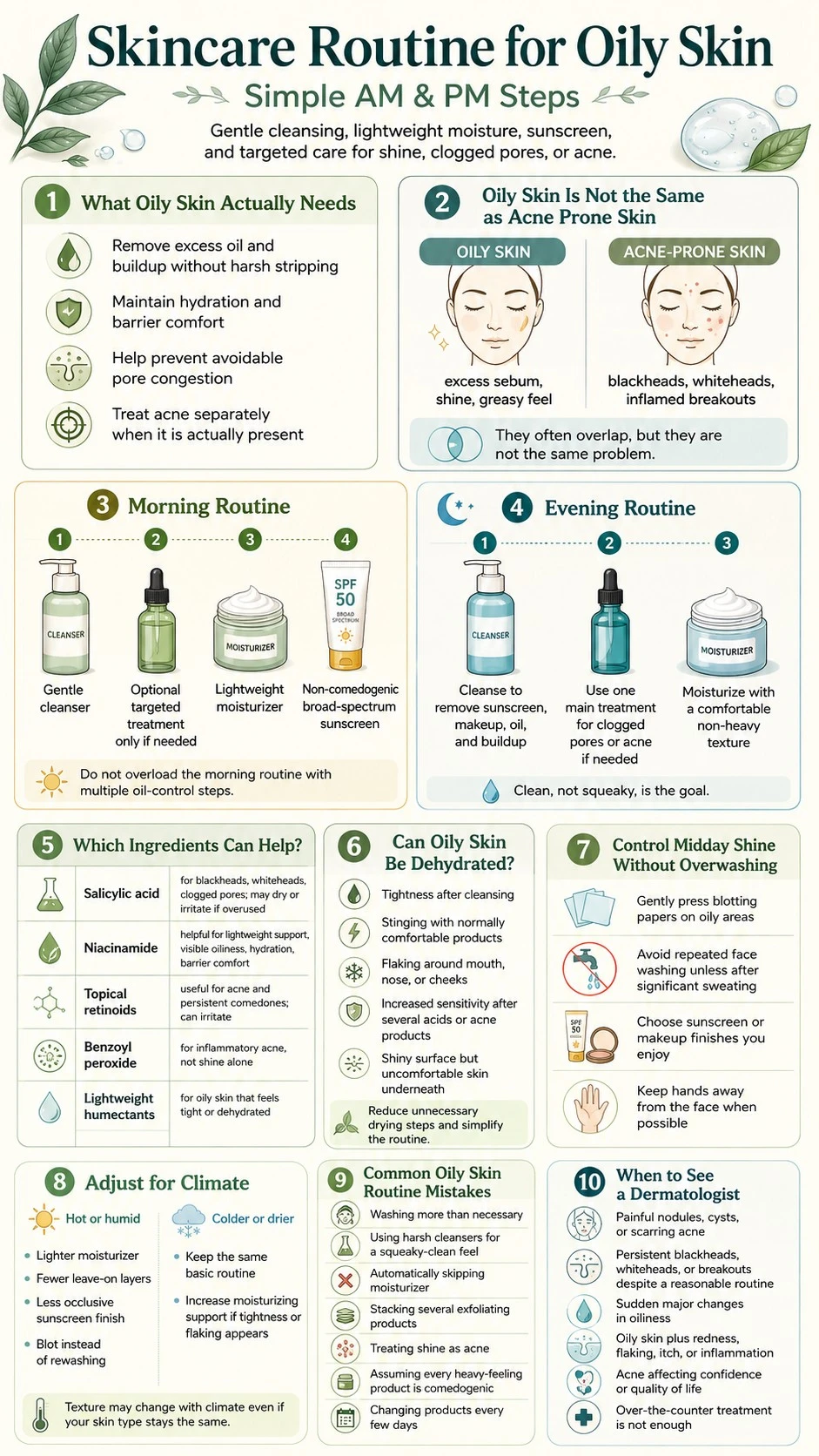
Oily skin often creates a misleading goal: make the face feel as dry as possible. Strong cleansers, alcohol-heavy products, frequent washing, and several exfoliating treatments can certainly remove surface oil for a while, but they can also irritate the skin and make a routine harder to tolerate.[1][2]
A better strategy is to separate three different problems: oiliness, clogged pores, and acne. They often occur together, but they are not identical. Your routine should manage excess shine while treating congestion or breakouts only when those problems are actually present.
What Does Oily Skin Actually Need?
Oily skin produces enough sebum to create persistent shine or a greasy feel, especially through areas such as the forehead, nose, and chin. Sebum itself is not something you need to eliminate completely; it contributes to the skin’s surface environment and helps protect the skin.[1]
A useful oily-skin routine has four jobs:
- Remove excess oil and buildup without aggressive stripping.
- Maintain enough hydration and barrier support that cleansing and treatment remain comfortable.
- Prevent avoidable pore congestion by choosing appropriate leave-on products.
- Treat acne separately when it is present instead of assuming that reducing shine alone will clear breakouts.
If you are unsure whether your skin is truly oily or simply becomes shiny in certain areas, start with What Is My Skin Type? Simple Test & Skincare Guide.
Oily Skin Is Not the Same as Acne-Prone Skin
Oily skin and acne frequently overlap because excess sebum can contribute to the environment in which pores become clogged, but having oily skin does not automatically mean you have acne. Likewise, someone with combination or even dry-feeling skin can still develop blackheads, whiteheads, or inflammatory acne.
This distinction changes product selection. If your main complaint is midday shine but your pores are generally clear, you may not need a strong acne treatment. If you have recurrent blackheads and whiteheads, an ingredient that helps unclog follicles becomes more relevant. If you have inflamed pimples, nodules, or persistent acne, treatment needs extend beyond simply choosing a mattifying cleanser.[3]
For persistent blackheads or whiteheads, Clogged Pores: Causes, Signs & How to Clear Them explains how follicular blockage differs from surface oiliness.
Morning Skincare Routine for Oily Skin

The morning routine should remove overnight buildup, keep the skin comfortable, and create a base that works beneath sunscreen without turning into a heavy stack of oil-control products.
1. Wash With a Gentle Cleanser
Cleanse in the morning with a mild face wash and lukewarm water. Washing up to twice daily and after significant sweating is generally enough; repeated cleansing throughout the day can irritate acne-prone or oily skin.[1][2][4]
Foaming texture can be comfortable for some oily skin, but the useful test is how the skin feels afterward. A cleanser should remove excess oil and debris without leaving persistent tightness, burning, or roughness. If cleanser selection is the difficult part, use How to Choose a Cleanser for Your Skin Type & Concerns.
2. Add a Treatment Only When It Has a Clear Job
You do not need a toner, exfoliating pad, pore serum, oil-control serum, and acne treatment simply because your skin is oily. Add a treatment according to the problem you are trying to solve.
For example, salicylic acid can be useful when oiliness is accompanied by blackheads, whiteheads, or clogged pores because it helps exfoliate and clear follicles.[3] A serum or treatment designed only to reduce shine is optional if the rest of your routine already keeps oiliness manageable.
3. Use a Lightweight Moisturizer
Oily skin does not automatically need to skip moisturizer. Moisturization can be especially useful if cleansing, salicylic acid, benzoyl peroxide, retinoids, or other acne treatments leave the skin dry or irritated.[5]
Look for a texture that gives enough hydration without feeling uncomfortably rich. Gel creams, light lotions, and fluid moisturizers can work well for many people, but texture is a preference and formulation issue rather than a strict rule that every oily skin type must use a gel.
4. Finish With Sunscreen
Use broad-spectrum sunscreen as the final skincare step in the morning. For oily or acne-prone skin, a non-comedogenic formula with a finish you can apply generously is more useful than choosing a sunscreen solely because it is marketed as “matte.”[1][6]
If heaviness, shine, or breakouts make SPF difficult to choose, How to Choose Sunscreen for Oily and Acne-Prone Skin focuses on that decision.
Evening Skincare Routine for Oily Skin
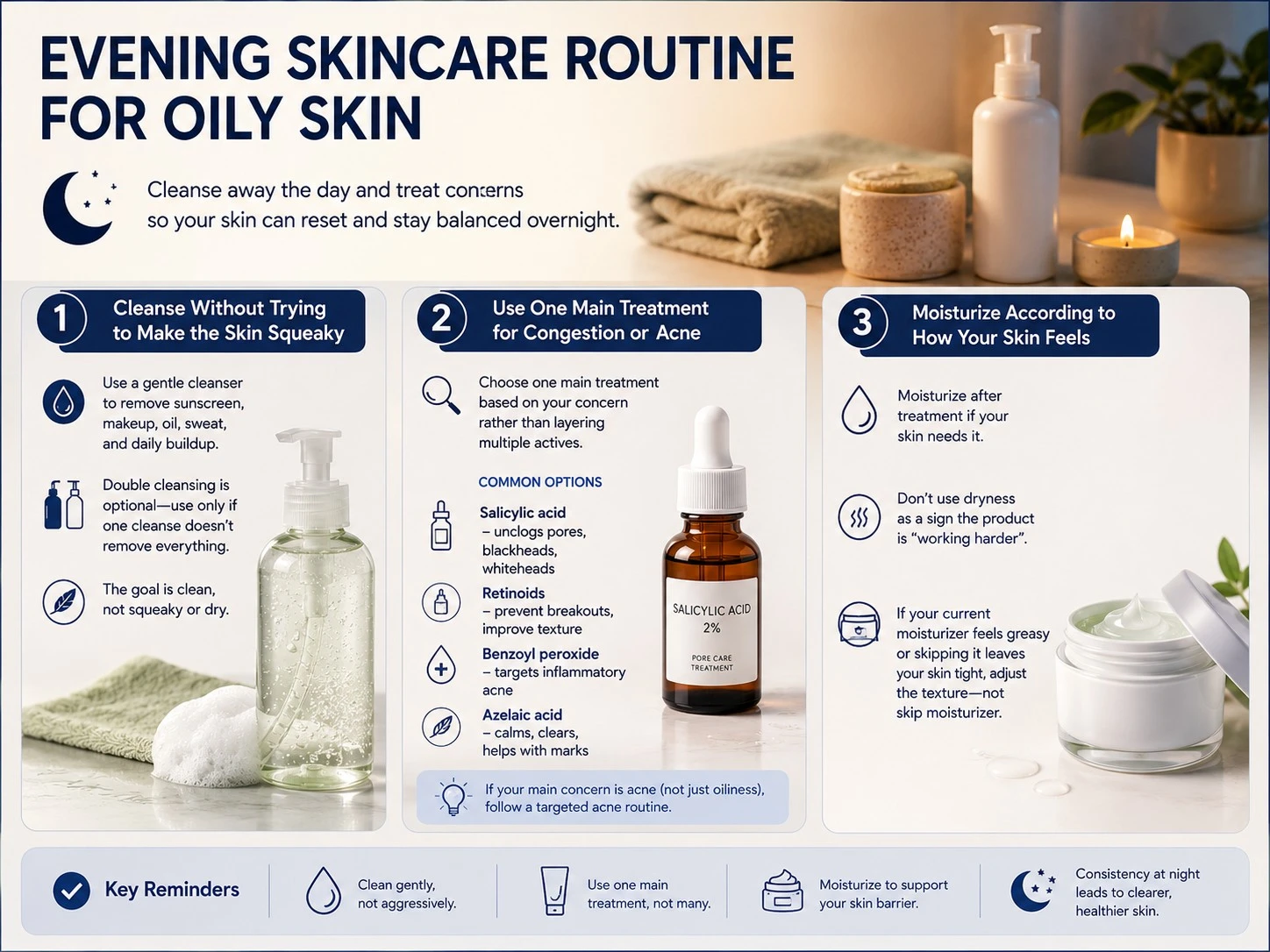
The evening routine should remove the day’s sunscreen, makeup, oil, sweat, and environmental buildup while giving any treatment product a clear place in the routine.
1. Cleanse Without Trying to Make the Skin Squeaky
Use a gentle cleanser before bed. If you wear heavy makeup or a sunscreen that your normal cleanser does not remove adequately, an additional removal step can be useful. Double cleansing is not mandatory simply because the skin is oily.
Avoid using cleansing as the main method of controlling oil production. The goal is to leave the skin clean, not deliberately dry.
2. Use One Main Treatment for Congestion or Acne
If your skin is simply shiny, this step may not be necessary. If you also have acne or clogged pores, choose treatment according to the lesion type and severity rather than stacking several ingredients at once.
Current acne guidance supports topical options including benzoyl peroxide, retinoids, salicylic acid, and azelaic acid, but these ingredients do different jobs and are not interchangeable.[3]
For blackheads and whiteheads, salicylic acid is a practical pore-focused option. If acne rather than oiliness is the dominant problem, Skincare Routine for Acne-Prone Skin: Clearer Skin Steps provides a more complete treatment framework.
3. Moisturize According to How Your Skin Feels
Apply moisturizer after treatment if the skin needs it. Do not interpret post-treatment dryness as evidence that the acne product is “working harder.” Excess irritation can make it difficult to use an otherwise useful treatment consistently.[2][5]
If your current moisturizer feels greasy but skipping it leaves your skin tight, the answer is usually to change the formulation or texture rather than abandon moisturizer completely. How to Choose a Moisturizer for Your Skin Type can help narrow that choice.
Which Ingredients Can Help Oily Skin?
Choose ingredients by the problem they solve. An ingredient used for clogged pores has a different role from one used mainly to improve hydration or reduce visible shine.
| Ingredient Direction | Where It May Fit | Main Limitation |
|---|---|---|
| Salicylic acid | Useful when oiliness overlaps with blackheads, whiteheads, or clogged pores | Can cause dryness or irritation when used too often or alongside several other exfoliating treatments[3] |
| Niacinamide | Can fit into a lightweight routine when hydration, barrier support, and visible oiliness are concerns | Sebum-control evidence exists, but concentration alone does not predict how well a finished product will work[7][8] |
| Topical retinoids | Relevant when oily skin is also acne-prone, especially with persistent comedones | Can cause dryness and irritation and should be used according to the specific product or clinician directions[3] |
| Benzoyl peroxide | Useful for inflammatory acne rather than oiliness by itself | Can dry or irritate the skin and is unnecessary when the only concern is shine[3] |
| Lightweight humectants | Useful when oily skin also feels tight or dehydrated | Hydration does not directly treat acne or necessarily reduce sebum production |
The table is not a checklist. You do not need every category. A person with uncomplicated oily skin may only need a gentle cleanser, comfortable moisturizer, and sunscreen, while someone with comedonal or inflammatory acne may need a targeted treatment plan.
Can Oily Skin Be Dehydrated?
Yes. Oil production and water content are different properties, so skin can look shiny while still feeling tight, rough, or uncomfortable. This often becomes noticeable after aggressive cleansing, frequent exfoliation, acne treatment, air conditioning, or low-humidity environments.
Signs that your routine may be over-drying rather than successfully controlling oil include:
- tightness immediately after cleansing;
- burning or stinging when applying normally comfortable products;
- new flaking around the mouth, nose, or cheeks;
- increasing sensitivity after adding several acids or acne treatments;
- feeling oily on the surface while the skin underneath feels uncomfortable.
When this happens, reduce unnecessary drying steps and restore a simpler moisturizing routine. Treating every sign of shine with another exfoliant can turn an oil-control routine into a barrier problem.
How to Control Midday Shine Without Overwashing
Oil production does not stop after your morning routine, so some shine later in the day is normal. You do not need to wash your face every time it becomes glossy.
For excess surface oil during the day:
- Use blotting papers by pressing them gently against oily areas rather than rubbing across the face.[1]
- Avoid repeated face washing unless you need to cleanse after significant sweating.[1][2]
- Choose makeup and sunscreen finishes that suit your preference rather than trying to eliminate all sebum through skincare.
- Keep hands away from the face when possible to reduce unnecessary transfer of oil, debris, and microorganisms.[1]
If you need to wash after exercise or heavy sweating, use the same gentle-cleansing principle rather than compensating with a stronger cleanser.
How Should You Adjust an Oily-Skin Routine for Climate?
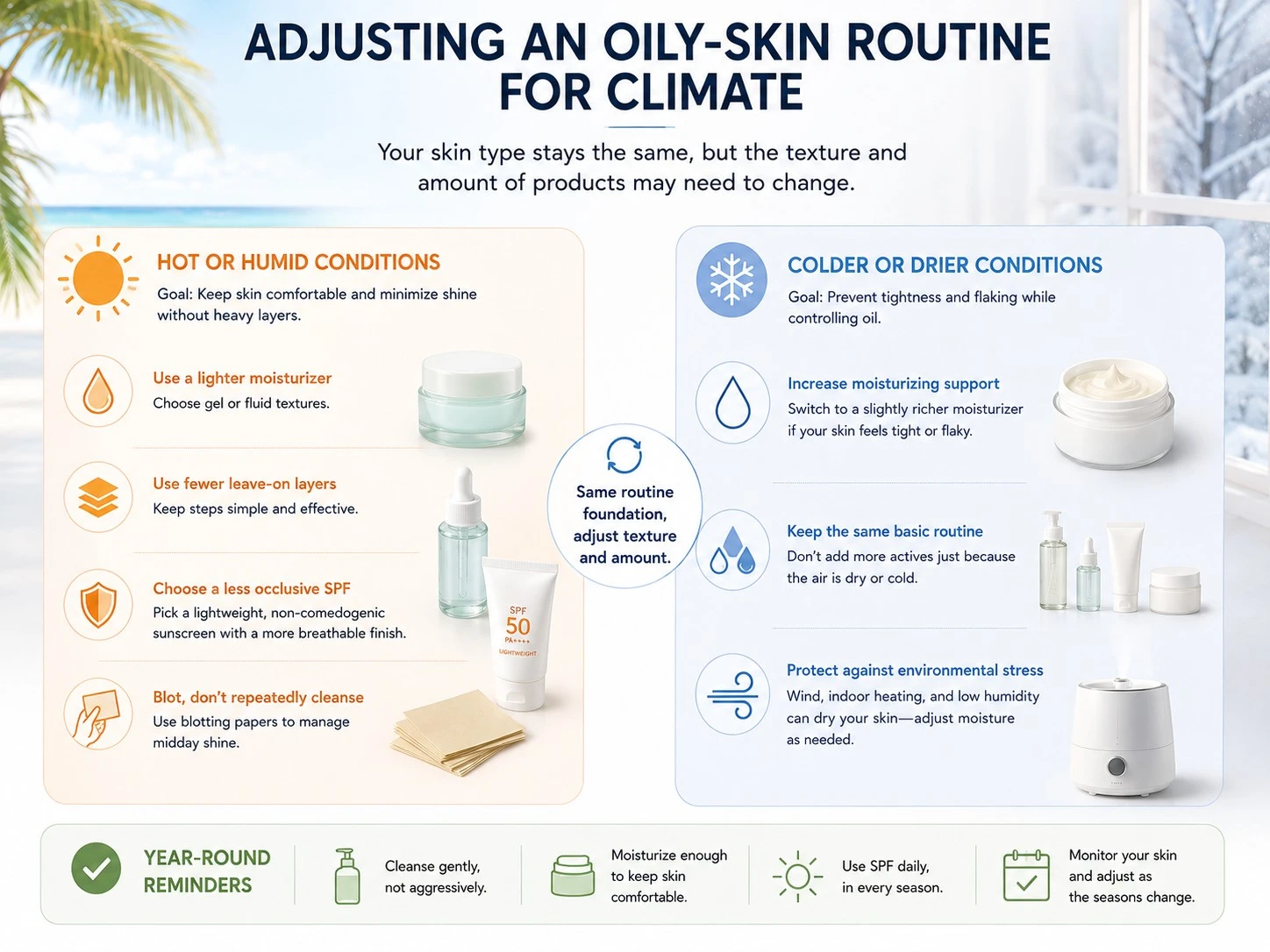
The same oily skin can prefer different textures in different environments. Heat and humidity can make rich layers feel uncomfortable, while cold weather, wind, air conditioning, or dry indoor air can make an aggressively matte routine feel tight.
In hot or humid conditions, you may prefer:
- a lighter moisturizer;
- fewer leave-on layers;
- a sunscreen with a less occlusive finish;
- blotting rather than repeated cleansing for midday shine.
In colder or drier conditions, keep the same basic routine but increase moisturizing support if tightness or flaking develops. Skin type is relatively stable, but the texture required to keep it comfortable can change with environment and treatment use.
Common Oily-Skin Routine Mistakes
- Washing more than necessary. Repeated cleansing can irritate the skin without solving the underlying reason for oil production.[1][2]
- Using harsh cleansers to create a squeaky-clean feeling. Strong cleansing is not automatically better oil control.
- Skipping moisturizer automatically. Oily skin can still become dry or irritated, especially during acne treatment.[5]
- Using several exfoliating products together. More acids can mean more irritation rather than clearer pores.
- Treating shine as acne. Oiliness alone does not require benzoyl peroxide, a retinoid, or other acne medication.
- Assuming every heavy-feeling product is comedogenic. Texture and pore-clogging potential are related consumer concerns but are not the same property.
- Trying to remove every visible pore or sebaceous filament. Normal follicular structures cannot be permanently extracted away.
- Changing products every few days. Frequent changes make it harder to identify what is helping or irritating your skin.[2]
When Should You See a Dermatologist?
Oily skin itself is usually a cosmetic concern, but professional evaluation becomes more useful when the problem is really persistent acne, sudden major changes in oil production, or irritation caused by repeated attempts to control shine.
Consider dermatologic care when:
- you have painful nodules, cysts, or acne that is leaving scars;
- blackheads, whiteheads, or inflammatory acne remain persistent despite an appropriate routine;
- oiliness changes suddenly without an obvious reason;
- the skin is simultaneously very oily, red, flaky, itchy, or inflamed;
- your acne is affecting your confidence or quality of life;
- over-the-counter treatment has not produced adequate improvement.[3][9]
At that point, the useful next step is identifying the skin condition and treatment need rather than continuing to add stronger oil-control cosmetics.
Final Thoughts
The goal of an oily-skin routine is balance, not total oil removal. Start with gentle cleansing, use a lightweight moisturizer when needed, protect the skin with sunscreen, and reserve treatment ingredients for specific problems such as clogged pores or acne.
A useful rule is: treat the concern, not the shine. If your skin is clear but glossy, you may only need better texture choices and midday oil management. If you have blackheads or acne, add a treatment that addresses those processes without turning the rest of the routine into an aggressive oil-stripping system.
FAQs About a Skincare Routine for Oily Skin
Should Oily Skin Wash Its Face More Than Twice a Day?
Usually no. Washing up to twice daily and after significant sweating is generally sufficient. Washing repeatedly throughout the day can irritate the skin rather than provide lasting oil control.[1][2][4]
Does Oily Skin Need Moisturizer?
Yes, when the skin needs hydration or when cleansers and acne treatments cause dryness. A lightweight, non-comedogenic moisturizer can support comfort without requiring a heavy finish.[1][5]
Is Salicylic Acid Good for Oily Skin?
It can be particularly useful when oiliness is accompanied by clogged pores, blackheads, or whiteheads because salicylic acid helps exfoliate and unclog follicles.[3] It is not necessary simply because the skin looks shiny.
Is Niacinamide Good for Oily Skin?
Niacinamide can be a reasonable supporting ingredient. Clinical studies and reviews have reported reductions in facial sebum with topical niacinamide formulations, although results depend on the finished formula and study conditions.[7][8] It should not be treated as a guaranteed solution for excessive oil production.
Why Is My Face Oily but Feels Tight After Washing?
That pattern can occur when oily skin is also dehydrated or irritated. A harsh cleanser, excessive washing, exfoliation, or acne treatments may remove surface lipids and increase discomfort even though the skin continues to produce sebum.
Can Oily Skin Skip Sunscreen?
No. Oily skin still needs sun protection. Choose a non-comedogenic sunscreen with a texture and finish you can apply consistently rather than skipping sunscreen because richer formulas feel uncomfortable.[1][6]
Sources
[1] American Academy of Dermatology. How to Control Oily Skin
[2] American Academy of Dermatology. 10 Skin Care Habits That Can Worsen Acne
[3] American Academy of Dermatology. Acne Clinical Guideline
[4] American Academy of Dermatology. Face Washing 101
[5] American Academy of Dermatology. Moisturizer: Why You May Need It if You Have Acne
[6] American Academy of Dermatology. Acne: Tips for Managing
[7] Draelos ZD et al. The Effect of 2% Niacinamide on Facial Sebum Production
[8] Boo YC. Niacinamide: A Review on Dermal Delivery Strategies and Clinical Evidence
[9] American Academy of Dermatology. Acne: Diagnosis and Treatment


