


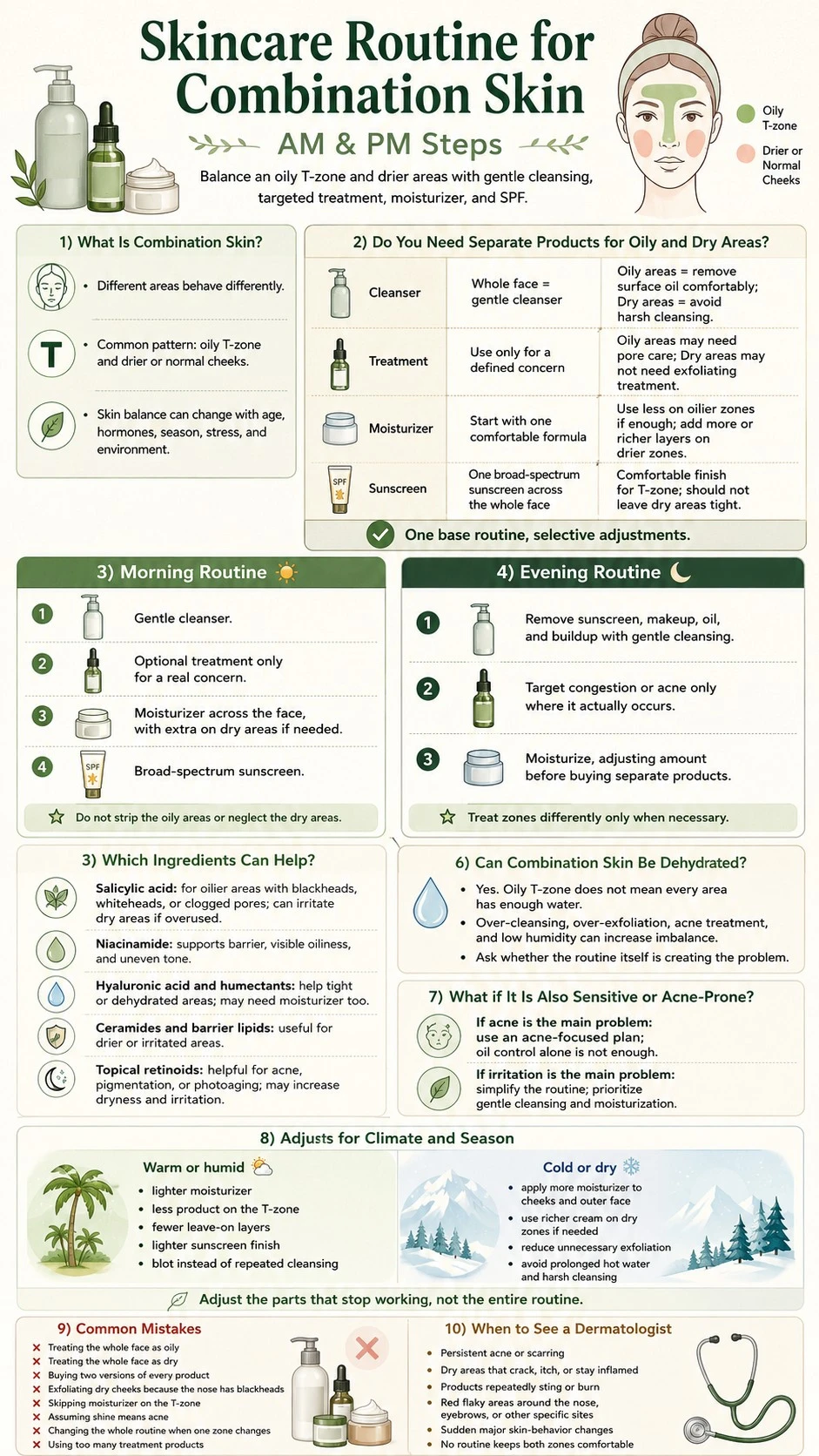
Combination skin can make product selection feel contradictory. A cleanser that makes the forehead and nose feel fresh can leave the cheeks tight, while a rich cream that comforts dry areas can feel excessive through the center of the face.
The solution is usually not to build two completely different skincare routines. A better approach is to keep cleansing, basic moisturization, and sun protection simple across the whole face, then make small zone-specific adjustments only when one area genuinely needs something different.
What Is Combination Skin?
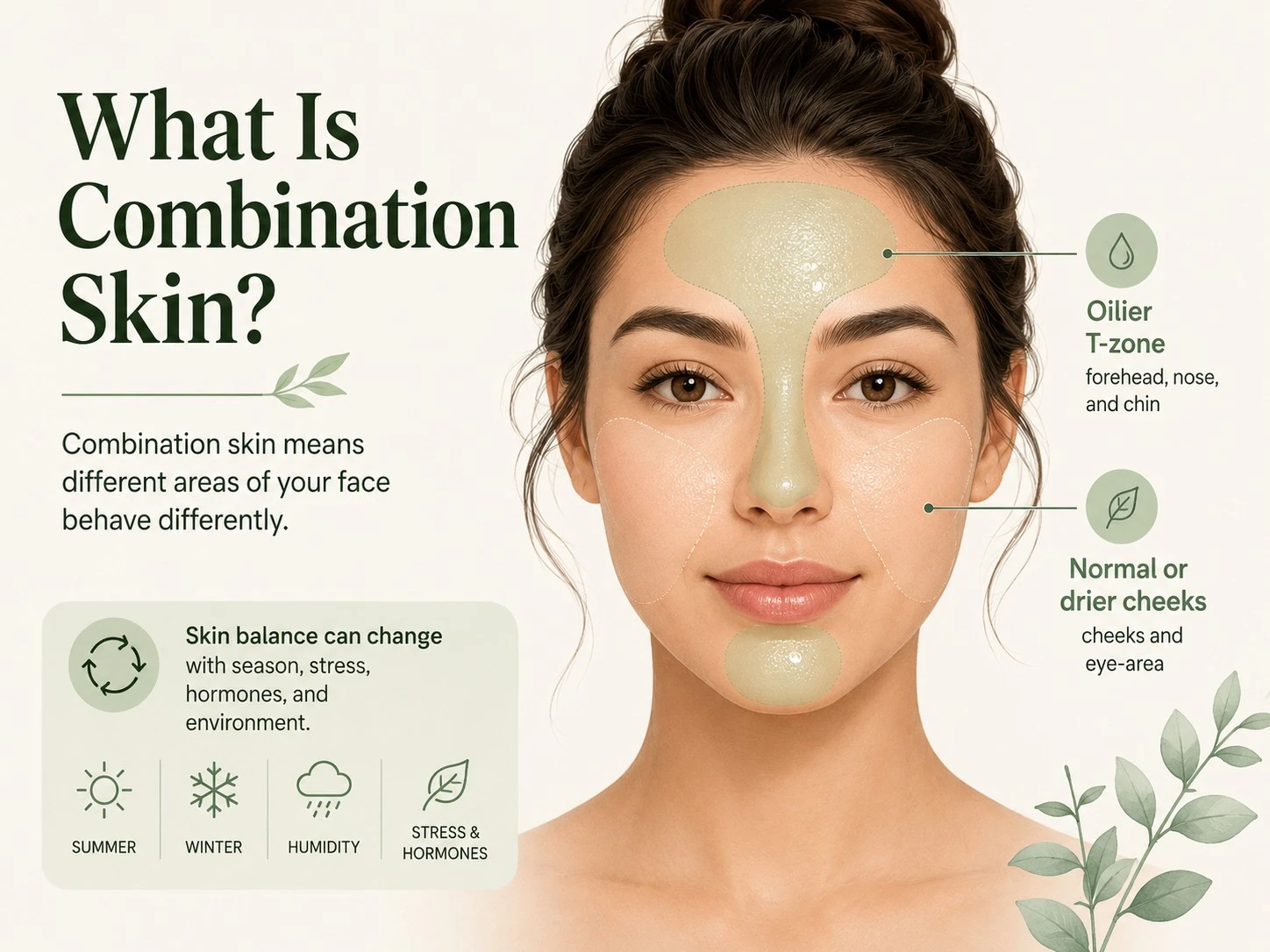
Combination skin means different areas of the face behave differently. The most familiar pattern is an oilier forehead, nose, and chin—the T-zone—with normal or drier cheeks and eye areas, although the exact distribution can vary from person to person.[1]
That means “combination” describes a pattern rather than one fixed formula. One person may have a very oily nose and slightly dry cheeks, while another may have only mild T-zone shine but noticeably flaky outer cheeks.
Skin behavior can also shift with age, hormones, season, stress, and environmental conditions, so the balance you need in summer may not be the same as in winter.[1]
If you are unsure whether your skin is truly combination rather than oily, dry, or temporarily dehydrated, start with What Is My Skin Type? Simple Test & Skincare Guide.
Do You Need Separate Products for Oily and Dry Areas?
Usually not for every step. Start with products that are mild enough for the drier areas but still comfortable on the oilier zones. Only split the routine when one area has a need that the whole-face product cannot solve well.[1]
| Routine Step | Whole-Face Starting Point | Oilier Areas | Drier Areas |
|---|---|---|---|
| Cleanser | Gentle, non-abrasive facial cleanser | Allow normal cleansing to remove excess surface oil | Avoid scrubbing or using a stronger cleanser just because the T-zone is oily |
| Treatment | Use only when there is a defined concern | Pore-clearing treatment can be concentrated here when congestion is localized | Skip unnecessary exfoliating treatment if these areas are already dry or irritated |
| Moisturizer | Light-to-medium formula that is comfortable across most of the face | Use a thinner layer if sufficient | Add more product or a richer layer when needed |
| Sunscreen | One broad-spectrum formula that works comfortably across the face | Choose a finish that does not feel excessively greasy | Make sure the formula does not leave these areas increasingly tight |
This is a useful way to think about combination skin: one base routine, selective adjustments. You only need separate products when those adjustments cannot be made comfortably with the same formula.
Morning Skincare Routine for Combination Skin
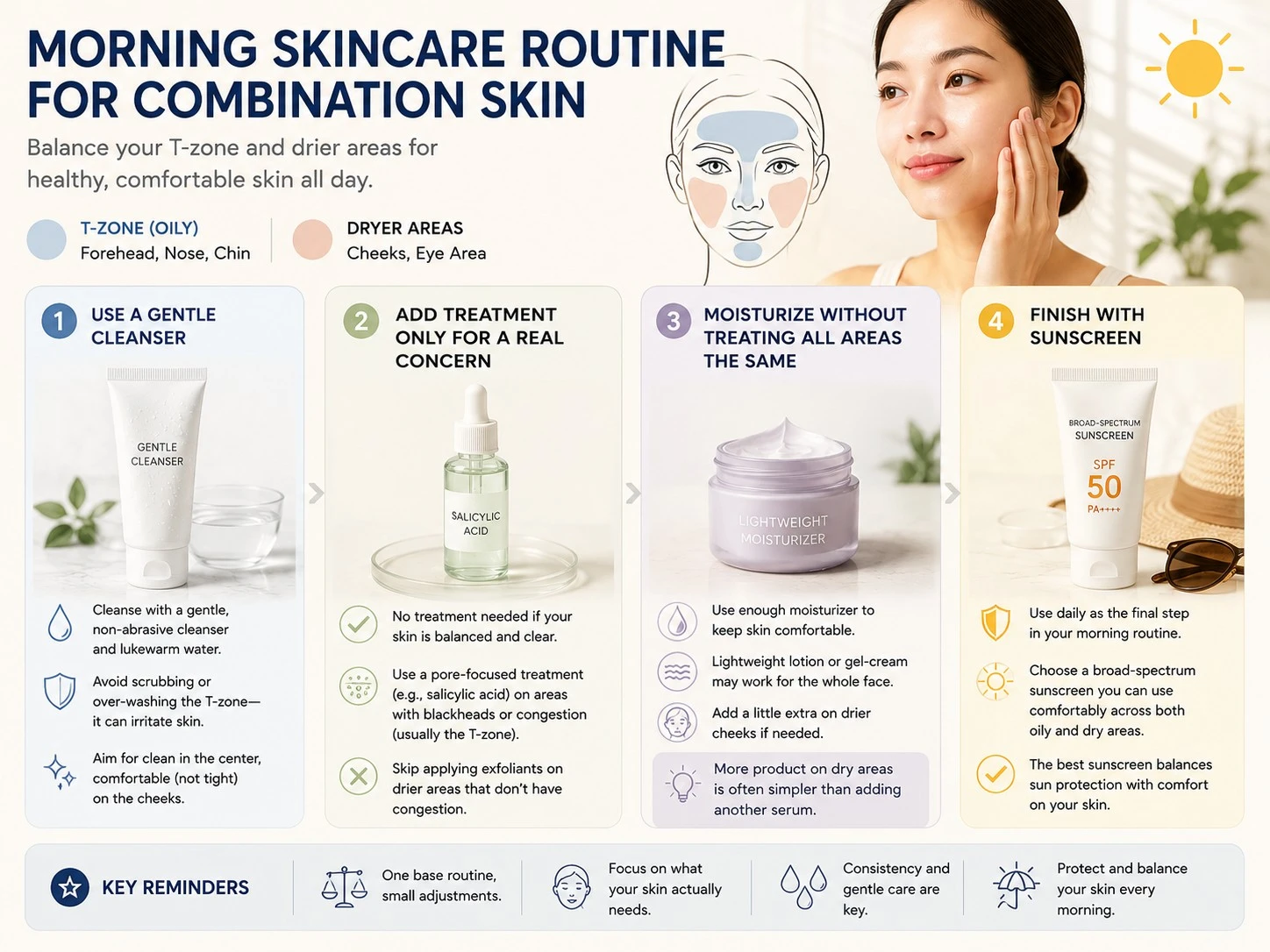
The morning routine should remove overnight buildup without drying the cheeks, keep both zones comfortable, and create a workable base for sunscreen.
1. Use a Gentle Cleanser
Wash with a gentle, non-abrasive cleanser and lukewarm water. Scrubbing or repeatedly washing the T-zone can irritate the skin without providing lasting control of oil production.[2][4]
Combination skin often does best with a cleanser that sits between an aggressive oil-control wash and an extremely rich cleansing product. The useful test is the result after rinsing: the center of the face should feel clean, while the cheeks should not feel persistently tight.
If finding that balance is difficult, How to Choose a Cleanser for Your Skin Type & Concerns explains how cleanser texture and cleansing strength should match the skin rather than a single label.
2. Add Treatment Only for a Real Concern
Combination skin does not automatically require an oil-control serum or exfoliant. If your T-zone is simply shinier than your cheeks but remains clear, a treatment step may add little value.
When blackheads or whiteheads cluster around the nose, forehead, or chin, a pore-focused treatment such as salicylic acid can be more relevant.[5] If the drier zones are not congested, you do not necessarily need to apply the same exfoliating product equally across the entire face.
3. Moisturize Without Treating the Whole Face as Identical
Use enough moisturizer to keep the skin comfortable. A lightweight lotion or gel-cream may work across the entire face for some people, while others need an extra layer on the cheeks without increasing the amount through the T-zone.
If the cheeks remain rough or tight, do not assume the answer is another hydrating serum. Increasing the amount or richness of moisturizer in those areas may be simpler and more effective.
4. Finish With Sunscreen
Sunscreen belongs at the end of the morning skincare routine.[6] Choose a broad-spectrum formula with a finish you can use consistently across both the oily and dry areas.
The best combination-skin sunscreen does not have to be maximally matte. A formula that controls shine but leaves the cheeks uncomfortable is not truly balanced for your skin.
Evening Skincare Routine for Combination Skin
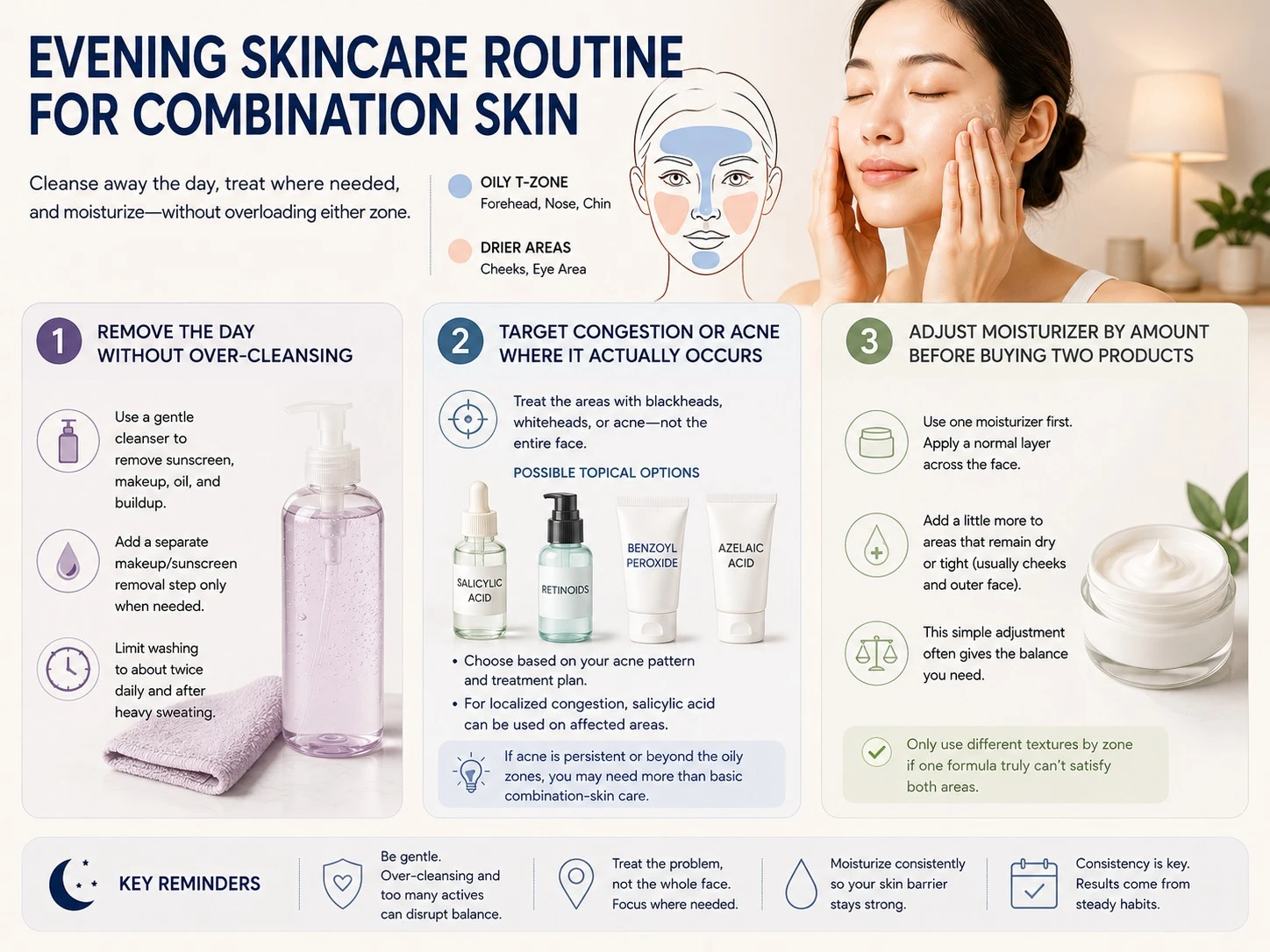
At night, the goal shifts toward removing sunscreen, makeup, and accumulated oil while giving any targeted treatment and moisturizer enough room to work without overloading either zone.
1. Remove the Day Without Over-Cleansing
Use a gentle cleanser in the evening. If makeup or water-resistant sunscreen is not removed adequately with one cleanse, add a separate removal step only when needed rather than assuming every combination-skin routine requires double cleansing.
Limit routine face washing to about twice daily and after heavy sweating unless a clinician has given you different instructions.[4]
2. Target Congestion or Acne Where It Actually Occurs
If the oily areas are also prone to blackheads, whiteheads, or acne, treatment should address those lesions rather than simply trying to make the area feel less oily. Current acne guidance includes topical options such as salicylic acid, retinoids, benzoyl peroxide, and azelaic acid, depending on the acne pattern and treatment plan.[5]
For localized congestion, salicylic acid may be useful on the affected areas. If acne is persistent or extends beyond the oilier zones, the problem has moved beyond basic combination-skin care.
3. Adjust Moisturizer by Amount Before Buying Two Products
Try one moisturizer first. Apply a normal layer across the face, then add a little more to areas that remain dry. This often gives combination skin enough flexibility without requiring separate jars for the T-zone and cheeks.
If one formula genuinely cannot satisfy both areas—for example, it leaves the forehead persistently greasy but still does not relieve cheek flaking—then using different textures by zone becomes reasonable.
Which Ingredients Can Help Combination Skin?
There is no universal “combination skin ingredient.” Choose ingredients according to the specific problem occurring in each area, and avoid turning every useful ingredient into another mandatory layer.
| Ingredient Direction | Where It May Fit | Important Limitation |
|---|---|---|
| Salicylic acid | Oilier areas with blackheads, whiteheads, or clogged pores | Applying it unnecessarily to already dry areas can increase irritation[5] |
| Niacinamide | Can fit a lightweight routine when barrier support, uneven tone, or visible oiliness are concerns | It is not a substitute for moisturizer on persistently dry areas |
| Hyaluronic acid and other humectants | Areas that feel dehydrated or tight | A humectant serum alone may not provide enough emollient or occlusive support for true dryness |
| Ceramides and other barrier lipids | Drier, irritated, or barrier-stressed areas | The complete moisturizer matters more than one highlighted lipid |
| Topical retinoids | Acne, comedones, pigmentation, or photoaging when there is a clear treatment reason | Can increase dryness and irritation, especially when combined with unnecessary exfoliation[5] |
You do not need all of these ingredients. A combination-skin routine may work perfectly well with no treatment serum at all if the main challenge is simply balancing texture and moisturization between facial zones.
Can Combination Skin Be Dehydrated?
Yes. Having visible oil through the T-zone does not mean every part of the face has adequate water or barrier support. Combination skin can become tight, flaky, or uncomfortable after harsh cleansing, over-exfoliation, acne treatment, low humidity, or other sources of irritation.
That is why an oily-looking forehead and tight cheeks should not automatically lead to stronger oil-control products. First ask whether the routine itself is creating part of the imbalance.
If the distinction between low water content and persistent dryness is unclear, Dehydrated vs Dry Skin: Signs, Causes & Best Routine provides the more useful next step.
What if Combination Skin Is Also Sensitive or Acne-Prone?
Skin type and skin condition are different layers of the same decision. You can have combination skin that is also sensitive, acne-prone, irritated, or affected by another condition.
If Acne Is the Main Problem
Do not keep escalating oil-control products if blackheads, whiteheads, inflamed pimples, or deeper acne are the real concern. Treating acne usually requires an acne-focused plan, while the combination-skin routine provides the cleansing, moisturization, and sunscreen framework around it.[5]
If breakouts are becoming the dominant issue, use Skincare Routine for Acne-Prone Skin: Clearer Skin Steps rather than trying to solve acne through T-zone oil control alone.
If Irritation Is the Main Problem
When the cheeks or other areas become persistently red, burning, flaky, or unusually reactive, simplify the routine. Gentle cleansing and adequate moisturization become more important than adding another pore-refining or exfoliating product.
Persistent irritation can also make the usual oily-versus-dry classification less useful. If the skin has become uncomfortable after aggressive treatment, Skin Barrier: Signs of Damage and How to Repair It is more relevant than another combination-skin product recommendation.
How Should You Adjust Combination Skin for Climate and Season?

Combination skin can shift noticeably with environmental conditions. Hot, humid weather may make the T-zone feel oilier, while cold weather, wind, heating, or low humidity may make the cheeks drier.[1][3]
In warmer or more humid conditions, you may prefer:
- a lighter moisturizer across the whole face;
- less product through the T-zone;
- fewer leave-on layers;
- a sunscreen with a lighter finish;
- blotting rather than repeated cleansing when midday shine develops.
In colder or drier conditions, the base routine can stay the same while you:
- apply more moisturizer to the cheeks and outer face;
- switch the dry zones to a richer cream if necessary;
- reduce unnecessary exfoliation;
- avoid prolonged hot water and harsh cleansing.[3]
You do not need to change your entire routine every season. Adjust the parts that have actually stopped working.
Common Combination-Skin Routine Mistakes
- Treating the entire face as oily. Strong cleansers and exfoliants used everywhere can make the drier zones worse.
- Treating the entire face as dry. An unnecessarily rich routine can feel uncomfortable through an already oily T-zone.
- Buying two versions of every product. Zone-specific care is useful only where the same product cannot do the job.
- Using toner to “balance” the face by default. Toner is optional; it does not automatically correct differences in oil production between facial areas.
- Exfoliating the dry cheeks because the nose has blackheads. Treatment should follow the location of the actual problem.
- Skipping moisturizer on the T-zone. Oily areas still need enough hydration to remain comfortable.[2]
- Assuming shine means acne. Oiliness without clogged pores or inflamed lesions does not automatically require acne medication.
- Changing the whole routine when one zone changes. Often the better solution is a small change in application amount, frequency, or treatment location.
- Using too many treatment products. Multiple actives can increase irritation without solving the dry-oily imbalance.[6]
When Should You See a Dermatologist?
Combination skin itself is not a disease, but problems that look like a difficult skin-type balance can sometimes reflect acne, dermatitis, rosacea, or another condition.
Consider professional evaluation when:
- acne remains persistent or is leaving scars;
- dry areas crack, itch intensely, or stay inflamed;
- the skin repeatedly burns or stings with otherwise mild products;
- red, flaky areas cluster around the nose, eyebrows, or other specific sites;
- your skin behavior changes suddenly without an obvious reason;
- you cannot find a routine that keeps both zones comfortable despite simplifying the products.[1][3][5]
At that point, identifying the underlying skin condition is more useful than continuing to alternate between stronger oily-skin and dry-skin products.
Final Thoughts
Combination skin becomes easier to manage once you stop trying to make every part of the face behave the same way. Begin with a gentle cleanser, moisturizer, sunscreen, and only the treatment products you genuinely need.
Then adjust by zone rather than rebuilding the entire routine: apply pore-clearing treatment where congestion occurs, use more moisturizer where the skin feels dry, and change texture or frequency when climate or treatment alters the balance. The goal is not perfect uniformity—it is keeping each area comfortable without making another area worse.
FAQs About a Skincare Routine for Combination Skin
Should Combination Skin Use Two Different Moisturizers?
Not necessarily. Start with one moisturizer that feels comfortable across most of the face, then adjust the amount by zone. Use separate moisturizers only if one formula consistently feels too rich on the oily areas while still being insufficient for the dry areas.
Should Combination Skin Use a Gel or Cream Moisturizer?
Either can work. A gel-cream or light lotion is a practical starting point when the T-zone is noticeably oily, while a cream can be more useful when the drier areas dominate. The finished formula and how you apply it matter more than the texture label alone.
Can I Use Salicylic Acid Only on My T-Zone?
Yes, when clogged pores or comedonal acne are concentrated there. There is no requirement to apply a pore-clearing treatment to dry, clear areas simply because another part of the face is congested.[5]
Does Combination Skin Need Toner?
No. Toner is optional. Use one only if the formula provides a specific benefit that your cleanser, treatment, or moisturizer does not already provide. It is not necessary simply because the skin is combination.
Why Are My Cheeks Dry but My Nose Is Oily?
Different facial zones can produce different amounts of sebum, which commonly creates an oilier T-zone and drier cheeks.[1] Climate, cleansing, treatment products, and irritation can make the contrast more noticeable.
Can Combination Skin Become More Oily or Dry Over Time?
Yes. Skin behavior can shift with age, hormonal changes, seasons, environmental conditions, stress, and other factors.[1] Adjust the routine according to what the skin is doing now rather than assuming the same balance will remain permanent.
Sources
[1] Cleveland Clinic. What Is My Skin Type and Why Does It Matter?
[2] American Academy of Dermatology. How to Control Oily Skin
[3] American Academy of Dermatology. Dermatologists’ Top Tips for Relieving Dry Skin
[4] American Academy of Dermatology. Face Washing 101
[5] American Academy of Dermatology. Acne Clinical Guideline
[6] American Academy of Dermatology. Should I Apply My Skin Care Products in a Certain Order?


