

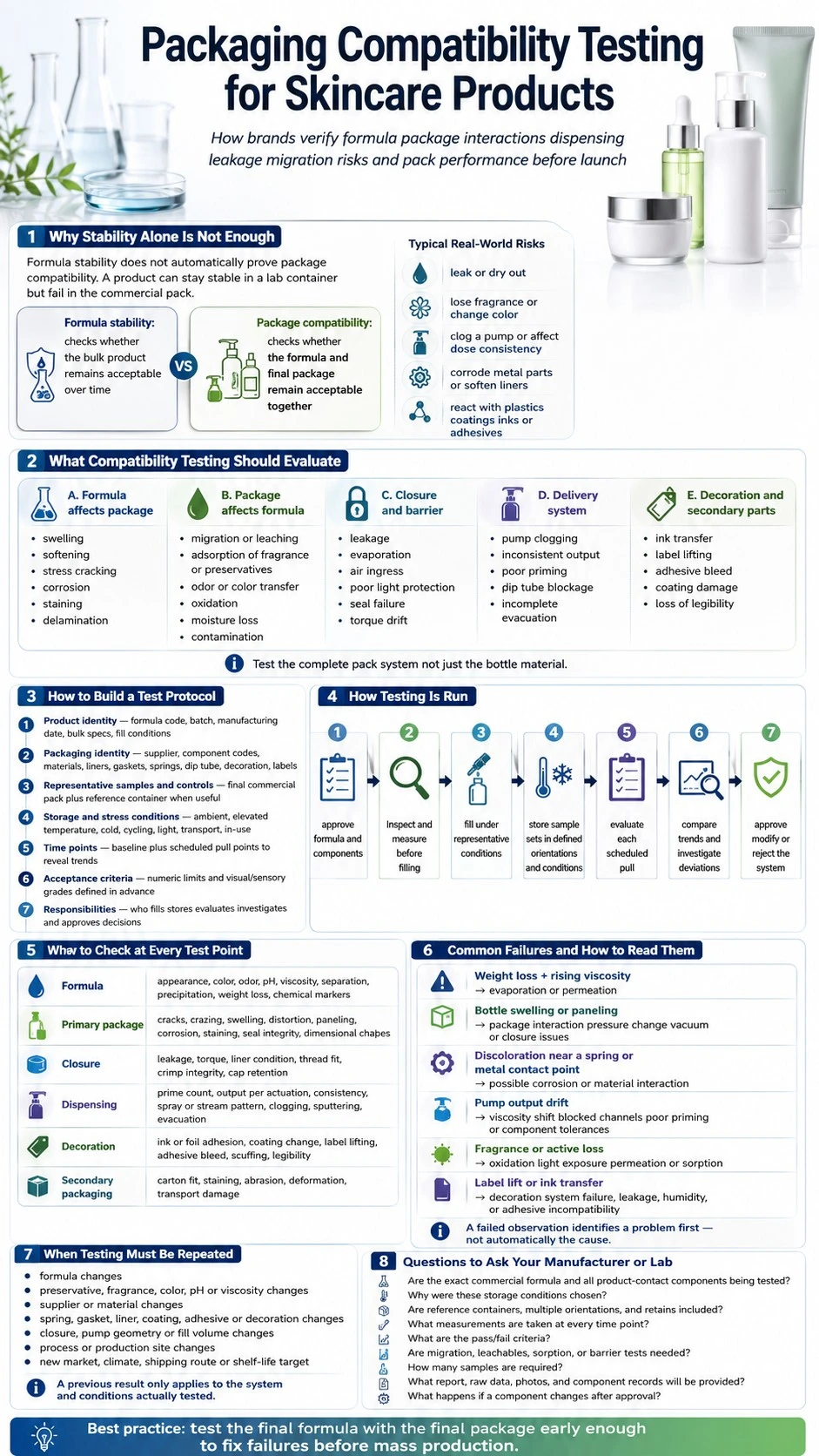
Packaging compatibility testing checks whether a skincare formula and its intended package remain suitable when they stay in contact over time. It evaluates more than the bottle or jar material. The test system should include every product-contact component, the closure and dispensing mechanism, and any decoration or secondary feature that could affect function.
A formula can look stable in a laboratory container yet leak, dry out, lose fragrance, clog a pump, corrode a spring, soften a liner, or change colour in the commercial pack. Testing the actual formula-package combination before mass production helps a brand find those failures while the formula, component choice, and launch plan can still be changed.
Why Formula Stability Does Not Prove Package Compatibility
Formula stability asks whether the bulk product remains acceptable over time. Packaging compatibility asks whether the product and the marketed pack remain acceptable together. The studies overlap, but one cannot automatically replace the other.
A neutral reference container can help determine whether a change originates mainly in the formula or in the commercial package. If both samples separate under the same condition, the formulation or process is the stronger suspect. If only the sample in the commercial package changes, the investigation should focus on package interaction, barrier performance, closure integrity, filling, or dispensing.
This is why a useful cosmetic stability testing program includes samples in the intended final pack rather than relying only on bulk product held in a temporary jar. Light, oxygen, moisture loss, headspace, and contact with plastics, elastomers, coatings, inks, adhesives, or metal parts can change the result. Testing laboratories also use final-pack and reference-container comparisons to help separate package effects from formula instability.[5]
What Packaging Compatibility Testing Should Evaluate
The package must be treated as a system, not as a material name. Two pumps described as polypropylene can behave differently because their springs, gaskets, dip tubes, colourants, lubricants, geometry, output, and manufacturing tolerances are not identical.
| Interaction area | What can happen | Useful evidence |
|---|---|---|
| Formula affects package | Swelling, softening, stress cracking, corrosion, delamination, staining, or loss of coating adhesion | Dimensions, weight, microscopy where needed, visual grading, closure and component function |
| Package affects formula | Migration or leaching, adsorption of fragrance or preservatives, colour or odour transfer, oxidation, moisture loss, or contamination | Formula specifications, mass change, targeted chemical analysis, package-material information |
| Closure and barrier | Leakage, evaporation, air ingress, poor light protection, seal failure, or torque drift | Leak and seal checks, weight loss, orientation studies, closure measurements, light exposure where relevant |
| Delivery system | Pump clogging, inconsistent output, sputtering, poor priming, dip-tube blockage, wiper failure, or incomplete evacuation | Dose-weight data, repeated actuation, spray pattern, priming, evacuation, and consumer-use simulation |
| Decoration and secondary parts | Ink transfer, label lifting, adhesive bleed, coating damage, carton staining, or loss of legibility | Rub and adhesion checks, visual standards, product-contact review, transport and humidity exposure |
Migration is only one possible concern. It describes substances moving from packaging into the product; sorption describes formula components being taken up by or onto packaging; permeation describes gases or vapours passing through a package wall. Recycled and novel materials may require more analytical attention because their composition and potential non-intentionally added substances can be more complex.[4]
The test scope should therefore begin with the complete bill of materials. A broader skincare packaging guide can help shortlist formats, but material compatibility still has to be verified with the exact formula and sourced components.
How to Build a Packaging Compatibility Test Protocol
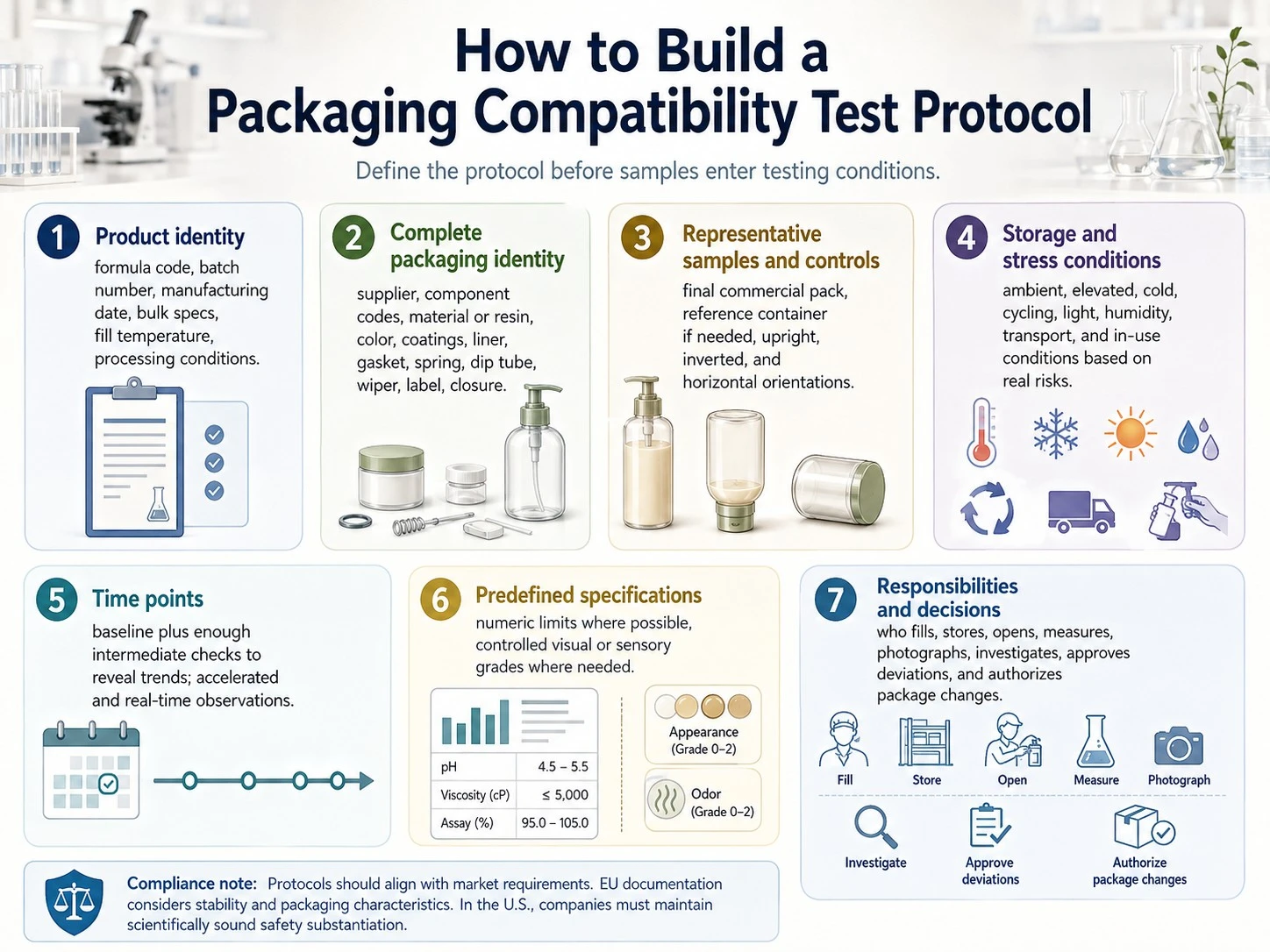
A defensible protocol starts before samples enter an oven or stability chamber. Record the question each condition is meant to answer and define what counts as acceptable before results are seen.
Include these elements:
- Product identity. Record the formula code, batch number, manufacturing date, bulk specifications, fill temperature, and any processing conditions that could affect the sample.
- Complete packaging identity. Record supplier, component codes, resin or material information, colour, coatings, liner, gasket, spring, dip tube, wiper, decoration, label, and closure specifications. “Airless pump” or “PET bottle” is not enough.
- Representative samples and controls. Use the intended commercial pack and a suitable reference container when it will help diagnose the source of change. Include upright, inverted, or horizontal orientations when different surfaces or seals may contact the formula.
- Justified storage and stress conditions. Select ambient, elevated, cold, cycling, light, humidity, transport, or in-use conditions according to formula risks and distribution realities. Do not assume one accelerated temperature suits every emulsion, gel, oil, balm, or active system.
- Time points. Set a baseline and enough intermediate observations to reveal a trend rather than comparing only the first and final samples. Accelerated observations can support development decisions, while real-time samples continue to confirm behaviour through the proposed shelf life.
- Predefined specifications. Set numeric limits where measurements are meaningful and controlled visual or sensory grades where they are not. A passing result should not mean merely “the sample still looks fine.”
- Responsibilities and decisions. State who fills, stores, opens, measures, photographs, investigates, approves deviations, and authorizes a package change.
The same principle applies to market compliance. EU cosmetic safety documentation considers finished-product stability and relevant characteristics of packaging material.[2] U.S. rules do not prescribe one fixed test list for every cosmetic; the responsible company must maintain adequate safety substantiation based on scientifically sound information.[3]
How Packaging Compatibility Testing Is Run

The exact protocol varies, but a controlled development study normally follows this sequence:
- Approve representative formula and component samples. Use the formula version intended for commercialization and production-representative packaging, not a visually similar substitute.
- Inspect and measure before filling. Record initial component condition, relevant dimensions, closure performance, empty weight, decoration, and any baseline mechanical data.
- Fill under representative conditions. Match the intended fill volume, headspace, temperature, capping or crimping, and settling time. These variables can change seals, paneling, vacuum, and pump performance.
- Store the defined sample sets. Apply the protocol’s orientations and environmental conditions. Keep retain or control samples clearly identified and prevent unplanned opening between pull points.
- Evaluate each scheduled pull. Allow conditioned samples to reach the specified evaluation state, then inspect formula, package, closure, dispensing, and decoration using the same methods each time.
- Compare trends and investigate deviations. Review results against baseline, controls, and acceptance criteria. Confirm whether the issue is repeatable before changing the formula or package.
- Approve, modify, or reject the system. Document the decision, required corrective work, retest scope, and any limits on supplier, component, fill process, storage, or distribution.
Compatibility should be planned alongside the wider skincare product testing program. It does not replace preservative efficacy, microbiological quality, safety, claim-support, transport, or other testing required by the product and markets.
What to Check at Every Test Point
Use the same sample handling, lighting, instruments, methods, and grading references at each pull point. Inconsistent evaluation can hide a small trend or make normal variation appear to be a failure.
| Area | Typical checks |
|---|---|
| Formula | Appearance, colour, odour, pH where relevant, viscosity or rheology, separation, precipitation, weight loss, and assay or other chemical markers when justified |
| Primary package | Cracks, crazing, swelling, distortion, paneling, corrosion, staining, delamination, seal integrity, and dimensional change |
| Closure | Leakage, torque, liner condition, thread fit, crimp integrity, cap retention, and evidence of evaporation or ingress |
| Dispensing | Prime count, output per actuation, consistency, spray or stream pattern, clogging, sputtering, droplet control, wiper action, and evacuation |
| Decoration | Ink or foil adhesion, coating change, label lifting, adhesive bleed, scuffing, colour transfer, and legibility |
| Secondary packaging | Carton fit, staining, abrasion, deformation, and damage after relevant distribution simulation |
Photographs are useful only when they are standardized and linked to a sample ID, condition, orientation, and time point. Keep the underlying measurements and observations; a photo album alone is not a test report.
How to Interpret Common Packaging Failures
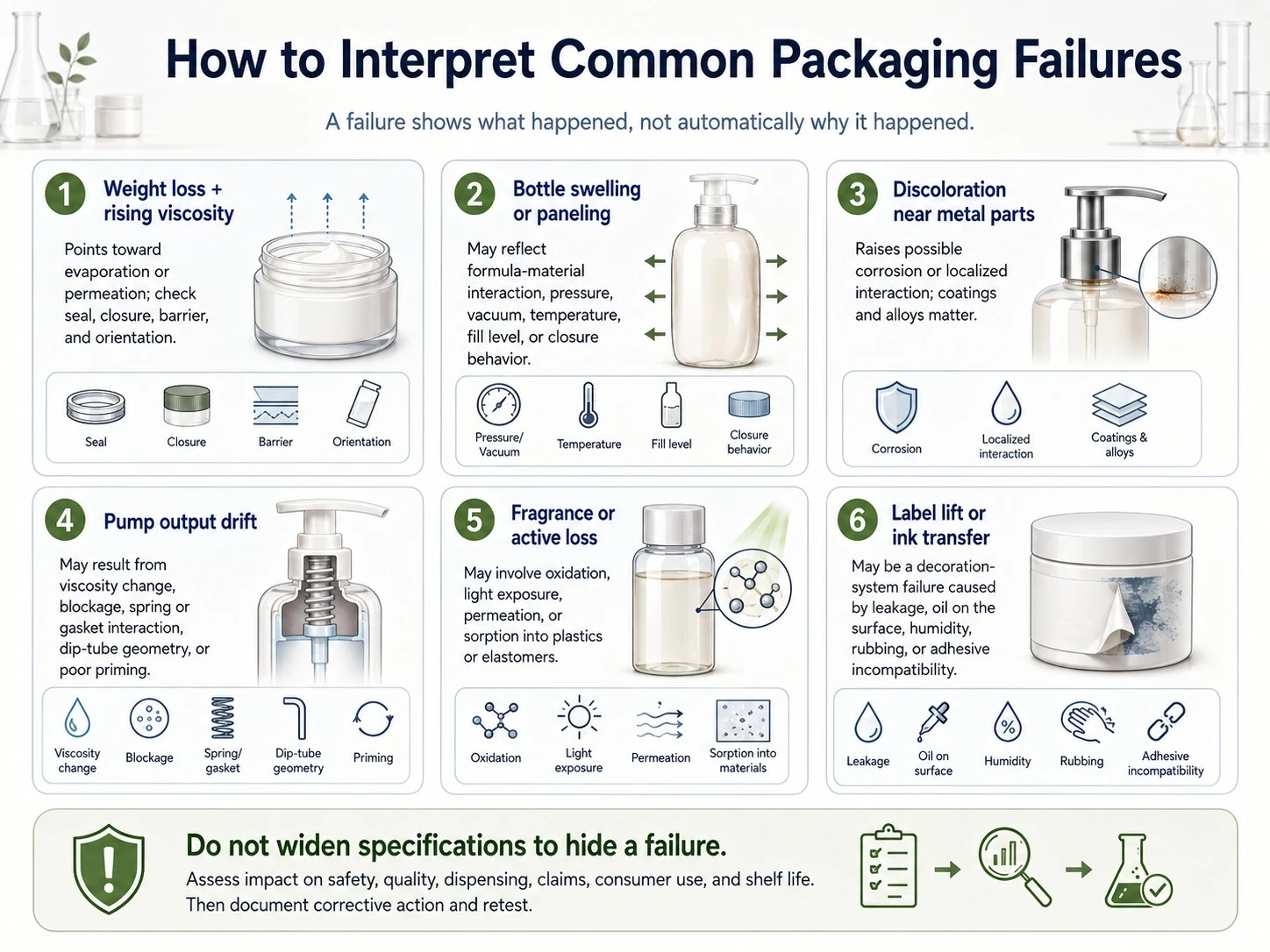
A failed observation identifies a problem, not automatically its cause. Use comparisons and component knowledge before deciding whether to reformulate or change the pack.
- Weight loss with rising viscosity points toward evaporation or permeation, especially when the reference sample remains stable. Check the seal, closure, wall barrier, and storage orientation.
- Bottle swelling or paneling can reflect formula-material interaction, pressure change, vacuum, temperature, fill level, or closure behaviour. Measure dimensions and compare filled and unfilled controls.
- Discolouration near a spring, ball, or metal contact point raises a localized corrosion or interaction question. Do not assume the visible metal is the only material involved; coatings and alloys matter.
- Pump output drift can result from viscosity change, blocked channels, spring or gasket interaction, dip-tube geometry, poor priming, or component tolerances. Test output across multiple units rather than relying on one package.
- Fragrance or active loss may involve oxidation, light exposure, permeation, or sorption into plastics or elastomers. Targeted analysis may be needed when appearance and odour cannot establish the cause.
- Label lift or ink transfer may be a decoration-system failure caused by product leakage, oils on the surface, humidity, rubbing, or adhesive incompatibility. It still matters commercially even when the formula remains safe.
Do not solve a failure by quietly widening the specification after seeing the result. Decide whether the change affects safety, quality, dispensing, claims, consumer use, or shelf-life support. Then document a corrective action and retest the affected system.
When Packaging Compatibility Testing Must Be Repeated
Retesting is not limited to a completely new product. A previous result applies only to the system and conditions it actually covered. Review compatibility when there is a meaningful change to:
- formula composition, fragrance, colour, preservative system, pH, viscosity, or processing;
- packaging supplier, resin grade, recycled content, colourant, coating, liner, gasket, spring, adhesive, ink, or decoration;
- mould, component geometry, neck finish, closure, pump engine, dip tube, wiper, or fill volume;
- filling temperature, capping or crimping settings, sterilization or cleaning process, or production site;
- target shelf life, storage statement, sales market, climate, shipping route, or e-commerce configuration.
Not every change requires repeating every condition. Use documented risk assessment to define a focused bridge study or a full retest. A supplier statement that two components are “equivalent” is useful input, but it is not evidence that the filled systems perform identically.
Because testing can control the critical path, add sample quantities, package variants, testing markets, and acceptance priorities to the skincare product brief. This also makes the effect on the product development timeline visible before components are ordered.
What to Ask Your Manufacturer or Testing Laboratory
Before approving a quotation or protocol, ask:
- Will the study use the exact commercial formula, all product-contact components, decoration, and final filling method?
- Which risks does each storage condition address, and why were those conditions selected?
- Are reference containers, multiple orientations, retains, and production controls included?
- Which formula, package, closure, dispensing, and decoration measurements are taken at every time point?
- What are the written pass/fail criteria, and who approves a deviation?
- Which analytical migration, leachables, sorption, or barrier tests are justified by the materials and formula?
- How many finished samples are required for testing, retains, investigation, and destructive checks?
- What report, raw data, photographs, component records, and change-control information will the brand receive?
- What happens if a component changes after approval, and who pays for the retest?
Package selection and formula development should stay connected. A skincare formulation decision can change material risk, while early packaging customization choices can determine which samples and component documents are available for testing.
Final Thoughts
Packaging compatibility testing should approve a specific formula-package system, not a generic bottle material. Build the protocol around the actual components, filling process, distribution conditions, use pattern, and predefined acceptance criteria. Test early enough to change weak choices, but use production-representative samples before final approval. The result should be a traceable decision supported by trends, controls, measurements, and documented follow-up—not a single sample that looked acceptable at the end of an arbitrary schedule.


