
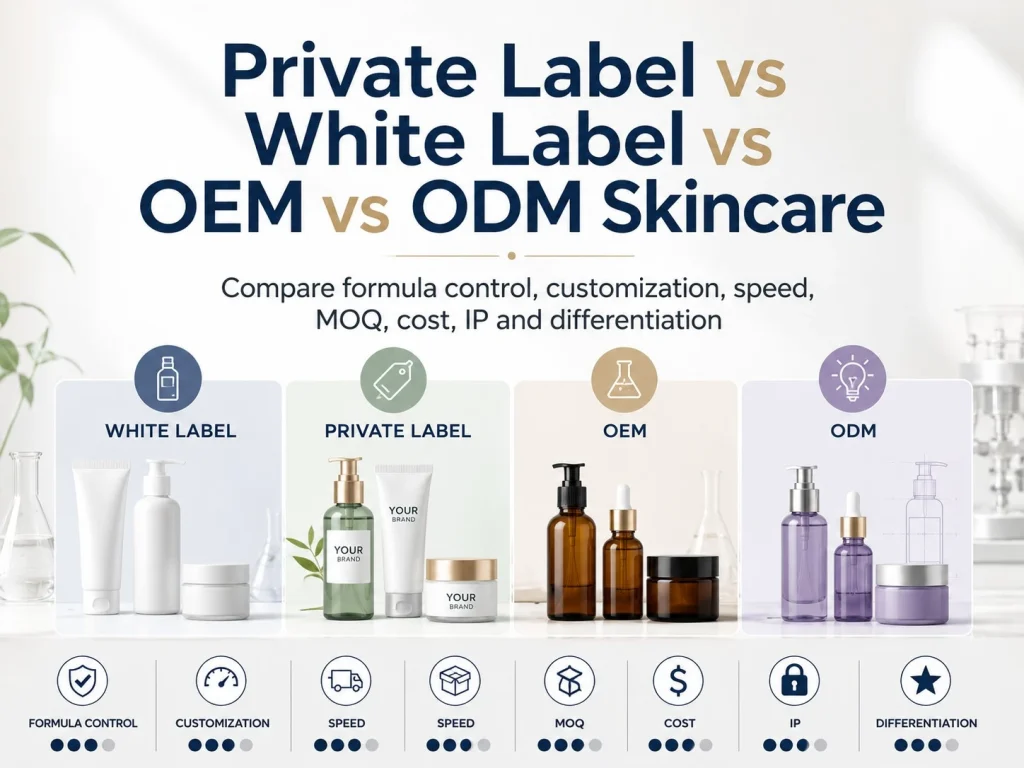

A skincare founder can ask four manufacturers for “private label serum” and receive four very different offers. One factory may show a finished stock serum that only needs your logo. Another may allow fragrance and active changes. A third may create a new formula from your brief but still call the project private label. The fourth may describe almost the same development process as OEM or ODM.
That terminology problem matters because the manufacturing model affects much more than the name on a quotation. It can change your development cost, launch speed, minimum order quantity, formula control, testing responsibilities, intellectual property, product differentiation, and ability to change manufacturers later.
The best way to compare suppliers is therefore to look behind the acronym and identify exactly what each party contributes to the finished product.
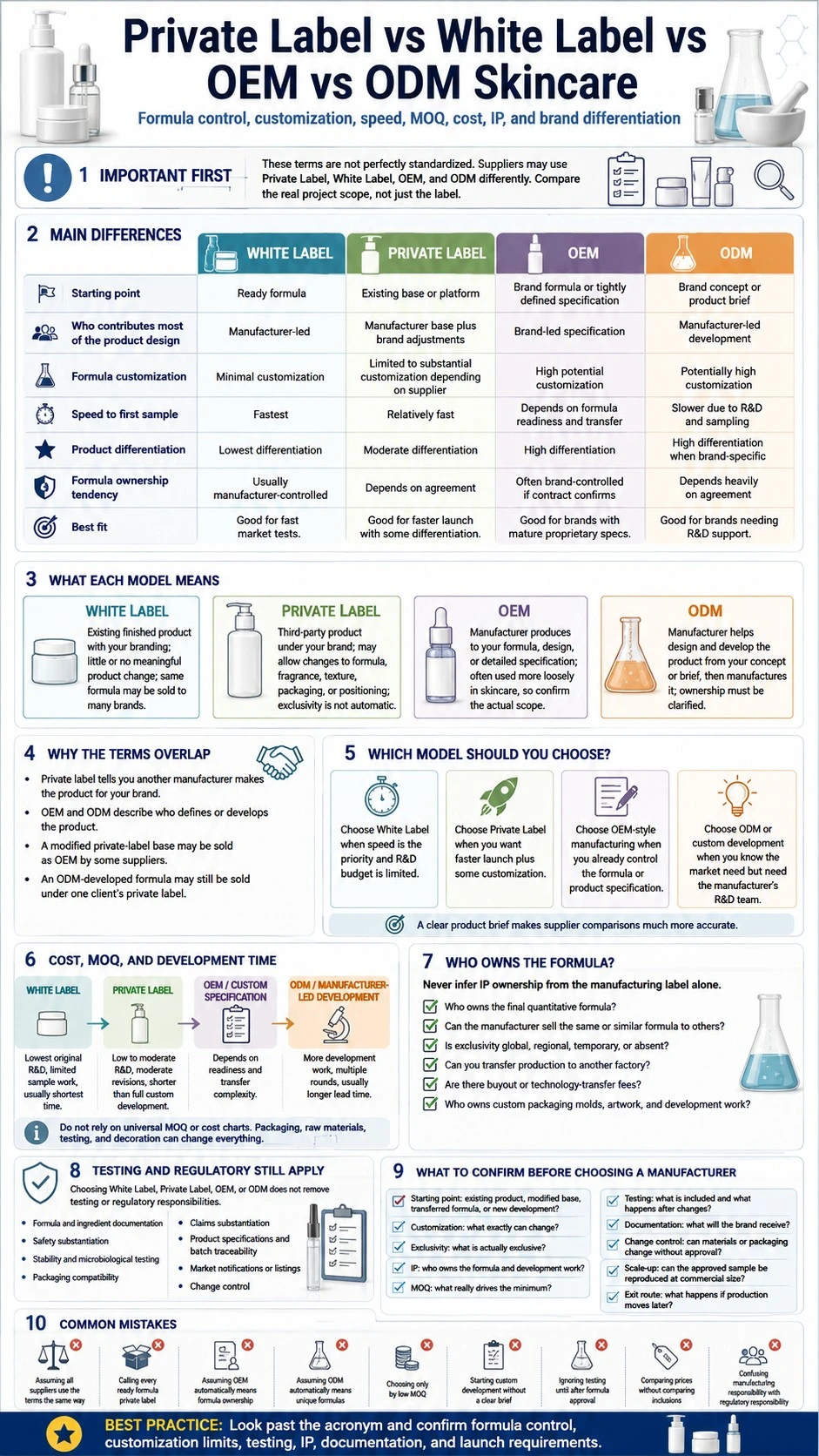
First: These Four Terms Are Not Perfectly Standardized
OEM, ODM, private label, and white label are commercial manufacturing terms rather than four universal cosmetic regulatory categories. Their meanings can overlap across industries and suppliers. Even the term OEM has developed several common uses, while private label and white label are sometimes used interchangeably despite meaningful differences in customization and exclusivity.[1][2]
In this article, the terms are used as a practical sourcing framework:
- White label describes the most standardized ready-to-brand route.
- Private label describes third-party manufacturing under your brand, often with some level of brand-specific customization.
- OEM describes a more buyer-defined product or specification that the manufacturer executes.
- ODM describes a manufacturer that contributes more of the product design and development.
A factory may use different terminology and still offer a commercially suitable service. The important task is to convert its sales label into specific contractual answers.
Private Label vs White Label vs OEM vs ODM: Main Differences
| Decision Point | White Label | Private Label | OEM | ODM |
|---|---|---|---|---|
| Typical starting point | Finished ready-to-brand product | Existing formula or established product platform | Brand-owned formula, specification, or tightly defined technical brief | Brand concept, benchmark, market need, or product brief |
| Who contributes most of the product design? | Manufacturer | Manufacturer provides the base; brand may request adjustments | Brand or brand-appointed developer | Manufacturer’s R&D team contributes substantially |
| Formula customization | Usually minimal | Limited to substantial, depending on supplier | Potentially high because production follows brand requirements | Potentially high, but manufacturer leads more of the development route |
| Speed to first sample | Usually fastest | Usually relatively fast if the base formula already exists | Depends on formula readiness and manufacturing transfer | Usually requires development and sampling |
| Upfront development work | Lowest in most cases | Low to moderate | Can be substantial before factory production begins | Often substantial because R&D is part of the manufacturer’s scope |
| Product differentiation | Usually lowest | Depends on how much is customized and whether exclusivity exists | Potentially high | Potentially high when the development is genuinely brand-specific |
| Formula ownership | Usually manufacturer-controlled | Depends on agreement | Often brand-controlled when the brand supplies the formula, but the contract must confirm this | Depends heavily on development and IP agreement |
| Best fit | Fast market tests and simple range expansion | Brands wanting faster launch with some differentiation | Brands with a mature proprietary specification or formula | Brands needing manufacturer-led R&D and development support |
Treat the table as a starting framework rather than a substitute for the supplier’s actual quotation and contract. A manufacturer calling its service “OEM” may offer formulation development that another factory would call ODM.
What Is White Label Skincare?
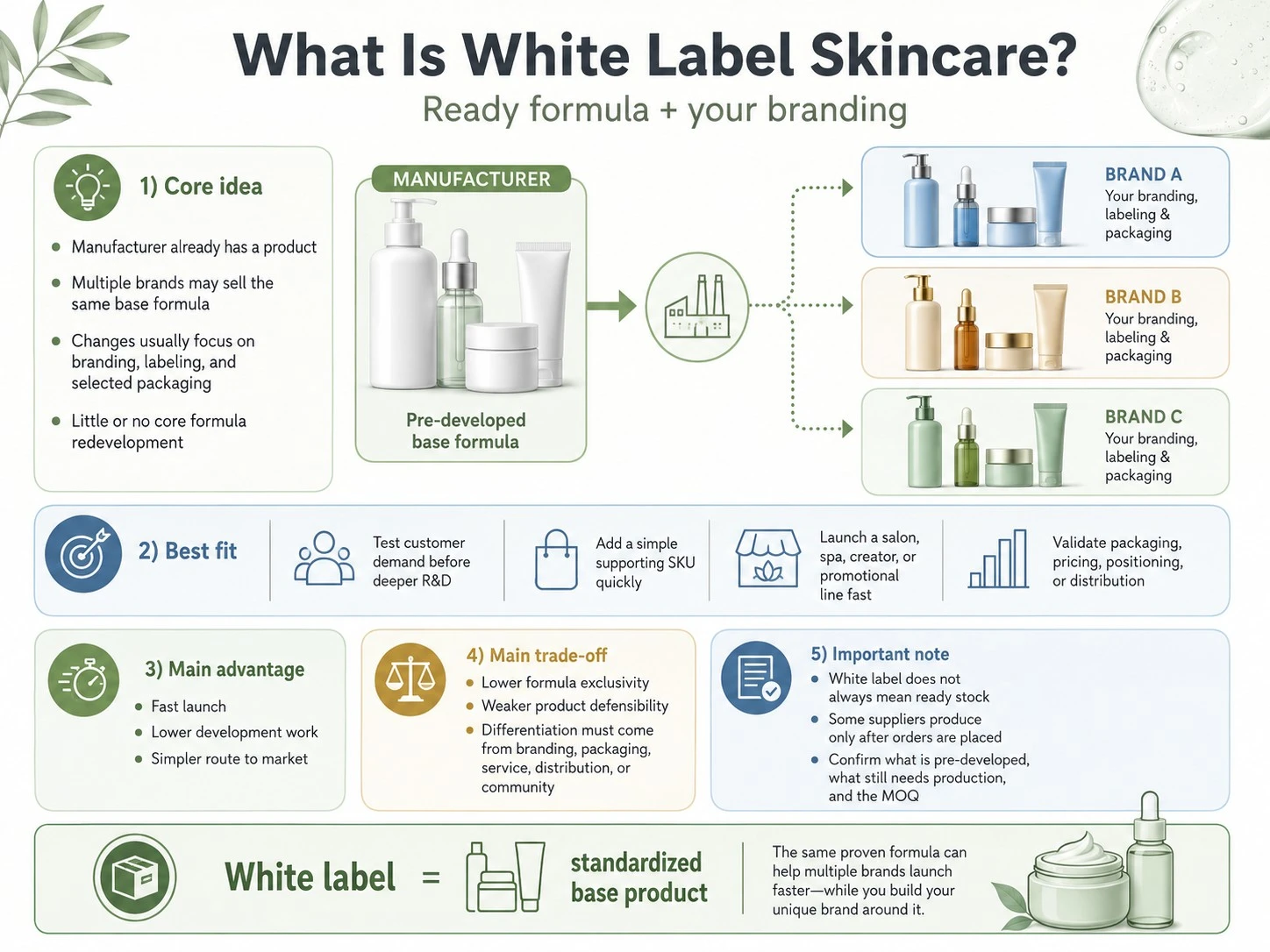
White label is the most standardized route. The manufacturer already has a product, and multiple buyers may be able to sell essentially the same formula under different brands. Customization is normally concentrated on branding, labeling, and selected packaging choices rather than redevelopment of the core product.[2]
White label makes the most sense when your competitive advantage is not expected to come from a proprietary formula.
It can work well when you want to:
- test customer demand before funding deeper R&D;
- add a straightforward supporting SKU quickly;
- launch a salon, spa, creator, or promotional range where speed matters more than formula exclusivity;
- validate packaging, pricing, positioning, or distribution before investing in a differentiated product.
The main trade-off is defensibility. If the manufacturer sells the same serum to ten other brands, your differentiation must come from branding, packaging, customer acquisition, service, distribution, or community rather than the formula itself.
Do not assume “white label” means the product is already manufactured and sitting in inventory. Some suppliers manufacture the standard formula only after orders are placed. Ask what is actually pre-developed, what remains to be produced, and what MOQ applies.
What Is Private Label Skincare?
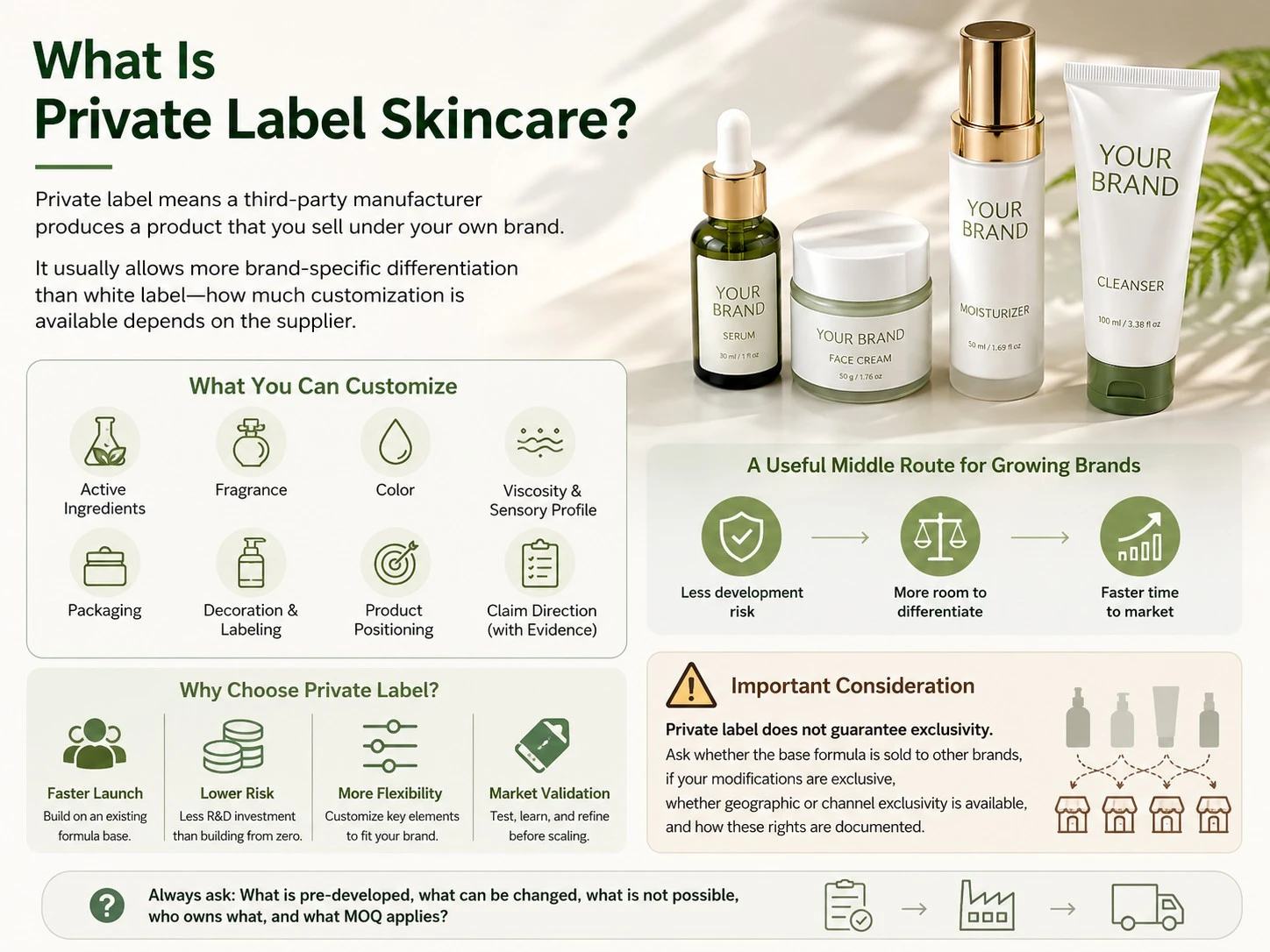
Private label broadly means a third-party manufacturer produces a product that you sell under your own brand. In commercial usage, private label usually allows greater brand-specific differentiation than white label, although exactly how much customization is available varies substantially by supplier.[2]
A skincare manufacturer might start with an established cream or serum base and allow you to change:
- selected active ingredients;
- fragrance;
- color;
- viscosity or sensory profile within technical limits;
- packaging;
- decoration;
- product positioning;
- claim direction where the formula and evidence support it.
This can give a growing brand a useful middle route: less development risk than building every formula from zero, but more room to differentiate than placing a new label on an unchanged product.
However, the words private label do not guarantee exclusivity. Ask whether the underlying base formula can be sold to other brands, whether your modifications are exclusive, whether geographic or channel exclusivity is available, and how those rights are documented.
If this is the route you are considering, ZICAIL’s Private Label Skincare page explains the manufacturing service rather than the terminology alone.
What Is OEM Skincare Manufacturing?

OEM stands for Original Equipment Manufacturer. In conventional manufacturing usage, an OEM produces according to another company’s product design or specification, while an ODM contributes more of the design work.[1]
Applied strictly to skincare, a strong OEM-style case would be a brand that already owns or controls:
- a validated formula;
- ingredient percentages and technical specification;
- target pH and viscosity ranges where relevant;
- manufacturing or processing requirements;
- finished-product specifications;
- packaging requirements;
- existing test data or a defined testing plan.
The factory’s primary role is then industrial execution: raw-material sourcing, manufacturing, filling, quality control, packaging, scale-up, and repeatable production according to the agreed specification.
In the skincare industry, however, many factories use OEM more broadly to mean custom manufacturing and may also provide formulation development. That is not necessarily a problem. It simply means the acronym does not tell you where product development responsibility actually sits.
If you already have a formula from your own chemist or another laboratory, ask whether the manufacturer accepts technology transfer and how it handles pilot batches, raw-material equivalents, process adaptation, specifications, and previous test data.
What Is ODM Skincare Manufacturing?
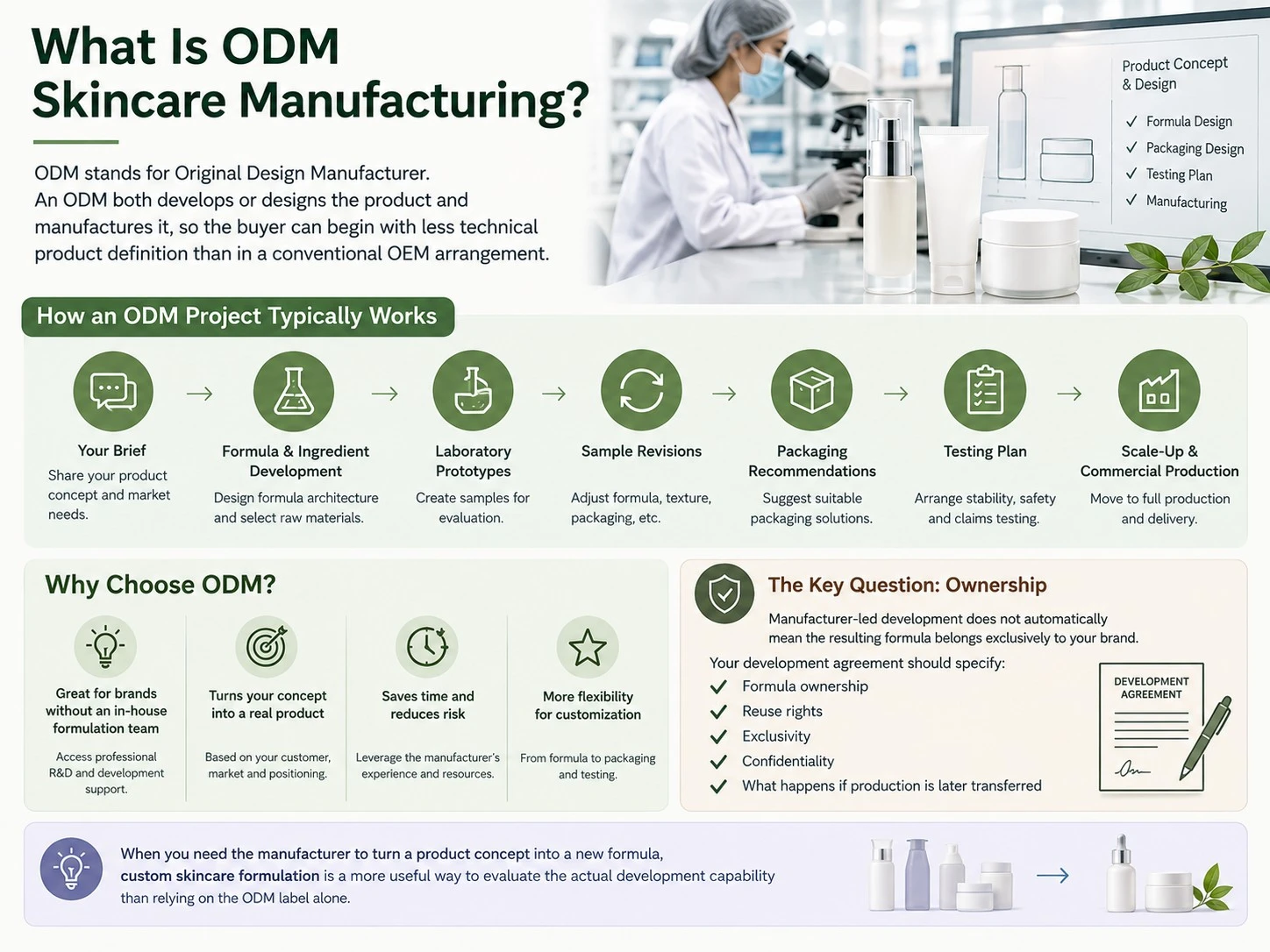
ODM stands for Original Design Manufacturer. An ODM both develops or designs the product and manufactures it, so the buyer can begin with less technical product definition than in a conventional OEM arrangement.[1]
A skincare ODM project might begin with a request such as:
“We need a lightweight barrier serum for humid climates, positioned for sensitive skin, with low tack, no fragrance, an airless package, and evidence for a hydration claim.”
The manufacturer may then translate that brief into:
- formula architecture;
- ingredient and raw-material selection;
- laboratory prototypes;
- sample revisions;
- packaging recommendations;
- testing plans;
- scale-up and commercial production.
ODM can therefore be attractive when a brand understands its customer and market opportunity but does not maintain its own formulation team.
The critical question is ownership. Manufacturer-led development does not automatically mean the resulting formula belongs exclusively to your brand. Your development agreement should specify ownership, reuse rights, exclusivity, confidentiality, and what happens if production is later transferred.
When you need the manufacturer to turn a product concept into a new formula, Custom Skincare Formulation is a more useful way to evaluate the actual development capability than relying on the ODM label alone.
Why Private Label, OEM, and ODM Can Overlap in Skincare
These categories are often presented as a simple ladder from least customized to most customized, but real cosmetic projects do not always fit that model.
Private label primarily tells you that another manufacturer makes a product sold under your brand. OEM and ODM more often describe who defines or develops the product. The concepts can therefore overlap.
For example:
- A brand can privately label a manufacturer’s existing moisturizer.
- A manufacturer may call a modified private-label base an OEM project.
- An ODM may develop a formula that is ultimately sold only under one client’s private label.
- A brand may own its custom formula but still rely on a contract manufacturer for every physical production step.
This is why a binary comparison between “private label or OEM” can sometimes be less useful than asking whether you need an existing formula or a genuinely custom product. Private Label vs Custom Skincare: Which Is Better? addresses that underlying development decision directly.
Which Manufacturing Model Should Your Skincare Brand Choose?
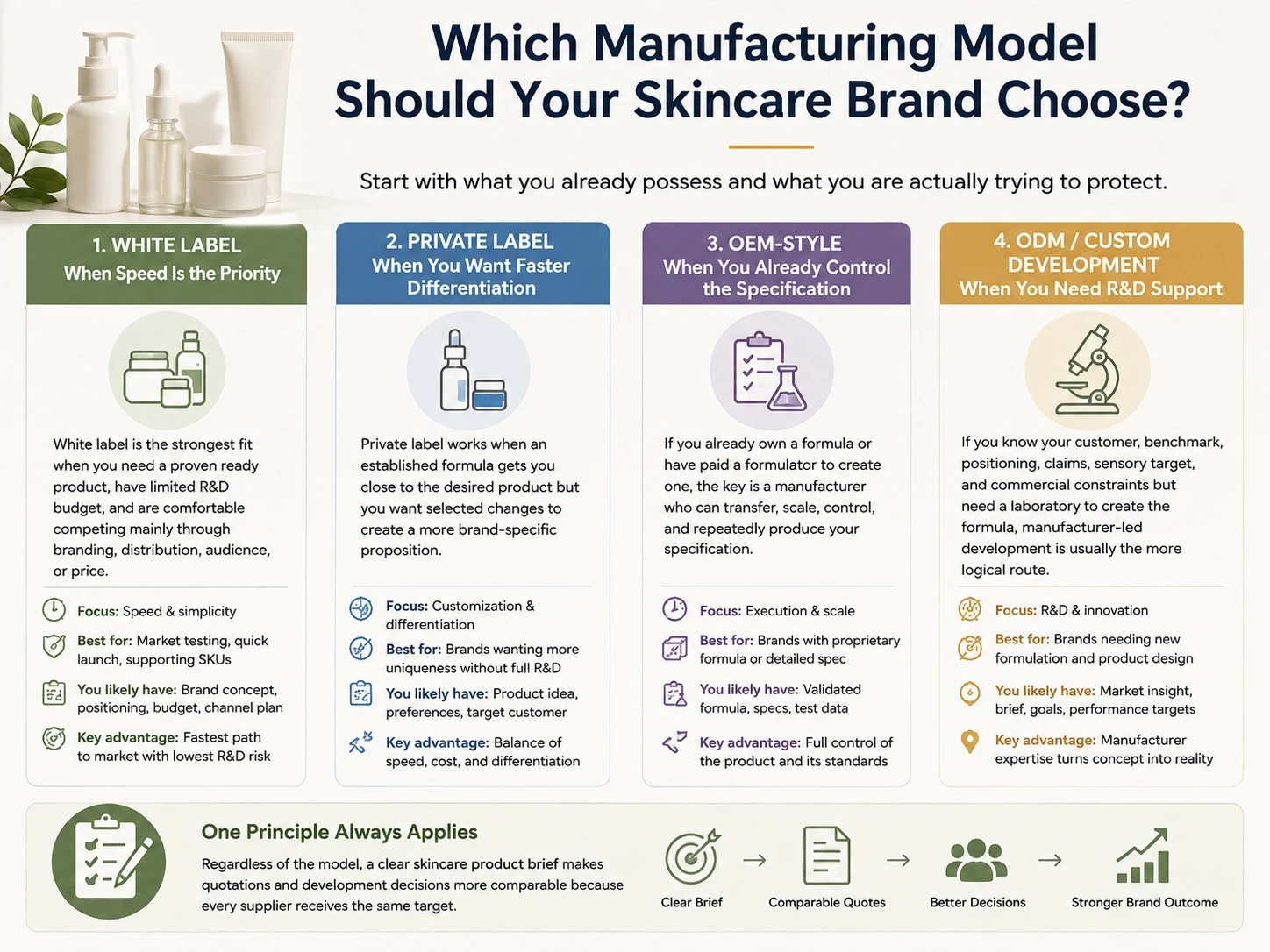
Start with what you already possess and what you are actually trying to protect.
Choose White Label When Speed Is the Priority
White label is the strongest fit when you need a proven ready product, have limited R&D budget, and are comfortable competing mainly through branding, distribution, audience, or price.
Choose Private Label When You Want Faster Differentiation
Private label can work when an established formula gets you close to the desired product but you want selected changes to create a more brand-specific proposition.
Choose an OEM-Style Route When You Already Control the Product Specification
If your brand already owns a formula or has paid an independent formulator to create one, the key requirement may be a manufacturer capable of transferring, scaling, controlling, and repeatedly producing that specification.
Choose an ODM or Custom-Development Route When You Need R&D Support
If you know your customer, benchmark, positioning, claims, sensory target, and commercial constraints but need a laboratory to create the formula, manufacturer-led development is usually the more logical route.
Regardless of the model, a clear skincare product brief makes quotations and development decisions more comparable because every supplier receives the same target.
How Do the Models Affect Cost, MOQ, and Development Time?
Do not rely on a universal chart claiming that one model always has a particular MOQ, dollar cost, or lead time. Packaging components, filling batch size, raw-material minimums, formula complexity, testing, artwork, decoration, and manufacturer policy can change all three.
The general direction is more useful:
| Factor | White Label | Private Label | OEM / Custom Specification | ODM / Manufacturer-Led Development |
|---|---|---|---|---|
| Original R&D requirement | Very low | Low to moderate | May already have been funded by the brand before manufacturing | Usually part of the project |
| Sample/revision work | Limited | Depends on modifications | Transfer and scale-up samples may be needed | Usually multiple development rounds |
| Time before production | Usually shortest | Usually shorter than full custom development | Depends on readiness and transfer complexity | Usually longer because development precedes production |
| Development spending | Usually lowest | Usually below full custom R&D | Depends on what development work the brand has already completed | Usually includes formulation and development work |
For actual budgeting, separate the development fee from the first production order. How Much Does Skincare Product Development Cost? explains formulation, testing, packaging, compliance, and claims costs, while MOQ for Private Label Skincare covers the variables that drive production minimums.
Who Owns the Formula in Private Label, OEM, and ODM?
Do not infer intellectual-property ownership from the manufacturing model.
A stock white-label formula will normally remain under the manufacturer’s control. A proprietary formula supplied by the brand in an OEM-style arrangement may remain the brand’s property. An ODM-created formula could belong to the manufacturer, the brand, or be licensed or restricted in another way depending on the agreement.
Before paying a development fee, put these questions in writing:
- Who owns the final quantitative formula?
- Who owns modifications created during the project?
- Can the manufacturer sell the same or substantially similar formula to another brand?
- Is exclusivity global, regional, channel-specific, temporary, or absent?
- Can the brand receive the complete formula if the relationship ends?
- Can another qualified factory manufacture the product?
- Are there formula buyout or technology-transfer fees?
- Can confidential formula data be shared with an authorized safety assessor or regulator?
- Who owns custom packaging molds, artwork, and other project assets?
A higher development fee does not automatically purchase formula ownership. Ownership is a contractual term and should be explicit before development becomes difficult or expensive to unwind.
Manufacturing Model Does Not Remove Testing or Regulatory Responsibilities
Choosing white label instead of ODM does not make regulatory responsibility disappear. The legal obligations depend on the product, market, supply chain, and entity placing or marketing the cosmetic—not on the sourcing acronym used in a manufacturer’s quotation.
In the EU, cosmetics placed on the market require a Responsible Person, safety assessment, Cosmetic Product Safety Report, Product Information File, and GMP-compliant manufacture, among other requirements.[3][4] ISO 22716 provides the established cosmetic GMP framework for production, control, storage, and shipment.[3]
In the United States, MoCRA defines the Responsible Person as the manufacturer, packer, or distributor whose name appears on the cosmetic label as specified by law, and requires the Responsible Person to maintain records supporting adequate safety substantiation.[5]
This means a brand should establish who handles:
- formula and ingredient documentation;
- safety substantiation;
- stability and microbiological testing;
- packaging compatibility;
- claims substantiation;
- product specifications;
- market notifications or listings;
- adverse-event processes;
- batch traceability;
- change control.
Before production, compare the documentation you will actually receive rather than accepting “full compliance support” as an undefined service. What Documents Should a Skincare Manufacturer Provide? gives a product-level checklist.
What Should You Confirm Before Choosing a Manufacturer?
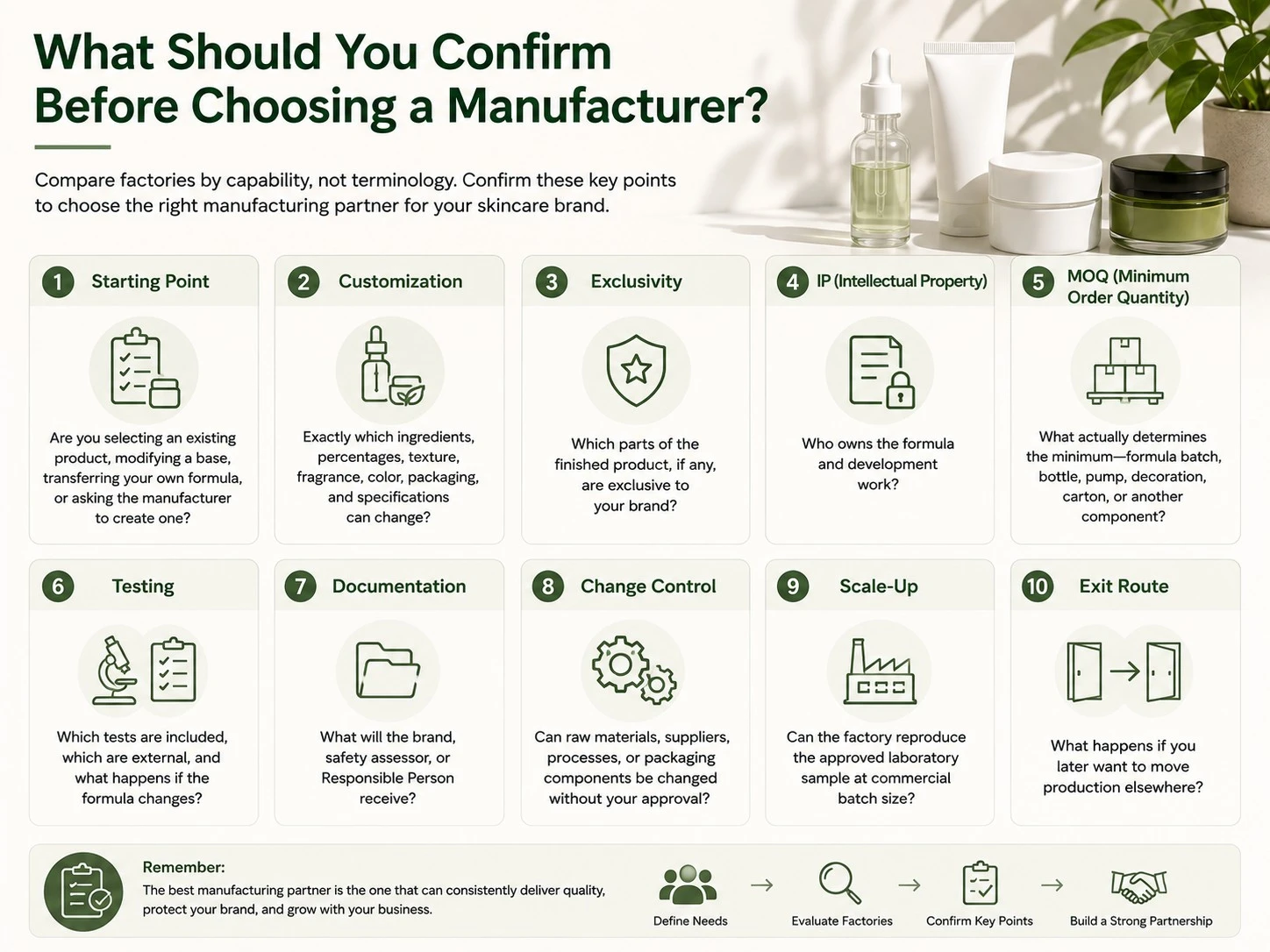
Once you understand the four models, the next step is to compare factories by capability rather than terminology.
- Starting point: Are you selecting an existing product, modifying a base, transferring your own formula, or asking the manufacturer to create one?
- Customization: Exactly which ingredients, percentages, texture, fragrance, color, packaging, and specifications can change?
- Exclusivity: Which parts of the finished product, if any, are exclusive to your brand?
- IP: Who owns the formula and development work?
- MOQ: What actually determines the minimum—formula batch, bottle, pump, decoration, carton, or another component?
- Testing: Which tests are included, which are external, and what happens if the formula changes?
- Documentation: What will the brand, safety assessor, or Responsible Person receive?
- Change control: Can raw materials, suppliers, processes, or packaging components be changed without your approval?
- Scale-up: Can the factory reproduce the approved laboratory sample at commercial batch size?
- Exit route: What happens if you later want to move production elsewhere?
If you are comparing several potential suppliers, How to Choose a Skincare Manufacturer provides the broader qualification framework.
Common Mistakes When Comparing Private Label, White Label, OEM, and ODM
- Assuming every manufacturer uses the terms the same way. Ask for the actual project scope.
- Calling every ready formula private label. Determine whether the product is standardized, customizable, or exclusive.
- Assuming OEM automatically means you own the formula. Confirm ownership contractually.
- Assuming ODM automatically means a unique formula. The manufacturer may begin from an existing platform or reuse its development unless exclusivity says otherwise.
- Choosing white label only because the MOQ looks low. Formula differentiation, packaging MOQ, and future positioning also matter.
- Paying for custom formulation before defining the brief. Undefined targets generate unnecessary revisions.
- Ignoring testing until the formula is approved. Claims, packaging, markets, and stability requirements can change the development route.
- Comparing prices without comparing inclusions. One quote may include samples, testing, documentation, and packaging support that another excludes.
- Confusing manufacturing responsibility with regulatory responsibility. Outsourcing production does not automatically outsource the brand’s legal obligations.
Final Thoughts
Private label, white label, OEM, and ODM are useful sourcing terms, but they should not become the basis of the decision by themselves. The real questions are more concrete: What already exists? What will be developed? What can change? Who pays for development? Who owns the result? Who can reuse it? What evidence and documentation come with it?
White label is usually strongest for speed and market testing. Private label can add differentiation without starting completely from zero. An OEM-style route makes sense when the brand already controls a detailed product specification, while ODM or custom development is useful when the manufacturer needs to convert the brand’s commercial brief into a viable formula.
If your brand is deciding between these routes, prepare your target markets, product brief, benchmark products, desired customization, formula-ownership requirements, packaging direction, claims, target cost, MOQ range, and launch timing. ZICAIL can use those inputs to determine whether an existing private-label route or a more customized OEM/ODM skincare manufacturing project is the better fit before development begins.


