


A skincare brand is not choosing only between “cheap and generic” or “expensive and unique.” A strong private label product can still be commercially distinctive through positioning, packaging, assortment, content, service, and channel strategy. A custom formula is valuable when the product itself must deliver something that an existing formula cannot.
What Is Private Label Skincare?
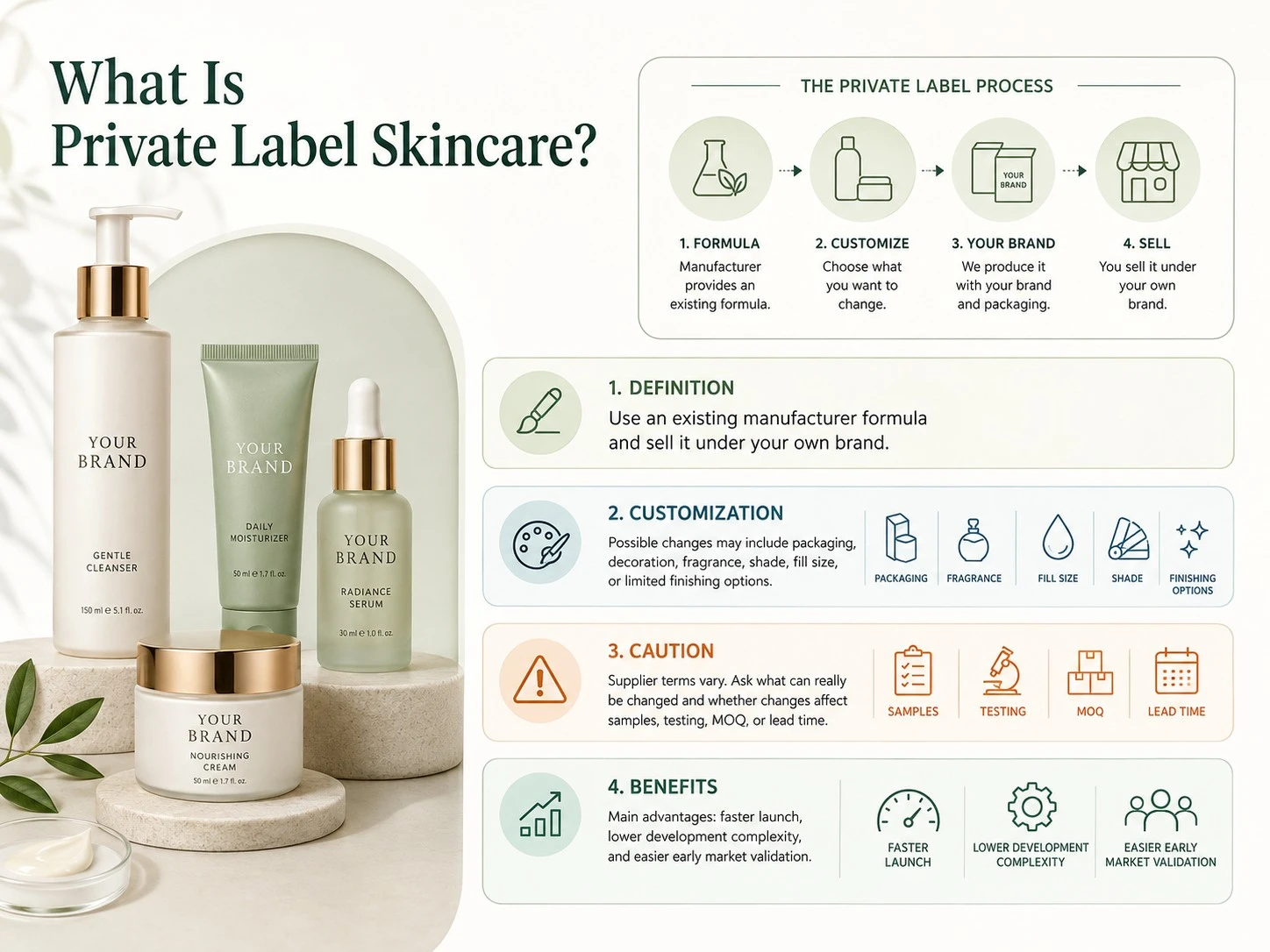
Private label skincare usually means selecting an existing formula from a manufacturer’s portfolio and selling the finished product under your own brand. Depending on the supplier, you may be able to choose packaging, decoration, fragrance, shade, fill size, or other limited options without developing the core formula from the beginning.
Supplier terminology is not standardized. Some manufacturers use “private label” and “white label” almost interchangeably, while others use private label for a formula with more packaging or finishing options. Before comparing quotations, ask what can actually be changed and whether any change triggers new samples, testing, MOQ, or lead time.
The main advantage is that much of the formulation work has already been completed. This makes private label skincare useful when speed, lower development complexity, or early market validation matters more than owning a highly differentiated formula.
What Is Custom Skincare Formulation?
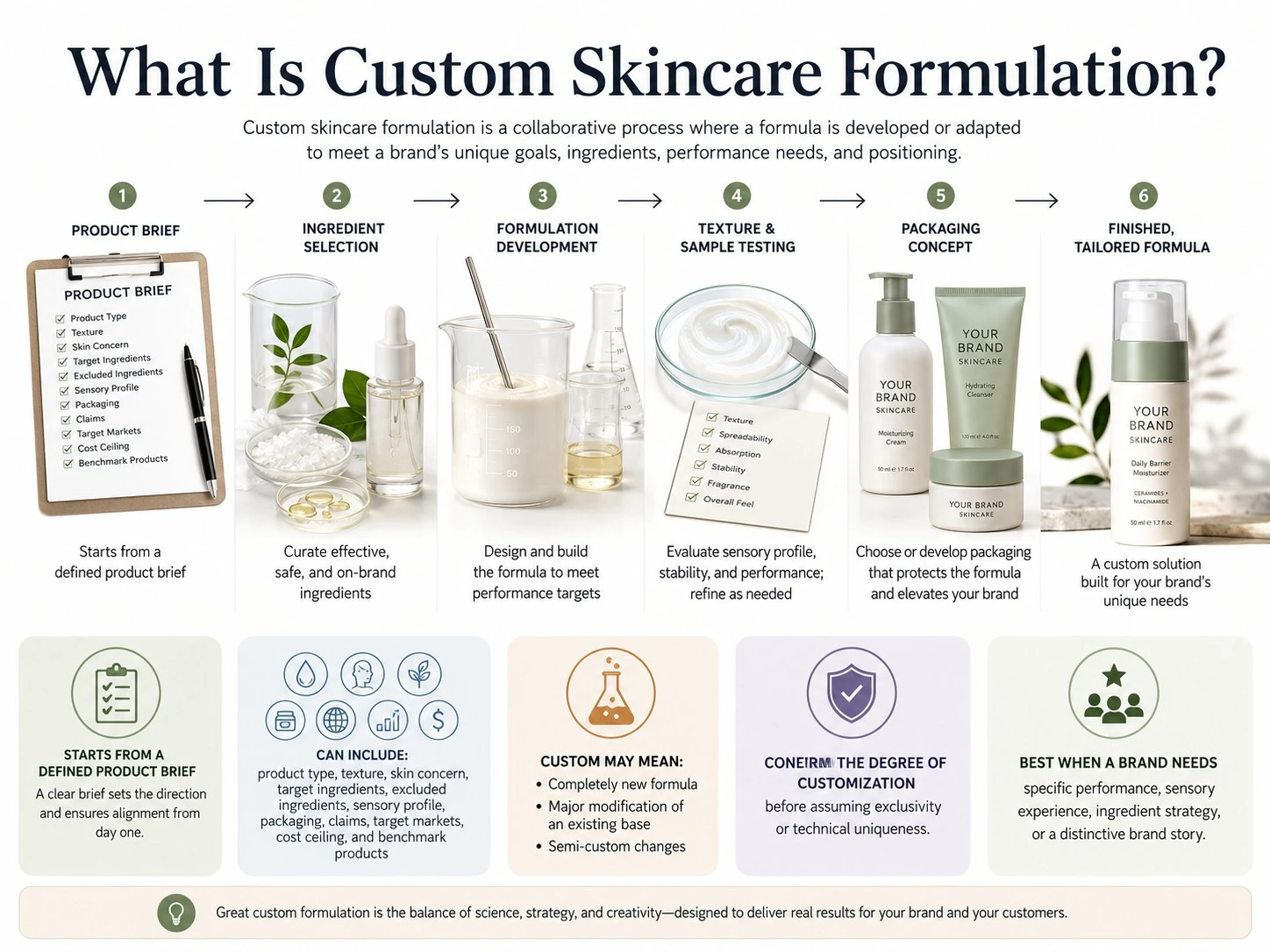
Custom skincare formulation starts from a defined product brief and develops a formula specifically around the brand’s requirements. The brief can include product type, texture, skin concern, target ingredients, excluded ingredients, sensory profile, packaging, claims, target markets, cost ceiling, and benchmark products.
“Custom” also needs clarification. A supplier may mean a completely new formula, a major modification of an existing base, or a semi-custom route that changes selected ingredients, fragrance, texture, or positioning. Confirm the degree of customization before assuming the formula will be exclusive or technically unique.
A true custom skincare formulation makes the most sense when specific product performance, sensory experience, ingredient strategy, or brand story cannot be achieved convincingly with an existing formula.
How Do Cost, MOQ, and Development Time Compare?
Private label usually reduces development cost and time because the manufacturer is not starting with a blank formulation brief. Custom development adds R&D work, sampling, revisions, compatibility checks, testing, documentation, and sometimes new raw-material or packaging sourcing.
| Commercial Question | Private Label | Custom |
|---|---|---|
| What are you paying to develop? | Mostly branding, packaging, samples, production, and market-specific launch work | Formula development plus packaging, testing, production, and launch work |
| What usually drives MOQ? | Manufacturer production minimums and selected packaging | Formula batch size, unique ingredients, packaging components, decoration, and production economics |
| Where can time increase? | Packaging sourcing, artwork, documentation, production scheduling | Briefing, lab samples, revisions, testing, packaging compatibility, scale-up, and production |
| What creates financial risk? | Launching too many similar SKUs before demand is proven | Spending heavily on differentiation customers may not value or ordering more inventory than the channel can absorb |
There is no universal private label or custom MOQ, and there is no reliable fixed development timeline across manufacturers. Formula type, packaging, testing scope, raw-material availability, target markets, and the number of revision rounds can all change the project. Use our guides to skincare MOQ, product development timelines, and product cost and profit margin to model the decision around your actual launch plan.
Which Option Gives Your Brand More Differentiation?
Custom formulation gives you more technical control, but technical control only matters if it creates a difference customers can understand or experience.
A custom route is easier to justify when your positioning depends on a distinctive texture, delivery format, ingredient combination, fragrance direction, excluded-ingredient requirement, performance target, or product experience that available stock formulas cannot provide. It can also make sense when a hero SKU needs to become a recognizable part of the brand.
Private label can still support strong differentiation when the formula is not the main reason customers choose the brand. Packaging architecture, niche positioning, education, bundles, merchandising, customer service, creator strategy, and channel selection can create substantial commercial separation even when the underlying formula began as a manufacturer-developed base.
Do not pay for custom development simply to say the product is custom. Define the difference you want the customer to notice first, then decide whether formulation is the right place to create it.
Does Private Label Reduce Testing and Compliance Work?
It can reduce duplicated development work, but it does not make compliance disappear. Existing stability, microbiology, safety, compatibility, or other documentation may be useful when it matches the exact formula and packaging, but the evidence still needs to fit the final product, claims, packaging, intended use, and target market.
Regulatory responsibility also depends on where the product is sold. In the United States, the responsible person has obligations that include maintaining adequate safety substantiation and product-listing requirements under MoCRA.[1] In the European Union, cosmetic products require an EU-based Responsible Person and notification through the Cosmetic Products Notification Portal before market placement.[2] In Great Britain, the Responsible Person must maintain a Product Information File that includes the safety report, evidence of GMP, and evidence supporting product effects.[3]
The practical lesson is global: do not assume that choosing a ready formula transfers every legal or documentation responsibility to the factory. Define the target markets first, then confirm which safety, testing, labeling, notification, claims, and documentation tasks are already covered and which remain with your brand or local Responsible Person. Our Skincare Product Testing Guide explains how to separate stability, compatibility, microbiology, safety, claims testing, and batch QC.
Who Should Choose Private Label and Who Should Choose Custom?
Use business stage and product strategy rather than prestige to make the choice.
| Your Situation | Better Starting Point | Why |
|---|---|---|
| You are launching your first skincare brand | Private label | Reduces technical complexity while you validate positioning, price, channel, and demand |
| You need to launch quickly for an existing audience or retail opportunity | Private label | A proven formula can shorten the path to samples and production |
| You are testing a new product category | Private label | Lets you validate demand before committing to deeper R&D |
| Your brand promise depends on a specific formula or sensory experience | Custom | The product itself needs to deliver the differentiation |
| Existing formulas cannot meet your target brief | Custom | Development can address specific texture, ingredient, performance, or format requirements |
| You have proven demand and want a stronger hero product | Custom or semi-custom | You can invest in deeper differentiation with better evidence about what customers value |
| You need several supporting SKUs around one custom hero | Hybrid approach | Use custom development where it matters most and private label where speed and assortment matter more |
A hybrid portfolio is often more practical than forcing every product into one development model. A brand might custom-develop its hero serum while using well-selected private label cleansers, masks, or supporting products to build a complete routine faster.
When Should You Move From Private Label to Custom?
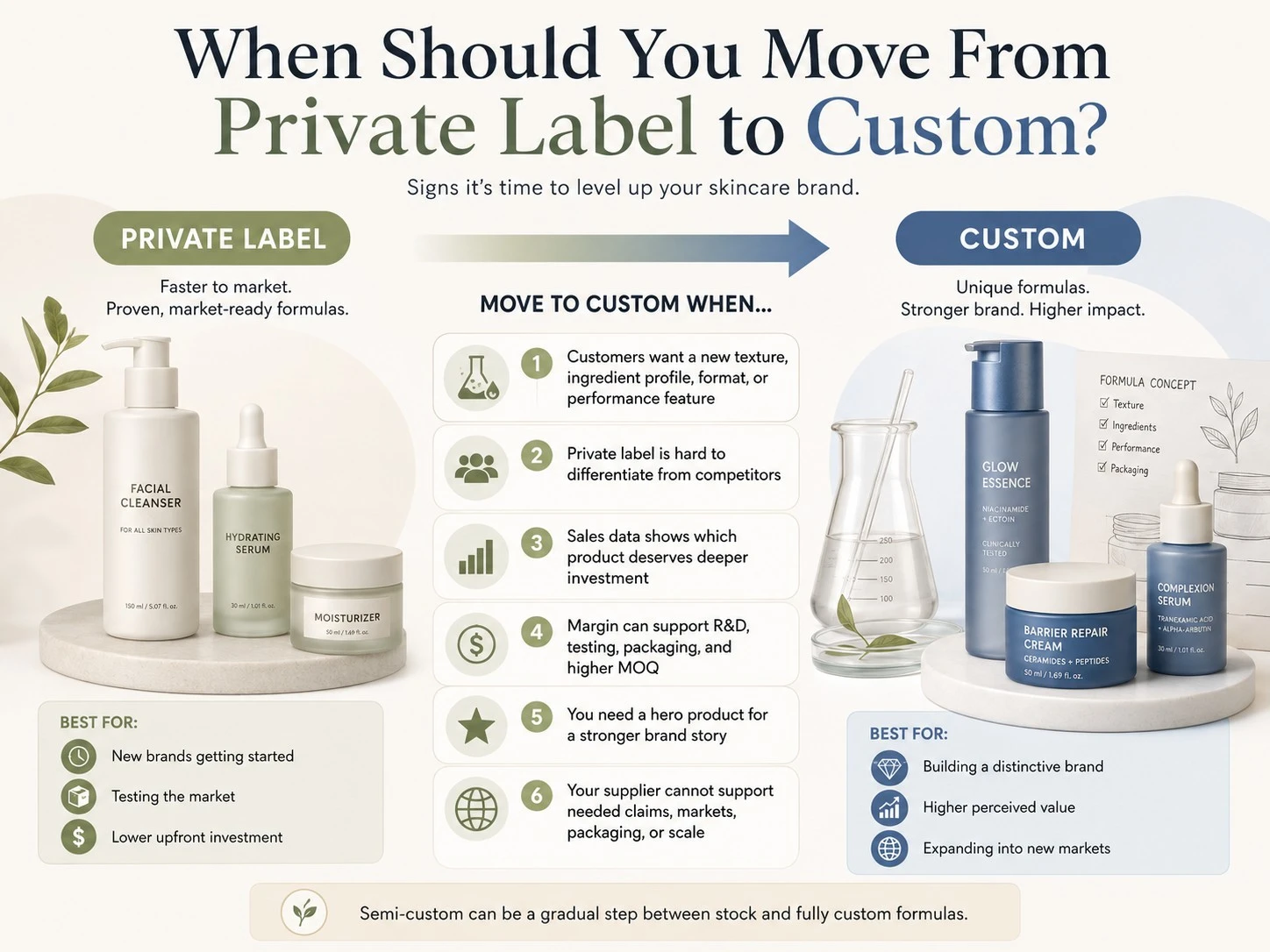
You do not need to move to custom formulation simply because the brand becomes larger. Upgrade when the existing formula starts limiting the business.
- Customers repeatedly ask for a texture, ingredient profile, format, or performance feature your current product cannot provide.
- Your private label product is becoming difficult to differentiate from competing offers.
- You have enough sales data to know which product deserves additional development investment.
- Your margin can support R&D, testing, packaging work, and a potentially higher MOQ.
- You need a hero product that supports a stronger proprietary brand story.
- Your current supplier cannot support the claims, target markets, packaging, or scale required for the next stage.
This progression can be gradual. Semi-custom development can sit between a stock formula and a completely new formulation, but confirm exactly which changes are permitted, whether they trigger new testing, and what exclusivity or ownership terms apply.
What to Ask a Manufacturer Before Choosing Either Route
A good comparison should make the commercial and technical boundaries visible before you approve samples or pay development fees.
- Formula status: Is this a stock formula, modified base, semi-custom formula, or new formula?
- Customization: What can be changed without reformulation, and what changes require new development or testing?
- Exclusivity and ownership: Who owns the formula, and can the manufacturer sell the same or similar formula to other brands?
- MOQ: Is the minimum driven by formula batch size, packaging, decoration, ingredients, or all of them?
- Testing: Which reports already exist, and will they still apply to your final formula and package?
- Target markets: What documentation and regulatory support can the supplier provide for the markets you plan to enter?
- Lead time: Separate lab development, testing, packaging procurement, production, and shipping rather than accepting one vague timeline.
- Cost changes: Ask how custom ingredients, packaging, testing, and smaller production quantities affect the unit cost.
- Scale-up: Confirm whether the factory can reproduce the approved sample consistently at commercial batch size.
If you are comparing suppliers, use Questions to Ask a Skincare Manufacturer alongside our guide on how to choose a skincare manufacturer.
Final Thoughts
Choose private label when speed, lower development complexity, and market validation matter most. Choose custom when the formula needs to create a meaningful product difference that supports your positioning, performance target, or long-term brand strategy.
If your brand is deciding between the two, ZICAIL can evaluate both routes against your product concept, target price, MOQ, packaging, launch markets, claims, and timeline. Share your brief and the level of differentiation you need so the project can be matched to a practical private label, semi-custom, or custom development path.


