


Using face serum correctly is less about a ritual—patting, massaging, counting drops, or timing every layer—and more about even coverage, suitable frequency, and compatibility with the rest of the routine.
The directions on the bottle matter because “serum” covers hydrating gels, antioxidant liquids, retinoid emulsions, exfoliating acids, and other very different formulas. The same application rule cannot safely fit all of them.
Before You Apply: Check the Formula and Directions
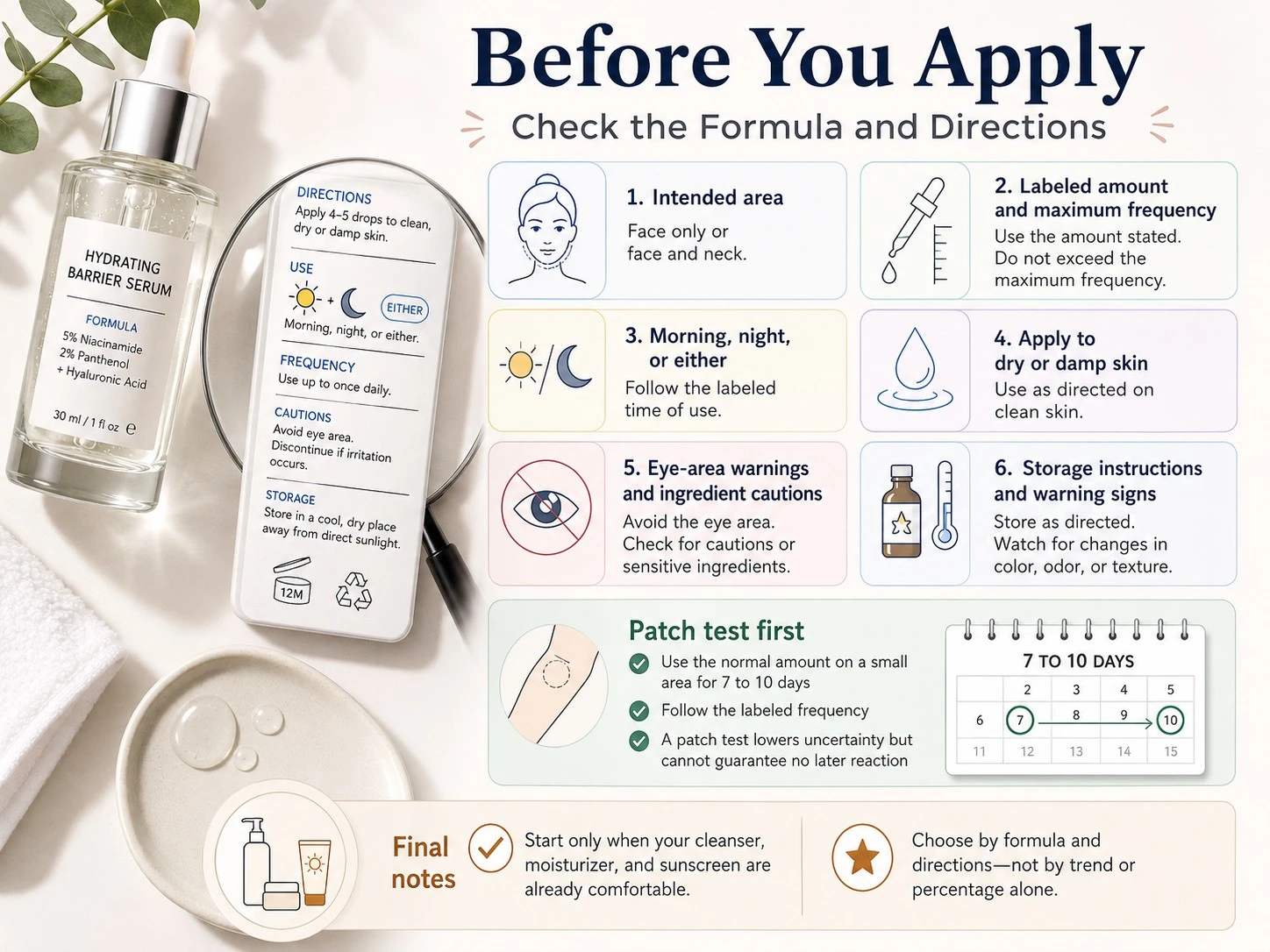
Read the label before the first full-face application. Confirm:
- the intended area, such as face only or face and neck;
- the labeled amount and maximum frequency;
- whether the product is intended for morning, night, or either;
- whether it should be applied to dry or damp skin;
- eye-area warnings and ingredient-specific cautions; and
- any storage instructions or unexpected changes in color, odor, or texture that may signal deterioration.
This matters most for retinoids, exfoliating acids, and other irritation-prone formulas. Even vitamin C derivatives differ in stability and skin delivery, so storage needs and expected performance cannot be inferred from the words “vitamin C serum” alone.[5]
Test a new serum on a small area before broader use. One practical method is to use the normal amount on a quarter-sized test spot for seven to ten days. For a twice-daily product, test twice daily; do not increase a once-daily product beyond its label simply to complete the test.[1] A clear test area lowers uncertainty but cannot guarantee that later irritation or allergy will never occur.
Add the serum only when your cleanser, moisturizer, and sunscreen are already comfortable. If you still need to select a suitable formula, use the separate guide to choosing a face serum rather than choosing by trend or percentage alone.
How Much Face Serum Should You Use?
Use enough to cover the intended area with a thin, even film. The correct amount cannot be reduced to one universal number of drops because droppers, pumps, viscosities, and treatment areas vary.
Start with the label amount. If none is provided, dispense a small amount into clean fingertips or your palm, dot it across the face, and spread gently. Add a little more only if you cannot cover the area without pulling or repeated rubbing. The skin does not need to look wet or remain coated in a visible layer.
More serum does not force more benefit. Excess product is more likely to run toward the eyes, remain tacky, pill under later layers, or increase exposure to an irritating active. Keep the dropper or pump opening away from the skin and fingers so residue is not transferred back into the container.
Should You Apply Serum to Damp or Dry Skin?
Follow the product directions. Damp skin is helpful for some formulas, not a universal absorption rule.
A simple hydrating serum with glycerin or hyaluronic acid can be applied to slightly damp skin when the label allows it. Follow promptly with moisturizer so the routine provides both water-binding and moisture-sealing support. The hyaluronic acid guide explains why a humectant serum and a complete moisturizer do different jobs.
Dry skin is the safer default when the label calls for it or when extra spread could raise irritation. For retinoid-type products, guidance may specify waiting 20 to 30 minutes after washing before application; moisturizer can also be applied first when dryness is a problem.[2] Use the specific product or prescription directions rather than applying that timing rule to every serum.
Do not apply serum while the face is dripping wet. Water can make the product run, spread beyond the intended area, or reach the eyelids and corners of the nose. Pat off the excess first.
When to Use Face Serum: Morning, Night, or Both?
The active ingredients and label determine timing. “Twice daily” is not a default for every serum.
| Serum type | Common timing | Frequency rule | Main caution |
|---|---|---|---|
| Hydrating or humectant serum | Morning, night, or both | Use as labeled and reduce if the routine becomes sticky or congested | Follow with moisturizer when more moisture retention is needed |
| Vitamin C or antioxidant serum | Often morning; some formulas allow either | Follow the formula directions because derivatives and strengths vary | Finish the morning routine with sunscreen; antioxidants do not replace it |
| Niacinamide serum | Morning or night | Once or twice daily only when the label supports it and the full routine remains comfortable | Check whether several other products already contain niacinamide |
| Retinol or retinoid serum | Usually night | Introduce at the labeled frequency rather than assuming nightly use | Dryness and irritation are more likely when combined with other strong actives.[2] |
| Exfoliating acid serum | Often night, but the label controls | Many formulas are not intended for daily use | AHAs can increase sun sensitivity during use and for up to a week afterward, making sun protection especially important.[3] |
Morning sun protection remains a foundational step regardless of serum type.[4] For ingredient-specific routines, see vitamin C for skin and the retinol guide.
How to Layer Serum With Other Skincare Products
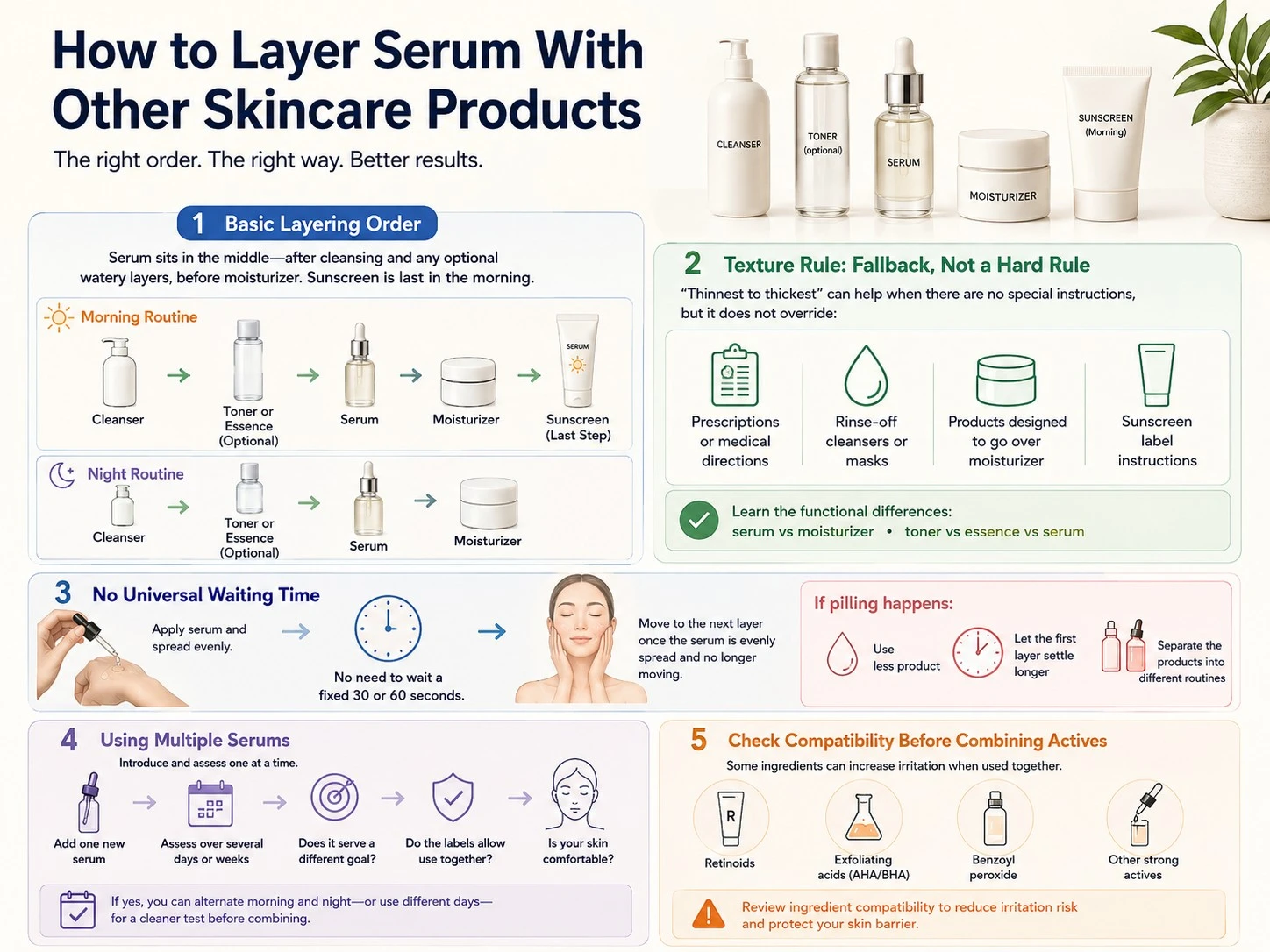
Serum usually sits after cleansing and any optional watery toner or essence, then before moisturizer. Sunscreen is the final morning skincare layer. The complete skincare routine order covers products that fall outside this basic sequence.
Texture is only a fallback rule. “Thinnest to thickest” can help when two ordinary cosmetic layers have no special instructions, but it does not override a prescription, a rinse-off step, a product designed to go over moisturizer, or a sunscreen label. The functional differences are explained further in serum vs moisturizer and toner vs essence vs serum.
There is also no universal requirement to wait 30 or 60 seconds after serum. Apply the next layer once the serum is evenly spread and no longer moving around the face. If immediate layering causes pilling, let the first layer settle longer, use less product, or separate the formulas into different routines. A fixed stopwatch interval cannot correct incompatible film-forming systems.
When using multiple serums, introduce and assess them one at a time. Then decide whether they serve different goals, whether their labels permit the same routine, and whether your skin remains comfortable. Alternating morning and night—or using different days—often gives a cleaner test than stacking everything together. Review skincare ingredients you should and shouldn’t mix before combining retinoids, exfoliating acids, benzoyl peroxide, or other strong actives.
Common Face Serum Problems and How to Fix Them
Application problems do not all mean the serum is ineffective. Match the symptom to the most likely cause before changing the whole routine.
| Problem | Likely reasons | What to change |
|---|---|---|
| Product pills or rolls into flakes | Too much product, too many layers, rubbing after films begin to set, or incompatible formulas | Use less, press or smooth fewer times, allow layers to settle, or separate the products |
| Skin stays very tacky or greasy | The amount is excessive or the vehicle is too rich for the routine | Reduce the amount; if coverage becomes uneven, choose a lighter formula instead of forcing a tiny dose |
| Skin feels dry or looks flaky | Retinoids, acids, or other actives are being used too often; moisturizer may be insufficient | Pause the active until comfortable, restart less often if appropriate, and use a suitable moisturizer |
| Burning, itching, swelling, or a rash persists | Irritation or an allergic reaction is possible | Wash the product off and stop using it; seek medical care for a severe or persistent reaction.[1] |
| Serum runs into the eyes or nose creases | Too much product or application to very wet skin | Reduce the amount, pat off excess water first, and keep a clear margin around sensitive areas |
| No useful change appears | The serum may not match the goal, use may be inconsistent, or the formula may have degraded | Recheck the claim, directions, expected timeframe, and storage; stop repurchasing if it is not earning a place in the routine |
Change one variable at a time. If you simultaneously cut the amount, remove three products, and change frequency, you will not know which adjustment solved the problem.
Final Thoughts
The right way to use face serum is the simplest method that gives even coverage without irritation or layering problems. Let the label control timing and frequency, use coverage rather than drop-count folklore to judge the amount, and keep moisturizer and morning sunscreen in their proper roles.
FAQs About Using Face Serum
Can you mix face serum with moisturizer?
Layering them separately usually preserves the labeled dose and spread of each product. Mix them only when the serum instructions or a healthcare professional specifically supports that method; mixing can change distribution, texture, and film formation.
Can you apply face serum around your eyes?
Only if the label permits eye-area use. Keep ordinary facial serums away from the eyelids, lash line, and inner corners. The eye area may react differently from the rest of the face.
Can you use face serum on your neck?
Yes, when the label includes the neck and the formula is tolerated there. Start gradually with retinoids or acids because the neck may be more reactive, and protect exposed skin from the sun.
Can you apply serum immediately after shaving?
Wait until the skin is comfortable and free of cuts. A simple hydrating formula may be tolerated, but acids, retinoids, fragranced products, and high-alcohol formulas can sting freshly shaved or irritated skin.
Sources
[1] American Academy of Dermatology Association. How to Test Skin Care Products
[2] American Academy of Dermatology Association. Dermatologist-Recommended Skin Care for Your 20s
[3] U.S. Food and Drug Administration. Alpha Hydroxy Acids
[4] American Academy of Dermatology Association. Skin Care on a Budget
[5] Enescu CD, Bedford LM, Potts G, Fahs F. A Review of Topical Vitamin C Derivatives and Their Efficacy


