


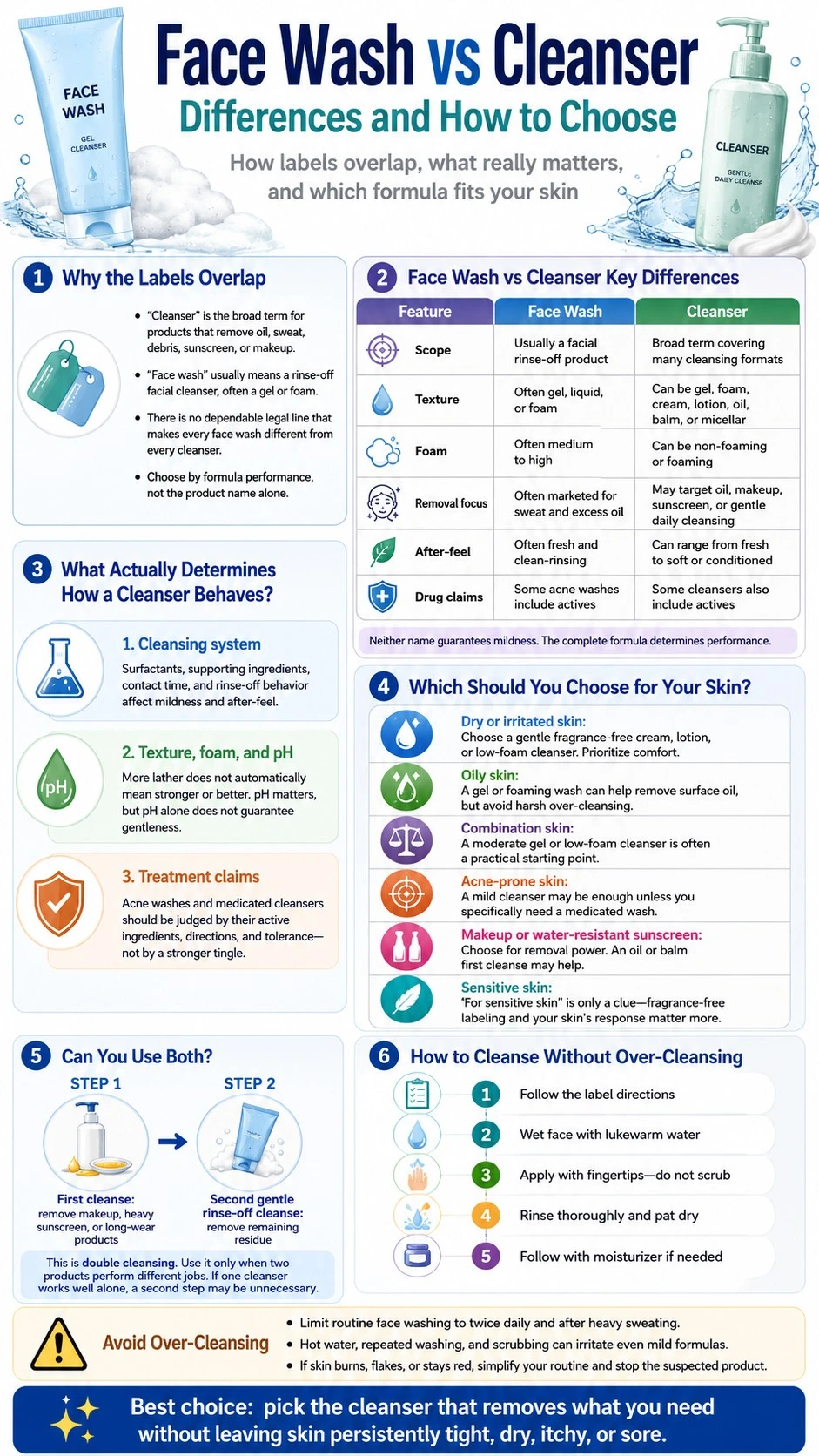
Product names alone rarely predict a facial cleanser’s strength or after-feel. Two foaming formulas may differ more from each other than a cream labeled cleanser differs from a gel labeled face wash. Compare the removal job, cleansing system, treatment claims, and your skin’s response.
Why the Labels Overlap
“Cleanser” is the broader functional term: it describes a product used to remove oil, sweat, debris, makeup, sunscreen, or other material from skin. “Face wash” usually describes a rinse-off cleanser made specifically for the face. In everyday retail language, either name can appear on a cream, gel, or foaming product.
There is no dependable legal dividing line that makes every face wash one kind of formula and every cleanser another. For U.S. products, intended use and composition determine whether a cleansing product is regulated as a cosmetic, a drug, or soap. A cleanser marketed to treat acne, for example, may also be an over-the-counter drug; the words “face wash” do not decide its status.[1]
This matters because popular rules such as “face wash is for oily skin” and “cleanser is for dry skin” are shortcuts, not definitions. They can describe common merchandising, but they should not override the ingredient list, directions, or how the finished formula performs.
Face Wash vs Cleanser: Key Differences
The practical differences are tendencies, not guarantees. Use this table to compare products, then verify the actual bottle.
| Feature | Products called face wash | Products called cleanser | What to verify |
|---|---|---|---|
| Product scope | Usually a facial rinse-off product | Umbrella term for many facial cleansing formats | Directions and whether rinsing is required |
| Texture | Commonly gel, liquid, or pre-foamed | Gel, foam, cream, lotion, oil, balm, or micellar water | Texture and dispensing format |
| Foam | Often medium to high | Can be non-foaming or highly foaming | Do not use lather alone as a mildness test |
| Removal focus | Often positioned for sweat and excess oil | May target oil, makeup, sunscreen, or gentle daily cleansing | Removal claims and your normal product load |
| After-feel | Often marketed as fresh or clean-rinsing | Can range from fresh to soft or conditioned | Tightness, stinging, residue, and comfort |
| Skin-type marketing | Frequently aimed at oily or combination skin | Available for every skin type | Fragrance, active ingredients, and overall tolerance |
| Drug claims | Some contain acne-treatment actives | Some also contain acne-treatment actives | Drug Facts panel and use directions in the U.S. |
A modern foaming cleanser can be mild, and a non-foaming cleanser can still irritate. Likewise, a rich cream may be comfortable on dry skin but fail to remove a tenacious sunscreen on its own. The useful question is whether the formula provides enough removal without leaving your skin persistently tight, dry, itchy, or sore.
What Actually Determines How a Cleanser Behaves?
The cleansing system and overall formula
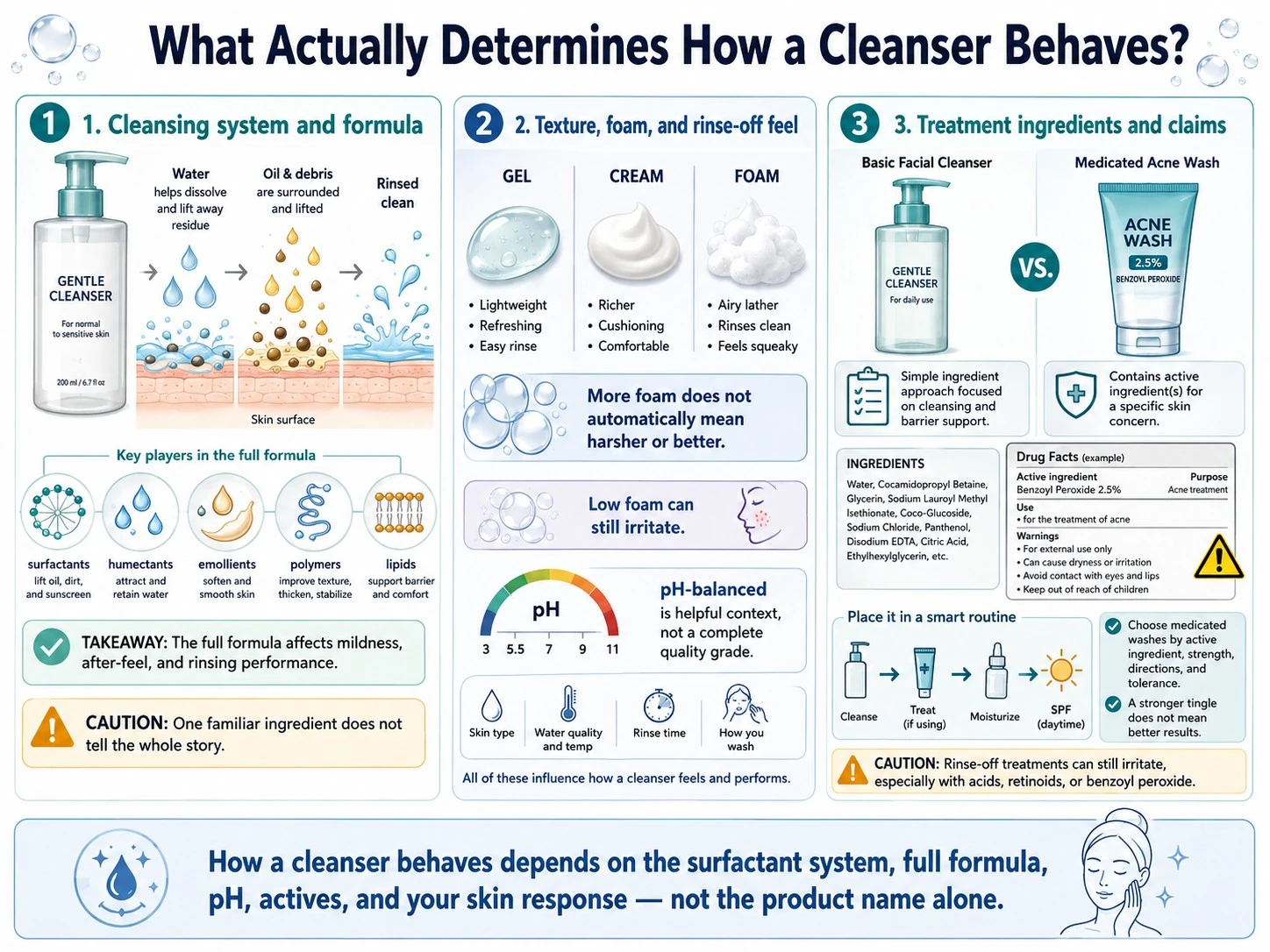
Most facial cleansers use surfactants—ingredients that help water lift oil and debris from skin. Surfactants differ in how strongly they interact with skin proteins and lipids, and formulators can combine them with humectants, emollients, polymers, or lipids to change mildness and after-feel. Harsh surfactant interactions can contribute to tightness, dryness, and irritation, while the complete formula can reduce those effects.[3]
That is why judging a product from one familiar ingredient is unreliable. Concentration, surfactant combinations, supporting ingredients, contact time, and how readily the formula rinses all affect the experience. If you want a deeper comparison of common formats, see gel vs cream vs foaming cleanser.
Texture, foam, and rinse-off feel
Foam changes the sensory experience and helps spread a cleanser, but the amount of lather does not reveal exactly how mild or effective the finished product is. Some gentle formulas foam well, while some low-foam products may still contain fragrance or other ingredients that do not suit a particular person.
“pH-balanced” is also not a complete quality grade. Cleanser pH affects how surfactants interact with the outer skin layer, but matching skin’s acidic pH does not by itself guarantee low irritation. The surfactant system and other ingredients must be considered under the product’s actual pH conditions.[4]
Treatment ingredients and claims
A basic cosmetic cleanser removes material from the skin. A medicated acne wash has a second job and should be chosen by its active ingredient, strength, label directions, and tolerance. In the U.S., products intended to treat or prevent disease are regulated differently from cosmetics, even when they also cleanse.[1]
Do not assume that a stronger tingle or tighter finish means an acne wash is working better. Rinse-off treatments can still irritate, especially when combined with leave-on exfoliants, retinoids, or benzoyl peroxide. Follow the Drug Facts label and simplify other potentially irritating steps if dryness builds.
Which Should You Choose for Your Skin?
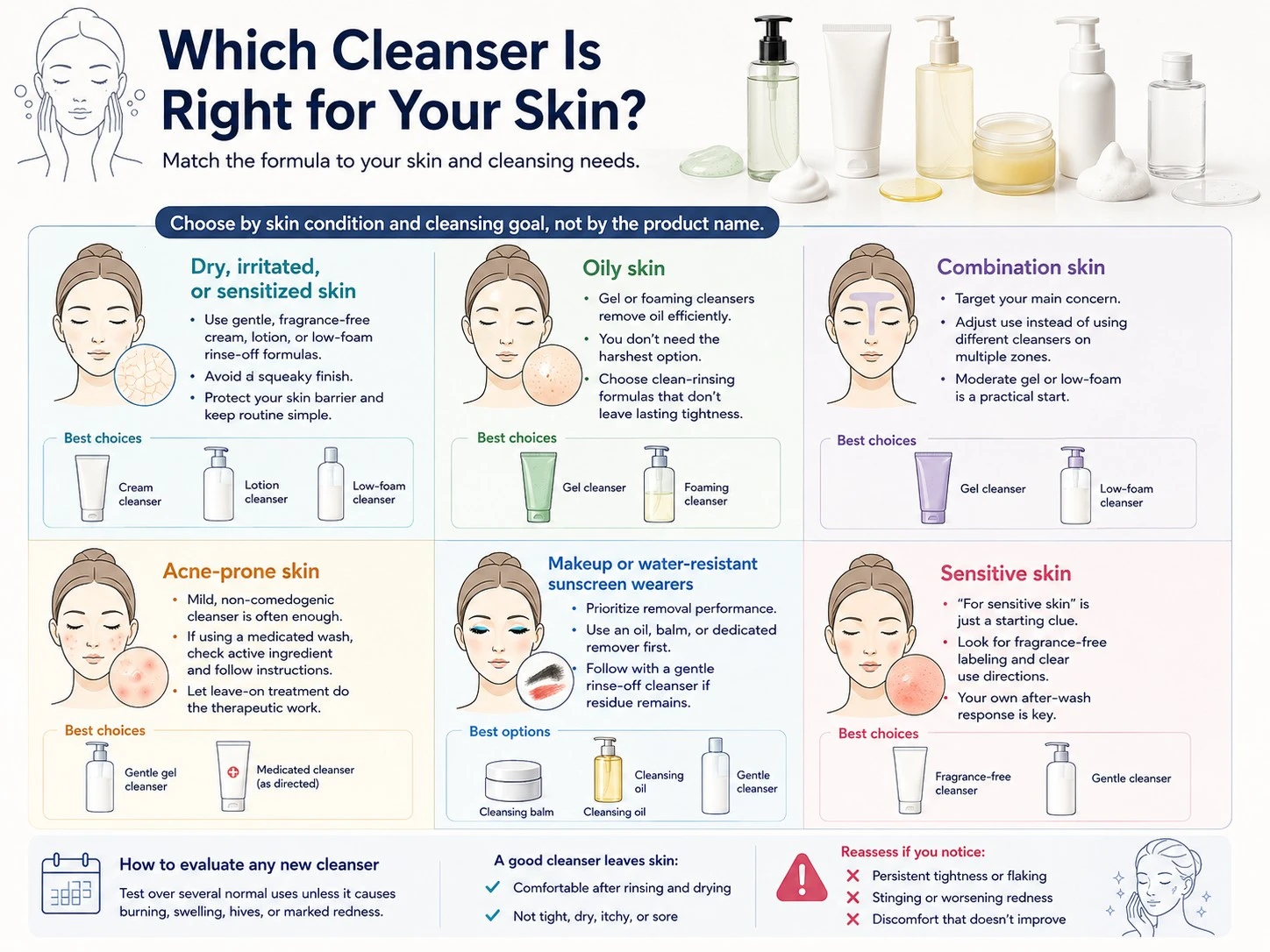
Start with your cleansing job and current skin condition. The word on the bottle comes last.
- Dry, easily irritated, or sensitized skin: Begin with a gentle, fragrance-free cream, lotion, or low-foam rinse-off formula. Avoid using a squeaky finish as a target. If your skin barrier already feels compromised, prioritize comfort and a simple routine over aggressive oil removal.
- Oily skin: A gel or foaming wash can feel pleasant and remove surface oil efficiently, but oily skin does not require the harshest option. Look for a formula that rinses clean without causing lasting tightness. Oiliness and dehydration can occur together.
- Combination skin: Choose for the more troublesome response, then adjust use rather than washing different facial zones with multiple products. A moderate gel or low-foam cleanser is often a practical starting point.
- Acne-prone skin: A mild, non-comedogenic cleanser may be enough when leave-on treatment does the therapeutic work. If you choose a medicated wash, check the active ingredient and instructions instead of relying on “deep cleansing” language.
- Makeup or water-resistant sunscreen wearers: Select for removal performance. An oil, balm, or dedicated remover may make the first step easier, followed by a gentle rinse-off product if residue remains.
- Sensitive skin: “For sensitive skin” is a starting clue, not a guarantee. Fragrance-free labeling, clear use directions, and your own after-wash response are more useful checks.
Evaluate a new product over several normal uses unless it causes immediate burning, swelling, hives, or marked redness. A suitable cleanser should leave skin comfortable once rinsed and dried. Persistent tightness, flaking, stinging, or worsening redness suggests that the formula, frequency, water temperature, or other routine steps need adjustment. For a fuller selection framework, use this guide to choose a cleanser for your skin type.
Can You Use Face Wash and Cleanser Together?
You can, but two products are useful only when they perform different jobs. A first step can dissolve long-wear makeup, water-resistant sunscreen, or a heavy layer of emollient product; a second gentle rinse-off cleanser can remove the remaining film. This is double cleansing, not a requirement for everyone.
If one cleanser removes your normal makeup and sunscreen and leaves skin comfortable, adding a face wash may only increase cost, friction, and surfactant exposure. Remove makeup before bed and cleanse gently rather than scrubbing it away.[5] If you prefer a water-based first step, compare micellar water vs cleanser before building a two-product routine.
How to Use Either Product Without Over-Cleansing
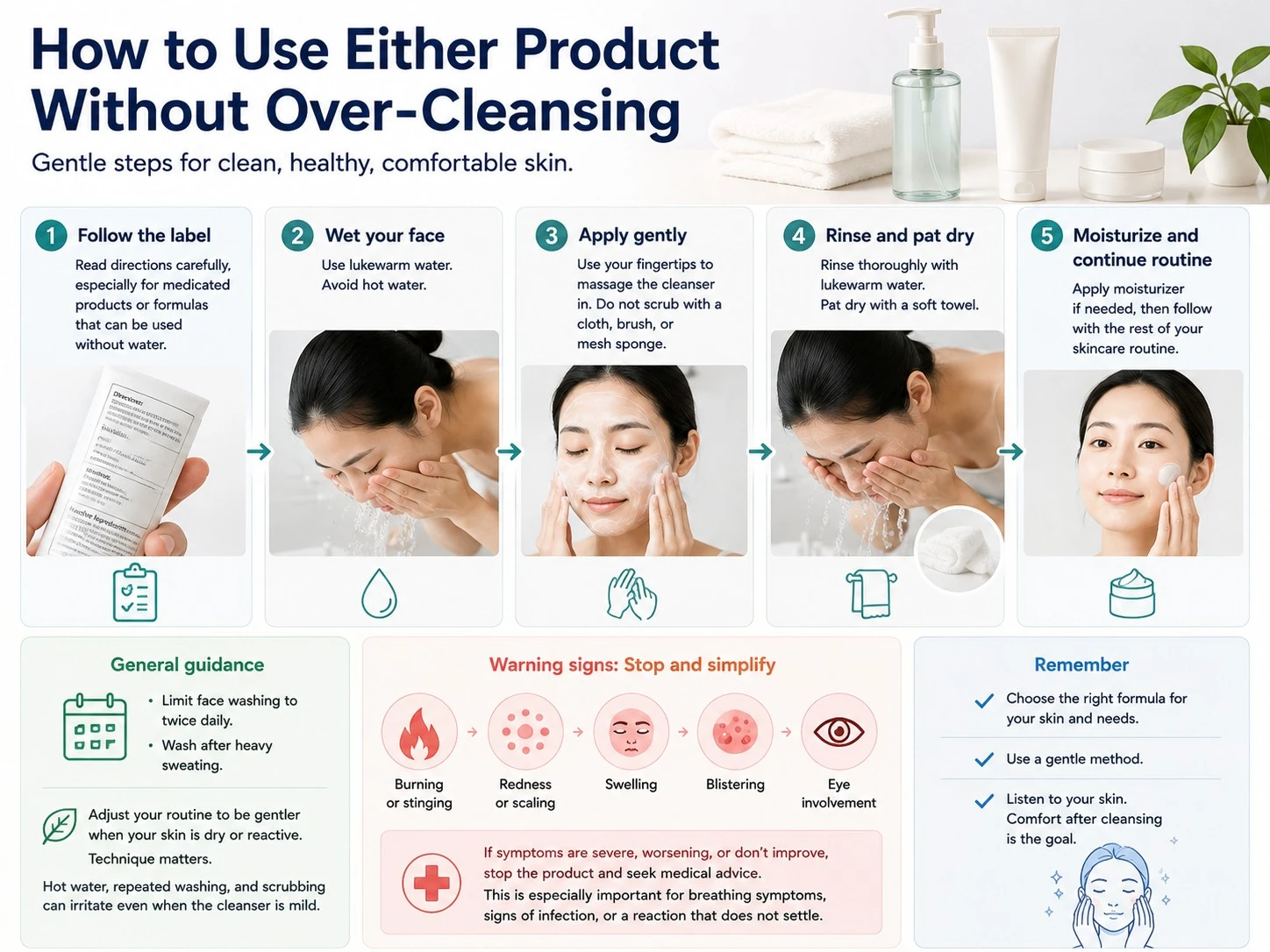
The same gentle method works for most rinse-off face washes and cleansers:
- Follow the label, especially for medicated products or formulas that can be used without water.
- For a standard rinse-off product, wet your face with lukewarm water.
- Apply the cleanser with your fingertips. Do not scrub with a rough cloth, brush, or mesh sponge.
- Rinse thoroughly with lukewarm water and pat dry with a soft towel.
- Apply moisturizer if your skin needs it, then complete the rest of your routine.
General guidance is to limit face washing to twice daily and after heavy sweating, but your routine can be gentler when your skin is dry or reactive. Technique matters: hot water, repeated washing, and scrubbing can irritate even when the cleanser itself is mild.[2]
If cleansing starts to burn or leaves ongoing redness and scaling, stop the suspected product and return to a simple routine. Seek medical advice for severe swelling, blistering, eye involvement, breathing symptoms, signs of infection, or a reaction that does not settle.
Final Thoughts
Face wash is usually one kind of facial cleanser, and the two names often overlap. Choose the product that removes what you need it to remove while keeping your skin comfortable; the full formula, directions, and after-wash response matter more than the marketing term.
FAQs About Face Wash and Cleanser
Is bar soap the same as face wash?
Not necessarily. “Soap” has a specific U.S. regulatory definition based on composition, cleansing action, and intended use, but many bars sold as beauty bars use synthetic detergents and are regulated as cosmetics. A bar can be made for the face, yet its format alone does not tell you whether it will be mild.[1]
Do men need a different face wash or cleanser?
No. Choose for skin type, shaving habits, product use, and concerns rather than gendered packaging. Someone who shaves frequently may prefer a low-irritation cleanser, while someone with oily skin may prefer a clean-rinsing gel regardless of gender.
Can a cleanser make your skin purge?
A plain cleanser should not need a “purging” period. New breakouts, burning, itching, or scaling may signal irritation, residue, or a formula that does not suit you. A medicated acne wash can change how skin behaves, but worsening symptoms should be assessed against its directions rather than automatically treated as proof that it is working.
Can you use face wash around your eyes?
Only if the label permits it and the formula does not sting. The eye area is delicate, and some foaming or medicated washes are not intended for eye makeup. Use a suitable eye-makeup remover when needed and rinse promptly if product enters the eyes.
Should you switch cleansers in winter?
Only if your skin’s needs change. Cold weather, low humidity, indoor heating, and stronger treatments can increase dryness, making a creamier or lower-foam cleanser more comfortable. If your usual product still removes adequately without tightness or irritation, there is no need to switch by calendar alone.
Sources
[1] U.S. Food and Drug Administration. Is It a Cosmetic, a Drug, or Both? (Or Is It Soap?)
[2] American Academy of Dermatology Association. Face Washing 101
[3] Ananthapadmanabhan KP, Moore DJ, Subramanyan K, Misra M, Meyer F. Cleansing Without Compromise: The Impact of Cleansers on the Skin Barrier and the Technology of Mild Cleansing
[4] Hawkins S, Dasgupta BR, Ananthapadmanabhan KP. Role of pH in Skin Cleansing
[5] American Academy of Dermatology Association. I Have Acne! Is It Okay to Wear Makeup?


