


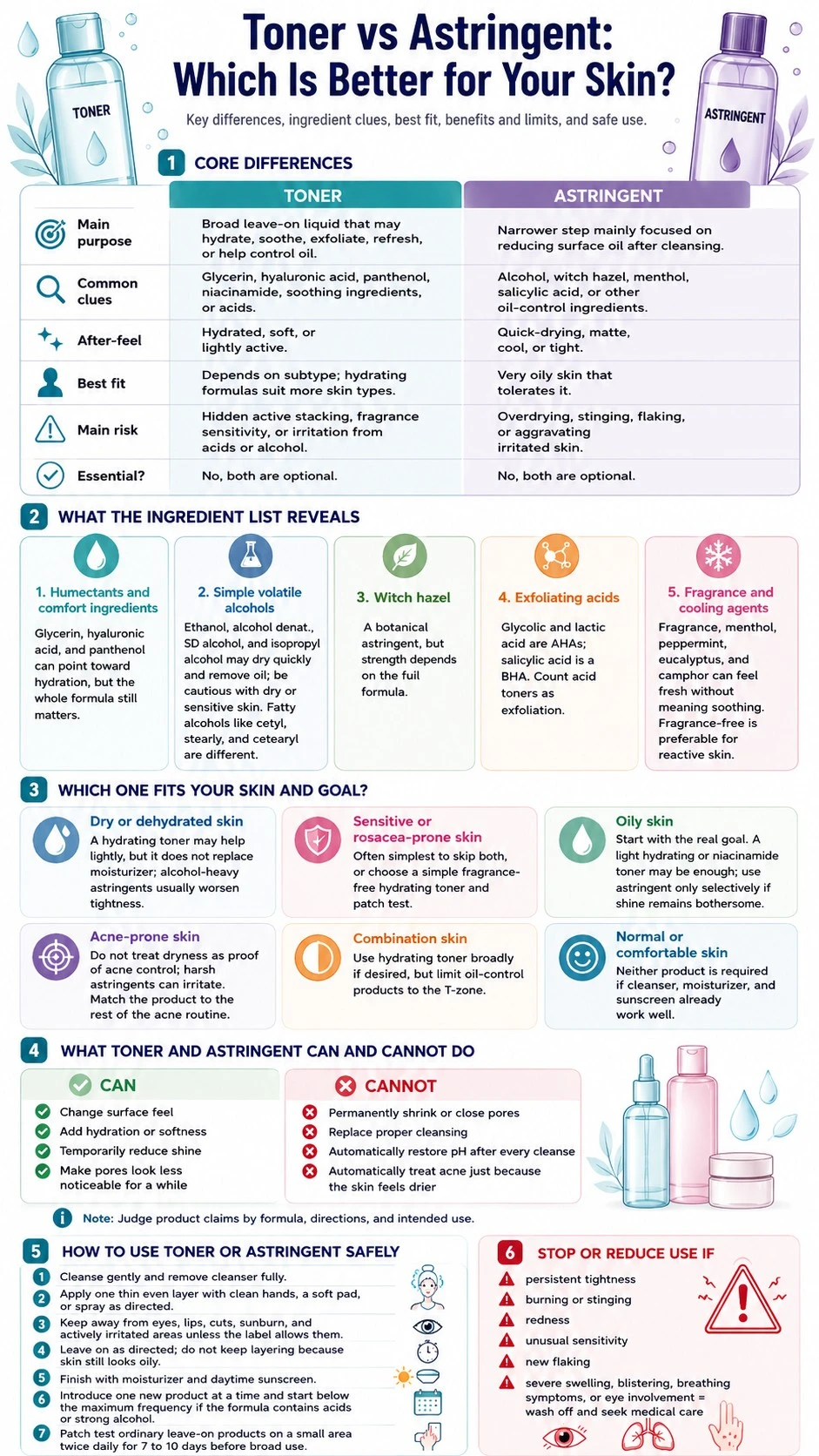
Product names do not create a clean formula boundary. Modern toners range from watery hydrators to leave-on acid exfoliants, while astringents range from high-alcohol liquids to milder witch-hazel blends. Compare the job, ingredients, directions, and skin response rather than assuming one label is always gentle or strong. Both are optional after-cleansing steps, not substitutes for a suitable cleanser.
The Core Differences Between Toner and Astringent
The traditional distinction is purpose: toner is the broader after-cleansing liquid, while astringent focuses more narrowly on reducing surface oil. Current formulas blur that boundary, so treat the comparison below as a starting framework rather than a rule that overrides the label.[1]
| Comparison point | Toner | Astringent |
|---|---|---|
| Main purpose | Broad liquid-care step that may hydrate, soothe, exfoliate, refresh, or manage oil | More targeted oil-removing or degreasing step used after cleansing |
| Common formula clues | Glycerin, hyaluronic acid, panthenol, niacinamide, soothing extracts, or exfoliating acids | Ethanol, alcohol denat., witch hazel, menthol, salicylic acid, or other oil-control ingredients |
| Typical after-feel | Ranges from soft and hydrated to active or lightly mattified | Often quick-drying, matte, cool, or tight |
| Most likely fit | Depends on the subtype; hydrating formulas fit more skin types, while acid formulas serve a specific treatment-like role | Very oily skin that tolerates the formula and wants temporary surface-oil reduction |
| Main risk | Hidden active stacking, fragrance sensitivity, or irritation from an acid or alcohol-heavy formula | Over-drying, stinging, flaking, rebound discomfort, or aggravating already irritated skin |
| Is it essential? | No | No |
The table does not make toner the universal winner. A strong glycolic acid toner can be more irritating than a simple low-alcohol astringent. Conversely, a hydrating toner and a high-alcohol astringent may have almost opposite effects. If no liquid step adds a distinct benefit, it is reasonable to skip toner and astringent entirely.
What the Ingredient List Reveals
The front label tells you how the brand positions the product. The ingredient list, directions, and claims give better clues about how it will behave.
- Humectants and comforting ingredients: Glycerin, hyaluronic acid, panthenol, beta-glucan, and similar ingredients point toward hydration or comfort rather than strong oil removal. Their presence does not guarantee that the whole formula is gentle, especially when acids, fragrance, or substantial alcohol are also present.
- Simple volatile alcohols: Ethanol, alcohol denat., SD alcohol, and isopropyl alcohol can help a formula dry quickly and remove oil. A high position on the ingredient list is a reason to be cautious if your skin is dry, sensitive, recently exfoliated, or already tight. Do not confuse these with fatty alcohols such as cetyl, stearyl, or cetearyl alcohol, which are commonly used as emollients or thickeners rather than as astringent solvents.
- Witch hazel: Witch hazel is a botanical astringent, but the finished product may be marketed as either toner or astringent. Check whether the formula also contains drying alcohol, fragrance, humectants, or soothing ingredients instead of assuming every witch-hazel product has the same strength.
- Exfoliating acids: Glycolic and lactic acid are AHAs; salicylic acid is a BHA. An acid toner should be counted as exfoliation, not as a neutral hydrating layer. AHA effects depend on the acid type, concentration, pH, and other ingredients, and AHAs can increase sensitivity to ultraviolet radiation.[3] Consider your total exfoliation routine rather than using the product at the maximum frequency simply because it is called toner; see how often to exfoliate for the wider decision.
- Fragrance and cooling agents: Fragrance, menthol, peppermint, eucalyptus, and camphor can make a liquid feel fresh without proving that it is soothing. If you react easily, favor a simple fragrance-free product. “Unscented” is not the same claim as fragrance-free.
The ingredient list does not reveal every concentration, pH value, extraction solvent, or interaction. Use it to identify likely functions and risks, then let the directions and skin response complete the judgment.
Which One Fits Your Skin and Goal?
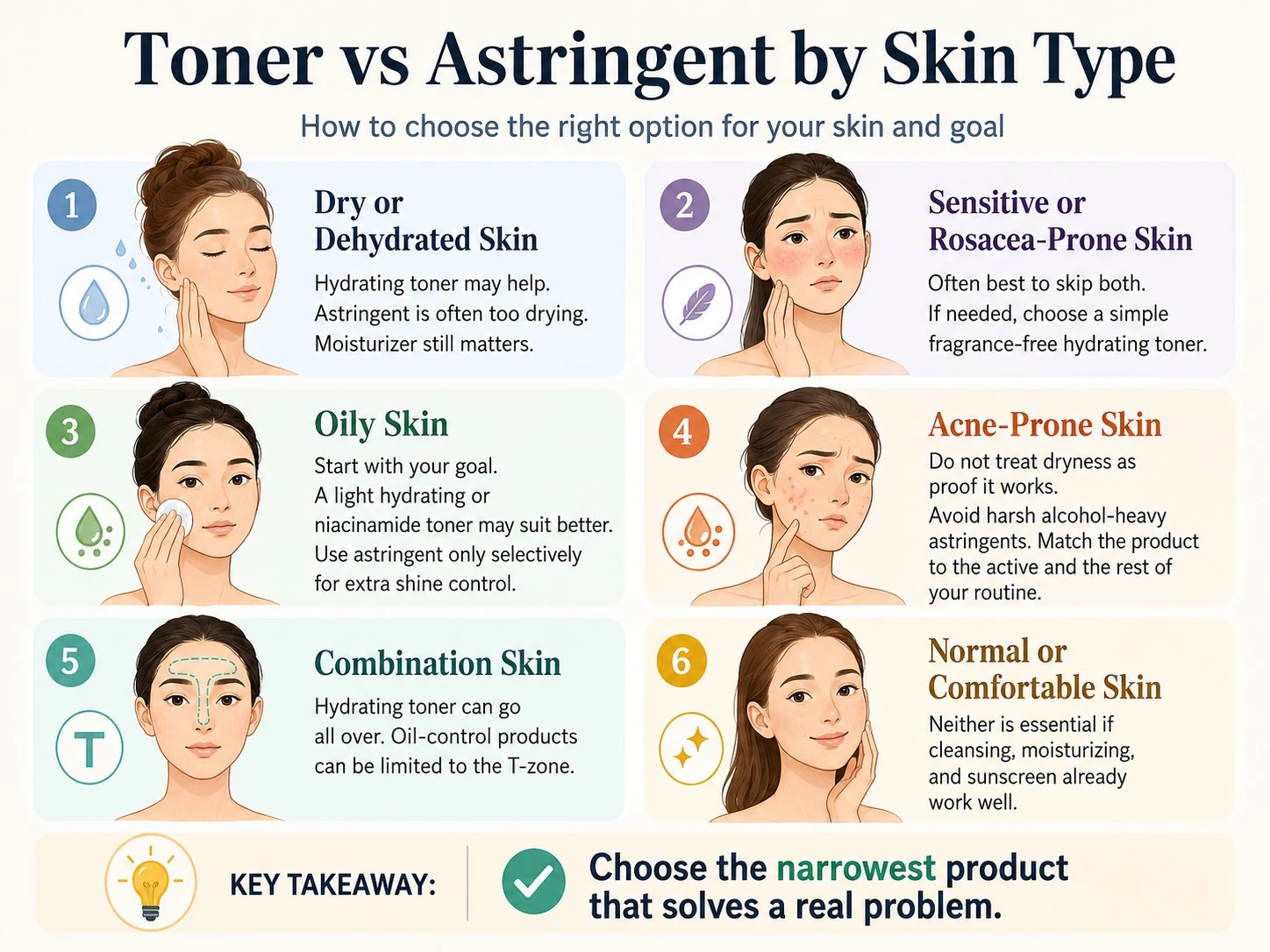
Choose the narrowest product that solves a real problem. Skin type is useful, but your current routine, climate, medications, and tolerance can change what fits.
- Dry or dehydrated skin: A hydrating toner may add a light water-binding layer, but it is optional and does not replace moisturizer. A traditional alcohol-heavy astringent is unlikely to help dryness and may increase tightness.
- Sensitive, rosacea-prone, or easily flushed skin: Skipping both is often the simplest starting point. If you want a toner, look for a fragrance-free, low-complexity hydrating formula and test it before full-face use. Avoid assuming that “botanical” means low-irritation. A basic sensitive-skin routine should take priority over an optional liquid step.
- Oily skin: Start by identifying the goal. A light hydrating or niacinamide toner may feel more comfortable than a strong astringent. If surface shine is still bothersome, a carefully chosen astringent can be used only on oily areas and at the lowest useful frequency. Oily skin still needs appropriate hydration; this guide explains why oily skin may need moisturizer.
- Acne-prone skin: Do not use dryness as proof that a product is treating acne. Aggressive astringents and rubbing alcohol can irritate acne-prone skin, and repeated drying can make the routine harder to tolerate.[2] Choose a product for a defined active ingredient and labeled purpose, then check it against cleansers, retinoids, benzoyl peroxide, acids, and prescriptions already in the routine.
- Combination skin: You do not have to treat the whole face alike. A hydrating toner can be used broadly, while an oil-control product—if needed—can be limited to the forehead, nose, or chin. Avoid applying astringent automatically to dry cheeks.
- Normal or comfortable skin: Neither product is required. If cleansing, moisturizing, and sunscreen already leave your skin comfortable, an extra liquid step needs a specific benefit to justify its cost and irritation potential.
What Toner and Astringent Can—and Cannot—Do
Product claims should be interpreted through the formula and, in the United States, the product’s intended use and labeling.
- They can change surface feel. A hydrating toner can make the outer skin layer feel softer, while an astringent can temporarily reduce shine and leave a drier finish. Neither effect proves that the product has permanently changed oil production.
- They cannot permanently close pores. Pore size is strongly influenced by genetics and skin structure. Removing oil or surface buildup can make pores look less noticeable, but a temporary tight feeling is not the same as shrinking them.[4]
- They do not replace cleansing. A cotton pad may collect remaining makeup or oil, but toner or astringent should not be used to compensate for incomplete makeup removal or a cleanser that does not suit the products you wear.
- They are not always necessary for pH. Some toners are mildly acidic, but the skin and cleanser formula both influence post-wash feel. A toner is not automatically required after every modern cleanser solely to “restore balance.”
- A cosmetic oil-control product is not automatically an acne treatment. In the United States, intended use and treatment claims help determine whether a product is a cosmetic, a drug, or both.[5] If the product is sold as an over-the-counter acne treatment, follow its Drug Facts panel rather than generic toner or astringent advice.
How to Use Toner or Astringent Safely
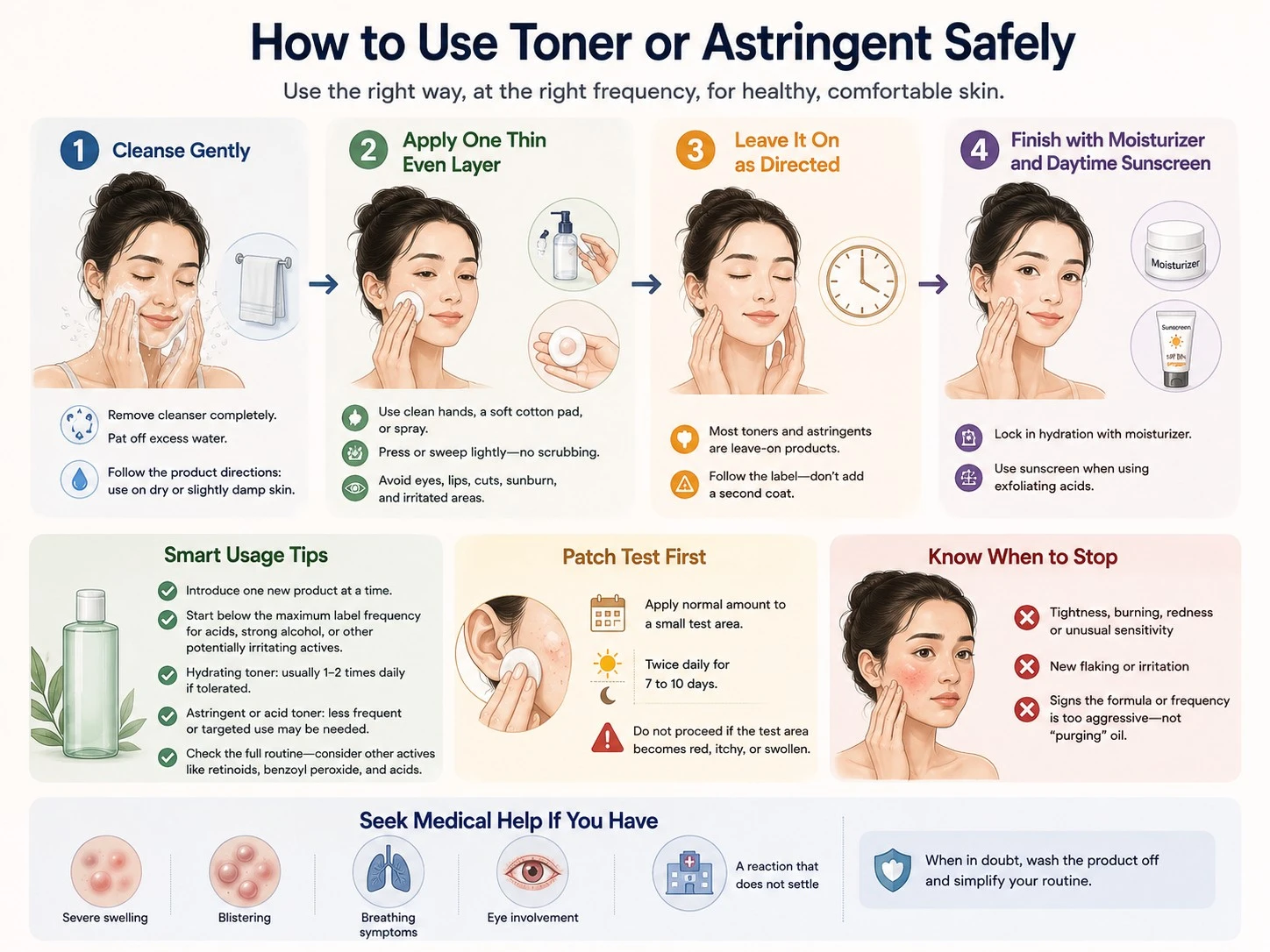
Read the product label first. A plain hydrating toner, an AHA liquid, and a medicated acne astringent may share the same watery texture but require different frequencies and precautions.
- Cleanse gently. Remove cleanser completely and pat off excess water. Follow the liquid product’s directions on whether the skin should be dry or slightly damp.
- Apply one thin, even layer. Use clean hands, a soft cotton pad, or the supplied spray format. Press or sweep lightly instead of scrubbing. Keep the product away from the eyes, lips, cuts, sunburn, and actively irritated areas unless the label specifically permits use there.
- Leave it on as directed. Most facial toners and astringents are leave-on products, but the label controls. Do not add a second coat because the skin still looks oily.
- Finish with moisturizer and daytime sunscreen. Moisturizer helps offset dryness but should not be used to justify continuing a product that repeatedly burns or irritates. Use sun protection when an exfoliating acid is part of the routine.[3]
Introduce one new product at a time and start below the maximum label frequency when the formula contains acids, strong alcohol, or other potentially irritating actives. A hydrating toner may fit once or twice daily if the label permits and skin remains comfortable; an astringent or acid toner may need less frequent or targeted use. The detailed guide to using toner covers application tools, layering, and frequency, while the full skincare routine order helps place it among treatments and moisturizer.
For an ordinary leave-on cosmetic without separate test instructions, apply the normal amount to a small test area twice daily for seven to 10 days. Do not proceed if the test area becomes red, itchy, or swollen.[6]
Reduce or stop the product if you notice persistent tightness, burning, redness, unusual sensitivity, or new flaking. Those signs suggest that the formula, frequency, or combination with other actives is too aggressive—not that the product is “purging” oil. Review the skin barrier before adding more exfoliation or oil-removing steps. Wash the product off and seek medical help for severe swelling, blistering, breathing symptoms, eye involvement, or a reaction that does not settle.
FAQs About Toner and Astringent
Can you use toner and astringent together?
You can, but most routines do not need both over the same areas. Layering a toner and an astringent can duplicate acids, alcohol, fragrance, or oil-control effects without adding a distinct benefit. If each product has a separate purpose, consider using them on different areas or at different times, follow both labels, and change only one variable at a time.
Is witch hazel a toner or an astringent?
Witch hazel is an astringent ingredient, but a finished witch-hazel product may be labeled toner or astringent. Its actual effect depends on the extract, solvent, added alcohol, humectants, fragrance, and the rest of the formula. Judge the complete product rather than treating “witch hazel” as proof that it is either gentle or harsh.
Sources
[1] Cleveland Clinic. What Does Toner Do for Your Face? 5 Benefits
[2] American Academy of Dermatology Association. 10 Skin Care Habits That Can Worsen Acne
[3] U.S. Food and Drug Administration. Alpha Hydroxy Acids
[4] Cleveland Clinic. 7 Ways to Minimize Pores
[5] U.S. Food and Drug Administration. Is It a Cosmetic, a Drug, or Both? (Or Is It Soap?)
[6] American Academy of Dermatology Association. How to Test Skin Care Products


