


Toner is an optional step, not a requirement for clean or healthy skin. It earns a place in a routine only when its formula provides a benefit you want without making the rest of the routine harder to tolerate.
The main challenge is that product names overlap. A watery product labeled toner may mainly hydrate, while another may function as a leave-on exfoliant or acne treatment. Correct use therefore begins with the directions and active ingredients, not with a universal social-media routine.
Check What Kind of Toner You Have
The toner type changes how often you should use it and which products can safely follow. If the categories on your shelf seem unclear, this comparison of toner, essence, and serum explains where the labels overlap. If you are still deciding whether to add one, see whether you need toner before focusing on technique.
| Toner type | Common formula clues | Main use | Practical starting approach |
|---|---|---|---|
| Hydrating or soothing toner | Glycerin, hyaluronic acid, panthenol, beta-glucan, or other water-binding and comforting ingredients | Adds light hydration and reduces the tight feeling that can follow cleansing | Pat or press on a thin layer; once or twice daily may be reasonable if the label permits and skin stays comfortable |
| Exfoliating acid toner | Glycolic acid, lactic acid, salicylic acid, or another exfoliating acid | Loosens surface buildup or helps manage texture and clogged pores | Use as a treatment step; start below the label maximum and do not stack it automatically with other exfoliants |
| Astringent or oil-control toner | High alcohol content, witch hazel, or a strong degreasing after-feel | Temporarily removes surface oil and reduces shine | Apply only where needed and reduce use if skin feels tight, dry, or reactive |
| Medicated acne toner | A Drug Facts panel or an active ingredient presented with acne-treatment directions | Treats acne while also functioning as a liquid leave-on step | Follow the Drug Facts directions for amount, frequency, warnings, and affected areas rather than ordinary toner advice |
Hydrating formulas may be tolerated once or twice daily, while strong acids or other irritating actives are better introduced less often, such as every other day, before increasing only if the label allows and skin remains comfortable.[1] The word “toner” does not guarantee that a product is gentle, alcohol-free, exfoliating, or suitable for daily use.
Choose Hands, a Cotton Pad, or Spray
No application tool is universally best. Choose based on the texture, dispenser, label, and how much friction your skin tolerates.
- Clean hands: Pour or dispense a small amount into one palm, spread it between clean fingertips or palms, and press it over the intended area. This suits many hydrating or milky toners, limits product absorbed by an applicator, and avoids wiping friction.
- Cotton pad: Dampen a soft pad enough that it glides instead of dragging. Sweep lightly across the face without repeatedly rubbing the same area. A pad can give controlled coverage with very fluid formulas, but brown or gray residue on the pad is not proof that toner “deep cleaned” the skin.
- Spray: Mist only as the label directs and keep the product out of the eyes and mouth. A few scattered droplets may not produce even coverage, so check the surface rather than counting sprays. A spray dispenser also does not make a product interchangeable with a face mist.
Use enough to create a light, continuous layer without liquid running down the face. Drop counts and coin-size rules are unreliable because openings, pumps, spray patterns, pad absorbency, and formula viscosity differ. Using more does not make an active toner work faster; it mainly increases waste and may raise irritation.
How Often Should You Use Toner?
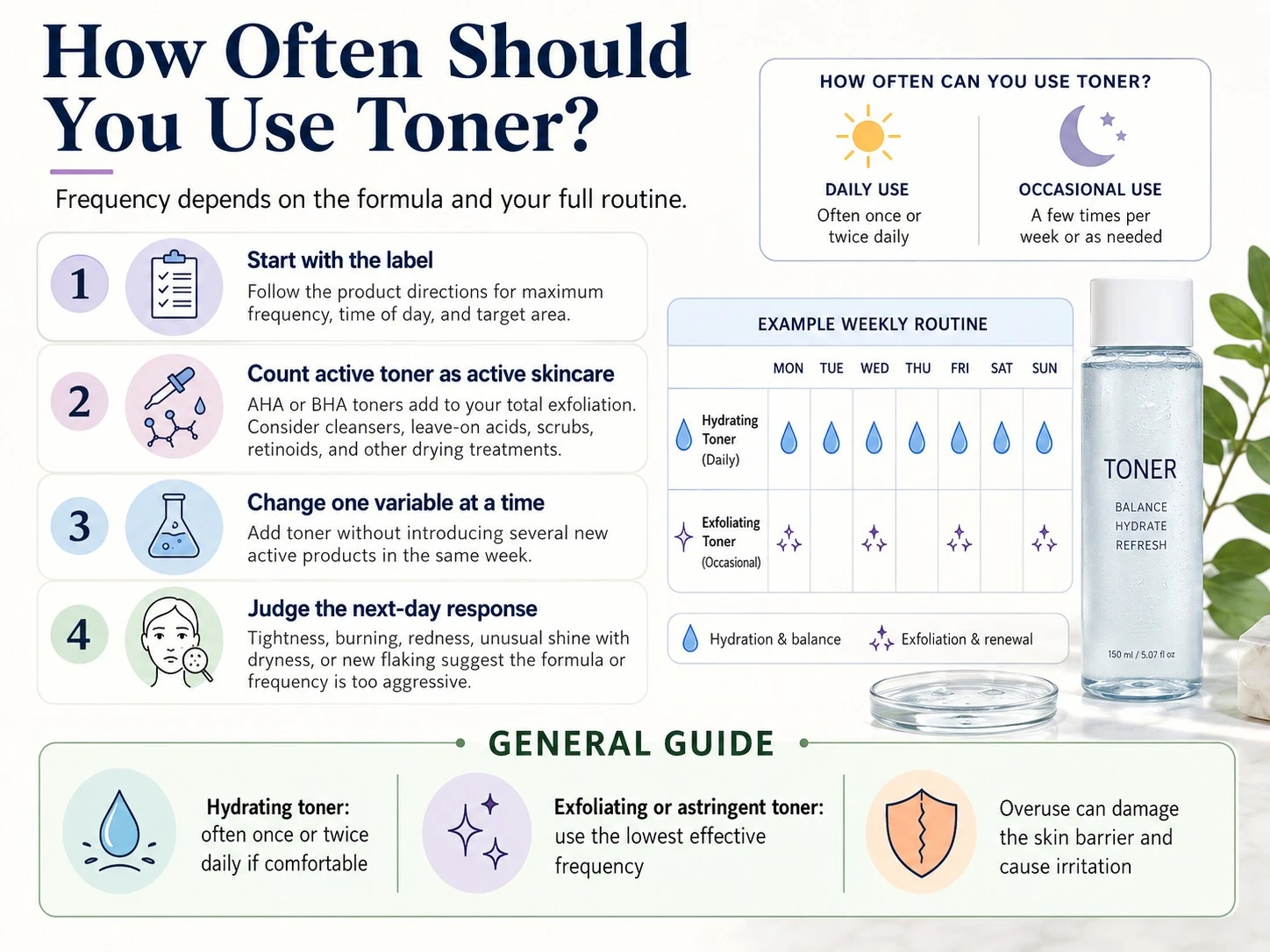
Frequency should come from the formula and your full routine, not from the idea that every toner belongs after every cleanse.
- Start with the label. It defines the intended maximum and may restrict the product to morning, evening, certain areas, or a specific number of uses.
- Count active toner as active skincare. An AHA- or BHA-based toner contributes to your total exfoliation. Do not judge its frequency separately from exfoliating cleansers, leave-on acids, scrubs, retinoids, or other drying treatments. This guide to how often to exfoliate provides a broader frequency framework.
- Change one variable at a time. Introduce the toner without adding several other active products in the same week. This makes irritation and useful changes easier to trace.
- Judge the next-day response. Persistent tightness, burning, redness, unusual shine with underlying dryness, or new flaking suggests that the formula or frequency is too aggressive.
Overusing exfoliating products can damage the protective skin barrier and leave skin raw or irritated.[5] A hydrating toner that remains comfortable may fit once or twice daily; an exfoliating or astringent formula should be used at the lowest frequency that meets its intended purpose.
Where Toner Fits in Your Skincare Routine
Toner normally sits immediately after cleansing and before serum, treatment, or moisturizer. The complete skincare routine order can help when you use several optional steps, but the basic logic is simple: remove the cleanser, apply the light liquid toner, then continue with leave-on products.
There is no universal wait time established for every toner and product combination. Move to the next step when the toner is evenly distributed and no longer dripping or pooling. A hydrating serum or moisturizer can usually follow while the surface still feels slightly damp. If a prescription, retinoid, acid, or other treatment says to apply it to completely dry skin, let that product’s directions override the general layering rule.
Do not mix toner and serum together in your hand unless the directions support it. Separate layers give you better control over the amount and spread of each product. If serum is the next step, this guide explains how to use face serum without relying on unnecessary wait-time rituals.
How to Prevent Irritation From Toner
- Test the product first. Follow any label-specific test directions. For an ordinary leave-on cosmetic without separate instructions, apply the normal amount to a small test area twice daily for seven to 10 days. Do not proceed if the area becomes red, itchy, or swollen.[2]
- Avoid sensitive or injured areas. Keep ordinary facial toner off the eyelids, lash line, lips, cuts, and actively irritated or sunburned skin unless its label explicitly permits that use.
- Do not build an acid stack by accident. When starting an exfoliating toner, avoid adding another leave-on acid, scrub, or strong retinoid in the same routine until you understand your tolerance. If the surface is already sore or flaky, simplify first; these guides to the skin barrier and over-exfoliated skin explain the recovery priorities.
- Check fragrance labeling carefully. Fragrance can be a problem for some sensitive users, and “unscented” does not necessarily mean fragrance-free. The distinction is explained in fragrance-free vs unscented skincare.
- Use sun protection with exfoliating acids. AHAs can increase skin sensitivity to sunlight, and U.S. safety information advises sun protection during use and for a week afterward.[3] BHA products also warrant label-directed use, small-area testing, and sun protection.[4]
A brief mild sensation from an active formula is not a reason to push through worsening discomfort. Wash the product off and stop using it if it causes strong or prolonged stinging, burning, swelling, hives, or a spreading itchy rash. Seek medical help for severe swelling, blistering, breathing symptoms, eye involvement, signs of infection, or a reaction that does not settle.
Troubleshooting Common Toner Problems
- The toner stings every time: Stinging is not proof that the product is working. Check for acids, alcohol, fragrance, or other active ingredients; reduce frequency or stop the product rather than applying more moisturizer over continuing irritation.
- Skin feels sticky: You may be using more than the surface can hold, or several humectant-rich layers may be building a tacky film. Use a thinner, even layer and remove one optional product at a time to find the source.
- Sunscreen or makeup pills afterward: Let liquid stop pooling, avoid repeated rubbing, and simplify the layers underneath. Change one product or amount at a time. Do not solve pilling by reducing the sunscreen below its labeled amount.
- The cotton pad looks dirty: Toner can collect loose makeup, oil, or tinted residue, but it should not be the main cleansing step. Recheck makeup removal and cleanser technique instead of scrubbing harder with toner.
- Nothing useful changes: A toner is optional. Confirm the benefit promised by the label and the timeframe it gives. If consistent, well-tolerated use does not solve a distinct need, the most efficient choice may be to skip it rather than keep adding layers.
FAQs About Using Toner
Can you use toner on your neck?
Yes, if the label permits use on the neck and the formula is tolerated there. Start gradually with exfoliating or strongly astringent toners because neck skin may react differently from facial skin, and protect exposed skin from the sun.
Can you apply toner around your eyes?
Only if the product directions allow eye-area use. Keep ordinary toners away from the eyelids, lash line, and inner corners. Apply a spray toner from your hands when direct misting could reach the eyes.
Can you apply toner after shaving?
Wait until the skin is comfortable and free of cuts. A simple hydrating toner may be tolerated, but acids, alcohol-heavy formulas, fragrance, and strongly astringent products can sting freshly shaved or irritated skin.
Sources
[1] Cleveland Clinic. Do You Need a Face Toner?
[2] American Academy of Dermatology Association. How to Test Skin Care Products
[3] U.S. Food and Drug Administration. Alpha Hydroxy Acids
[4] U.S. Food and Drug Administration. Beta Hydroxy Acids
[5] American Academy of Dermatology Association. Dermatologist-Recommended Skin Care for Your 20s


