

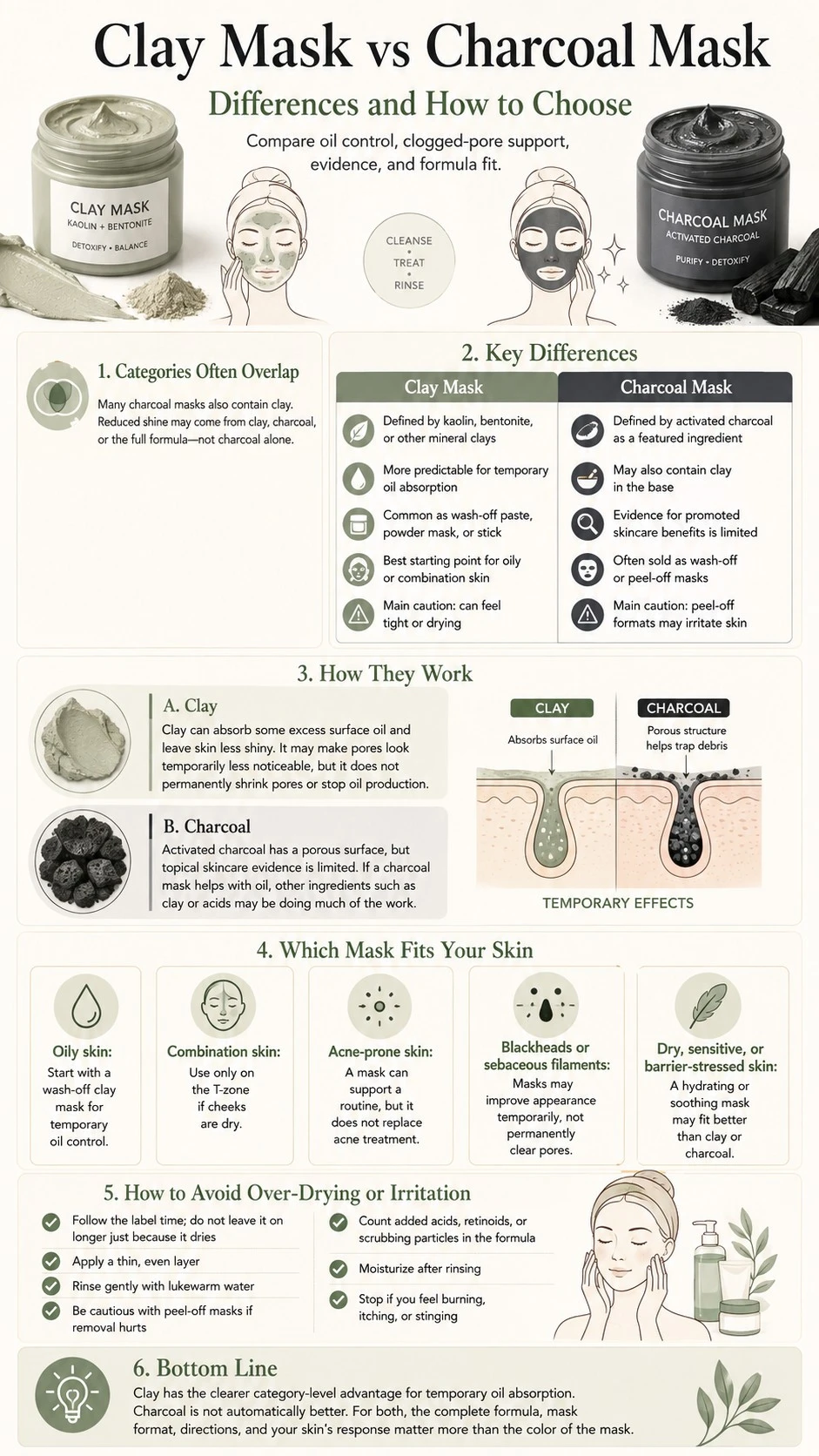
Clay and charcoal masks are often presented as rivals, but the categories overlap. A product can contain activated charcoal plus kaolin or bentonite, making it both a charcoal mask and a clay-based mask. Reduced shine may come from the clay, charcoal, or finished formula rather than charcoal alone.
That overlap is central to the comparison. Do not choose by black versus gray packaging. Check the ingredient list, the mask format, the stated purpose, and whether the formula adds acids, fragrance, alcohol, scrubbing particles, or moisturizing ingredients.
Clay Mask vs Charcoal Mask: Key Differences
The table below compares the two labels as they are commonly used. It cannot replace the product directions because formulas within either category can be very different.
| Comparison point | Clay mask | Charcoal mask |
|---|---|---|
| Defining feature | One or more mineral clays, commonly kaolin or bentonite | Activated charcoal is a featured ingredient; the base may also contain clay |
| Most plausible cosmetic role | Absorbs excess surface oil and leaves skin feeling less greasy | May adsorb substances at its surface, but the practical facial-skin benefit depends on the formula |
| Evidence | Dermatologists commonly recommend clay as an oil-absorbing mask ingredient; studies of specific clay formulas offer additional but product-specific support | A dermatology review found little clinical evidence for promoted charcoal skincare claims |
| Common formats | Creamy wash-off paste, powder mixed before use, or clay-containing stick | Wash-off cream or gel, clay-charcoal paste, or peel-off film |
| Most likely fit | Oily or combination skin seeking temporary oil control | Oily skin that tolerates the complete formula and prefers that product—not someone choosing from the charcoal claim alone |
| Main cautions | Tightness, flaking, or irritation from a drying formula, overuse, or added actives | The same risks as clay when clay is present, plus possible mechanical irritation from peel-off formats |
Clay has the clearer category-level advantage for absorbing oil. That does not make every clay mask better than every charcoal mask. A balanced charcoal mask containing clay and humectants may be more comfortable than a clay mask loaded with alcohol, fragrance, or exfoliating acids. Conversely, a simple clay mask may be easier to evaluate than a charcoal product whose main appeal is an unsupported cleansing claim.
How Clay and Charcoal Masks Work
How clay masks work
Kaolin, bentonite, and other clays are fine mineral particles with surfaces that can interact with oil and water. In a facial mask, they can absorb and retain some surface sebum as the product sits on the skin and is rinsed away. The American Academy of Dermatology includes kaolin and bentonite among mask ingredients that can help absorb oil for oily or acne-prone skin.[1]
The most realistic immediate result is less surface shine and a cleaner, drier after-feel. That may temporarily make pores or sebaceous filaments look less noticeable, but it does not switch off sebaceous glands or permanently change pore structure.
A study of one kaolin- and bentonite-containing finished mask reported improvements in several measures in adults with oily or combination skin. However, it evaluated a specific commercial formula over a defined regimen, not every clay mask. Its results cannot tell you that any clay powder, DIY mixture, or different finished product will perform the same way.[3] For a broader look at supported uses and limitations, see the guide to clay mask benefits.
How charcoal masks work
Activated charcoal is processed to create a highly porous surface. Substances can adhere to that surface through adsorption, which is different from absorption into the material. This property has established uses in other settings, but it does not prove that a charcoal facial mask draws oil, pollution, bacteria, or “toxins” from deep inside pores.
A dermatology review found that charcoal is generally considered safe in cosmetic products but that clinical evidence did not support widely promoted exfoliating, rejuvenating, and treatment claims.[2] That does not mean every charcoal mask is useless. It means the word “charcoal” is weak evidence by itself. If a charcoal mask controls oil, check whether kaolin, bentonite, salicylic acid, or another functional ingredient may be doing much of the work.
Which Mask Should You Choose for Your Skin?

Use your current skin condition and the full formula—not a promise of “deep cleansing”—to make the decision.
- Oily skin: A wash-off clay mask is the more evidence-aligned starting point when temporary oil absorption is the goal. Look for a formula that rinses without aggressive scrubbing and does not leave the face painfully tight. Charcoal is optional rather than an upgrade.
- Combination skin: Apply an oil-absorbing mask only to areas that need it, such as the nose, forehead, or chin. There is no requirement to dry out the cheeks to treat an oily T-zone.
- Acne-prone skin: A mask can be an occasional supporting step, but it does not replace an acne treatment plan. Check for acids or other acne actives already present elsewhere in the routine so you do not duplicate irritation. Clay can absorb oil; it cannot treat every cause of acne.[1]
- Blackheads or visible sebaceous filaments: Either mask may make the area look temporarily clearer by removing surface oil, but neither permanently empties pores or prevents normal filaments from returning. First make sure you know whether you are seeing sebaceous filaments or blackheads. For persistent buildup, a well-tolerated routine designed for clogged pores is more useful than repeatedly applying a stronger mask.
- Dry, sensitive, or barrier-stressed skin: Neither category is an automatic fit. If you still want one, favor a short-contact wash-off formula with moisturizing ingredients and without fragrance, strong acids, or scrubbing particles. A hydrating or soothing mask may match the skin’s actual need better.
If you are unsure whether your face is oily, dry, or simply dehydrated after cleansing, identify your skin type before buying the stronger-looking option. Skin that becomes shiny later can still be over-dried and uncomfortable underneath.
How to Avoid Over-Drying or Irritation
Clay and charcoal masks are optional, so there is no benefit in tolerating burning or prolonged tightness to finish a routine.
- Follow the label time. Do not assume the mask must dry until it cracks. Leaving it on longer than directed can increase dryness and irritation without proving that more oil was removed.[1]
- Use a thin, even layer. More product does not create deeper pore cleansing. Keep it off the eyelids, lips, cuts, sunburn, and actively irritated areas unless the directions specifically permit those areas.
- Rinse gently. Soften a wash-off mask with lukewarm water and remove it without scrubbing. For a peel-off mask, follow its directions and stop if removal is painful or leaves lasting redness.
- Count all the active ingredients. A clay or charcoal mask containing salicylic acid, glycolic acid, retinoids, or exfoliating particles contributes to the total irritation load. Avoid stacking it automatically with a scrub, peel, or strong active used in the same routine.
- Moisturize afterward. Apply a suitable moisturizer after rinsing. If the skin repeatedly stings, burns, flakes, or feels sore, reduce use or stop the product rather than relying on moisturizer to make continued irritation acceptable.
The complete guide to using a face mask covers application and removal, while how often to use a face mask explains why frequency should follow the formula and skin response rather than a universal weekly rule. Wash the mask off immediately if you feel itching, burning, or stinging. Seek medical care for severe swelling, blistering, eye involvement, breathing symptoms, or a reaction that does not settle.
FAQs About Clay and Charcoal Masks
Is charcoal better than clay for blackheads?
No clear clinical evidence shows that charcoal masks are better than clay masks for blackheads. Either may temporarily remove surface oil and make dark dots less visible, especially if the charcoal formula also contains clay. Neither pulls out a permanent “root.” Salicylic acid and a consistent pore-care routine are more directly relevant to recurring blackheads, provided your skin tolerates them.
Can sensitive skin use a clay or charcoal mask?
Sometimes, but the category name does not establish gentleness. Choose a fragrance-free wash-off formula without strong acids, alcohol, or abrasive particles, follow the shortest label-directed contact time, and stop if it burns or causes persistent redness. Very dry, irritated, or barrier-damaged skin may be better served by skipping both.
Can you use clay and charcoal in the same mask?
Yes. Many charcoal masks already combine activated charcoal with kaolin or bentonite. The combination is not automatically stronger or more effective; it simply means both materials are present. Judge how the complete formula rinses, feels, and fits your routine.
Are charcoal peel-off masks safe?
A peel-off charcoal mask is not automatically unsafe, but the film-forming format can add pulling and friction during removal. Avoid it on sunburned, inflamed, freshly exfoliated, or very sensitive skin, and do not use it over facial hair or near the delicate eye area unless the label allows it. Stop if peeling is painful or leaves marked irritation.
Do clay or charcoal masks detox your skin?
No skincare mask detoxifies the body. Clay can absorb surface oil, and charcoal can adsorb substances onto its surface, but those actions are not evidence that either material removes systemic toxins through the skin. Treat “detox” as a marketing description unless the brand defines a specific, measurable cosmetic effect.
Sources
[1] American Academy of Dermatology Association. Do Facial Masks Work, and Should I Add One to My Skin Care Routine?
[2] Sanchez N, Fayne R, Burroway B. Charcoal: An Ancient Material With a New Face
[3] Zhang X, Zhang Z, Tao H, et al. Comprehensive Assessment of the Efficacy and Safety of a Clay Mask in Oily and Acne Skin


