


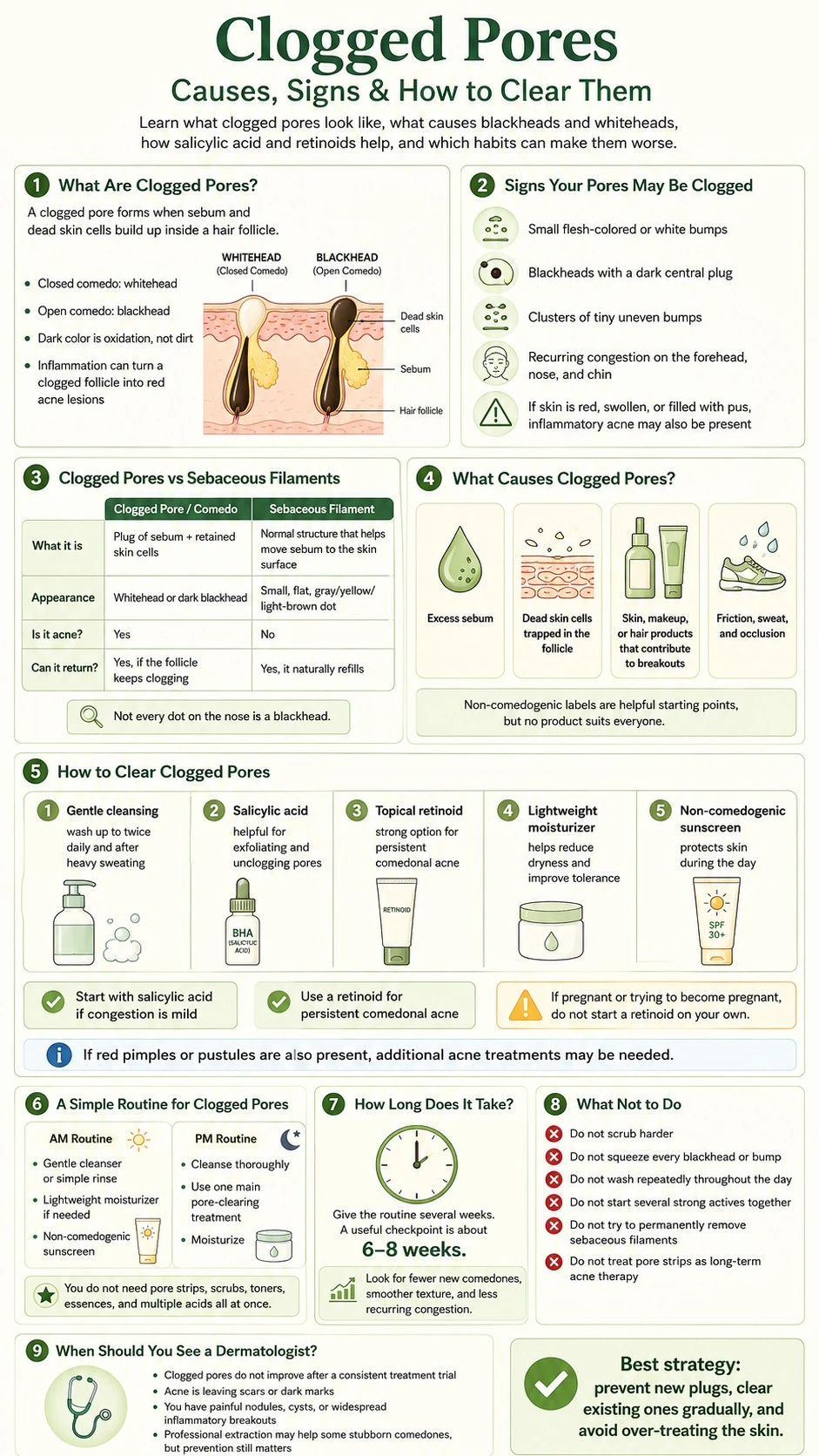
Clogged pores are easier to manage when you stop treating every visible dot or bump as the same problem. A true clogged pore forms when oil and dead skin cells accumulate inside a hair follicle. If the opening stays closed, it can become a whitehead; if it stays open, it can become a blackhead.[1]
The most effective approach is usually not squeezing, scrubbing, or repeatedly “deep cleaning” the skin. It is preventing new plugs from forming while gradually clearing existing ones with a gentle routine and a pore-targeted active such as salicylic acid or a topical retinoid.[2]
What Are Clogged Pores?

A pore is the visible opening of a hair follicle and its associated oil gland. In acne-prone skin, excess sebum and retained skin cells can form a plug inside that follicle. The earliest blockage may be microscopic, while a visible plug can develop into a comedo.[1]
- Closed comedo: a white or flesh-colored bump commonly called a whitehead.
- Open comedo: a blackhead. The dark color is caused by oxidation of material exposed at the surface, not by dirt trapped in the skin.[1]
- Inflamed acne lesion: when a blocked follicle also develops significant inflammation, it can progress to a red papule, pustule, or deeper lesion.[1]
This distinction matters because “clogged pores” is often used loosely for everything from blackheads to visible sebaceous filaments. Treating the wrong thing can lead to unnecessary extraction and irritation.
Signs Your Pores May Be Clogged

Clogged pores usually produce texture rather than a feeling of being “dirty.” Common signs include:
- small flesh-colored or white bumps;
- blackheads with a dark central plug;
- clusters of tiny bumps that make the skin feel uneven;
- recurrent congestion in oilier areas such as the forehead, nose, or chin.
If the area is red, tender, swollen, or filled with pus, you are dealing with inflammatory acne as well as—or instead of—simple comedonal congestion.[1]
Clogged Pores vs Sebaceous Filaments
Not every visible dot on your nose is a blackhead. Sebaceous filaments are normal structures that help move sebum through the follicle to the skin surface. They tend to look smaller, flatter, lighter, and more evenly distributed than blackheads, and they are not acne.[6]
| Feature | Clogged Pore / Comedo | Sebaceous Filament |
|---|---|---|
| What it is | A plug of sebum and retained skin cells inside a follicle | A normal structure that helps conduct sebum to the skin surface |
| Typical appearance | White or flesh-colored bump, or a darker open blackhead | Small, flat gray, yellowish, or light-brown dot |
| Is it acne? | Yes, when it forms a whitehead or blackhead | No |
| Can it return? | Yes, if the follicle keeps clogging | Yes; sebaceous filaments are normal and naturally refill |
Before trying to “empty” every pore on your nose, compare the pattern with our Sebaceous Filaments vs Blackheads: How to Tell the Difference guide.
What Causes Clogged Pores?

A clogged pore usually develops because the follicle is producing or retaining more material than it can shed normally. Several factors can push that process in the same direction.
Excess Sebum
Oil is a normal part of healthy skin, but a greater amount of sebum inside the follicle gives dead skin cells more material to combine with, making plugs more likely.[1]
Dead Skin Cells That Accumulate Inside the Follicle
Acne is not simply a surface-cleanliness problem. Dead skin cells can collect within the follicle and combine with sebum, which is why effective treatment focuses on preventing and clearing follicular blockage rather than washing the surface more aggressively.[1][2]
Skin, Makeup, or Hair Products
Some leave-on products can contribute to breakouts in people who are prone to acne. Hair oils, pomades, conditioners, styling products, makeup, sunscreen, and skin care can be relevant when congestion repeatedly appears where those products touch the skin.[3][4]
Labels such as non-comedogenic, non-acnegenic, or won’t clog pores are useful starting points, although no label can guarantee that every individual will tolerate a product.[3]
Friction, Sweat, and Occlusion
Tight equipment, repeated rubbing, sweat, and occlusion can worsen acne-prone areas on some parts of the face or body. Reducing friction, changing out of sweaty clothing, and cleansing gently are more useful than scrubbing harder.[8]
How to Clear Clogged Pores
The best routine depends on whether you mainly have whiteheads and blackheads or also have inflamed acne. For straightforward congestion, build around one pore-clearing active instead of stacking multiple exfoliants immediately.
| Step | What to Do | Why It Helps |
|---|---|---|
| 1. Gentle cleansing | Wash with a mild cleanser up to twice daily and after heavy sweating | Removes surface oil and debris without adding irritation from repeated washing or scrubbing[3] |
| 2. Salicylic acid | Use a salicylic-acid cleanser or leave-on product according to its directions | Helps exfoliate and unclog pores; current acne guidelines conditionally recommend topical salicylic acid[2] |
| 3. Topical retinoid | For persistent comedones, consider a retinoid such as adapalene where appropriate and available | Topical retinoids have a strong guideline recommendation and help prevent follicles from clogging[2] |
| 4. Moisturizer | Use a lightweight, non-comedogenic moisturizer if your skin feels dry or irritated | Improves tolerance of acne treatments and helps prevent over-drying from becoming the reason you stop treatment[3] |
| 5. Sunscreen | Use a non-comedogenic broad-spectrum sunscreen during the day | Protects exposed skin while keeping the daytime routine compatible with acne-prone skin[3] |
Start With Salicylic Acid if Congestion Is Mild
Salicylic acid is especially useful for blackheads and whiteheads because it helps exfoliate and clear follicular buildup.[2] You do not need several acid products at once. Start with one format at the frequency recommended on the label and adjust based on tolerance.
For concentration, frequency, and routine guidance, see our Salicylic Acid for Skin: Benefits, Uses & How to Use It article.
Use a Retinoid for Persistent Comedonal Acne
Topical retinoids are one of the most established treatments for clogged follicles and comedonal acne.[2] They are not instant extraction products; their value comes from reducing follicular blockage over time so existing congestion can improve and new comedones form less easily.
Retinoids can cause dryness, peeling, or irritation when introduced too aggressively. Start according to the product or clinician instructions, support the routine with moisturizer, and avoid adding several other irritating actives at the same time.
If you are pregnant or trying to become pregnant, do not start a retinoid on your own. Topical retinoids are generally avoided during pregnancy, and your treatment options should be reviewed with a qualified clinician.[5]
Add Other Acne Treatments Only When the Problem Requires Them
If clogged pores are accompanied by red pimples or pustules, treatment may need to address inflammation and acne-associated bacteria as well as follicular blockage. Benzoyl peroxide and azelaic acid are among the topical options included in current acne guidance.[2]
For a gentler multi-purpose option, our Azelaic Acid for Skin: Benefits, Uses & How to Use It guide explains where azelaic acid can fit.
A Simple Routine for Clogged Pores
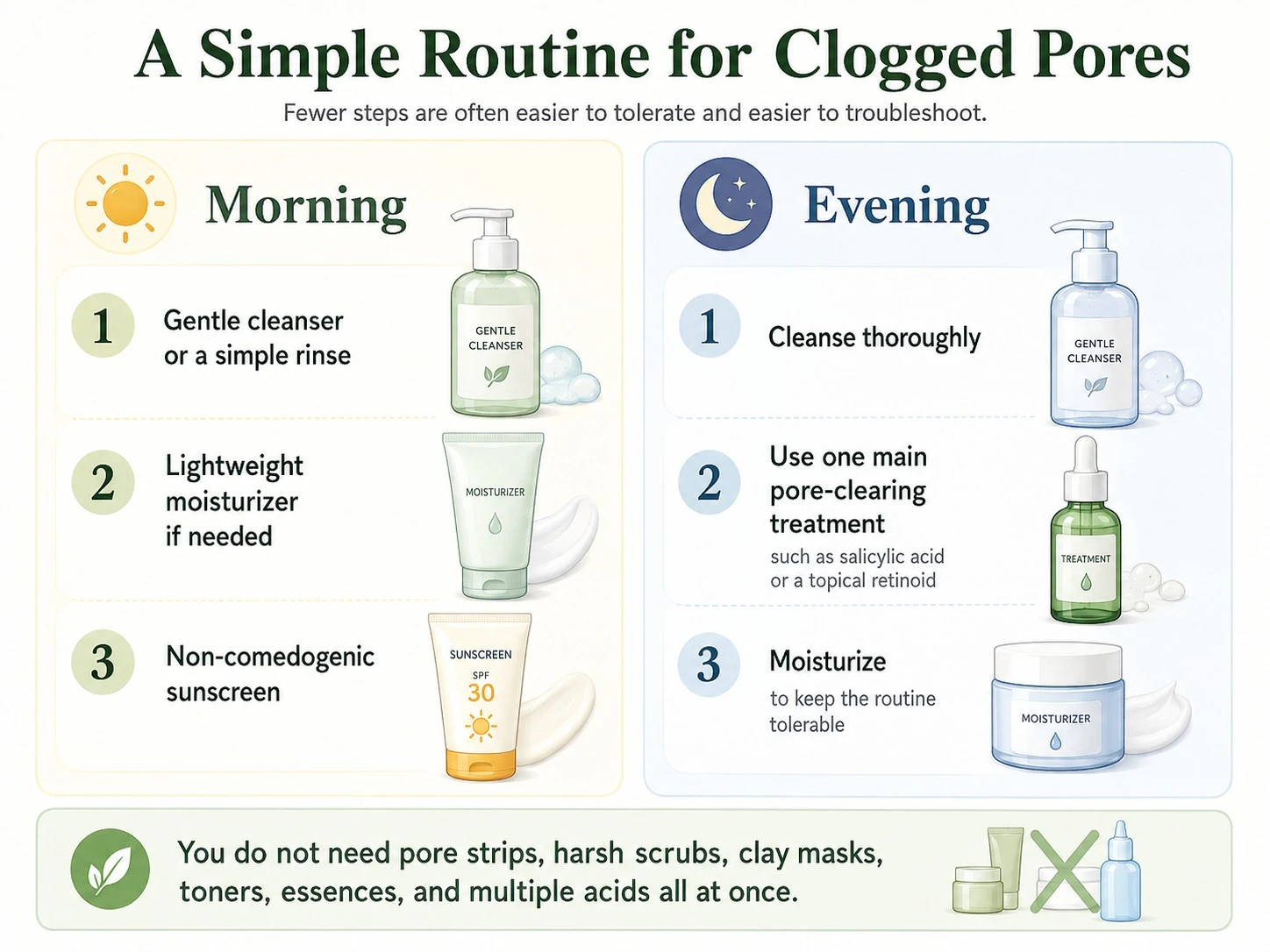
You do not need a pore strip, scrub, clay mask, toner, essence, and three acids to treat congestion. A routine with fewer variables is usually easier to tolerate and easier to troubleshoot.
Morning
- Gentle cleanser or a simple rinse if that is sufficient for your skin and routine.
- Lightweight moisturizer if needed.
- Non-comedogenic sunscreen.
Evening
- Cleanse thoroughly to remove makeup, sunscreen, and surface buildup.
- Use one main pore-clearing treatment, such as salicylic acid or a topical retinoid, according to its directions.
- Moisturize to keep the routine tolerable.
If oily skin makes you hesitant to moisturize, read Do You Need Moisturizer If You Have Oily Skin. If you want a complete acne-focused routine rather than a congestion-only plan, see our Skincare Routine for Acne-Prone Skin: Clearer Skin Steps.
How Long Does It Take to Unclog Pores?
Do not judge a pore-clearing routine after a few days. Whiteheads and blackheads commonly need several weeks of consistent treatment, and a useful initial checkpoint is around six to eight weeks.[7]
That does not mean every pore should be completely clear by then. The better signs of progress are fewer new comedones, smoother texture, and less recurrent congestion. Constantly switching products before you reach that point can make it difficult to tell whether the treatment is working.
What Not to Do to Clogged Pores
- Do not scrub harder. Abrasive cleansing can irritate acne-prone skin without correcting the follicular process that forms comedones.[3]
- Do not squeeze every blackhead or bump. Picking can increase inflammation, discoloration, infection risk, and scarring.[3]
- Do not wash repeatedly throughout the day. More washing is not the same as better pore control; excessive cleansing can irritate the skin.[3]
- Do not start several strong actives together. If your skin becomes red, peeling, or painful, you will not know which product caused the problem.
- Do not try to permanently remove sebaceous filaments. They are normal structures and naturally refill.[6]
- Do not treat pore strips as long-term acne therapy. They may remove surface material temporarily, but they do not replace a routine that prevents follicular blockage.[6]
If a new routine is leaving your skin tight, burning, or peeling, the problem may have shifted from congestion to irritation. Our Skin Barrier: Signs of Damage and How to Repair It guide can help you recognize that difference.
When Should You See a Dermatologist?
Professional evaluation is useful when clogged pores do not improve after a consistent trial of appropriate treatment, when acne is leaving scars or persistent dark marks, or when you also have painful nodules, cysts, or widespread inflammatory breakouts.
Stubborn blackheads and whiteheads can sometimes be treated with professional comedone extraction, but extraction is a procedure—not the main strategy for preventing future blockages.[7] Recurrent congestion still needs a maintenance plan that addresses why the follicles keep clogging.
Final Thoughts
Clearing clogged pores is less about physically “emptying” them and more about changing the conditions that keep creating plugs. Gentle cleansing removes surface buildup, salicylic acid can help clear follicular debris, and topical retinoids can reduce the formation of new comedones.[2]
The most useful first step is diagnosis at the level of the bump: is it a whitehead, a blackhead, an inflamed acne lesion, or simply a normal sebaceous filament? Once you know what you are treating, a simple routine is usually more effective than repeatedly extracting, scrubbing, or adding new “pore detox” products.
FAQs About Clogged Pores
Can Clogged Pores Go Away on Their Own?
Some mild congestion can improve as the follicle naturally sheds material, but recurring blackheads and whiteheads often need a routine that reduces new blockages. Salicylic acid and topical retinoids are established options for acne-prone clogged pores.[2]
Why Do My Pores Keep Getting Clogged?
Common reasons include naturally higher oil production, retained dead skin cells inside follicles, hormonal influences, acne-prone skin, and products that do not suit your skin. Repeated friction or oily hair products can also contribute in the areas they contact.[3][4]
Does Double Cleansing Unclog Pores?
If one gentle cleanser removes your makeup and sunscreen adequately, a second cleanse is optional. Cleansing helps remove surface buildup, but comedonal treatment works by clearing and preventing follicular blockage.[1][2]
Is Salicylic Acid or a Retinoid Better for Clogged Pores?
Both can be useful. Salicylic acid is a practical starting option for mild blackheads and whiteheads, while topical retinoids have a stronger evidence base across acne and are especially useful for persistent comedonal acne.[2] The best choice also depends on tolerance, other acne lesions, pregnancy status, and local product availability.
Can Moisturizer Clog Pores?
Any individual product can be a poor fit for a particular person, but moisturizer is not inherently pore-clogging. For acne-prone skin, choose a product labeled non-comedogenic or “won’t clog pores,” and use a texture that suits your skin.[3]
Can I Permanently Get Rid of Pores on My Nose?
No. Pores and sebaceous filaments are normal parts of skin anatomy. You can reduce blackheads and make congestion less noticeable, but you cannot permanently eliminate the follicles or stop normal sebaceous filaments from refilling.[6]
Sources
[1] American Academy of Dermatology. Acne: Signs and Symptoms
[2] American Academy of Dermatology. Acne Clinical Guideline
[3] American Academy of Dermatology. 10 Skin Care Habits That Can Worsen Acne
[4] American Academy of Dermatology. Are Your Hair Care Products Causing Breakouts?
[5] American Academy of Dermatology. Dermatologist-Approved Pregnancy Skin Care
[6] Cleveland Clinic. Sebaceous Filaments: Difference From Blackheads & Treatment
[7] American Academy of Dermatology. How to Treat Different Types of Acne
[8] American Academy of Dermatology. Back Acne: How to See Clearer Skin


