


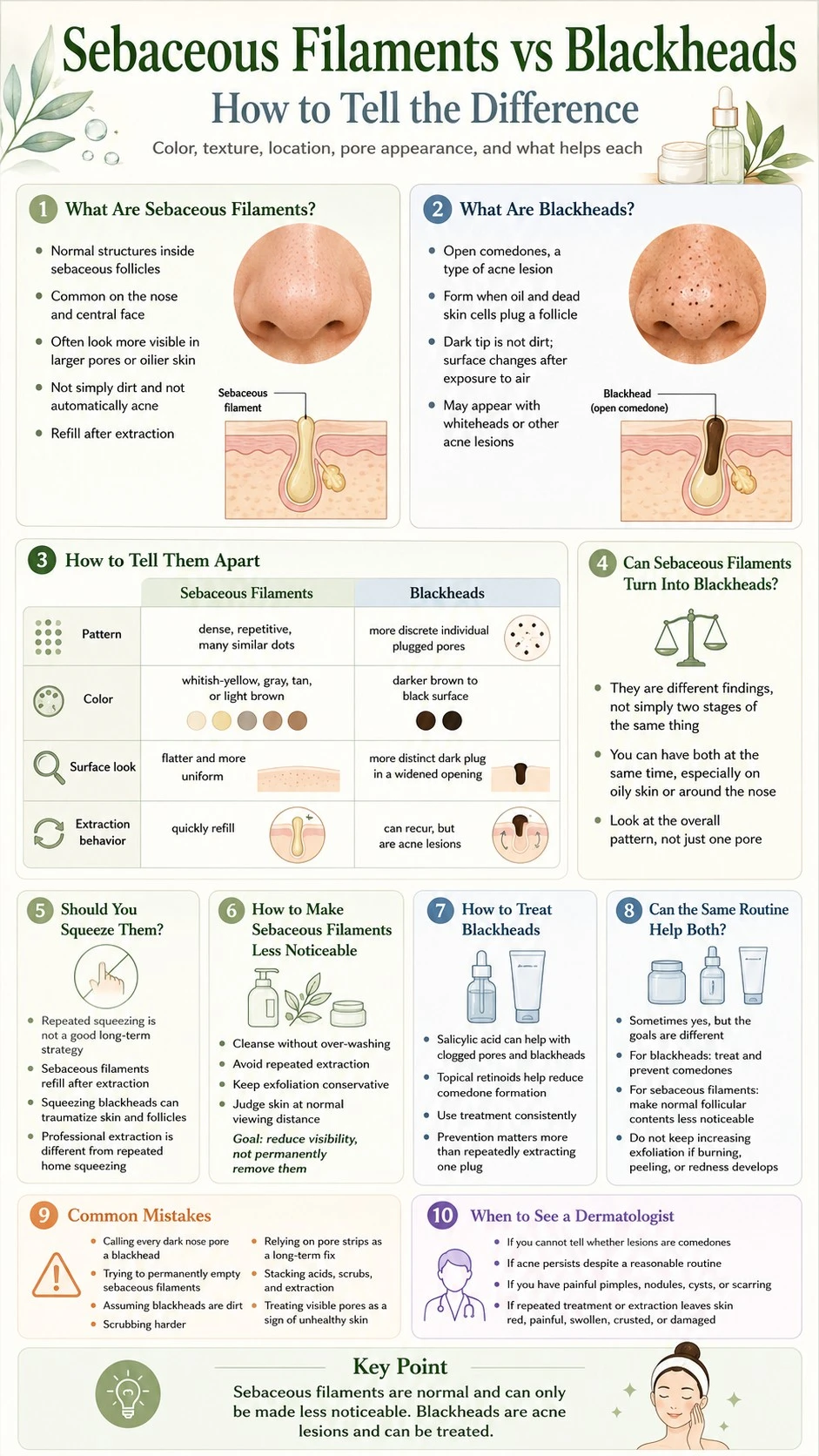
Small dark dots on the nose are often called blackheads, but many of them are actually sebaceous filaments. The distinction matters because trying to permanently extract a normal follicular structure can lead to repeated squeezing, scrubbing, pore strips, and exfoliation without solving the underlying concern.
Blackheads are different. They are acne lesions caused by follicular plugging and can respond to acne treatments that reduce comedone formation.[2][3]
The goal is therefore not to make every visible pore completely empty. It is to identify whether you are seeing normal follicular contents, true comedones, or a mixture of both, then choose a routine that matches the problem.
What Are Sebaceous Filaments?
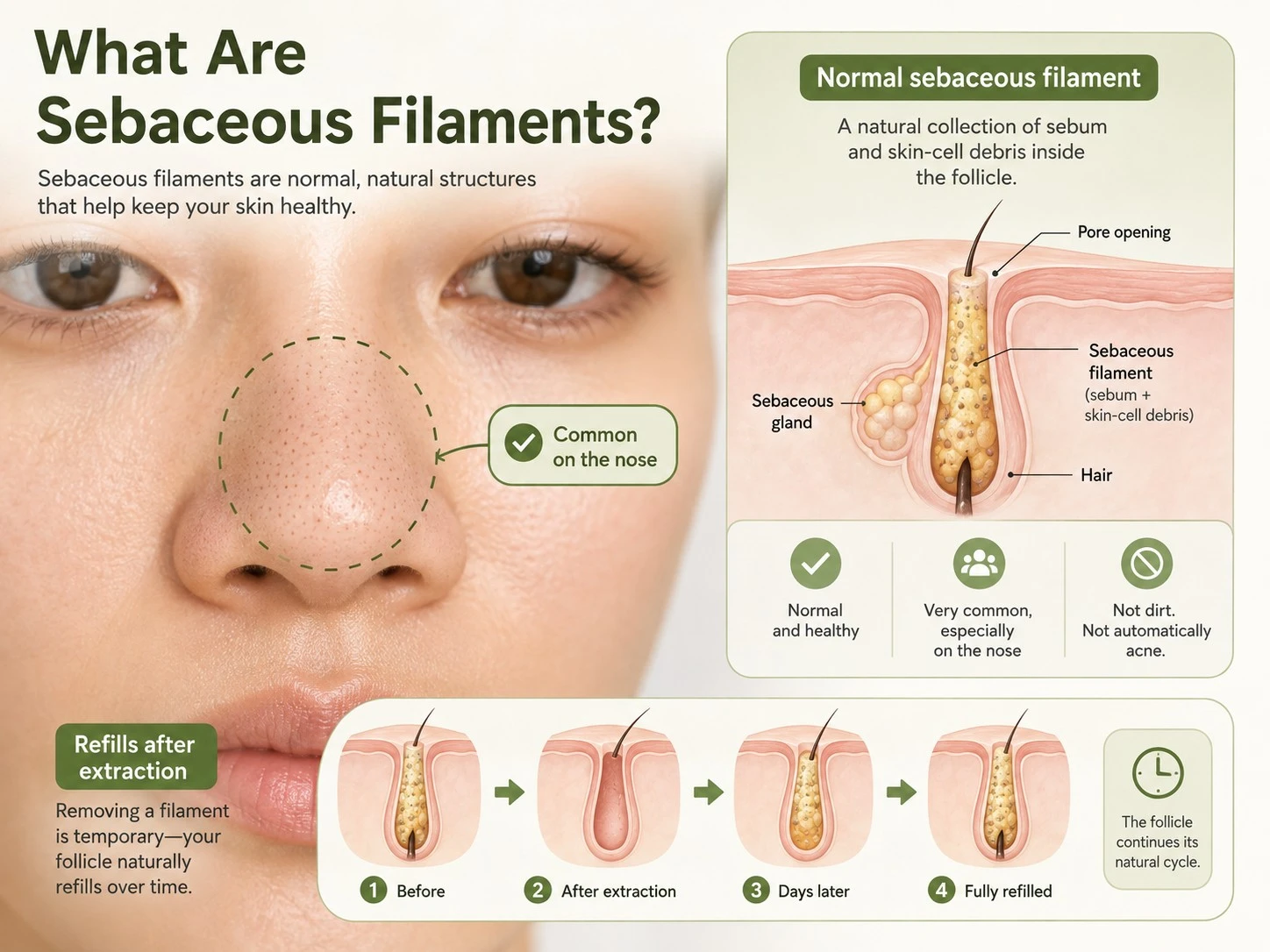
Sebaceous filaments are normal structures within sebaceous follicles. Classic microscopic research described them as cylindrical collections containing horny cell layers, sebaceous lipids, corneocyte fragments, microorganisms, and a hair.[1]
They are especially common in the central face and around the sides of the nose, where sebaceous follicles are prominent. They tend to become easier to see in people with larger pores or more visible sebum.[1]
An important point is that a sebaceous filament is not simply dirt trapped in a pore and is not automatically acne. The original morphologic work classified it as a common variant of sebaceous follicles and distinguished it from a microcomedo.[1]
That also explains why extraction is temporary. In the original study, follicles refilled after expressed sebaceous filaments were removed.[1]
What Are Blackheads?

Blackheads are open comedones, a type of acne lesion. They develop when oil and dead skin cells accumulate inside a follicle while the follicular opening remains exposed to the surface.[2]
The dark tip is not a sign that the pore is dirty. The material exposed at the follicular opening undergoes chemical changes when exposed to air, producing the characteristic dark appearance.[2]
Blackheads may occur alone, but they can also appear alongside whiteheads, inflammatory pimples, or other acne lesions. If clogged pores are a recurring concern rather than just uniform dots across the nose, see our Skincare Routine for Acne-Prone Skin.
How Can You Tell Sebaceous Filaments From Blackheads?
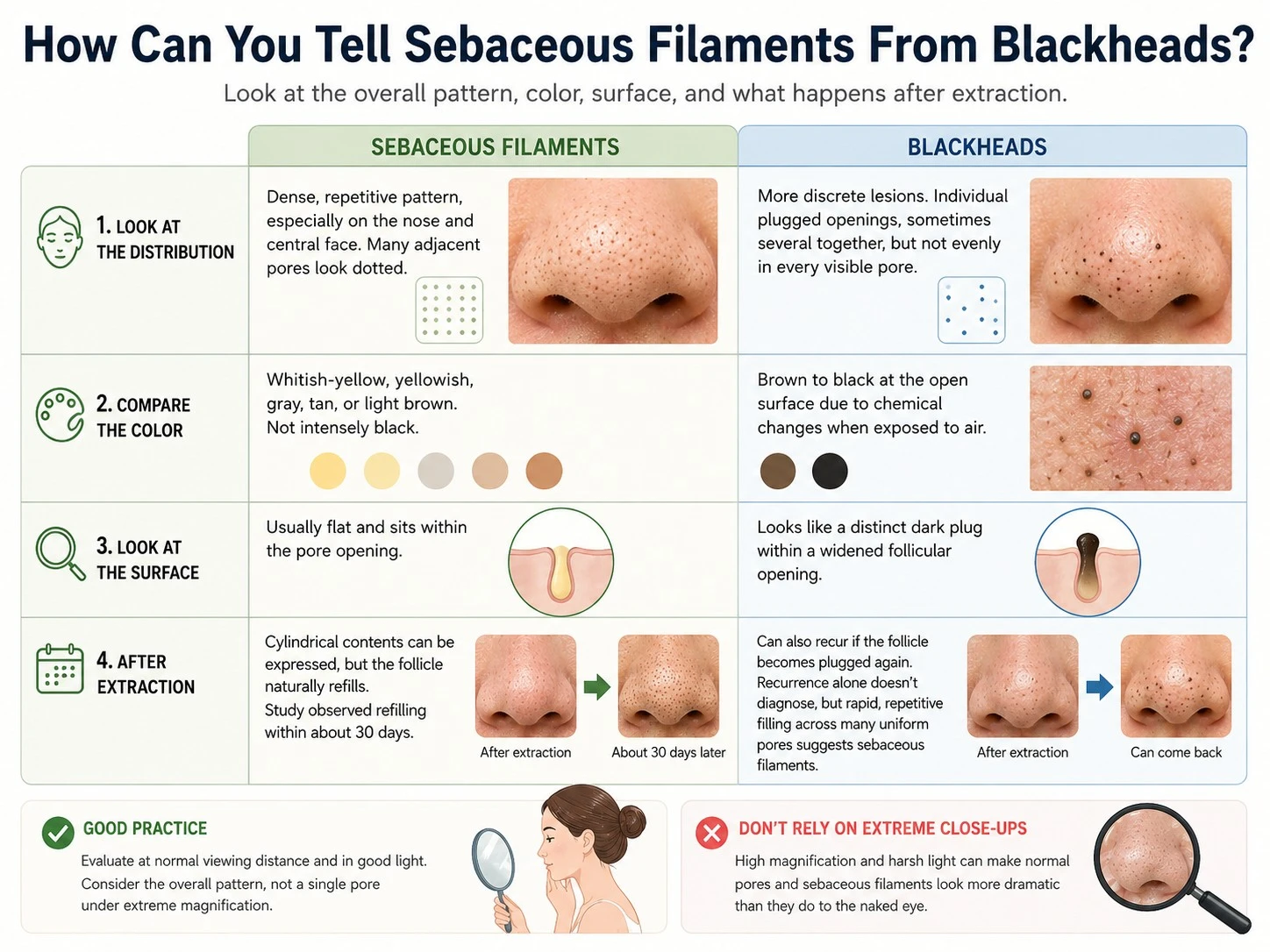
No single visual sign is perfect, especially when both occur in the same area. Look at the overall pattern rather than one pore under magnification.
Look at the Distribution
Sebaceous filaments often appear in a dense, repetitive pattern across sebaceous areas, particularly the nose and central face.[1] They can make many adjacent pores look dotted at the same time.
Blackheads are usually more discrete lesions. You may have several together, but they tend to look like individual plugged follicular openings rather than a nearly uniform dot in every visible pore.
Compare the Color
Sebaceous filaments were originally described as whitish-yellow cylindrical structures.[1] When visible through the follicular opening, they may look yellowish, gray, tan, or light brown rather than intensely black.
Blackheads generally have a darker exposed surface because the contents of the open comedo undergo chemical changes at the follicular opening.[2]
Look at the Surface
A sebaceous filament is often relatively flat and sits within the visible pore. A blackhead is more likely to look like a distinct dark plug within a widened follicular opening.
Do not rely on extreme close-up phone photography alone. Magnification makes normal pores and follicular contents look more dramatic than they do at normal viewing distance.
Notice What Happens After Extraction
When sebaceous filaments are expressed, their characteristic cylindrical contents can come out, but the follicle naturally fills again. The original morphologic study observed refilling within about 30 days.[1]
A blackhead can also recur after extraction if the follicle becomes plugged again. Recurrence alone therefore does not diagnose a sebaceous filament, but rapid, repetitive filling across many uniform nose pores supports that possibility.
Can Sebaceous Filaments Turn Into Blackheads?
They should be treated as different follicular findings rather than two stages of the same lesion. Sebaceous filaments are normal follicular structures, while blackheads are open comedones created by abnormal follicular plugging.[1][2]
They can still appear in the same skin. A person with oily skin or prominent sebaceous follicles may have obvious sebaceous filaments across the nose and true blackheads in some of those areas at the same time.
This is one reason why a pore-by-pore diagnosis from a mirror is not always reliable. Look for the overall pattern and whether other acne lesions are present.
Should You Squeeze Sebaceous Filaments or Blackheads?
Repeated squeezing is not a good long-term strategy for either problem.
For sebaceous filaments, extraction does not remove the structure permanently. The follicle refills, so repeated squeezing can turn a normal cosmetic feature into a cycle of temporary emptying followed by reappearance.[1]
For blackheads, squeezing can traumatize the follicle and surrounding skin, and acne guidance favors treatment over picking or squeezing because manipulation can contribute to infection or scarring.[2]
Occasional professional comedone extraction is different from repeatedly pressing the nose with fingernails or tools at home. Extraction removes existing contents; it does not prevent the follicular process that created them.
How to Make Sebaceous Filaments Less Noticeable
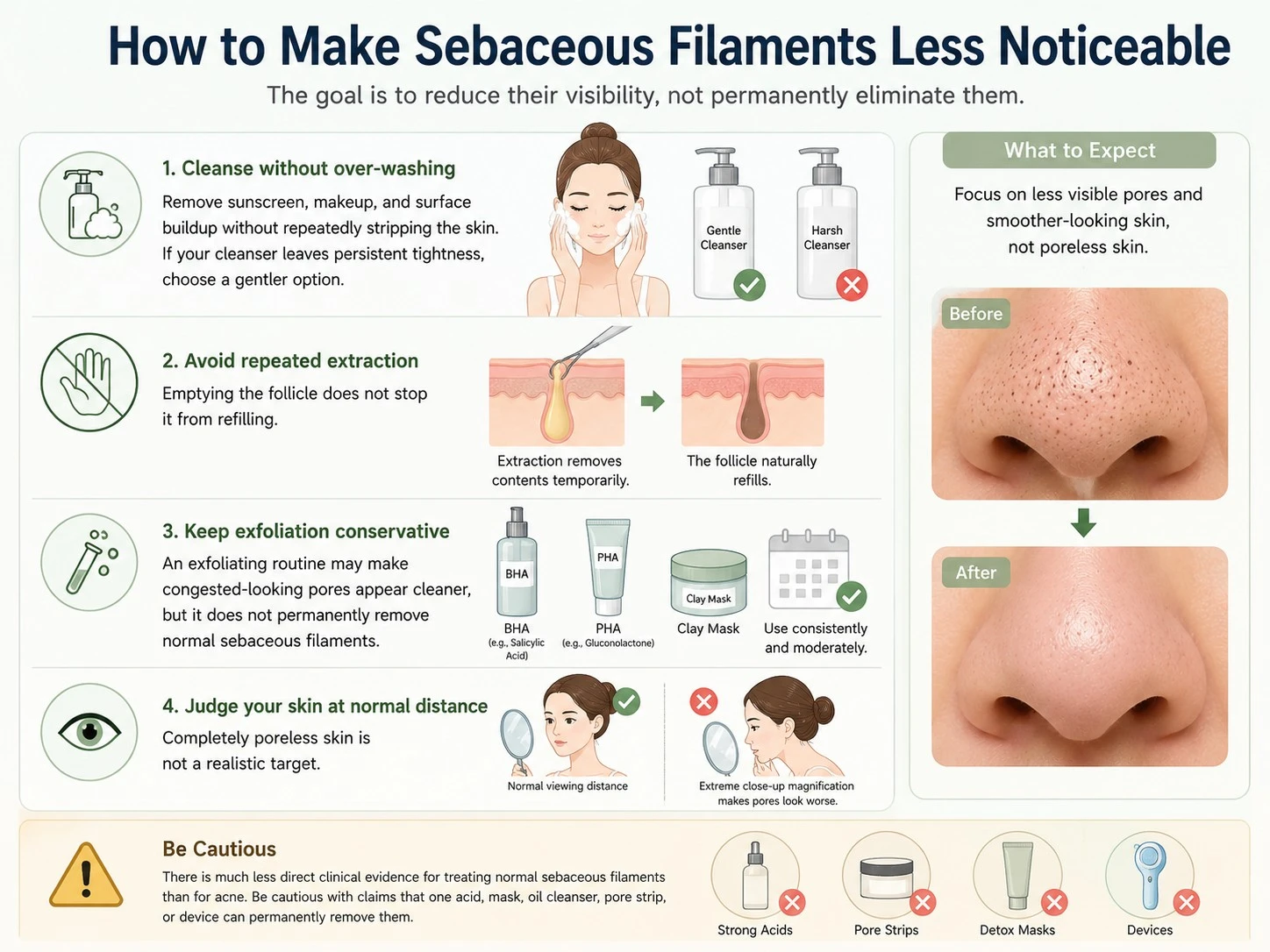
Because sebaceous filaments are normal follicular structures, the realistic goal is to reduce their visibility, not permanently eliminate them.
- Cleanse without over-washing: Remove sunscreen, makeup, and surface buildup without repeatedly stripping the skin. If your cleanser leaves persistent tightness, choose a gentler option using our How to Choose a Cleanser guide.
- Avoid repeated extraction: Emptying the follicle does not stop it from refilling.[1]
- Keep exfoliation conservative: An exfoliating routine may make congested-looking pores appear cleaner, but evidence for acne ingredients should not be misrepresented as proof that they permanently remove normal sebaceous filaments.
- Judge your skin at normal distance: Completely poreless skin is not a realistic target.
There is much less direct clinical evidence for treating normal sebaceous filaments than for treating acne. Be cautious with claims that one acid, mask, oil cleanser, pore strip, or device can permanently remove them.
How to Treat Blackheads

Blackheads have a clearer treatment pathway because they are acne lesions. Current evidence-based acne guidance supports topical retinoids and also conditionally recommends salicylic acid among topical acne therapies.[3]
Salicylic Acid
Salicylic acid is a practical option when blackheads and clogged pores are the main concern. It is used in acne care because of its exfoliating and comedolytic role, although the ideal product and frequency depend on formulation and tolerance.[3]
For product selection and use, see Salicylic Acid for Skin.
Topical Retinoids
Topical retinoids are strongly recommended in current acne guidelines and help reduce comedone formation by normalizing follicular keratinization.[3]
Do not assume every cosmetic retinol product is interchangeable with an acne retinoid. The specific molecule, formulation, concentration, regulatory status, and evidence differ by product and market.
Use Treatment Consistently
Blackhead treatment is preventive as well as corrective. Removing one visible plug does not stop another from forming, so a routine that reduces comedone formation is more useful than repeatedly extracting individual lesions.
Can the Same Routine Help Both?
Sometimes, but the goal is different.
A simple routine with gentle cleansing and well-tolerated pore-focused treatment can make a nose with both sebaceous filaments and blackheads look less congested. However:
- For blackheads: The goal is to treat and prevent acne comedones.
- For sebaceous filaments: The goal is only to make normal follicular contents less visually prominent.
Do not keep increasing treatment strength simply because every pore is still visible. If a routine produces burning, persistent peeling, or increasing redness while the “dots” remain, the problem may be the target rather than insufficient exfoliation.
If that happens, review our Over-Exfoliated Skin guide before adding another acid or scrub.
Common Sebaceous Filament and Blackhead Mistakes
- Calling every dark nose pore a blackhead: Many uniform dots are normal sebaceous filaments.
- Trying to permanently empty sebaceous filaments: Normal follicles refill after their contents are expressed.[1]
- Assuming blackheads are dirt: Their dark surface is not evidence of poor hygiene.[2]
- Scrubbing harder: Friction does not correct the follicular process that creates a comedone.
- Using pore strips as a long-term treatment: Temporary removal of surface material does not prevent normal follicular filling or new acne lesions.
- Stacking acids, scrubs, and extraction: More treatment can create irritation without making normal follicles disappear.
- Using cosmetic pore appearance as the only measure of skin health: Visible pores and sebaceous filaments can exist on otherwise healthy skin.
When Should You See a Dermatologist?
A few visible nose dots rarely require medical care. Consider professional assessment if you cannot tell whether the lesions are comedones, if acne is persistent despite an appropriate routine, or if you also have painful inflammatory lesions, nodules, cysts, or scarring.
Professional assessment is also useful when repeated extraction or aggressive treatment has left the skin persistently red, painful, swollen, crusted, or damaged.
Final Thoughts
Sebaceous filaments and blackheads can look similar, but they represent different things. Sebaceous filaments are normal structures of sebaceous follicles and naturally refill after extraction. Blackheads are open comedones and belong to the acne process.[1][2]
If the dots on your nose are small, flat, uniform, and spread across many pores, focus on reducing their appearance rather than trying to remove every one. If you have discrete dark plugs and other signs of comedonal acne, evidence-based acne treatment such as an appropriate topical retinoid or salicylic acid is more relevant than repeated squeezing.[3]
FAQs About Sebaceous Filaments vs Blackheads
Are sebaceous filaments clogged pores?
Not in the same sense as blackheads. Sebaceous filaments are normal follicular structures containing sebum and cellular material, while blackheads result from comedonal plugging.[1][2]
Why do sebaceous filaments come back so quickly?
Because the follicle continues functioning normally after its contents are expressed. Classic morphologic research found that expressed sebaceous follicles refilled within about 30 days.[1]
Can salicylic acid get rid of sebaceous filaments?
Salicylic acid can be useful for acne and clogged pores, but evidence supporting it for blackheads should not be interpreted as proof that it permanently eliminates normal sebaceous filaments.[3] It may make pores look less congested, but the underlying follicular structure remains.
Are blackheads caused by poor hygiene?
No. The dark surface of a blackhead is not dirt. Blackheads form when a follicle becomes plugged and remains open to the surface, where the exposed material develops its dark appearance.[2]
Do pore strips remove blackheads or sebaceous filaments?
They can remove some material from the follicular opening temporarily, but that does not distinguish what was removed or prevent the follicle from filling again. They should not be treated as a permanent solution for either concern.
Can you have sebaceous filaments and blackheads at the same time?
Yes. Sebaceous filaments are normal follicular structures, while blackheads are acne lesions, so both can be visible in the same sebaceous areas of the face.
Sources
[1] Plewig G, Wolff HH. Sebaceous Filaments
[2] American Academy of Dermatology. Acne: Signs and Symptoms
[3] Reynolds RV et al. Guidelines of Care for the Management of Acne Vulgaris


