


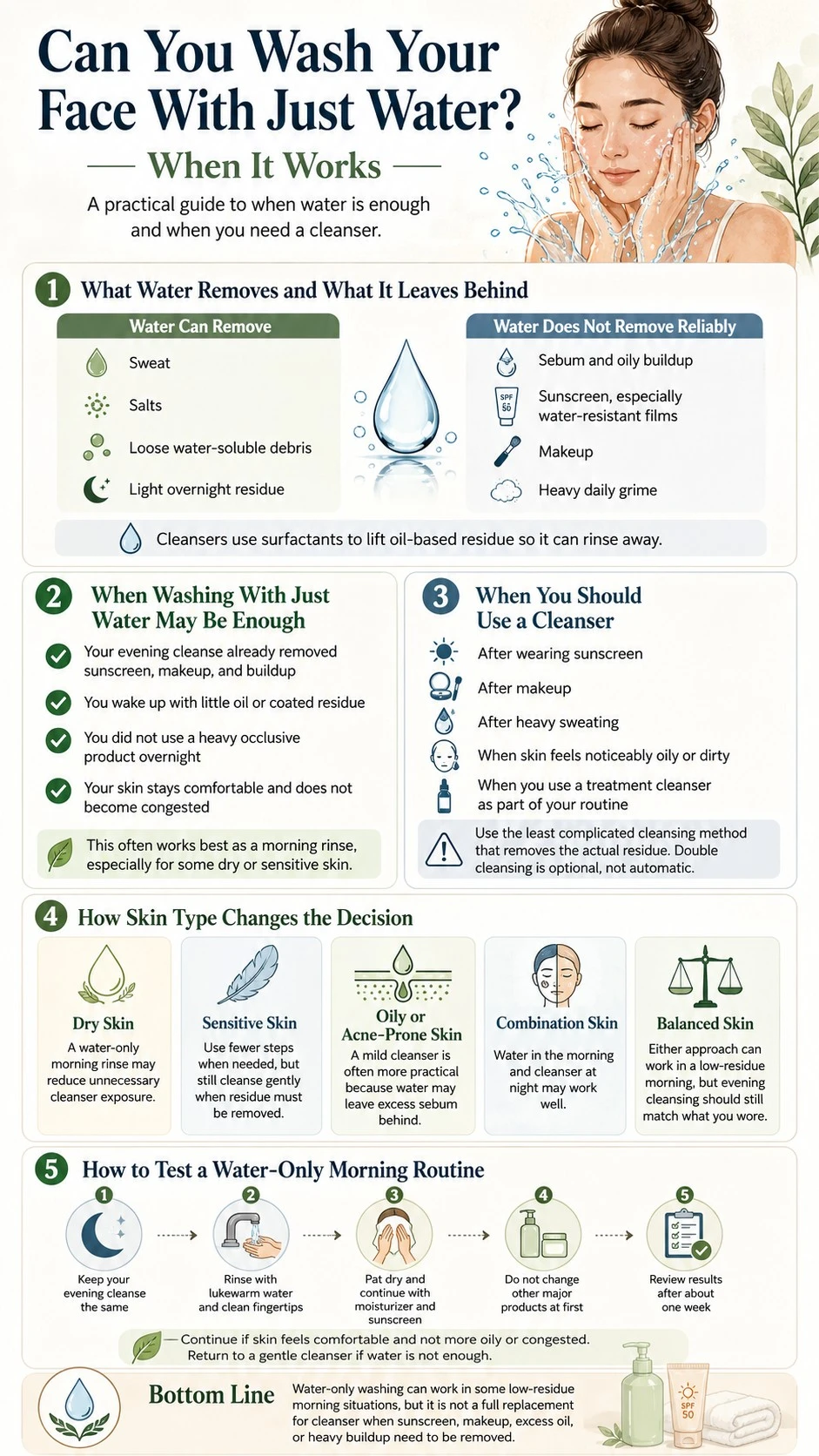
Water-only face washing sounds like a simple yes-or-no choice, but the important question is what is sitting on the skin. A face with only light overnight sweat has a different cleaning need from one covered with water-resistant sunscreen, foundation, excess sebum, or city grime.
The goal is not to remove every trace of natural oil or make the skin feel tight. It is to remove unwanted material without creating avoidable dryness or irritation. That balance can change between morning and evening and from one skin type to another.
What Water Removes—and What It Leaves Behind
Plain water can rinse away some sweat, salts, and loose water-soluble debris. The movement of your fingertips and the rinse itself also carry away material that is not strongly attached to the skin. That can be sufficient when the face has little residue to remove.
Water is much less effective with oily material. Sebum, many makeup ingredients, water-resistant sunscreen films, and oily skin-care products do not mix readily with water.[1] Facial cleansers contain surfactants—molecules with water-attracting and oil-attracting parts—that help lift oily material so it can be rinsed away.[2]
This does not mean a stronger cleanser is always better. Cleansing products also interact with the skin’s proteins and lipids, and harsh surfactants or frequent washing can increase dryness, tightness, and irritation. A well-matched cleanser should remove the day’s residue without making the skin feel stripped.[2]
Think of water-only washing as a light rinse, not a universal replacement for cleansing. Whether it is enough depends on the amount and type of material on your face, not on how many splashes you use.
When Washing With Just Water May Be Enough
A water-only morning rinse is most reasonable when the cleaning demand is low. It is a practical option when all three conditions are true:
- The previous evening cleanse did its job: Sunscreen, makeup, excess oil, and daily buildup were already removed.
- There is little overnight residue: You did not apply a heavy or strongly occlusive product and do not wake with noticeable oil or a coated feel.
- Your skin responds well: The water-only rinse does not lead to persistent oiliness, congestion, or discomfort.
Some people with dry or sensitive skin can use water in the morning and cleanser at night instead of cleansing twice with a product.[4] This is an option, not a rule. If the face feels coated, unusually oily, or congested after the change, water alone is probably not meeting that routine’s needs.
Use lukewarm water, rinse gently with clean fingertips, and pat rather than rub. The complete guide to washing your face properly covers technique without relying on scrubs, brushes, or very hot water.
When You Should Use a Cleanser
Choose a suitable cleanser when there is oil-based, adherent, or substantial residue to remove:
- At the end of a sunscreen day: Water alone does not reliably remove sunscreen, especially a water-resistant film. A small study comparing water, a foaming cleanser, and a cleansing oil found substantially more sunscreen residue after water-only washing; the best method also differed between non-water-resistant and water-resistant formulas.[5] The guide to removing sunscreen explains how to adjust the method to the product rather than double cleanse automatically.
- Before bed after makeup: Makeup should be removed before sleep.[3] A remover, cleansing balm, cleansing oil, or micellar water may help with long-wear products, followed by a gentle cleanser when needed.[4]
- When the face is noticeably oily or dirty: A cleanser can remove excess sebum and grime more reliably than water. Use a formula suited to your skin instead of scrubbing harder; this guide explains how to choose a cleanser.
- After heavy sweating: Cleanse or wash soon after substantial sweating, particularly when a hat, helmet, or other equipment traps sweat against the face.[3]
- When a treatment cleanser is part of your plan: A medicated wash has a different job from plain water. Follow its label or your clinician’s directions for frequency, contact time, and the areas treated.
One cleanser may be enough. Double cleansing can help with stubborn makeup or resistant sunscreen, but it is not required for every person or every evening. Repeated washing can be drying, so choose the least complicated method that removes the actual residue.[4]
How Skin Type Changes the Decision
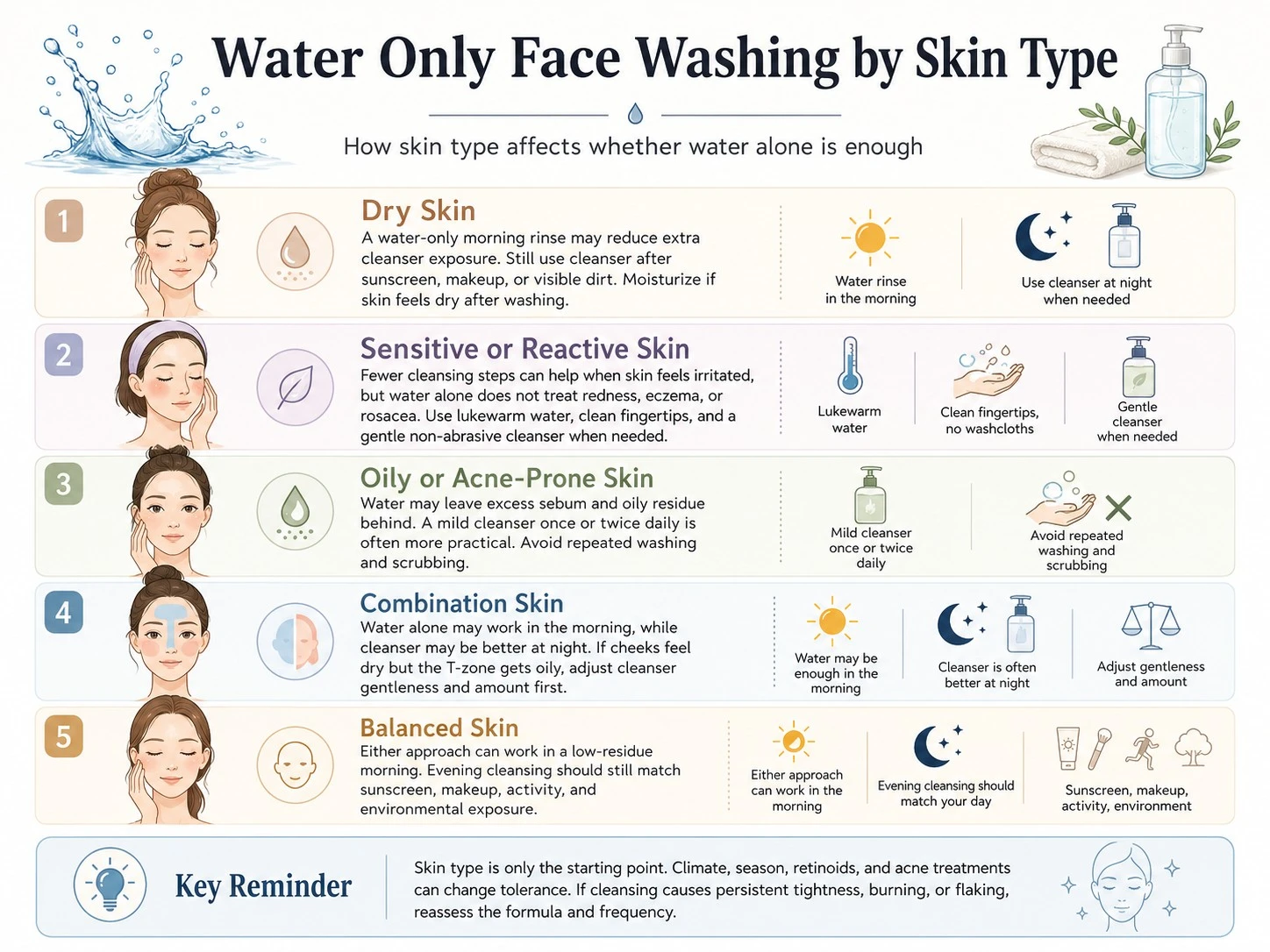
Skin type changes how much oil and residue you are likely to notice and how well you tolerate cleansing, but it does not create an absolute rule.
- Dry skin: A water-only morning rinse may reduce unnecessary cleanser exposure. Still use an appropriate cleanser when removing sunscreen, makeup, or visible dirt, and apply moisturizer if washing leaves the skin dry.
- Sensitive or reactive skin: Fewer cleansing steps can help when the current routine causes irritation, but water alone does not treat redness, eczema, or rosacea. Favor lukewarm water, clean fingertips, and a gentle, non-abrasive cleanser when one is needed.
- Oily or acne-prone skin: Water may leave excess sebum and oil-based residue behind. A mild cleanser once or twice daily is often more practical, while repeated washing and scrubbing can irritate acne-prone skin.[3]
- Combination skin: You may tolerate water alone in the morning but need cleanser at night. If cheeks feel dry while the T-zone becomes oily, first adjust cleanser gentleness and amount rather than aggressively washing only the oily areas.
- Balanced skin: Either approach can work in a low-residue morning. Evening cleansing should still match sunscreen, makeup, activity, and environmental exposure.
Pay attention to change rather than a skin-type label alone. A routine that worked in humid weather may feel drying in winter; acne medication or retinoids can also change tolerance. If cleansing produces persistent tightness, burning, or flaking, review the formula and frequency instead of assuming water-only washing is the only alternative. The guides to face-washing frequency and the skin barrier can help separate over-washing from a product that simply does not fit.
How to Test a Water-Only Morning Routine
If your evening cleanse already removes the day’s products, a short morning trial can show whether water alone works for your skin.
- Keep evening cleansing unchanged. Remove sunscreen, makeup, and daily buildup as usual so the test evaluates only the morning step.
- Rinse with lukewarm water. Use clean fingertips and gentle movements; do not compensate for skipping cleanser by rubbing harder or using a rough washcloth.
- Pat dry and continue your routine. Apply moisturizer if needed, followed by sunscreen in the morning.
- Change no other major product at first. Keeping the rest of the routine stable makes dryness, new congestion, or improved comfort easier to interpret.
- Review the result after about one week. Continue if the skin feels comfortable and does not become noticeably oilier, coated, or more congested. Return to a gentle morning cleanser if water is not enough.
Stop the trial sooner if you develop persistent itching, burning, swelling, a spreading rash, or a rapid acne flare. Those problems may involve more than cleansing frequency and deserve appropriate evaluation if they continue.
FAQs About Washing Your Face With Just Water
Can washing your face with only water cause acne?
Water itself does not directly cause acne, but water-only washing may leave oil, makeup, sunscreen, or other residue that is better removed with a cleanser. If breakouts or congestion increase after changing the routine, restore a gentle cleanser and assess the rest of the products touching your face rather than scrubbing more often.
Is it better to wash your face with hot or cold water?
Lukewarm water is the safest general choice. Hot water can increase dryness and irritation, while very cold water is not necessary for cleansing. Choose a comfortable lukewarm rinse and avoid prolonged heat.[3]
Can you use only water in the morning and cleanser at night?
Yes. This approach may suit dry or sensitive skin when the evening cleanser removes the day’s residue and the face is not oily or coated in the morning.[4] Use a morning cleanser again if water alone leaves an unwanted film, worsens congestion, or does not fit an overnight product.
Does water remove sunscreen from your face?
Not reliably. Sunscreen is designed to form a film, and water-resistant formulas are specifically made to resist water exposure. Use a cleanser that removes your particular sunscreen without excessive rubbing; resistant sunscreen or long-wear makeup may require an oil-based first step.[5]
Sources
[1] Cleveland Clinic. A Guide on How to Wash Your Face
[2] Mijaljica D, Spada F, Harrison IP. Skin Cleansing without or with Compromise: Soaps and Syndets
[3] American Academy of Dermatology Association. Face Washing 101
[4] Cleveland Clinic. How Often Should You Wash Your Face?
[5] Chen W, et al. The Optimal Cleansing Method for the Removal of Sunscreen: Water, Cleanser or Cleansing Oil?


