


Hydrogel and conventional sheet masks both hold a water-based skincare formula against the face for a limited time. Their most dependable shared role is a temporary boost in hydration and surface comfort, not a permanent change in pores, collagen, or skin structure.
The tactile differences still matter. A slippery mask that keeps lifting is unlikely to create a pleasant routine, even if its ingredient list looks strong. A perfect-fitting mask can still sting if the formula does not suit your skin.
Hydrogel Mask vs Sheet Mask at a Glance
The clearest differences involve the carrier—the physical sheet touching your face. The formula on or inside that carrier varies by product.
| Comparison point | Hydrogel mask | Conventional sheet mask |
|---|---|---|
| Carrier | Flexible, jelly-like polymer network containing a large amount of water | Thin woven or nonwoven fiber sheet, often cotton, rayon, microfiber, or another cellulose-based material |
| Formula placement | Water and cosmetic ingredients are held within the gel matrix, sometimes with extra essence in the pouch | The sheet is saturated with a separately prepared essence or serum |
| Feel | Cushioned, cool, smooth, and sometimes slippery | Light, wet, soft, and more fabric-like |
| Fit | Often supplied in two pieces and can hug curves closely, but a heavy or poorly cut mask may slide | Easy to position, though gaps and lifted edges depend on stretch, thickness, and cut |
| Handling | Can tear if stretched aggressively and may have protective films to remove | Usually easier to unfold, but a very thin saturated sheet can bunch or fold onto itself |
| Wear time | Some are designed for longer wear, but the label—not the word hydrogel—sets the time | Commonly designed for a shorter session; follow the stated time |
| Likely result | Temporary hydrated, smoother, or plumper appearance when the formula suits the skin | The same types of temporary cosmetic results are possible with a suitable formula |
| Cost and access | Often priced higher per mask | Usually available across more price points and formula choices |
These are market patterns, not rigid rules. A thin hydrogel can slide, and a well-designed fiber sheet can fit closely. An expensive carrier also cannot rescue a poorly tolerated formula.
What the Material Names Actually Mean
A hydrogel is a three-dimensional network of water-loving polymers that can hold substantial water while remaining a soft solid. Cosmetic hydrogels may use agar, carrageenan, alginate, gelatin, cellulose derivatives, or synthetic polymers. The blend determines strength, stretch, thickness, water retention, and tear resistance.[1]
“Sheet mask” is the broader physical format: a face-shaped sheet carries a cosmetic formula and is removed after use. In retail language, people often use “sheet mask” to mean the familiar thin fiber version and contrast it with a jelly-like hydrogel. This article follows that practical comparison while recognizing that hydrogel is also a sheet-mask material.
Bio-cellulose shows why labels are not tidy. It is a dense network of fine cellulose fibers produced by microorganisms. Researchers have described bacterial cellulose mask membranes as hydrogels because the porous fiber network holds water, yet stores may call them bio-cellulose sheet masks.[2] If material sourcing or disposal matters, check the exact carrier and the brand’s product-specific information instead of inferring those properties from “hydrogel” or “sheet mask.”
Do Hydrogel Masks Work Better Than Sheet Masks?
There is no sound basis for saying every hydrogel mask outperforms every conventional sheet mask. The carrier changes water holding, contact, feel, and wear experience, but results also depend on the formula, pH, fit, directions, and your skin.
Hydrogel can create a moist, partly occlusive environment at the surface. In a small 2026 study, one PVP, PEG, and agar hydrogel containing hyaluronic acid, ectoine, allantoin, and tocopherol improved measured hydration and firmness during six weeks of repeated use. Short-term changes were transient and consistent with occlusion. The main phase had 15 participants, tested one formula without a parallel conventional-sheet group, and included authors affiliated with the developer.[3] It supports that mask’s potential, not category-wide superiority.
Conventional sheet masks can also support short-term hydration when they hold a suitable moisturizing formula against the skin.[4] The benefits and limits are covered in more detail in sheet mask benefits. Neither carrier makes an ingredient work independently of its formula.
Claims of “deeper absorption” need caution. Ingredient penetration depends on molecular size, concentration, vehicle, contact time, and the skin barrier. A mask turning transparent does not measure absorption; evaporation, warmth, thinning, and closer contact can all change its appearance.
Which Mask Should You Choose?
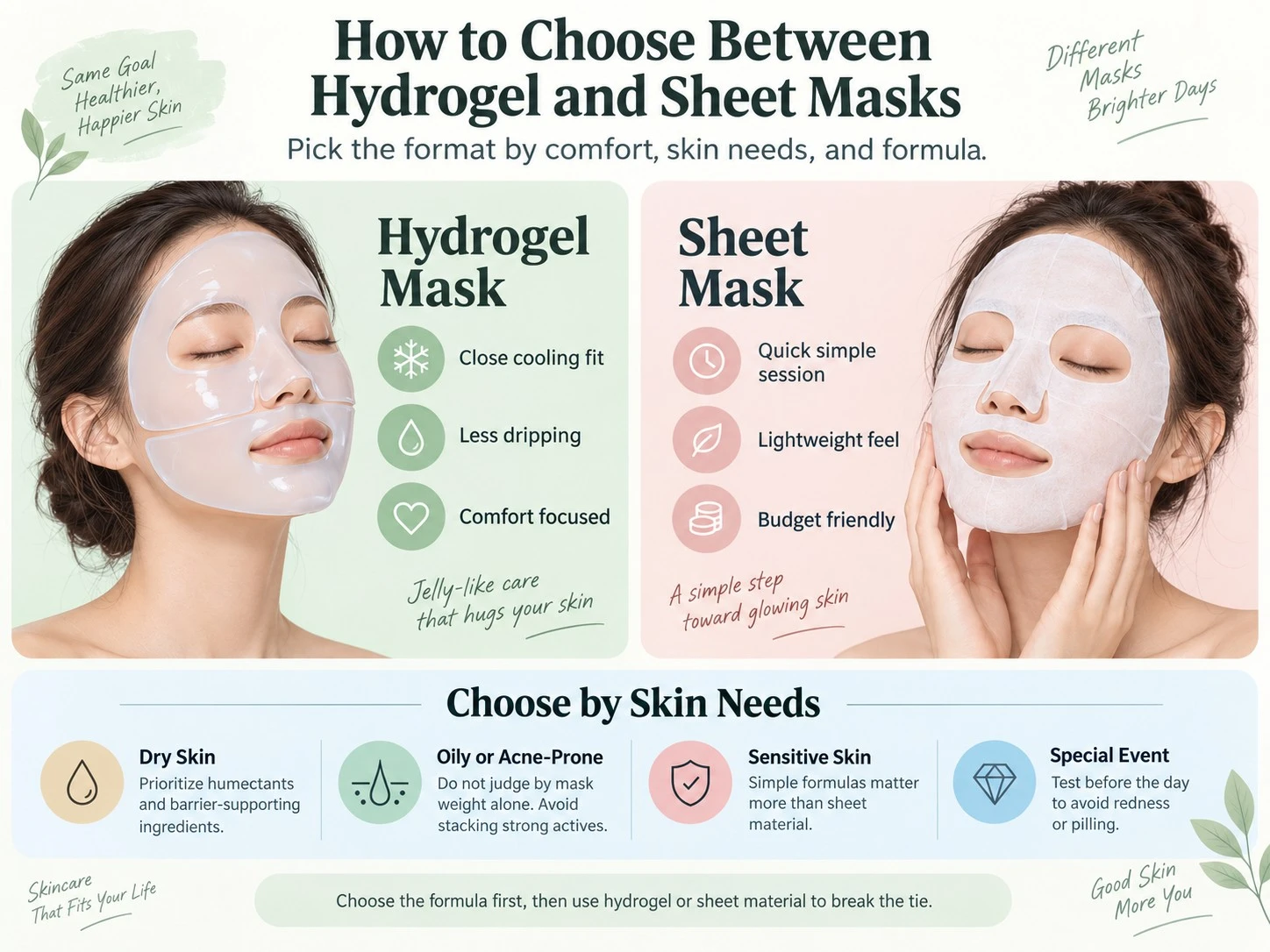
Start with the result you want and ingredients that support it. Then choose the carrier that makes the routine comfortable and practical.
- Choose hydrogel for a close, cooling feel. A two-piece gel mask can be easier to align across the upper and lower face. This is a comfort advantage, not proof of stronger treatment.
- Choose hydrogel when you dislike dripping. Formula is held within the gel structure, although some products still contain loose essence and can slide at first.
- Choose a conventional sheet for a short, simple session. Fiber sheets are widely available, light, and usually offer more choices at lower prices.
- For dry skin, prioritize humectants and barrier-supporting ingredients. Glycerin, hyaluronic acid, and ceramides are more useful clues than gel versus fiber. A mask can supplement, but should not replace, moisturizer.[4]
- For oily or acne-prone skin, avoid choosing by weight alone. A light sheet can carry a rich or irritating essence, while a hydrogel can use a light formula. Avoid unnecessarily stacking exfoliating acids or other strong actives.[4]
- For sensitive or reactive skin, simplify the formula. Fragrance, essential oils, and duplicated exfoliating actives may matter more than sheet material.[4] U.S. terms such as “hypoallergenic,” “fragrance-free,” and “for sensitive skin” have no federal definition that guarantees tolerance.[5]
- For a special event, test before the day itself. Either format can leave a temporarily smoother, dewier surface, but a new formula can also cause redness, stickiness, or pilling under makeup.
If you are still choosing among clay, cream, sleeping, sheet, and gel formats, use the broader guide to choosing a face mask before comparing carriers.
How to Use Either Mask Correctly
The product label takes priority because wear time and aftercare vary, especially among newer long-wear hydrogels.
- Clean your hands and face. Remove makeup, sunscreen, and surface residue so the mask sits evenly.
- Open and position the mask. Remove any protective films from a hydrogel. Align the openings, then smooth the carrier outward without pulling hard.
- Use it for the stated time. Do not turn a 15-minute mask into an overnight product. Longer contact is not automatically more effective and can increase irritation.[4]
- Remove gently. Peel the mask away without rubbing. Follow the label on whether to pat in remaining formula or rinse it off.
- Finish according to your routine. Apply moisturizer if your skin needs it, and use sunscreen during the day. Stop and rinse immediately if the mask causes itching, burning, or stinging.[4]
The full face mask application guide covers preparation and aftercare across mask types. Frequency should also follow the formula and skin response rather than a rule that every hydrating mask can be used daily; see how often to use a face mask for that separate decision.
Common Hydrogel and Sheet Mask Mistakes
- Treating the carrier as the active ingredient. Hydrogel, cotton, microfiber, and bio-cellulose deliver a formula; they do not reveal its complete benefit or irritation risk.
- Assuming a higher price means stronger results. Material, packaging, fit, and sensory design affect cost. Compare ingredients, directions, comfort, and the result you notice.
- Reading transparency as an absorption meter. A clear-looking hydrogel has changed physically, but that does not prove every active entered the skin.
- Wearing every hydrogel for hours or overnight. Extended wear is a product-specific direction. Remove the mask at the label time or sooner if it becomes uncomfortable.
- Ignoring folds, air gaps, or sliding. Reposition the mask gently. Good contact is more useful than forcing a poor cut to stay on while walking around.
- Stacking too many active products. Avoid duplicating acids, retinoids, or other potentially irritating steps in the same routine.[4]
- Continuing through burning or swelling. Remove and rinse off the mask if it burns or stings.[4] Seek medical care for severe swelling, breathing difficulty, eye involvement, blistering, or a reaction that persists.[5]
FAQs About Hydrogel and Sheet Masks
Are hydrogel masks a type of sheet mask?
Yes. A hydrogel face mask is a removable face-shaped sheet made from a water-rich gel network. Retail comparisons often use “sheet mask” to mean a conventional cotton, rayon, microfiber, or cellulose-fiber sheet, which is why the two are presented as separate choices.
Can you leave a hydrogel mask on overnight?
Only if the directions specifically say it is designed for overnight wear. Many hydrogel masks are intended for much shorter use. The material name does not set the wear time, and keeping any mask on longer than directed can increase irritation rather than improve the result.
Is a hydrogel mask better for sensitive skin?
Not automatically. A soft, cooling hydrogel may feel comfortable, but its formula can still contain fragrance, preservatives, botanical extracts, or active ingredients that trigger irritation or allergy.[5] Check the ingredient list, test a new product on a small area, and stop if skin burns, itches, or swells.[4]
Does a hydrogel mask turning clear mean it has fully absorbed?
No. Transparency shows that the gel sheet changed during wear. Water evaporation, warmth, thinning, and closer skin contact can affect how clear it looks. It does not measure how much of each ingredient entered the skin, so follow the stated wear time.
Can you reuse a hydrogel or sheet mask?
Treat a single-use packaged mask as disposable unless its label clearly says otherwise. Once the carrier has contacted your face and hands, putting it back into leftover essence does not restore its original hygienic condition. Do not save a used mask for another session or share it.
Sources
[1] Saeed HAM, Yang H. The Versatile World of Cosmetic Facial Masks in Skincare: Fabrication, Properties, and Future Directions: A Review
[2] Pacheco G, et al. Bacterial Cellulose Skin Masks—Properties and Sensory Tests
[3] Rokita B, et al. Hydrogel Facial Mask for Sensitive Skin: A Pilot Study of Long-Term Effects on Hydration, Barrier Function and Mechanical Properties
[4] American Academy of Dermatology Association. Do Facial Masks Work, and Should I Add One to My Skin Care Routine?
[5] U.S. Food and Drug Administration. Allergens in Cosmetics


