

Skin type is a useful starting point, but it is not the whole decision. Your face can be oily and dehydrated, normally dry but temporarily irritated, or combination with an acne treatment making one area flaky. The best mask addresses the current concern without duplicating products already doing the same job.
Product names can also be misleading. A sheet mask may contain soothing humectants or a fragranced acid blend; a clay mask may be gentle and creamy or strongly degreasing. Read the ingredient list, directions, and warnings instead of treating the format as a promise.
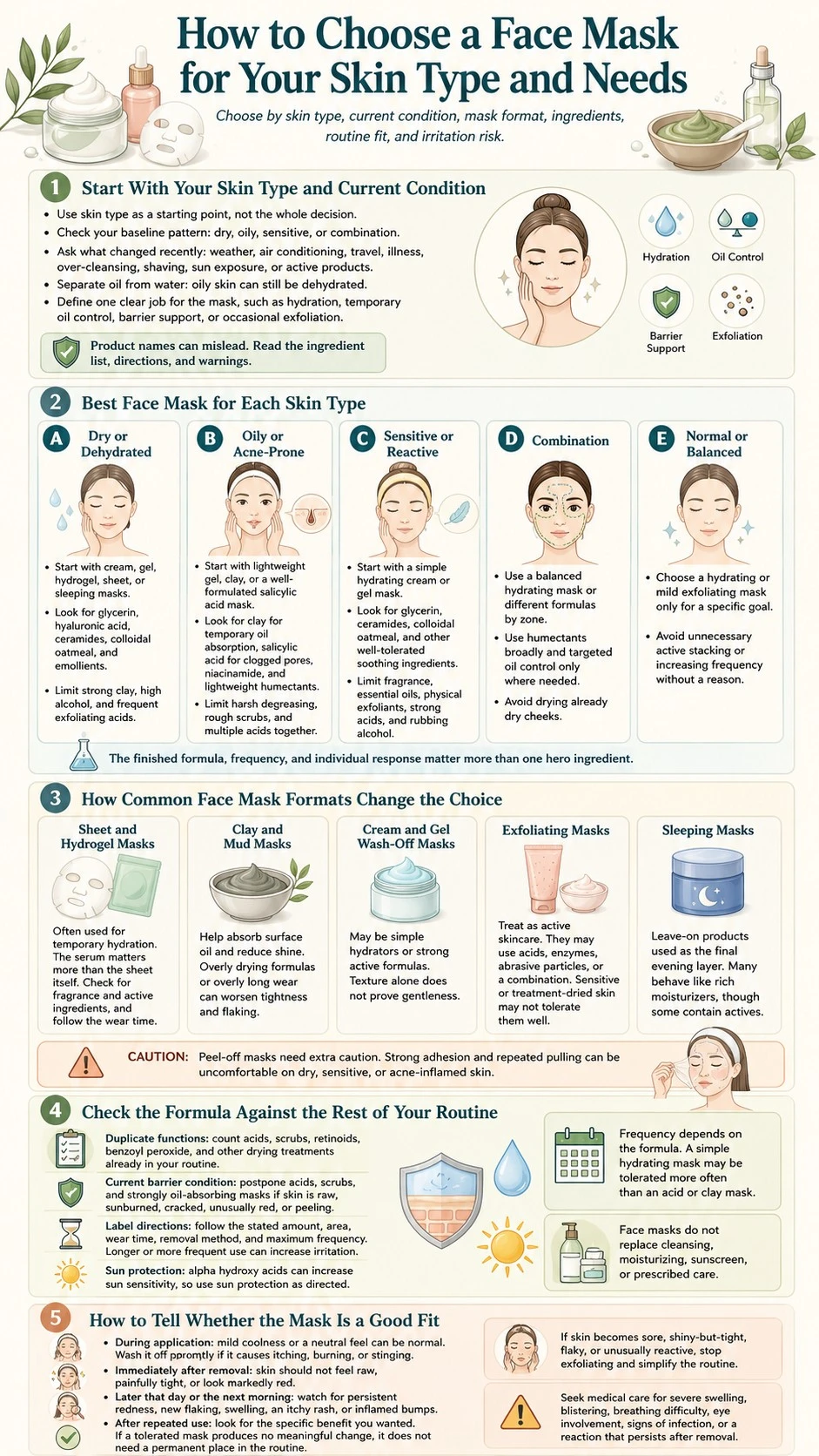
Start With Your Skin Type and Its Current Condition
First identify your baseline pattern: whether the face tends to feel dry, become shiny, react easily, or behave differently across zones. If that is unclear, the guide to finding your skin type gives a practical starting point.
Then ask what has changed recently. Weather, air conditioning, travel, illness, over-cleansing, shaving, sun exposure, and active products can temporarily change what the skin tolerates. A rich mask that comforts treatment-related dryness may feel excessive once the skin settles; an acid mask that once felt manageable may sting after a retinoid increase.
It also helps to separate oil from water. Dehydrated skin lacks water and can occur alongside visible oil, while naturally dry skin tends to lack enough protective lipids. The distinction between dehydrated and dry skin can prevent an oily-but-tight face from being treated with increasingly harsh clay masks.
Finally, define one job for the mask. “Make my skin better” is too broad. Useful goals include reducing a tight after-cleansing feel, temporarily absorbing surface oil, supporting a dry barrier, or adding occasional exfoliation. One clear goal makes the formula easier to evaluate and reduces the temptation to stack several strong functions in one session.
Best Face Mask for Each Skin Type
The following options are starting points rather than rigid rules. The finished formula, frequency, and individual response matter more than a single featured ingredient.[1]
| Skin type or state | Useful starting options | Ingredients or functions to look for | What to limit or approach cautiously |
|---|---|---|---|
| Dry or dehydrated | Cream, gel, hydrogel, sheet, or sleeping mask | Glycerin, hyaluronic acid, ceramides, colloidal oatmeal, emollients | Strong clay, high alcohol content, frequent exfoliating acids |
| Oily or acne-prone | Lightweight gel, clay, or an appropriately formulated salicylic-acid mask | Clay for temporary oil absorption, salicylic acid for clogged pores, niacinamide, lightweight humectants | Harsh degreasing, rough scrubs, several acids used together |
| Sensitive or reactive | Simple hydrating, cream, or gel mask | Glycerin, ceramides, colloidal oatmeal, other well-tolerated soothing ingredients | Fragrance, essential oils, physical exfoliants, strong acids, rubbing alcohol |
| Combination | Balanced hydrating mask or different formulas by zone | Humectants over the whole face; targeted oil absorption only where needed | Applying a drying mask to already dry cheeks |
| Normal or balanced | Hydrating or occasional mild exfoliating mask chosen for a specific goal | Formula depends on the goal and the rest of the routine | Unnecessary active stacking or increasing frequency without a reason |
For dry skin, a formula that combines water-binding ingredients with emollient or occlusive support usually makes more sense than a watery product that evaporates quickly. Sheet and hydrogel masks can provide short-term hydration, but the serum composition determines whether they feel soothing, sticky, fragranced, or irritating. A cream or sleeping mask may be more practical when longer-lasting softness is the goal.
For oily or acne-prone skin, oil absorption is not the same as treating acne. Clay can reduce surface shine temporarily, while salicylic acid can help with clogged pores when the formula and frequency are tolerated. Neither requires leaving skin squeaky, tight, or burning. Lightweight hydration may still be useful because oily skin can also become dehydrated.
Sensitive skin needs the fewest assumptions. “Natural,” “clean,” and “for sensitive skin” are not guarantees. Essential oils, fragrance, strong acids, and abrasive particles can still cause problems. A shorter routine and a simple mask with a clearly defined hydrating or soothing role are easier to assess than a multi-active formula.
How Common Face Mask Formats Change the Choice
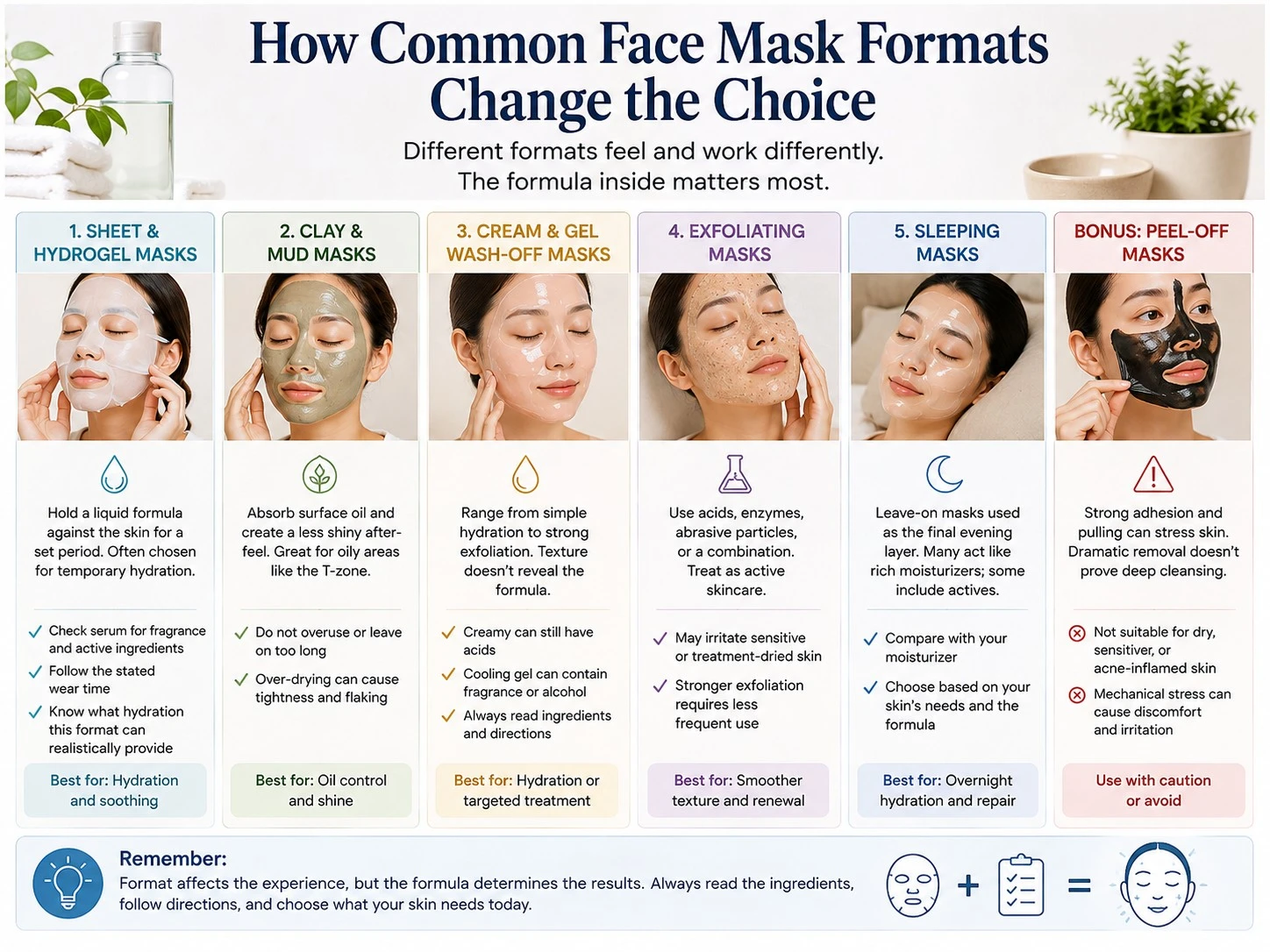
Mask format affects wear, mess, and the way product sits on the skin, but it does not tell you everything the formula does.
- Sheet and hydrogel masks hold a liquid formula against the face for a set period. They are often chosen for temporary hydration, but the material itself does not make every mask gentle or suitable for sensitive skin. Check the serum for fragrance and active ingredients, follow the stated wear time, and learn what the format can realistically provide in the guide to sheet mask benefits.
- Clay and mud masks absorb surface oil and can create a less shiny after-feel. They may suit an oily T-zone, but a highly drying formula or overly long wear can aggravate tightness and flaking. The explanation of clay mask benefits separates temporary oil control from exaggerated “detox” claims.
- Cream and gel wash-off masks range from simple hydration to strong exfoliation. Texture alone is not enough: a creamy mask can contain acids, and a cooling gel can contain fragrance or alcohol. Read the active ingredients and directions before classifying it as gentle.
- Exfoliating masks use acids, enzymes, abrasive particles, or a combination. Treat them as active skincare, not as a relaxing extra. Sensitive, irritated, or treatment-dried skin may not tolerate them, and stronger exfoliation generally requires less frequent use.[2]
- Sleeping masks are leave-on products used as the final evening layer. Many function like rich moisturizers, though some include active ingredients. Compare a sleeping mask with moisturizer before buying both for the same purpose.
Peel-off masks deserve particular caution when they adhere strongly or encourage repeated pulling. The dramatic removal does not prove that the mask extracted deep impurities, and mechanical stress can be uncomfortable on dry, sensitive, or acne-inflamed skin.
Check the Formula Against the Rest of Your Routine
A mask should be evaluated as part of the routine. A salicylic-acid mask may appear reasonable for oily skin, but the routine could already include an exfoliating cleanser, leave-on acid, retinoid, or benzoyl peroxide. Another active step can turn a suitable ingredient into an excessive schedule.
Before using an active mask, check four things:
- Duplicate functions: Count acids, scrubs, retinoids, benzoyl peroxide, and other drying treatments already in use. Do not add an exfoliating mask automatically because it is marketed as a separate category.
- Current barrier condition: Postpone acids, scrubs, and strongly oil-absorbing masks if the skin is raw, sunburned, cracked, unusually red, or peeling. Home exfoliation should not be used over open cuts, wounds, or sunburned skin.[2]
- Label directions: Follow the stated amount, area, wear time, removal method, and maximum frequency. Using a mask more often or leaving it on longer is more likely to increase irritation than accelerate results.[1]
- Sun protection: Alpha hydroxy acids can increase sun sensitivity. Follow the product warning and use sun protection during use and for a week afterward.[3]
Frequency depends on the formula rather than the word “mask.” A simple hydrating product may be tolerated more often than an acid or clay mask. The guide to how often to use a face mask explains how to adjust without assuming every mask belongs in a weekly ritual.
Face masks do not replace the core routine or prescribed care. A hydrating mask may comfort eczema-prone skin, and an acid mask may support an acne routine, but neither automatically treats the underlying condition. Persistent acne, eczema, swelling, or a recurring rash deserves professional assessment.[1]
How to Tell Whether the Mask Is a Good Fit
Judge a mask by both the immediate experience and the skin’s response after the temporary glow or matte finish fades.
- During application: Mild coolness or a neutral feel can be normal. Wash the mask off promptly if it causes itching, burning, or stinging rather than waiting for the timer to finish.[1]
- Immediately after removal: Skin should not feel raw, painfully tight, or look markedly red. Follow the label for rinsing, then apply moisturizer after a wash-off mask. The full guide to using a face mask covers application and removal.
- Later that day or the next morning: Watch for persistent redness, new flaking, swelling, an itchy rash, or a cluster of inflamed bumps. These are reasons to pause the product, not to use it more often.
- After repeated use: Look for the specific benefit you selected the mask to provide. If a tolerated mask produces no meaningful change, it can be removed from the routine; an optional product does not need a permanent slot.
If several active products have left the skin sore, shiny-but-tight, flaky, or unusually reactive, stop exfoliating and simplify the routine rather than testing another corrective mask. The guide to over-exfoliated skin explains the warning signs and recovery priorities.
Seek medical care for severe swelling, blistering, breathing difficulty, eye involvement, signs of infection, or a reaction that persists after the product is removed.
FAQs About Choosing a Face Mask
Can every skin type use a sheet mask?
Potentially, but not every sheet-mask formula suits every skin type. Check the liquid for fragrance, exfoliating acids, and other active ingredients rather than assuming the sheet format is automatically hydrating or gentle. Oily skin can use a lightweight hydrating sheet mask, while sensitive skin may need a simpler fragrance-free formula.
Is a clay mask only for oily skin?
No. Someone with combination skin may use clay only on an oily T-zone, and a normal skin type may use it occasionally for temporary oil absorption. Dry or irritated areas generally need less exposure to oil-absorbing formulas. Comfort and the finished formula matter more than the skin-type label.
Can sensitive skin use a face mask?
Yes, but a simple hydrating or soothing mask is usually a more cautious starting point than a scrub, peel-off mask, strong acid, or heavily fragranced formula. Stop and rinse if the mask causes itching, burning, or stinging. A mask is optional, so there is no need to force one into a routine that is already comfortable.
Can you use different masks on different parts of your face?
Yes. Multi-masking can be practical when the T-zone is oily and the cheeks are dry, provided each formula stays on the area it is intended to treat. It is not automatically better than one balanced mask, and using several active products at once can make irritation harder to trace.
Do you need a face mask in your skincare routine?
No. Face masks are optional products for a specific temporary or supportive benefit. Cleansing, moisturizing, sun protection, and any necessary treatment are more fundamental. If a mask duplicates another product, irritates the skin, or provides no useful result, skipping it is a valid choice.
Sources
[1] American Academy of Dermatology Association. Do Facial Masks Work, and Should I Add One to My Skin Care Routine?
[2] American Academy of Dermatology Association. How to Safely Exfoliate at Home
[3] U.S. Food and Drug Administration. Alpha Hydroxy Acids


