


Whether a mask belongs before or after a shower depends more on what happens to the product afterward than on the shower itself. Most conventional sheet masks leave formula on the skin, while clay masks are normally rinsed away.
Start by identifying the format, then check whether the directions call for clean, dry, damp, or wet skin. That avoids washing off a leave-on formula or diluting a mask that needs a dry surface.
Best Shower Timing by Face Mask Type
Use this table as a practical default, then follow the directions on your specific product.
| Mask type | Usual shower timing | Why it fits | Main caution |
|---|---|---|---|
| Sheet or hydrogel mask | After the shower | Clean skin is ready for application, and the remaining essence will not be rinsed off immediately | Pat away dripping water so the mask can stay in place |
| Rinse-off clay, mud, or charcoal mask | Before or after the shower | Before is convenient when the shower will be the removal step; after also works on clean skin | Cleanse before applying and do not exceed the label time |
| Rinse-off cream or gel mask | Before or after the shower | Either order works when the mask is applied and removed as directed | Check whether the formula requires dry, damp, or wet skin |
| Exfoliating or active mask | After the skin has cooled, or at a separate time | Cooler, comfortable skin makes it easier to notice the mask’s own effects | Do not apply to hot, flushed, freshly shaved, or already irritated skin |
| Sleeping mask | After the shower | It belongs at the end of the evening routine and remains on overnight | Do not rinse it off in the shower unless the label says otherwise |
A face mask’s name does not always reveal whether it is rinse-off or leave-on. Some gel masks are rinsed after a set time, while others remain on overnight, so packaging directions outrank the category shorthand.
If you are choosing between formats rather than only timing them, the guides to sheet mask benefits and clay mask benefits explain the separate jobs they perform.
Why Clean Skin Matters More Than Shower Order
A mask should generally be applied to freshly cleansed skin unless its label says otherwise. Makeup, sunscreen, sweat, and surface oil can interfere with even contact and can become trapped under an occlusive sheet or layer. Gentle cleansing is more useful than trying to time the mask around an imagined pore-opening window.
Use a mild cleanser with lukewarm water, apply it with your fingertips, and avoid scrubbing; dermatology guidance also recommends patting the face dry with a soft towel.[1] The complete face-washing method covers this step without turning the mask routine into extra cleansing.
A warm shower may leave skin feeling softer, but that does not make “after shower” universally superior or prove that every mask will absorb better. The reliable advantage is logistical: you can cleanse once, apply a leave-on or timed mask, and finish the routine without exposing it to more water.
If you apply a rinse-off mask before showering, wash your face first rather than treating the shower at the end as the initial cleanse. The mask needs contact with clean skin during its wear time, not only after it has been removed.
How to Time a Face Mask Around a Shower
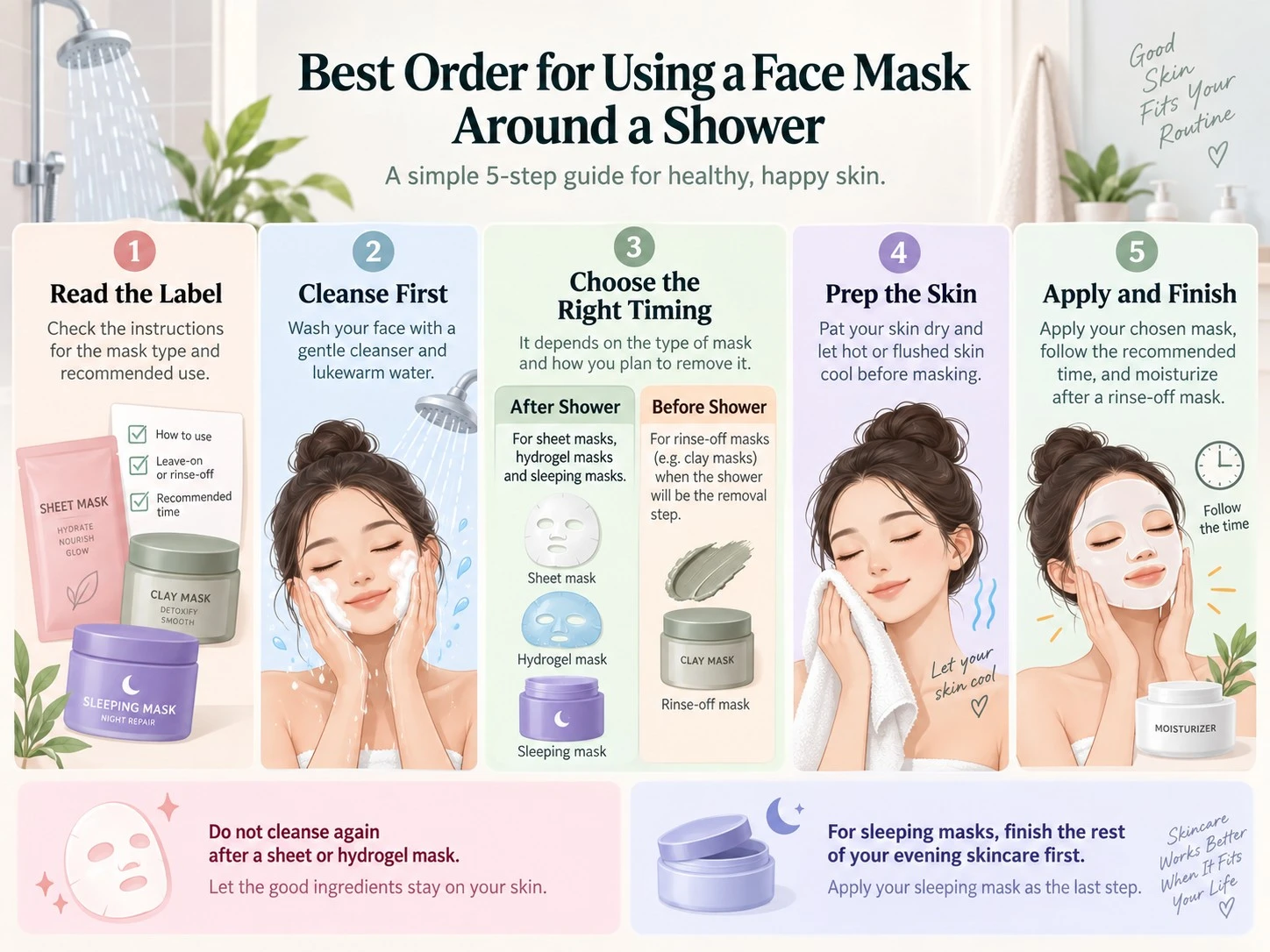
This sequence covers both the after-shower default and the before-shower rinse-off exception.
- Read the mask directions. Confirm whether it is rinse-off, leave-on, or intended for in-shower use, and note the required skin condition and wear time.
- Cleanse your face gently. Remove makeup, sunscreen, and surface buildup with lukewarm water and an appropriate cleanser.
- Choose the shower order. Shower first for a sheet, hydrogel, sleeping, or other leave-on mask. For a rinse-off mask, apply it before the shower only when the label permits and the shower will be your removal step.
- Prepare the skin as directed. After a shower, pat away excess water and let the face cool if it is hot or flushed. Do not assume every mask belongs on damp skin.
- Apply, time, and finish the mask. Keep it on only as long as directed. Remove a rinse-off mask with lukewarm water; after a timed mask, follow its directions about massaging in, rinsing, or removing residue. Apply moisturizer after washing off a mask.[2]
Do not insert a second cleanse after a sheet or hydrogel mask just because you showered first. That would remove the formula the mask was designed to leave behind. If the finish feels excessively sticky or uncomfortable, follow the package directions rather than assuming all remaining essence must stay on.
For a sleeping mask, finish the rest of your leave-on evening routine first. The comparison of a sleeping mask and moisturizer explains when the mask supplements a moisturizer and when the finished product may already provide enough emollience and occlusion.
What to Avoid With Heat, Steam, and Wet Skin
Keep the shower warm rather than hot. Hot water and long showers can worsen dryness, while short showers in warm water are less disruptive for dry skin.[3] A mask does not cancel out the drying effect of an overly hot shower.
Let the face cool before applying an acid, enzyme, peel, or other active mask if the shower left it red or uncomfortable. Heat-related stinging can make it harder to judge whether the product itself is irritating. Avoid layering a strong exfoliating mask with other exfoliating products or retinoids in the same routine; redundant active ingredients can increase dryness and irritation.[2]
Do not apply a mask to soaking-wet skin unless the directions call for it. Excess water can make a sheet slide, dilute a rinse-off formula, or create an uneven layer. Patting dry does not mean rubbing the face until it feels tight.
Wash a mask off immediately if you feel itching, burning, or stinging. Leaving it on until the timer ends is not a test of effectiveness.[2]
Common Face Mask and Shower Timing Mistakes
- Applying a mask over uncleansed skin: Showering later does not correct the poor contact during the mask’s wear time.
- Showering after a sheet or hydrogel mask: Water can rinse away the leave-on formula and undo the practical reason for masking after cleansing.
- Using an ordinary mask in a steamy shower: Heat, water, and condensation can change how the mask sits, dilute it, or make it difficult to track the intended time.
- Assuming steam guarantees better absorption: The product formula and label determine use; a hot face is not proof that a mask will work better.
- Leaving a clay mask on until it cracks completely: More drying time is not automatically more effective. Remove it at the label-directed time.
- Applying an active mask to freshly shaved or flushed skin: Wait until the skin is comfortable, or use the mask on a different day.
- Skipping moisturizer after a rinse-off mask: A mask does not replace the rest of a basic routine. Dermatologists advise applying moisturizer after washing off a facial mask.[2]
- Masking more often to compensate for poor timing: Frequency depends on the formula and skin response, not whether you showered first. See how often to use a face mask for that separate decision.
FAQs About Face Masks and Shower Timing
Do you wash your face before a mask if you shower afterward?
Yes. If you plan to use a rinse-off mask before showering, cleanse your face first unless the product directions explicitly say otherwise. The later shower removes the mask; it does not provide clean-skin contact during the time the mask is working.
Can you use a sheet mask in the shower?
Usually not. Water and condensation can make a sheet mask slip or dilute its essence, and showering makes the wear time harder to control. Use it after the shower on clean skin unless the product is specifically designed and labeled for in-shower use.
How long after a shower should you wait before using a face mask?
There is no universal waiting period. Pat off excess water and apply a hydrating sheet or hydrogel mask once the skin is clean and comfortable, following its directions. If the face is hot, red, or dripping wet—or if you are using an exfoliating mask—wait until it has cooled and reached the dry or damp condition named on the label.
Is a clay mask better before or after a shower?
Either can work. Before the shower is convenient because you can rinse the clay away at the end, but you still need to cleanse first. After the shower also works if the skin is clean, cool, and prepared as directed. Choose the order that prevents over-wearing and makes complete, gentle removal easiest.
Sources
[1] American Academy of Dermatology Association. Face Washing 101
[2] American Academy of Dermatology Association. Do Facial Masks Work, and Should I Add One to My Skin Care Routine?
[3] American Academy of Dermatology Association. Dry Skin Remedies for Darker Skin Tones


