
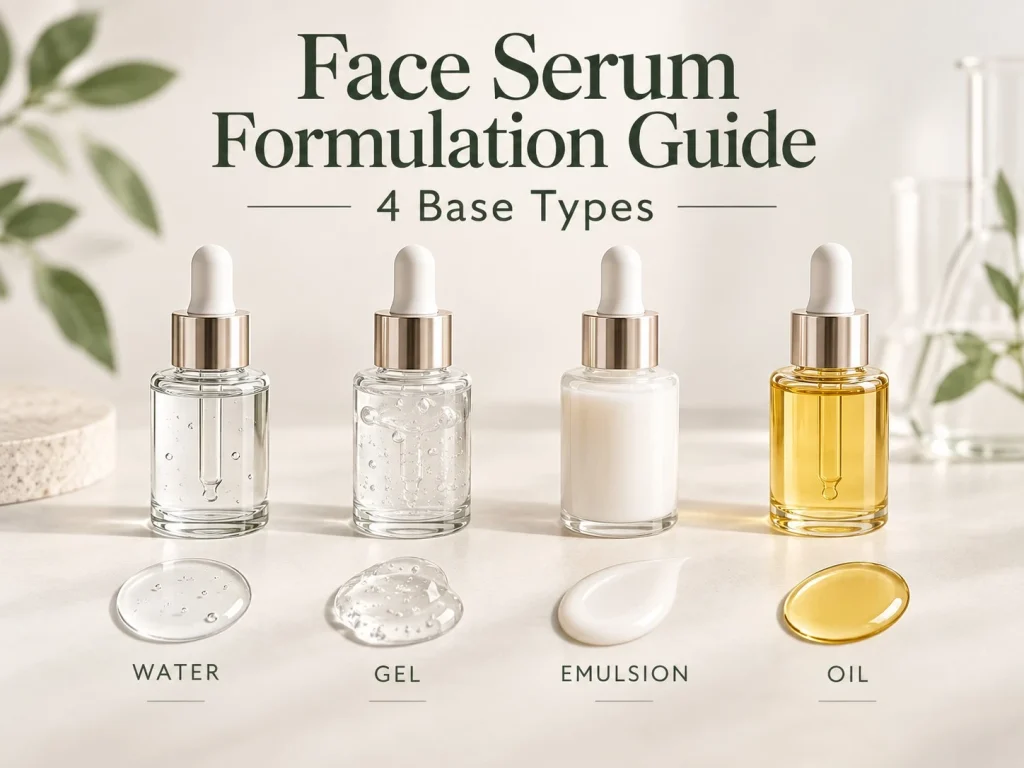

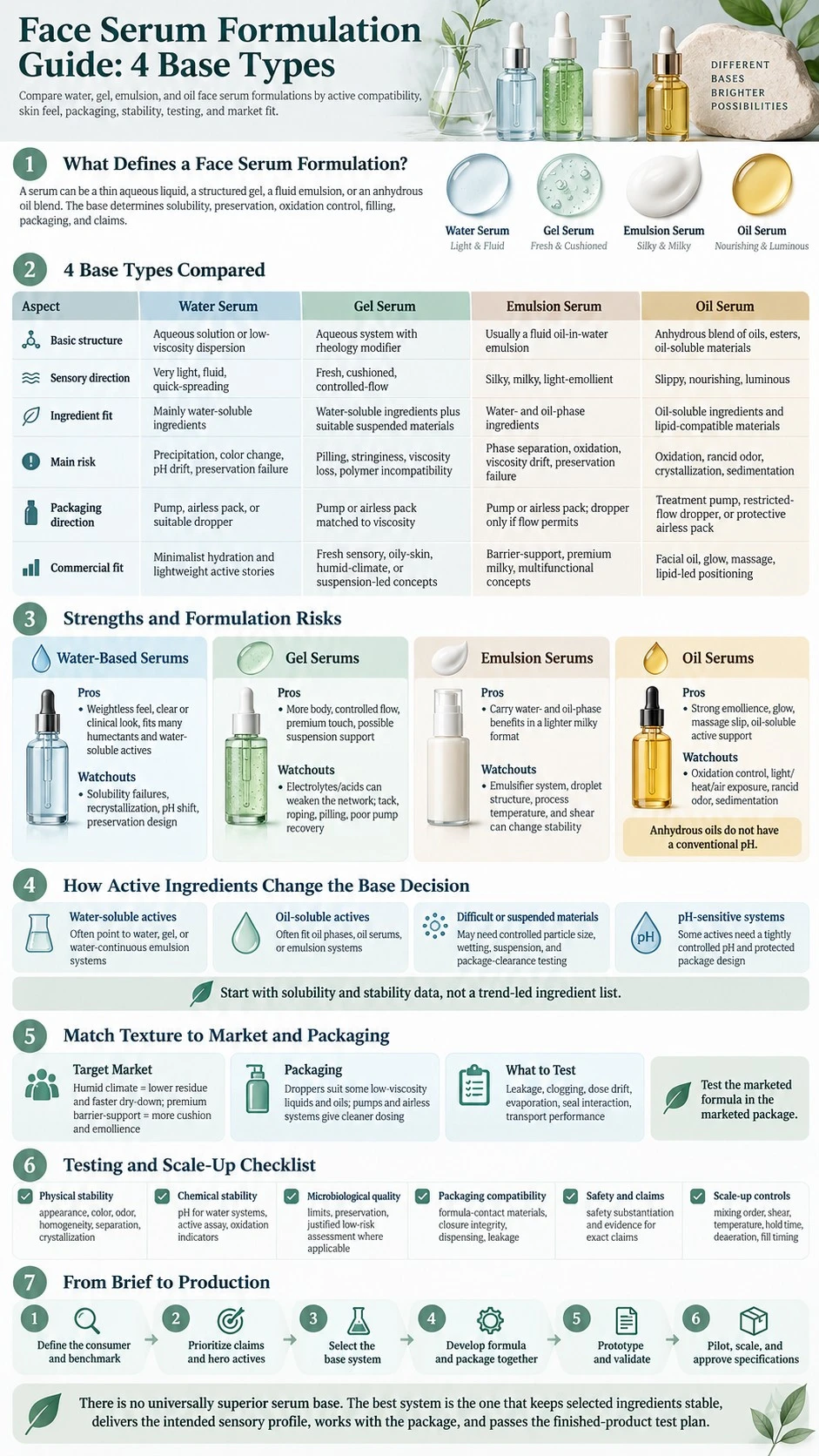
A face serum can be a thin aqueous liquid, a structured gel, a fluid emulsion, or an anhydrous oil blend. Those formats may look similar in a product lineup, but they create different constraints for ingredient solubility, preservation, oxidation control, filling, packaging, and claims. For a skincare brand, selecting the base is therefore an early product-development decision—not a styling choice made after the active list is complete.
This guide compares the four principal serum systems from a formulation and commercialization perspective. It is designed to help brand founders and product developers write a clearer brief, evaluate prototypes, and coordinate formula and packaging decisions with a manufacturer.
What Defines a Face Serum Formulation?
A face serum is usually positioned as a concentrated or targeted leave-on product with a lighter application profile than a conventional cream. However, the name does not establish a standardized viscosity, oil content, ingredient concentration, or delivery system. A serum can be water-thin, gelled, milky, or fully oil-based.
The technical identity comes from the formula’s continuous phase and structure. A simple water serum is primarily an aqueous solution. A gel serum adds a rheology network to an aqueous base. An emulsion serum contains water and oil phases held together by an emulsifying system. An oil serum is normally anhydrous and uses lipids or esters as its vehicle. This distinction should be made before ingredient percentages are finalized because the base controls what can be dissolved, dispersed, protected, and dispensed.
Brands that need a broader view of development stages can use the skincare formulation guide to connect the serum brief with sampling, testing, scale-up, and launch preparation.
Water, Gel, Emulsion and Oil Serums Compared
| Decision factor | Water serum | Gel serum | Emulsion serum | Oil serum |
|---|---|---|---|---|
| Basic structure | Aqueous solution or low-viscosity dispersion | Aqueous system structured with a polymer, gum, or other rheology modifier | Usually a fluid oil-in-water emulsion | Anhydrous blend of oils, esters, and oil-soluble materials |
| Typical sensory direction | Very light, fluid, quick-spreading | Fresh, cushioned, controlled-flow | Silky, milky, light-emollient | Slippy, nourishing, luminous |
| Ingredient fit | Primarily compatible water-soluble ingredients | Water-soluble ingredients plus suitable suspended materials | Compatible water- and oil-phase ingredients | Oil-soluble ingredients and lipid-compatible materials |
| Main formulation risk | Precipitation, color change, pH drift, or inadequate preservation | Pilling, stringiness, viscosity loss, or polymer incompatibility | Phase separation, viscosity drift, oxidation, or preservation failure | Oxidation, rancid odor, crystallization, or sedimentation |
| Packaging direction | Pump, airless pack, or suitable dropper | Pump or airless pack matched to viscosity | Pump or airless pack; dropper only if flow and stability permit | Treatment pump, restricted-flow dropper, or protective airless pack |
| Commercial fit | Minimalist hydration and lightweight active stories | Fresh sensory, oily-skin, humid-climate, or suspension-led concepts | Barrier-support, premium milky, or multifunctional concepts | Facial oil, glow, massage, or lipid-led positioning |
The table is a briefing tool, not a formula rulebook. Ingredient grade, use level, solvent system, processing order, pH, and supplier data can make a material suitable—or unsuitable—for a format that appears compatible in principle.
Water-Based Serums: Strengths and Formulation Risks
Choose a water serum when low viscosity and a nearly weightless afterfeel are central to the brief. Humectants and many water-soluble actives can fit this format, while solubilizers or co-solvents may be used for limited amounts of less water-compatible material. A clear appearance can support minimalist or clinical positioning, but clarity is a demanding technical target rather than proof of simplicity.
The main development challenge is keeping every component soluble and stable across the intended temperature range and shelf life. An ingredient may dissolve during a heated laboratory batch and later recrystallize. Electrolytes, botanical extracts, fragrances, and concentrated active blends can also shift color, odor, or pH. The usable pH window must satisfy the most restrictive combination of active stability, preservative performance, skin compatibility, and packaging compatibility.
Because the system contains available water, microbial control belongs in the initial design. Contamination can arise from raw materials, water, manufacturing conditions, an ineffective preservation system, packaging, storage, or consumer use.[1] The preservative is only one part of that control strategy; hygienic production, container design, and verified finished-product performance also matter.
Gel Serums: Rheology, Suspension and Pilling
A gel serum is usually an aqueous serum whose flow has been structured with a rheology modifier. This can keep a product from running off the fingertips, create a more substantial first touch, and help suspend compatible particles or droplets. The gel network can also make a modest formula feel more premium without adding a large oil phase.
The tradeoff is that the thickener becomes part of the compatibility problem. Electrolytes, acids, cationic ingredients, high solvent loads, and changes in neutralization may weaken some polymer networks. Increasing the thickener is not a universal fix: it can create tack, roping, poor pump recovery, or a film that rolls into visible flakes when layered with sunscreen or makeup.
Prototype evaluation should therefore include more than a viscosity number. Check flow from the chosen package, pickup and spread, dry-down, tack after several minutes, and layering with representative products. Rheological behavior can relate both to physical structure and to how a topical product spreads and feels during use.[2] The target is not the highest viscosity; it is repeatable flow and sensory performance throughout the product’s life.
Emulsion Serums: Combining Water- and Oil-Phase Benefits
An emulsion serum is often the most flexible choice when the concept needs humectancy, emollience, and ingredients from both phases. Most fluid “milky serums” are oil-in-water emulsions: small oil droplets are dispersed through a water-continuous phase. The format can deliver a silky or cushioning feel while remaining lighter than a conventional lotion or cream.
That flexibility adds formulation variables. The emulsifier system, oil-phase composition, droplet structure, thickener, process temperature, shear, cool-down additions, and fill conditions all affect the finished product. Phase separation, creaming, coalescence, viscosity drift, and active migration are possible failure modes. Published formulation research uses measurements such as pH, conductivity, centrifugation screening, microscopy, rheology, and microbiological control to characterize emulsion behavior; no single screening test proves full shelf life.[2]
An emulsion serum also has both water-related microbial considerations and oil-phase oxidation considerations. That makes package protection and stability testing especially important. If the same concept could be made as a gel or emulsion, prototype both only when the consumer experience or ingredient delivery differs enough to justify the additional development work.
Oil Serums: Anhydrous Design and Oxidation Control
Choose an oil serum when the product story is built around emollience, glow, massage slip, or oil-soluble ingredients. A well-designed blend can range from a traditional rich facial oil to a dry-touch ester system. The absence of a water phase may simplify some manufacturing and microbial-control decisions, but it does not make the product automatically stable or low risk.
Oils vary in oxidation resistance, odor, color, polarity, spreading, and compatibility with lipophilic actives. Heat, light, oxygen, metal contamination, headspace, and repeated opening can accelerate quality loss. Antioxidants can help delay oxidation, but an antioxidant is not a preservative and cannot replace a microbiological risk assessment. If the formula, manufacturing process, or consumer use can introduce water, the team should assess whether the finished product still qualifies as microbiologically low risk under the applicable test strategy. ISO 11930 provides a reference preservation-efficacy approach for products that are not considered low risk and points to risk assessment for low-risk products.[3]
An anhydrous oil does not have a conventionally measurable pH because pH describes an aqueous environment. Specifications should instead emphasize relevant attributes such as appearance, odor, viscosity, density, peroxide or other oxidation indicators when appropriate, and active assay. For consumer-positioning differences between these categories, the face oil vs serum guide provides a useful downstream reference.
How Active Ingredients Change the Base Decision
Start with solubility and stability data, not with a trend-led list of hero ingredients. A material’s common marketing category does not guarantee that it will remain dissolved, active, and visually acceptable in every water, gel, emulsion, or oil serum.
- Water-soluble actives: Ingredients such as niacinamide, many humectants, and many peptide solutions often point toward a water, gel, or water-continuous emulsion. The supplier’s recommended pH, temperature, electrolyte tolerance, and addition phase still govern the decision.
- Oil-soluble actives: Retinoids, tocopherol, and oil-soluble vitamin derivatives may fit an oil phase or emulsion. Solubility in the exact carrier blend and sensitivity to oxygen, light, and heat must be verified.
- Difficult or suspended materials: Powders, encapsulates, pigments, or poorly soluble extracts may require controlled particle size, wetting, suspension, and package-clearance testing. A gel can slow settling but cannot correct an incompatible dispersion.
- pH-sensitive systems: Pure L-ascorbic acid illustrates why a familiar active should not dictate a generic “vitamin C serum” base. Its acidic aqueous requirements, oxidation behavior, concentration, color expectations, and package protection need to be designed together.
When the active list becomes long, interactions increase and claim priorities can become unclear. Rank one or two hero outcomes, identify supporting ingredients, and remove additions that create risk without materially improving the brief. The ingredient declaration should later be reviewed as a finished formula; the guide to reading a skincare ingredient list explains what the final order can and cannot reveal.
Match Serum Texture to Target Market and Packaging
A technically stable serum can still fail commercially if its application experience conflicts with the market. A humid-climate, daytime hydration concept may favor low residue and fast dry-down. A premium barrier-support launch may accept more cushion and emollience. An oil serum can suit dry-skin or massage-led positioning, while a clear gel may better communicate freshness. These are positioning hypotheses that should be tested with the intended consumer, not stereotypes about skin type.
Package selection should run alongside formula development. Droppers suit some low-viscosity liquids and oil blends, but they repeatedly expose the product to air and depend on suitable flow, seal, bulb, and wiper performance. Pumps provide cleaner dosing, while airless systems can reduce repeated exposure; neither works automatically with every viscosity, suspended particle, or volatile component. The face serum packaging comparison examines these dispensing tradeoffs in more detail.
Test the marketed formula in the marketed package. Look for leakage, paneling, discoloration, clogging, dose drift, evaporation, seal or gasket interaction, dip-tube performance, and changes after transport simulation. A dedicated packaging compatibility testing guide can help the brand define that work before components are ordered.
Testing and Scale-Up Checklist for Face Serums
The final test plan should reflect the system, ingredients, claims, package, manufacturing process, and sales markets. In the United States, the responsible person must maintain records supporting adequate safety substantiation; FDA does not prescribe one universal test set for every cosmetic.[4]
- Physical stability: Track appearance, color, odor, homogeneity, viscosity or flow, and any separation, precipitation, or crystallization under relevant storage and stress conditions.
- Chemical stability: Monitor pH for water-containing systems, active assay where necessary, and oxidation or degradation indicators appropriate to sensitive ingredients.
- Microbiological quality: Establish raw-material and finished-product limits, assess preservation, and perform preservation-efficacy testing or a justified low-risk assessment as applicable.
- Packaging compatibility: Evaluate formula-contact materials, closure integrity, dispensing, dose consistency, headspace, leakage, and visual changes in the final pack.
- Safety and claims: Build a safety substantiation file and select instrumental, clinical, consumer, or other suitable evidence for the exact claims used.
- Scale-up controls: Confirm mixing order, shear, temperature, hold times, deaeration, filtration if applicable, fill temperature, and bulk-to-fill timing at pilot and production scale.
Shelf life is the period during which a cosmetic is expected to remain safe and perform as intended. Heat, moisture, air, light, preservation breakdown, and emulsion separation can all change a product over time, so accelerated data should be interpreted with real-time observations and the actual package.[5]
How to Develop a Face Serum From Brief to Production
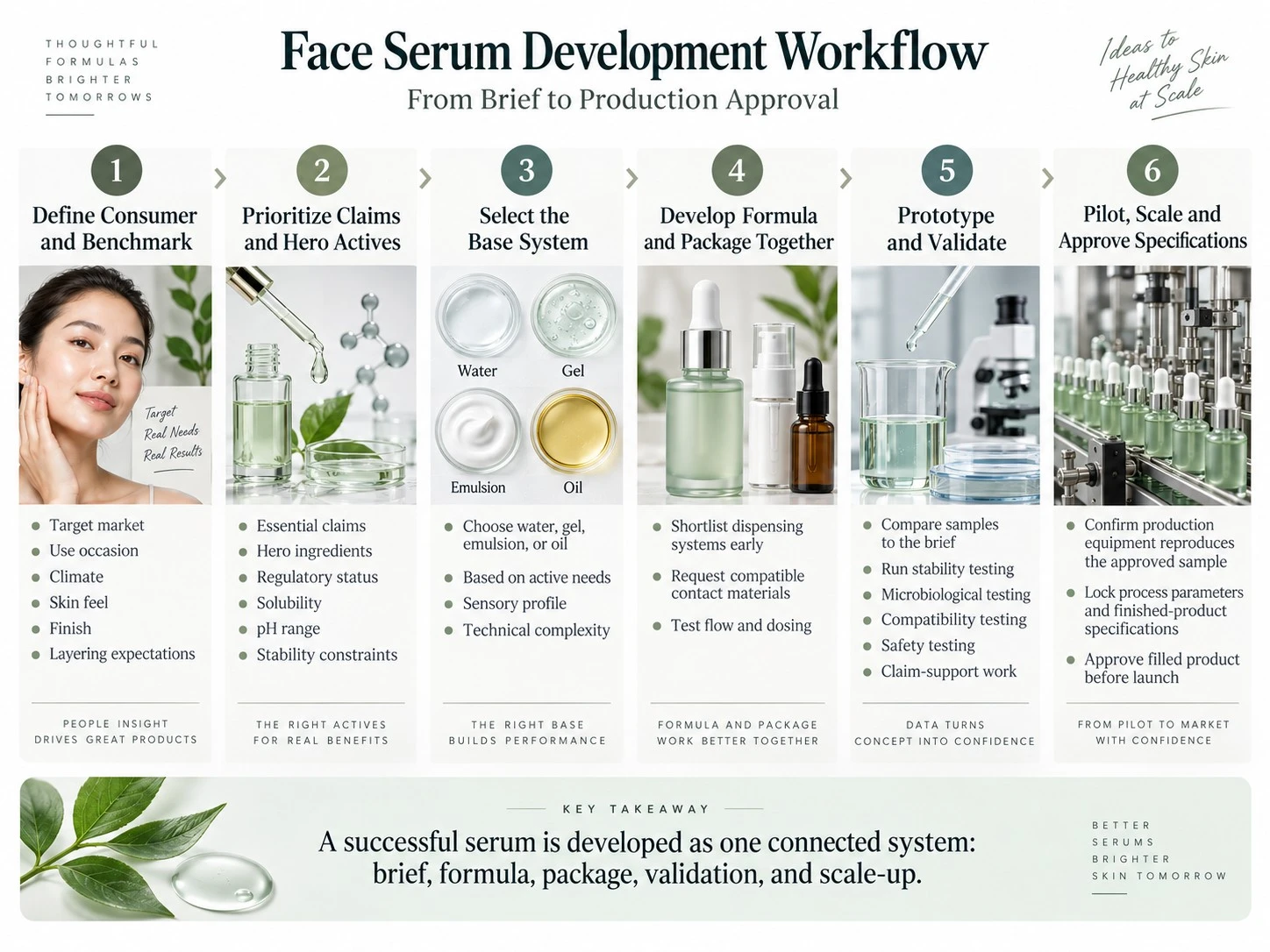
- Define the consumer and benchmark. Record the target market, use occasion, climate, skin-feel goal, finish, color, odor, viscosity direction, and products the serum must layer with.
- Prioritize claims and hero actives. Separate essential claims and ingredients from optional additions, then verify regulatory status, supplier documentation, solubility, pH range, use level, and stability constraints.
- Select the base system. Choose water, gel, emulsion, or oil by matching the active requirements to the target sensory profile and acceptable technical complexity.
- Develop formula and package together. Shortlist dispensing systems early, request compatible contact materials, and test prototype flow and dosing before committing to decoration or component volume.
- Prototype and validate. Compare samples against the written brief, then run stability, microbiological, compatibility, safety, and claim-support work appropriate to the finished product.
- Pilot, scale and approve specifications. Confirm that production equipment reproduces the approved sample, lock critical process parameters and finished-product specifications, and approve the filled product before launch.
A qualified development partner should document why the chosen system fits the brief and which remaining decisions belong to validation. ZICAIL’s R&D, production and quality-control overview shows how those stages connect in a manufacturing project.
Develop the Right Face Serum Format With ZICAIL
ZICAIL supports private label and custom face serum projects from brief development through formulation, packaging coordination, production, and quality control. Share your sales market, target consumer, texture benchmark, hero actives, claims, package preference, target price, and order quantity so the team can evaluate whether a water, gel, emulsion, or oil system is the strongest starting point.
Explore ZICAIL’s custom skincare formulation service or discuss your face serum project with the team.


