


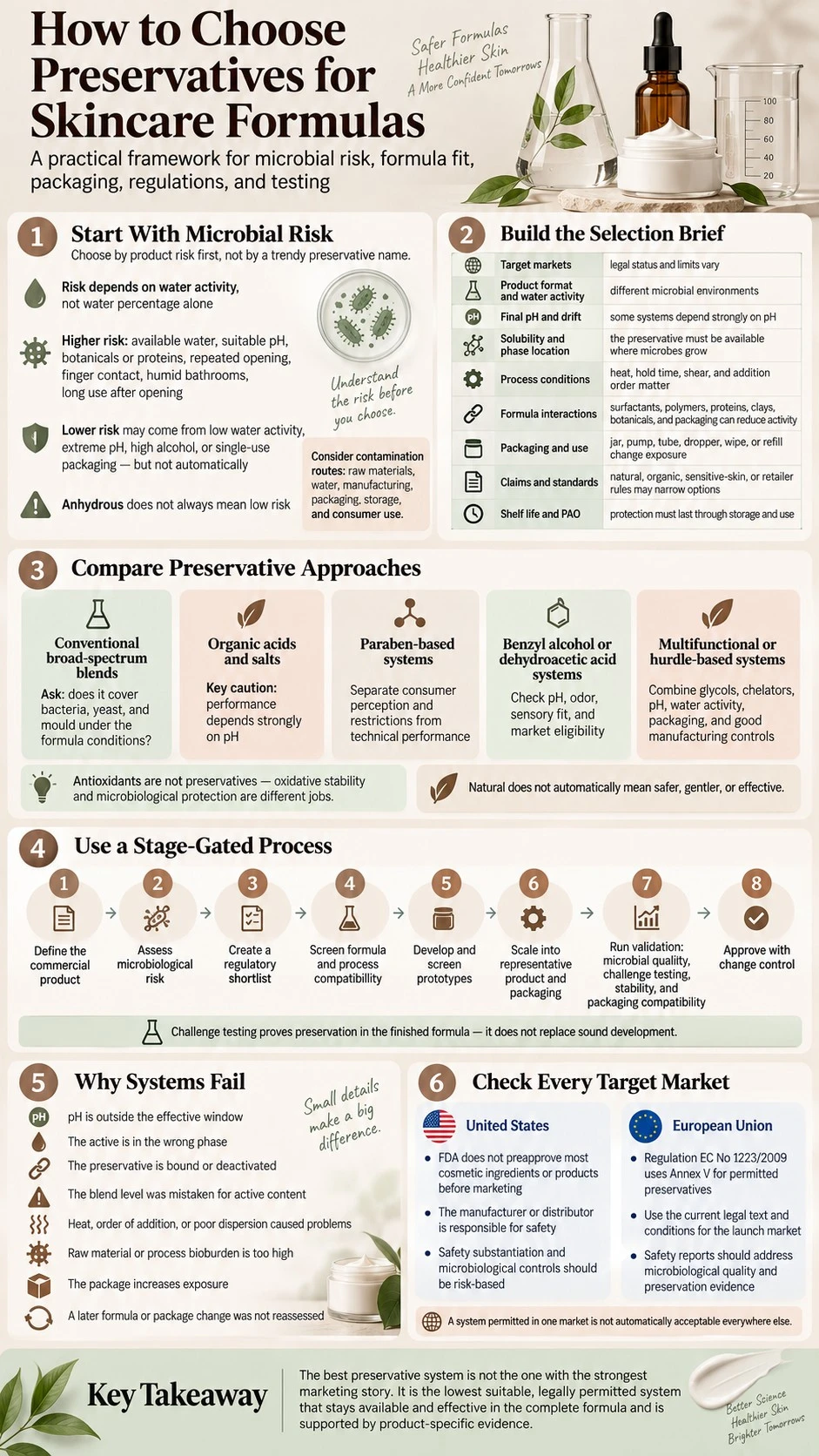
Preservatives are not plug-and-play ingredients. A system that performs in a low-pH toner can fail in a neutral cream; one that works in a simple emulsion can lose activity when a polymer, surfactant, botanical extract, or package changes. Supplier guidance narrows the options, but it cannot prove that a finished commercial formula is protected.
This guide gives skincare brands and product developers a practical selection framework. It does not provide universal use rates, because the correct level depends on the exact preservative, supplier grade, formula, product category, target market, and test result.
Start With Microbial Risk, Not a Preservative Name
Begin by asking how readily the product could support contamination and how microorganisms could enter it. Potential contamination routes include raw materials or water, poor manufacturing conditions, ineffective preservation, inadequate packaging, storage, and consumer use.[1]
Water content matters, but water activity is the more useful concept for microbial growth. Water activity describes how much water is available to microorganisms; it is not simply the percentage of water on the formula sheet. A product can contain water yet have reduced availability because of dissolved materials, while a nominally anhydrous product can still face contamination through wet fingers, a damp environment, or water introduced during use.
Risk usually rises when a formula combines several of these conditions:
- substantial available water;
- a pH and temperature range that supports microbial survival;
- botanicals, proteins, clays, or other materials with higher bioburden or nutrient potential;
- repeated opening or direct finger contact;
- use in a warm, humid bathroom;
- a package that allows water ingress, backflow, or product residue around the closure;
- long use after opening;
- use near the eyes, on compromised skin, or by a more vulnerable population.
Conversely, low water activity, extreme pH, high alcohol content, single-use packaging, or other hurdles may reduce risk. They do not create an automatic exemption. ISO 29621 provides a framework for identifying microbiologically low-risk finished products through documented risk assessment.[2] ISO 11930 excludes products shown to be low risk through that route.[3]
Two common category mistakes follow from skipping this assessment. First, “water-based” does not identify one uniform risk level: a cleanser, essence, emulsion, and hydrogel can expose preservatives to very different pH, surfactant, polymer, and packaging conditions. Second, “anhydrous” does not always mean “no microbiological concern.” The use pattern and package remain part of the product environment.
Build the Preservative Selection Brief
Before requesting samples from suppliers, write a brief that turns the formula concept into technical constraints. This prevents teams from selecting a fashionable system and redesigning the entire product around it later.
| Input to define | Why it changes the decision | Evidence or decision to record |
|---|---|---|
| Target markets | Permitted substances, maximum levels, product restrictions, and required documentation vary | Current regulatory screen for every launch market |
| Product format and water activity | An emulsion, surfactant system, low-water paste, and oil product create different microbial environments | Formula type plus measured or scientifically justified risk factors |
| Final pH and drift | Some systems depend strongly on pH; stability can shift pH over time | Initial specification, stability range, and preservative operating window |
| Solubility and phase location | A preservative can be present on paper but unavailable where microbes grow | Addition method, solubility data, and oil-water partition considerations |
| Process conditions | Heat, order of addition, hold times, and shear can affect the ingredient or formula | Supplier processing limits and pilot manufacturing instructions |
| Formula interactions | Surfactants, emulsifiers, polymers, proteins, clays, and packaging can bind or reduce available preservative | Compatibility screen in the complete formula |
| Packaging and use | A jar, pump, tube, dropper, refill, or wipe changes exposure and dosing behavior | Representative pack, closure, use simulation, and contamination-risk rationale |
| Claims and standards | “Natural,” organic, sensitive-skin, retailer, or certification rules may narrow choices beyond the law | Written claim standard and ingredient policy—not an informal blacklist |
| Shelf life and period after opening | Protection must remain adequate throughout intended storage and use | Stability plan, microbiological plan, and change-control triggers |
This brief should include the actual commercial formula version, not just a marketing description. “Gentle botanical cream” is not enough. The formulator needs the intended pH, complete ingredient system, package, processing conditions, target markets, expected shelf life, and any certification or retailer constraints.
Supplier documents then become screening tools. Request the technical data sheet, safety data sheet, composition or active-content information, recommended use conditions, regulatory statements for the target markets, solubility and processing guidance, and any supporting efficacy data. Treat a recommended range as a starting boundary, not proof that a particular finished product will pass.
Compare Preservative Approaches Without Choosing by Trend
Preservatives are often discussed as winners and losers. That framing is too crude for formulation work. Each approach has a different spectrum, pH dependence, solubility profile, sensory effect, regulatory status, and interaction risk. Preservation strategies can also combine antimicrobial ingredients with physicochemical controls, protective packaging, and good manufacturing practice.[6]
| Approach | Useful screening question | Important caution |
|---|---|---|
| Conventional broad-spectrum ingredients or blends | Does the system cover bacteria, yeast, and mould under the formula’s pH and process conditions? | Broad-spectrum supplier data do not guarantee performance in the finished formula |
| Organic acids and their salts | Will the final pH keep enough of the active acid in its effective form? | Raising pH can sharply reduce contribution; yeast and mould coverage may need particular attention |
| Paraben-based systems | Are the selected members soluble, legally permitted, and compatible with the product and brand brief? | Consumer perception and regional restrictions must be separated from technical performance |
| Benzyl alcohol– or dehydroacetic acid–based systems | Does the blend fit the formula pH, odor, sensory profile, and target-market conditions? | A familiar certification-compatible blend is still formula-dependent |
| Multifunctional or hurdle-based systems | Do glycols, chelators, solvents, pH, water activity, and packaging create a defensible combined system? | “Preservative-free” wording does not remove the need for safety assessment or efficacy evidence |
Do not confuse antioxidants with antimicrobial preservatives. Tocopherol and similar antioxidants can slow oxidation of oils, but they do not by themselves demonstrate protection against bacteria, yeast, and mould. Oxidative stability and microbiological preservation are different jobs.[6]
Likewise, “natural” does not mean inherently safe, gentle, or effective. Natural or organic origin does not guarantee safety, and testing may still be needed.[4] A botanical antimicrobial may introduce color, odor, allergens, variability, or its own microbial load. Evaluate it through the same legal, toxicological, formulation, and efficacy gates as any other ingredient.
Preservative selection should also avoid the “stronger is always better” shortcut. Higher addition can create irritation, odor, sensory, compatibility, claims, or legal problems without fixing the actual failure mechanism. If the system is poorly distributed, deactivated, outside its pH window, or overwhelmed by manufacturing bioburden, simply adding more may be the wrong corrective action.
Use a Stage-Gated Preservative Selection Process
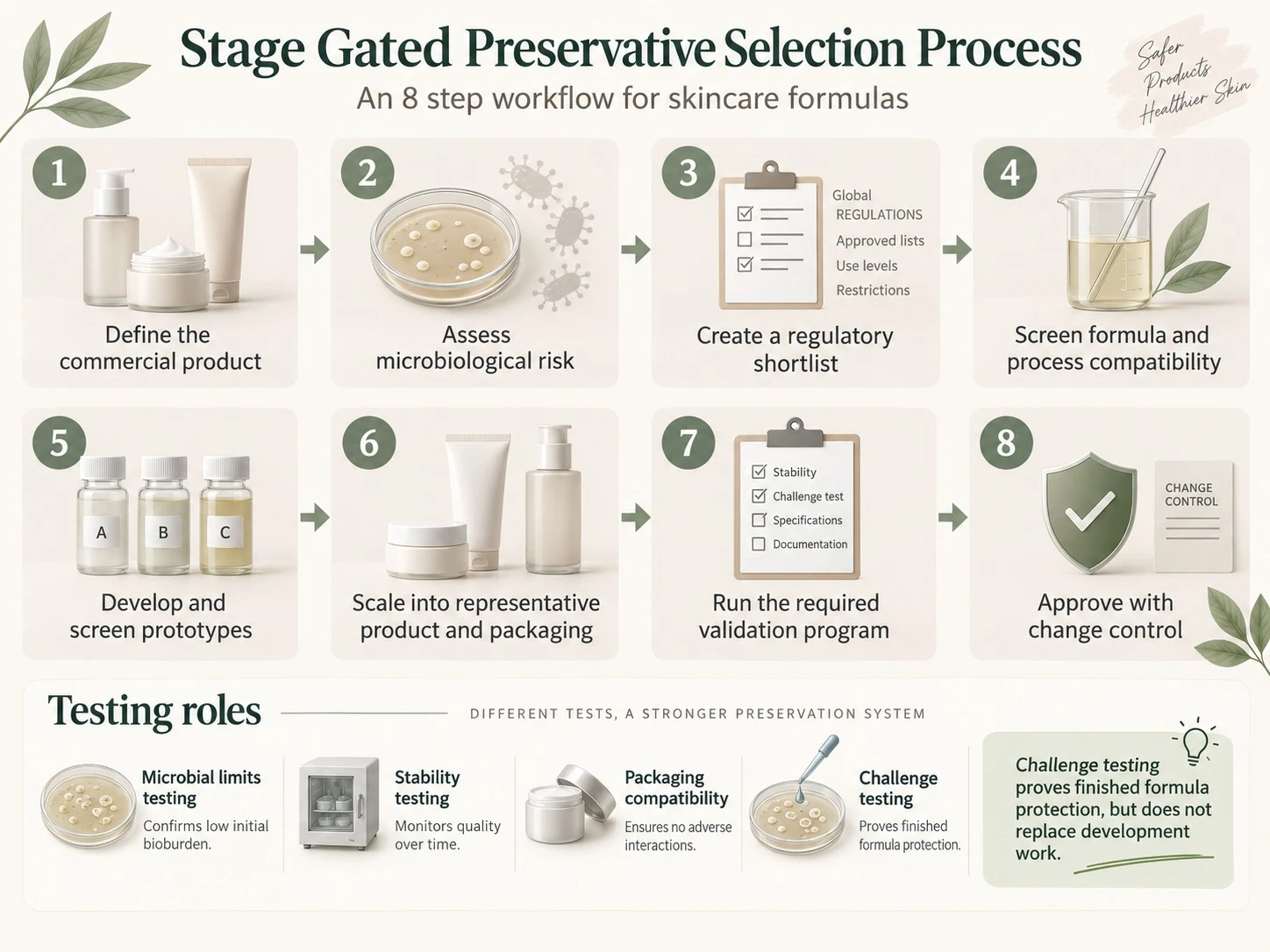
Use the following sequence for each commercial formula. A team may iterate between steps, but it should not treat a later pass as proof that an earlier requirement was satisfied.
- Define the commercial product. Lock the intended format, target markets, user group, application area, packaging, claims, shelf life, and period after opening assumptions.
- Assess microbiological risk. Review water activity, pH, raw-material risk, manufacturing exposure, package protection, storage, and foreseeable consumer contamination. Document any low-risk rationale instead of relying on the word “anhydrous.”
- Create a regulatory shortlist. Check each candidate’s current legal status, maximum concentration, restrictions, labeling implications, and purpose in every target market. Use the regulation itself or qualified regulatory review, not an outdated blog table.
- Screen formula and process compatibility. Compare the system’s pH window, solubility, phase behavior, temperature limits, addition point, active content, and known interactions with the complete formula.
- Develop and screen prototypes. Make controlled lab batches, verify pH and physical quality, and use suitable development screens to eliminate weak options. Record exact formula versions and processing conditions.
- Scale into representative product and packaging. Confirm that pilot manufacturing, filling, closure, and pack function do not create new contamination or compatibility risks.
- Run the required validation program. Evaluate microbial quality and preservation efficacy where applicable, plus stability and packaging compatibility. ISO 11930 describes a preservation-efficacy test and an overall antimicrobial-protection evaluation for cosmetics that are not classified as low risk.[3]
- Approve with change control. Link reports to the approved formula, process, and package. Reassess changes that could affect pH, water activity, preservative availability, processing, packaging, or contamination exposure.
The challenge test is the proof step for the finished preservation system, not a substitute for sound development. It deliberately introduces specified microorganisms and evaluates their behavior over time. Learn what the test proves, when low-risk assessment may apply, and what to do after failure in ZICAIL’s guide to preservative challenge testing for cosmetics.
Keep the other tests in their own lanes. Microbial limits testing evaluates the microorganisms present in the tested sample. Stability testing evaluates physical and chemical behavior over time. Packaging compatibility evaluates the formula-package relationship. Challenge testing evaluates antimicrobial protection under a defined microbial challenge. The stability vs compatibility vs challenge testing guide explains why one passing result cannot replace another.
Why Preservative Systems Fail
When a prototype fails, investigate the mechanism before changing the percentage. Common causes include:
- The pH is outside the effective window. This is especially important for weak organic acids, whose antimicrobial contribution depends on the undissociated form.
- The active is in the wrong phase. Microorganisms grow mainly in the aqueous environment, but partitioning can pull part of a preservative into the oil phase or another structure.
- The preservative is bound or deactivated. Surfactants, nonionic emulsifiers, polymers, proteins, clays, or other ingredients can reduce the freely available concentration.
- The calculation used the blend instead of active content. Commercial products can be mixtures; nominal addition and active preservative concentration are not always the same.
- The process damaged or misplaced the system. Excessive heat, wrong addition order, poor dispersion, long holds, or variable pH adjustment can undermine a sound bench concept.
- Bioburden is too high. Preservation is not a substitute for qualified water, controlled raw materials, sanitation, environmental controls, or hygienic filling.
- The package increases exposure. Repeated finger dipping, wet use, backflow, refill practices, or closure residue can create a challenge the original assessment missed.
- A later change was not reassessed. New fragrance, extract, surfactant, polymer, package, or manufacturing site can alter the preservation environment even if the ingredient list looks similar.
Packaging should be treated as part of the control strategy, but not as magic. A well-designed pump or single-use format can reduce exposure compared with a wide-mouth jar. It does not prove that the formula is adequately protected, and package protection must be evaluated under realistic filling, transport, storage, and use conditions.
Check Regulatory Eligibility in Every Target Market
Regulatory eligibility is a gate, not a performance claim. A permitted preservative may still fail in a formula, while a technically promising ingredient may not be legally usable for the intended preservative purpose or concentration in a target market.
United States. FDA does not preapprove cosmetic products or most cosmetic ingredients before marketing, except color additives. The manufacturer or distributor remains legally responsible for safety.[4] Cosmetics must not be prepared, packed, or stored under conditions that may contaminate them or make them harmful.[1] FDA does not prescribe one universal test list for every cosmetic, so the safety substantiation and microbiological program should be risk-based and scientifically sound.
European Union. Regulation (EC) No 1223/2009 uses Annex V as the positive list of preservatives allowed in cosmetic products, subject to stated conditions and limits. The Cosmetic Product Safety Report must address microbiological quality and preservation-challenge results where applicable.[5] Because the consolidated annexes can change, screen against the current legal text for the planned launch date; the CosIng database is a useful navigation tool but does not replace the regulation.
For multi-market launches, do not assume that a system acceptable in one jurisdiction is automatically acceptable everywhere else. Preserve the regulatory review, supplier declarations, formula version, specifications, test reports, and approval decision in the product dossier. Recheck when the formula, supplier grade, intended use, label claims, or market list changes.
Develop a Preservative Strategy With ZICAIL
ZICAIL’s custom skincare formulation support is suitable for brands that need a more tailored product concept, function, texture, sample path, and packaging fit. For a productive preservative discussion, prepare your product format, target markets, complete claims or certification brief, intended pH and texture, package type, expected shelf life, and any ingredient exclusions.
Share these inputs early so preservation, processing, packaging, and testing can be considered before the formula is approved for scale-up. Contact ZICAIL to discuss the project direction and the evidence your launch plan will require.


