


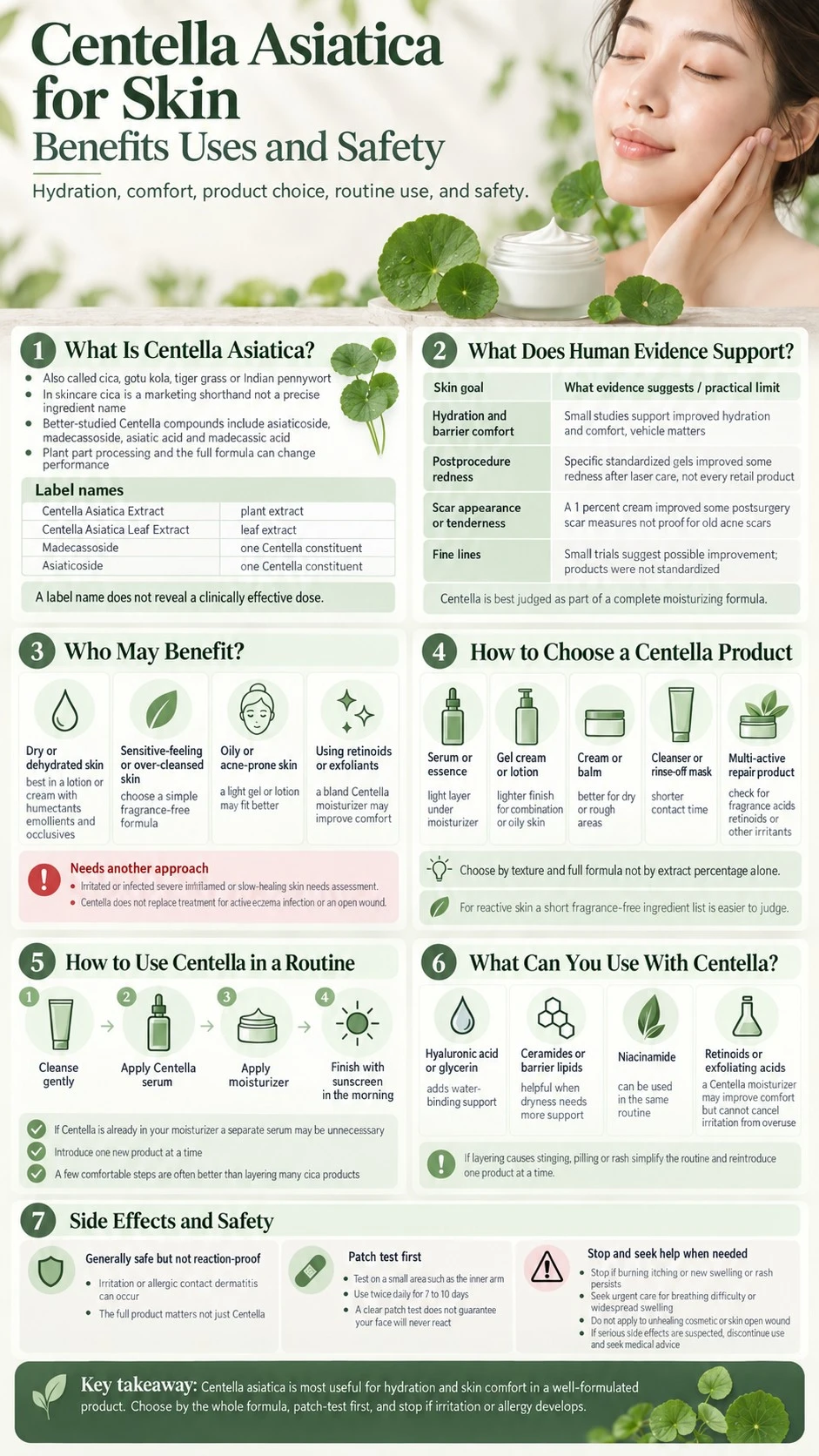
Centella asiatica appears in watery serums, gel creams, and rich “cica” balms. Its reputation as a soothing ingredient has grown faster than the clinical evidence for many advertised benefits. A consumer may see the same plant name on a basic moisturizer, a concentrated extract, and a postprocedure product even though those formulas have different uses.
The useful questions are which benefits have human evidence, whether a finished product suits your skin, and when a reaction calls for stopping it. For everyday skincare, Centella is best judged as one part of a moisturizing formula, not as a stand-alone treatment for damaged skin.
What Is Centella Asiatica and How Does It Work?
Centella asiatica is a leafy plant also known as gotu kola, tiger grass, or Indian pennywort. In skincare, “cica” usually points to a Centella-themed product; it is a marketing shorthand, not a precise ingredient name. On the ingredient list, you may see Centella Asiatica Extract, a more specific plant-part extract, or an isolated constituent such as madecassoside.[1] Cosmetic safety assessors identify several distinct plant-part and cell-culture extracts, so “Centella extract” is not one uniform raw material.[2]
The plant’s better-studied constituents include asiaticoside, madecassoside, asiatic acid, and madecassic acid. Laboratory work links these triterpenes to inflammatory and collagen-related pathways. That gives researchers a reason to study Centella in skin recovery, but a mechanism in cells does not prove that a retail cream can heal skin or erase a scar.[1]
An extract’s plant part, processing, and measured triterpene content can differ from another supplier’s material. The base matters too: a serum may supply a light water-binding layer, while a cream can also reduce the tight feeling associated with a dry surface. When a study tests a finished formula, its result belongs to that formula and use setting. The ingredient name alone cannot tell you how much of the studied compounds reached the skin.[1]
How do Centella names on labels differ?
The names below describe different materials. A label term identifies what was added; it does not disclose a clinically effective dose.
| Label term | What it identifies | What not to assume |
|---|---|---|
| Centella Asiatica Extract | An extract from the plant | Every extract has the same triterpene content |
| Centella Asiatica Leaf Extract | An extract specifically from the leaves | It is interchangeable with every whole-plant extract |
| Madecassoside | One of Centella’s triterpene glycosides | Its percentage equals the percentage of Centella extract |
| Asiaticoside | Another Centella triterpene glycoside | A product containing it has proven scar-treatment effects |
The ingredient list helps you identify the material, while published trials apply only to the preparations they tested. A “100% cica” marketing phrase cannot tell you the concentration of madecassoside or asiaticoside in a finished product.[1]
Centella Asiatica Benefits: What Does Human Evidence Support?
Centella has a plausible biological story, but the human evidence is smaller and more varied than a typical “miracle repair” claim suggests. The table separates everyday cosmetic use from findings in clinical settings.
| Skin goal | What the evidence suggests | Practical limit |
|---|---|---|
| Hydration and barrier comfort | A Centella cream improved hydration in a small dry-skin study.[3] | The tested cream did not outperform a ceramide cream; vehicle matters. |
| Less visible postprocedure redness | A standardized gel improved some redness and wound-appearance measures after laser resurfacing.[5] | The result applies to a specific clinician-supervised setting and gel. |
| Scar appearance or tenderness | A postsurgery trial reported better scar measures with a 1% Centella cream after sutures were removed.[7] | This does not show that any cosmetic cream will fade established acne scars. |
| Fine lines | A review of small trials found possible improvements around the eyes and lips.[8] | Products were not standardized; results cannot be generalized to every cica serum. |
A second hydration study found better moisture levels and lower water loss after a fluid containing Centella stem-cell extract, glycerin, and hyaluronic acid. Because several ingredients were tested together, that result cannot isolate Centella’s contribution.[4] The studies support considering Centella within a complete moisturizing system, but they do not establish a dose or extract percentage that works for every product.
Recovery claims need a narrower reading. The laser study tested a standardized gel on skin receiving professional care.[5] The scar study used a 1% cream after surgical sutures were removed.[7] A wound-healing review found only four eligible clinical trials across different wounds and preparations. None of these results proves that an ordinary cica serum will heal broken skin or flatten an old acne scar.[6]
For daily skincare, it is reasonable to expect a well-made Centella moisturizer to help dry skin feel more comfortable. It is not reasonable to expect the ingredient alone to treat an infection, active acne, eczema, rosacea, or an open wound. If tightness or stinging is persistent, the broader skin barrier problem deserves attention beyond adding one extract.
Who May Benefit from Centella—and Who Needs Another Approach?
Centella suits a supporting role when the goal is comfort rather than disease treatment. The product base matters as much as the headline ingredient. Match the texture to what your routine lacks: water-binding ingredients for dehydration, and enough emollient or occlusive support when dryness and tightness persist.
- Dry or dehydrated skin: A cream or lotion can combine Centella with humectants, emollients, and moisture-sealing ingredients. A thin serum may feel pleasant but may not be enough alone.
- Sensitive-feeling or over-cleansed skin: A simple, fragrance-free Centella moisturizer can be a comfortable option. “Cica” on a label does not make fragrance, strong acids, or essential oils less irritating.
- Oily or acne-prone skin: A light gel or lotion may fit better than a heavy balm. Centella may support comfort during an acne routine, but it does not replace acne treatment.
- Skin using retinoids or exfoliants: A bland Centella moisturizer may help with dryness. If burning or peeling continues, reduce the irritating treatment instead of adding more soothing layers.
Skin that is blistered, infected, severely inflamed, or slow to heal needs assessment rather than an over-the-counter cica experiment. Medical and postprocedure studies should be read in the context of the specific preparation and clinical care used.[5] The small, mixed wound-study evidence does not support substituting a cosmetic for medical care.[6]
How to Choose a Centella Product
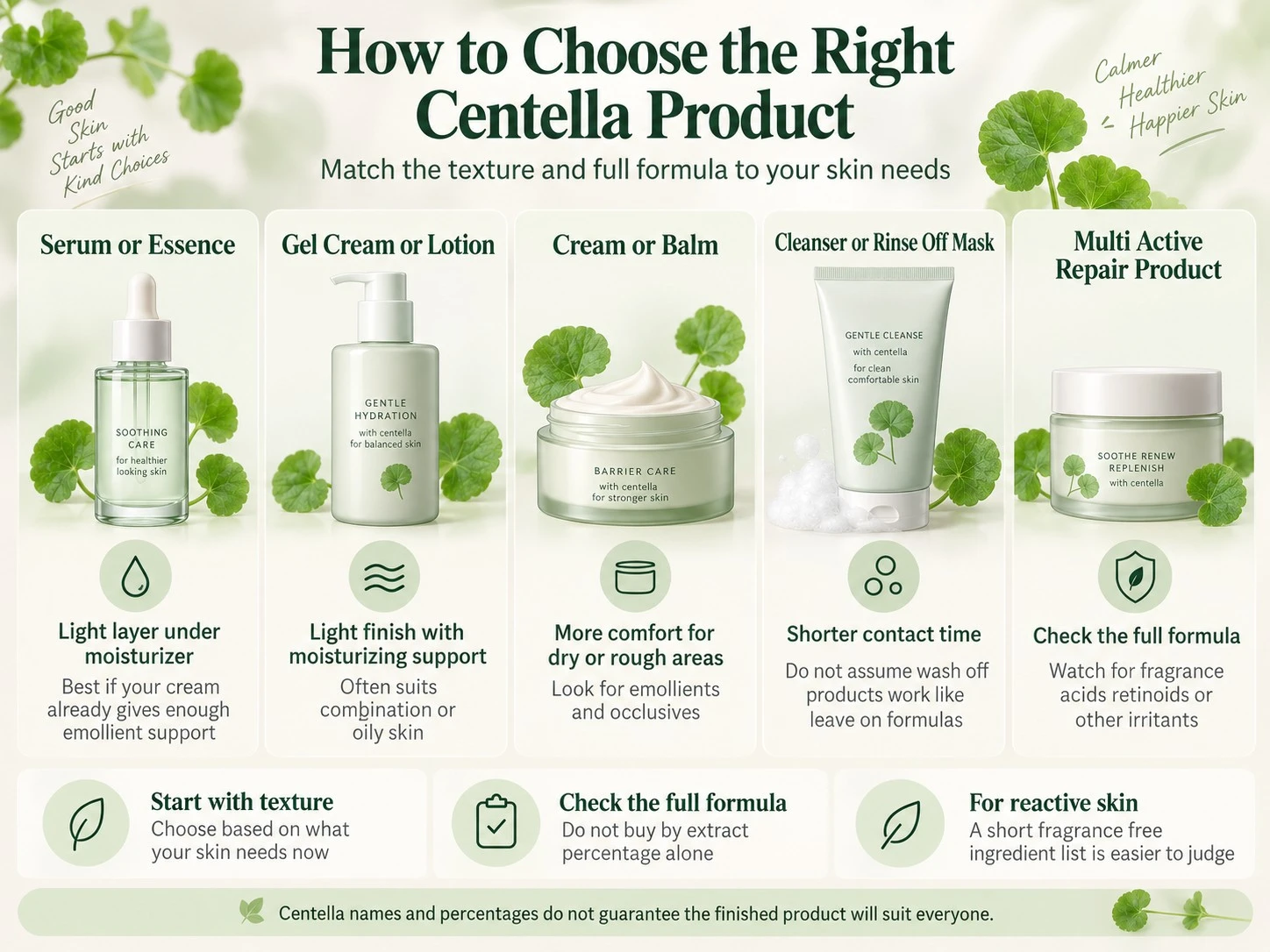
Start with the texture you need, then check what else is in the formula. A percentage on the front label may describe an extract, diluted ingredient solution, or other manufacturer-defined material; it is not a standardized measure of active triterpenes or clinical strength.[1]
- Serum or essence: Adds a light layer beneath moisturizer. Choose it if your current cream already supplies enough emollient support.
- Gel cream or lotion: Combines a lighter finish with moisturizing ingredients and may suit combination or oily skin.
- Cream or balm: Can help dry or rough areas feel less tight when the base includes suitable emollients and occlusives.
- Cleanser or rinse-off mask: Offers shorter contact time. Do not assume that evidence from a leave-on preparation applies to a wash-off product.
- Multi-active “repair” product: Check for fragrance, acids, retinoids, or other ingredients that may control how often you can use it.
For reactive skin, a short, fragrance-free ingredient list is easier to judge than a complex formula with several new actives. Check whether a product marketed for “repair” also contains fragrance, essential oils, or exfoliating acids; those may matter more to tolerability than the Centella claim. If you already tolerate a plain moisturizer, compare a prospective cica product with that moisturizer rather than buying by extract percentage alone. A nearby option is panthenol, another common comfort ingredient; neither name guarantees that the finished product will suit everyone.
How to Use Centella in a Skincare Routine
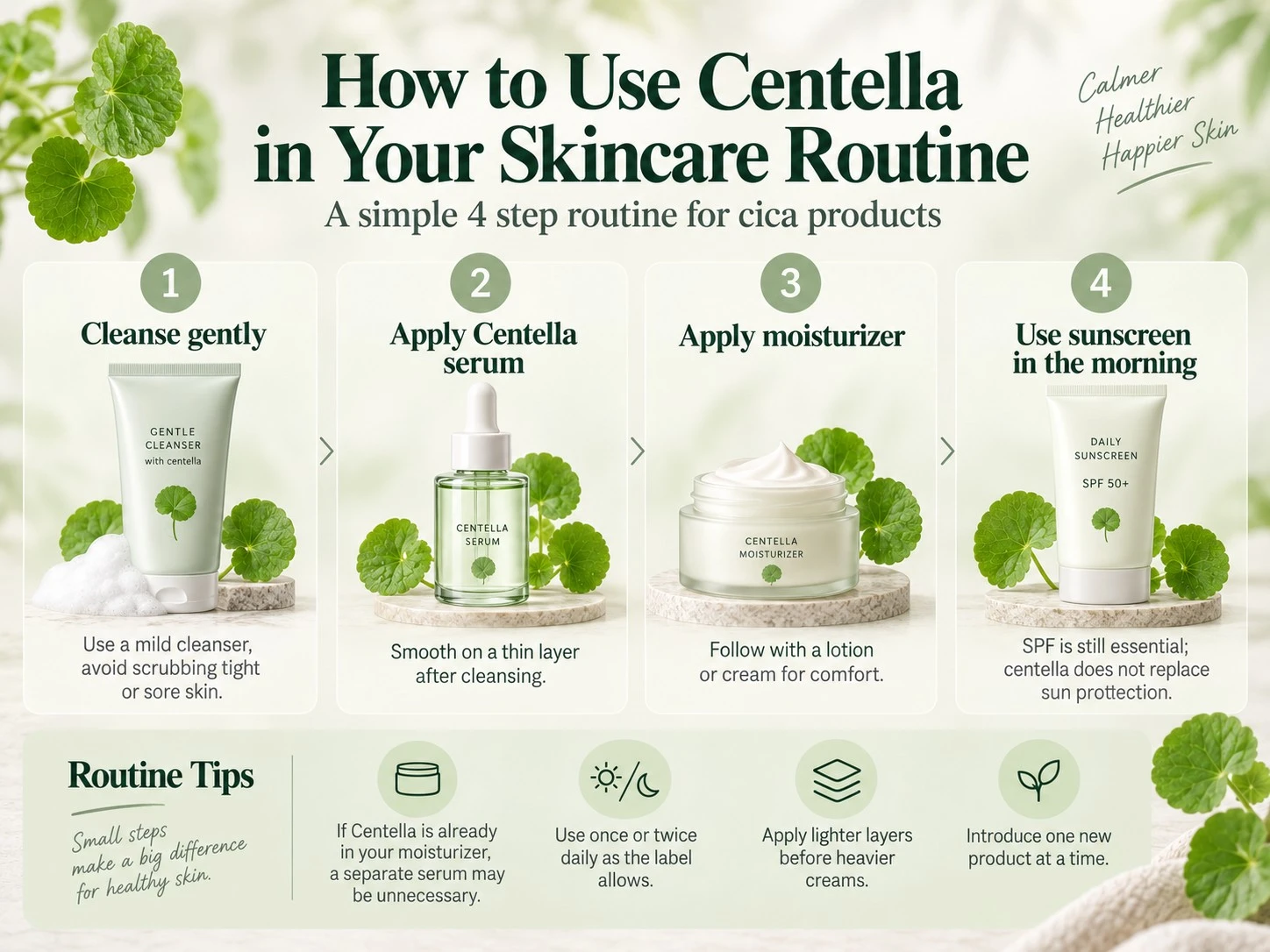
Follow the product label. For a typical leave-on Centella serum, this sequence gives a practical starting point:
- Cleanse gently. Use a mild cleanser and avoid scrubbing skin that already feels tight or sore.
- Apply the Centella serum. Smooth on a thin layer after cleansing, following the label amount.
- Apply moisturizer. Follow the serum with a lotion or cream that keeps your skin comfortable.
- Finish with sunscreen in the morning. Centella is not a sunscreen and does not replace UV protection.
If Centella is already in your moisturizer, use that at step three; a separate serum is unnecessary. A simple product can often be used once or twice daily when the label permits and your skin remains comfortable. Frequency follows the complete product: a gentle Centella cream may fit daily use, while a cica product that also contains an exfoliating acid may need less frequent use.
Introduce one new product at a time. Apply a light serum before a heavier cream if you use both, and allow layers to settle if they pill. A routine with fewer potentially irritating steps may be more useful than layering several cica products; the sensitive skin routine explains that approach.
What Can You Use With Centella Asiatica?
Centella is not an exfoliating acid, and there is no general rule that it must be separated from another skincare ingredient by time of day. The combined formulas and your response decide whether layering works.
- Hyaluronic acid or glycerin: These add water-binding support. Hyaluronic acid can be paired with Centella in a comfortable formula; follow a light serum with moisturizer if dry skin still feels tight.
- Ceramides or other barrier lipids: These can complement a moisturizing Centella formula when dryness calls for more than a humectant layer.
- Niacinamide: The two can appear in the same routine; introduce a new multi-active product gradually if your skin is reactive.
- Retinoids or exfoliating acids: A Centella moisturizer may improve comfort, but it cannot neutralize an overly strong or overused treatment.
If layering causes stinging, pilling, or a new rash, simplify the routine and reintroduce products one at a time. That helps identify a formula problem rather than assuming the ingredient pair is inherently incompatible.
Centella Asiatica Side Effects and Safety Limits
A cosmetic safety assessment concluded that nine Centella-derived ingredients are safe in current practices of cosmetic use and concentration when formulated to be non-sensitizing. That conclusion is conditional; it does not guarantee that every product is allergy-free.[2] Irritation or allergic contact dermatitis can occur, and published case reports have linked Centella-containing creams to allergy.[9]
Before using a new product widely, test the complete formula on a small area such as the inner arm twice daily for 7–10 days. This longer home test may reveal a delayed reaction; a clear result does not guarantee that your face will never react. If you develop persistent burning, itching, redness, swelling, or a rash, wash the product off and stop using it.[10]
A reaction may be caused by Centella or another ingredient, including fragrance or a preservative. Possible warning signs include worsening stinging, an itchy rash, swelling, or new scaling after repeated use. Stop the product rather than layering more “calming” products over the reaction. If the cause is unclear or the rash persists, a dermatologist can assess it and may recommend medical patch testing.[10] Seek urgent care for breathing difficulty or marked facial swelling.
Do not apply an ordinary cosmetic to an open wound or immediately after a procedure unless your clinician’s aftercare plan allows it. Trials involving standardized postprocedure gels are not instructions to use retail products on broken skin.[5] In a postsurgery trial, the studied cream was applied after sutures were removed.[7] Oral gotu kola is a different exposure; the advice here concerns topical skincare.
FAQs About Centella Asiatica for Skin
Can you use Centella asiatica every day?
Yes, a simple leave-on Centella product can often be used daily if its label allows it and your skin tolerates the complete formula. Start with one new product and stop if persistent irritation develops.
Is Centella asiatica good for acne-prone skin?
A comfortable Centella moisturizer can support an acne routine, but it is not an established acne treatment. Choose a texture your skin tolerates and continue any prescribed treatment as directed.
Is Centella asiatica the same as madecassoside?
No. Centella asiatica is the plant; madecassoside is one compound found in it. A whole-plant extract and isolated madecassoside are not automatically equivalent in concentration or effect.[1]
Can Centella asiatica fade acne scars?
Evidence from specific postprocedure and postsurgery preparations does not establish that a retail cica cream can remove indented or raised acne scars. The laser study addressed early recovery, not removal of established indented scars.[5] A postsurgery scar-cream result should not be generalized to every acne scar.[7]
Sources
[1] Handayani et al. Centella asiatica (L.) Urb. in skin health and cosmeceuticals: mechanisms, clinical evidence, and advanced delivery systems
[2] Cosmetic Ingredient Review. Safety Assessment of Centella asiatica-Derived Ingredients as Used in Cosmetics
[3] Anggraeni et al. Role of Centella asiatica and ceramide in skin barrier improvement: a double blind clinical trial of Indonesian batik workers
[4] Milani and Sparavigna. The 24-hour skin hydration and barrier function effects of a hyaluronic 1%, glycerin 5%, and Centella asiatica stem cells extract moisturizing fluid: an intra-subject, randomized, assessor-blinded study
[5] Damkerngsuntorn et al. The Effects of a Standardized Extract of Centella asiatica on Postlaser Resurfacing Wound Healing on the Face: A Split-Face, Double-Blind, Randomized, Placebo-Controlled Trial
[6] Arribas-López et al. A Systematic Review of the Effect of Centella asiatica on Wound Healing
[7] Balevi and Balevi. The effect of Centella Asiatica cream on scar development in patients who underwent open carpal tunnel release surgery
[8] Kongkaew et al. Efficacy and Safety of Centella Asiatica (L.) Urb. on Wrinkles: A Systematic Review of Published Data and Network Meta-Analysis
[9] Izu et al. Allergic contact dermatitis from a cream containing Centella asiatica extract
[10] American Academy of Dermatology. How to test skin care products


