

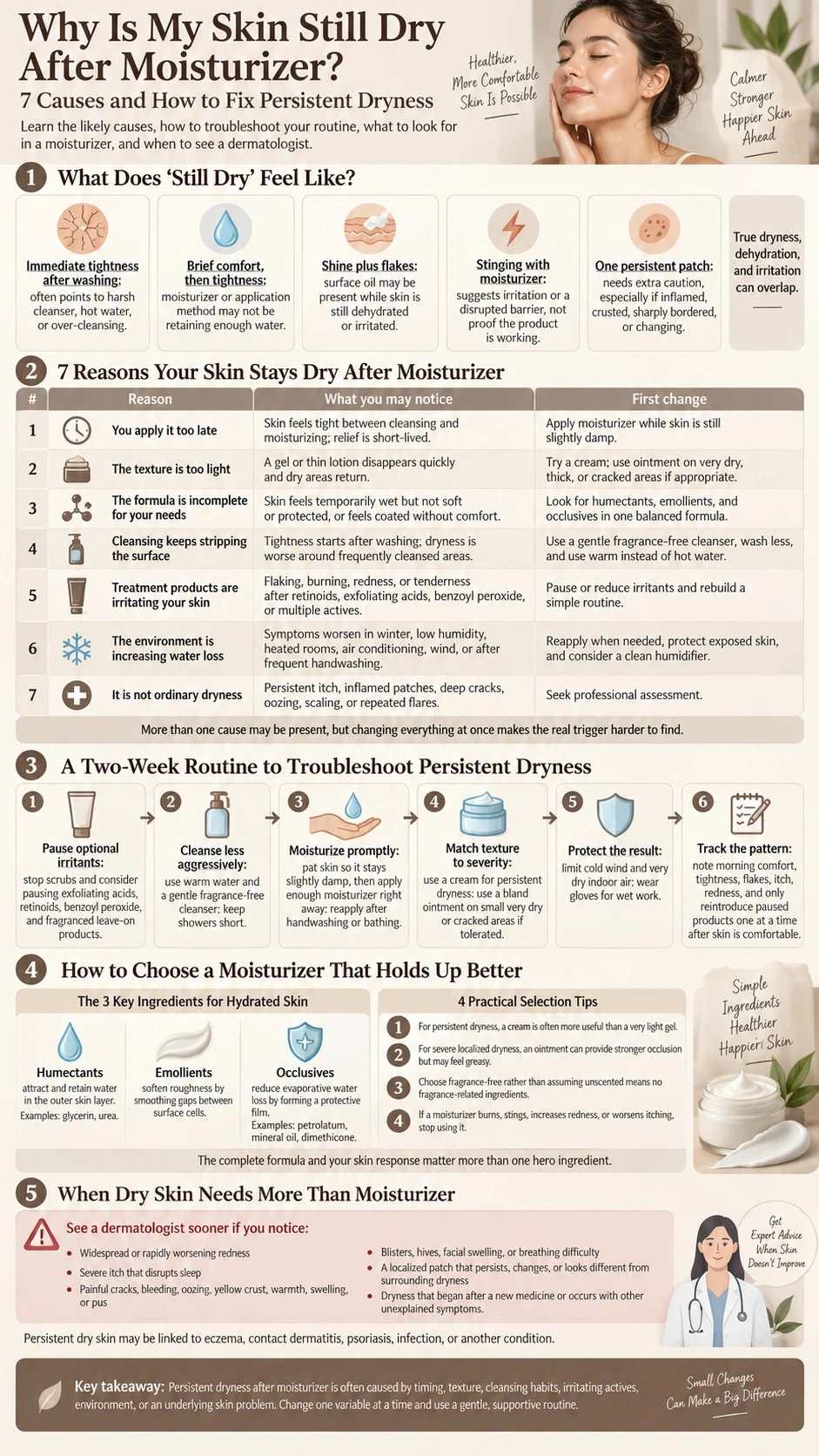
Start by noticing when the discomfort returns. Tightness immediately after cleansing points to a different problem than flakes that reappear hours later, and moisturizer that stings calls for a different response than one that simply feels too light. That timing helps you change the right variable instead of adding more products at random.
What Does “Still Dry” Feel Like?
Use the pattern, not just the word “dry,” to choose your next step. True dry skin lacks enough surface lipids and often feels rough, flaky, or tight. Dehydrated skin describes low water content and can occur even when the face becomes oily. Irritated skin may add burning, tenderness, redness, or itching. These patterns can overlap, so dry skin and dehydrated skin are not always separate categories.
Pay attention to timing and location:
- Immediate tightness after washing points toward a harsh cleanser, hot water, or over-cleansing.
- Brief comfort followed by tightness suggests that the product or application method is not retaining enough water.
- Shine plus flakes can mean surface oil is present while the outer layer remains dehydrated or irritated.
- Stinging when moisturizer touches the skin suggests irritation or a disrupted barrier, not proof that the product is “working.”
- One persistent patch deserves more caution than evenly dry skin, especially if it is inflamed, sharply bordered, crusted, or changing.
7 Reasons Your Skin Stays Dry After Moisturizer
The table below maps the most useful clues to a likely failure point and a controlled change. More than one cause may be present, but changing everything at once makes the real trigger harder to identify.
| Likely reason | What you may notice | What to change first |
|---|---|---|
| 1. You apply it too late | Skin feels tight between cleansing and moisturizing; relief is short-lived | Pat rather than air-dry, then apply moisturizer while skin is still slightly damp |
| 2. The texture is too light | A gel or thin lotion disappears quickly and dry areas return | Move to a cream; use an ointment only on very dry, thick, or cracked areas if appropriate |
| 3. The formula is incomplete for your needs | Skin feels temporarily wet but not soft or protected, or feels coated without becoming comfortable | Look for a balanced formula with humectants, emollients, and occlusives rather than chasing one hero ingredient |
| 4. Cleansing keeps stripping the surface | Tightness starts after washing; dryness is worse around frequently cleansed areas | Use a gentle, fragrance-free cleanser, reduce unnecessary washes, and use warm rather than hot water |
| 5. Treatment products are irritating your skin | Flaking, burning, redness, or tenderness follows retinoids, exfoliating acids, benzoyl peroxide, or multiple actives | Pause or reduce likely irritants and rebuild a simple routine before reintroducing one product at a time |
| 6. The environment is increasing water loss | Symptoms worsen in winter, air conditioning, heated rooms, low humidity, wind, or after frequent handwashing | Reapply when needed, protect exposed skin, and consider a clean humidifier in dry indoor air |
| 7. It is not ordinary dryness | Persistent itch, inflamed patches, deep cracks, oozing, scaling, or repeated flares remain despite careful moisturizing | Seek professional assessment for contact dermatitis, atopic dermatitis, psoriasis, infection, or another cause |
Applying a moisturizer while skin is still damp and reapplying when it feels dry are standard dry-skin measures.[1] The timing matters because moisturizer can help hold onto water already present after washing; it cannot reverse every source of ongoing water loss by itself. See the focused guide to using moisturizer on wet or dry skin for timing details.
Texture also changes performance. Lipid-rich ointments generally retain water better for very dry skin, while creams and lotions may be more practical for milder dryness or daytime use. No single format is best everywhere: the face, hands, lower legs, and skin folds may tolerate different textures.[2]
If stinging, redness, or tenderness appeared after you increased exfoliation or added several actives, focus on the routine rather than buying a heavier jar. A damaged skin barrier can lose water more easily, and another strong treatment can extend the irritation cycle.
A Two-Week Routine to Troubleshoot Persistent Dryness
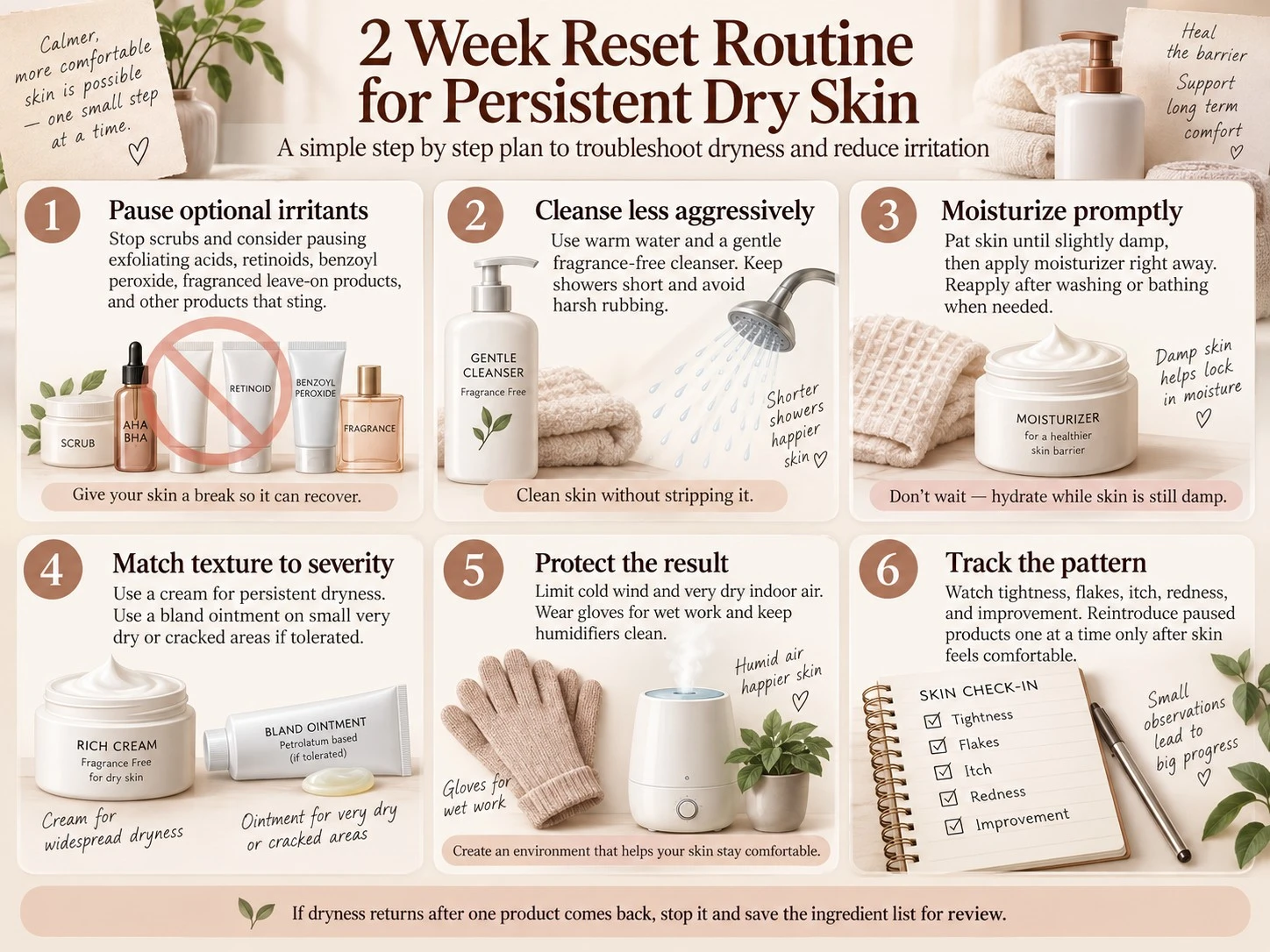
This reset is designed to reveal whether application, product texture, or routine irritation is the main problem. It is not a treatment plan for diagnosed eczema, psoriasis, infection, or allergy.
- Pause optional irritants. For one to two weeks, stop scrubs and consider pausing exfoliating acids, retinoids, benzoyl peroxide, fragranced leave-on products, and other products that sting. Follow a clinician’s instructions before changing a prescribed treatment.
- Cleanse less aggressively. Use warm water and a gentle, fragrance-free cleanser. Keep showers short, avoid vigorous washcloths or cleansing brushes, and cleanse only as often as needed.
- Moisturize promptly. Pat the skin so it remains slightly damp, then apply enough moisturizer to cover the dry area without hard rubbing. Reapply after handwashing, bathing, or whenever the area feels dry.[1]
- Match texture to severity. Use a cream for persistent facial or body dryness. For small, very dry or cracked areas, a thin layer of a bland ointment can reduce evaporation if the area and your skin tolerate it.
- Protect the result. Limit exposure to cold wind and very dry indoor air. Wear gloves for wet work and clean any humidifier according to its instructions.
- Track the pattern. Note morning comfort, post-cleansing tightness, flakes, itch, redness, and which areas improve. Add paused products back one at a time only after the skin is comfortable.
Improvement supports a routine or formulation problem, but it does not identify one ingredient with certainty. If symptoms return after a specific product is reintroduced, stop it and keep the ingredient list for a clinician to review if reactions continue.
How to Choose a Moisturizer That Holds Up Better
A better moisturizer is not automatically the product with the longest ingredient list or highest price. It should match the severity and location of dryness, remain comfortable enough to use consistently, and avoid ingredients that repeatedly irritate you.
Moisturizers commonly combine three functional groups:
- Humectants such as glycerin and urea attract and retain water in the outer skin layer.
- Emollients soften roughness by smoothing gaps between surface cells.
- Occlusives such as petrolatum, mineral oil, or dimethicone form a film that reduces evaporative water loss.[3]
For persistent dryness, a cream that combines these roles is often more useful than a very light, humectant-led gel. For severe localized dryness, an ointment provides stronger occlusion but may feel greasy and may not suit every facial or acne-prone area. The guide to humectants, emollients, and occlusives explains how to read these formula roles without treating them as rigid ingredient categories.
Choose “fragrance-free” rather than assuming “unscented” means no fragrance-related ingredients. If a product burns, stings, increases redness, or makes itching worse, stop using it even if its ingredients are popular for barrier care. Ceramides, glycerin, hyaluronic acid, dimethicone, petrolatum, mineral oil, shea butter, urea, or lactic acid can all appear in useful dry-skin formulas, but the complete formula and your response matter more than any one name.[1]
If a moisturizer feels heavy yet your skin remains tight, adding more layers of the same product may only increase residue. Reassess cleansing and active use, then compare texture and formula balance using the guide to choosing a moisturizer for your skin type.
When Dry Skin Needs More Than Moisturizer
Arrange a medical evaluation when careful self-care does not improve the dryness, symptoms keep returning, or anything applied to the skin causes ongoing burning or stinging.[1] Persistent dry skin can accompany conditions such as atopic dermatitis or psoriasis and may need more than a cosmetic moisturizer.[4]
Seek care sooner for:
- widespread or rapidly worsening redness;
- severe itch that disrupts sleep;
- painful cracks, bleeding, oozing, yellow crust, warmth, swelling, or pus;
- blisters, hives, facial swelling, or breathing difficulty;
- a localized patch that persists, changes, or looks different from the surrounding dryness;
- dryness that began after a new medicine or occurs with other unexplained symptoms.
Do not repeatedly exfoliate flakes that are attached to sore or inflamed skin. Scrubbing may remove more of the protective outer layer and make moisturizer sting more. A clinician can distinguish ordinary xerosis from eczema, contact dermatitis, psoriasis, infection, or another condition and recommend treatment for the actual cause.
FAQs About Skin That Stays Dry After Moisturizer
Why does my skin feel dry immediately after moisturizer?
The moisturizer may be too light, you may have waited until the skin fully dried, or washing and treatment products may already have irritated the surface. Apply a fragrance-free cream to slightly damp skin and simplify the routine. Persistent burning, redness, or itching points away from a simple application problem.
Why is my skin oily but still flaky?
Surface oil does not guarantee that the outer skin layer holds enough water. Oily, flaky skin can also reflect irritation from acne products, retinoids, exfoliation, harsh cleansing, or seborrheic dermatitis. Avoid assuming that either a heavier cream or stronger exfoliation is automatically the answer; use the location and accompanying symptoms to guide the next step.
Can using too much moisturizer make skin dry?
Using a large amount does not usually create true dryness by itself, but it can leave residue, feel uncomfortable, contribute to congestion in some people, or hide the fact that the cleanser or active routine is the real problem. Use enough for an even layer, then change the formula or routine if tightness persists instead of endlessly increasing the amount.
How long should a moisturizer take to improve dry skin?
A suitable moisturizer can make skin feel more comfortable soon after application, but visible flaking and barrier disruption may take days or longer to settle. You should see a consistent trend toward less tightness, roughness, and itch during a gentle one- to two-week trial. Seek professional advice if symptoms do not improve or become worse.[4]
Sources
[1] American Academy of Dermatology Association. Dermatologists’ Top Tips for Relieving Dry Skin
[2] Augustin M, et al. Optimization of Basic Emollient Therapy for the Management of Xerosis Cutis
[3] DermNet. Emollients and Moisturizers
[4] Mayo Clinic. Dry Skin: Diagnosis and Treatment


