

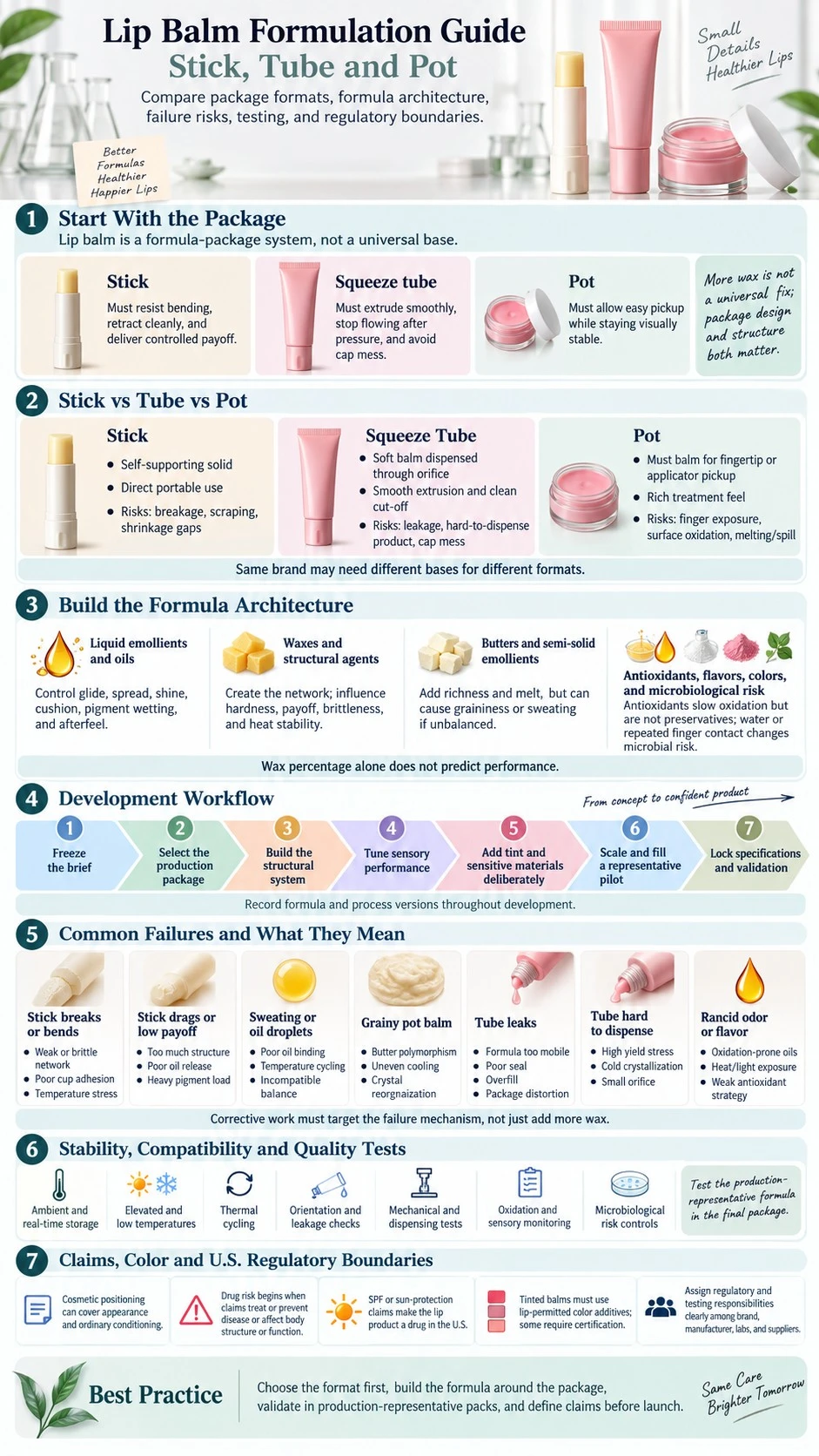
Lip balm formulation is not simply a matter of mixing oils, butter, and wax until the blend feels firm. The correct structure depends on how the product leaves its package, contacts the lips, survives distribution, and supports its claims. A formula that performs well as a pot balm may be too soft for a stick and too resistant to flow through a squeeze-tube orifice.
This guide uses “stick” for a solid balm poured into a twist-up mechanism and “squeeze tube” for a soft balm dispensed through an orifice. That distinction matters: a twist-up tube is still a stick format from a formulation perspective.
Start With the Package, Not a Universal Base Formula
Choose the commercial format before locking the lip balm base. The package determines the forces the formula must withstand and the behavior the consumer expects.
A stick must remain attached to its cup, resist bending during application, rise and retract without scraping, and deposit enough product without dragging. A squeeze-tube balm must move under hand pressure, stop flowing after pressure is released, avoid leaking into the cap, and remain dispensable after cold storage. A pot balm must be easy to pick up with a fingertip or applicator while remaining visually stable across its full surface.
These requirements cannot be reduced to one melting point. Two blends can soften at similar temperatures yet differ in brittleness, payoff, oil binding, crystal growth, or recovery after heat exposure. Likewise, adding more wax may increase hardness but worsen drag, reduce product transfer, cause cracking, or make a squeeze tube nearly impossible to dispense.
Treat the package as a formulation input rather than decoration added after development. Component resin, internal coating, diameter, cup design, wiper, orifice, seal, cap, headspace, and fill volume can change compatibility and function. Production-representative packs should therefore enter development early, not after the bulk formula has been approved.
Stick vs Squeeze Tube vs Pot Lip Balm
The best format is the one that matches the intended use, texture, climate, claims, price position, and application experience. The same brand may need separate bases for different formats.
| Decision point | Stick | Squeeze tube | Pot |
|---|---|---|---|
| Required structure | Self-supporting solid with controlled bend and break resistance | Soft solid or high-viscosity balm that flows under pressure | Soft to firm balm that allows fingertip or applicator pickup |
| Application target | Low drag, even payoff, clean glide, limited surface sweating | Smooth extrusion, clean cut-off, spreadability, no stringing | Easy pickup, fast melt on contact, no graininess or oil pooling |
| Structural demand | Generally highest | Usually lowest, but yield behavior must suit the orifice | Adjustable from soft balm to firmer salve-like texture |
| Primary packaging risks | Bullet pull-out, scraping, cap contact, mechanism failure, shrinkage gaps | Leakage, seal contamination, paneling, poor extrusion, cap mess | Finger exposure, surface oxidation, liner interaction, heat-softened spill |
| Typical filling challenge | Voids, sinkholes, center collapse, poor adhesion, uneven cooling | Air pockets, hot-fill distortion, inconsistent fill weight, tailing | Surface ripples, frosting, uneven set, bubbles, concavity |
| Best fit | Portable, direct application with familiar twist-up use | Glossy, cushiony, or softer balm with hygienic direct dispensing | Rich treatment positioning, larger pickup, or ritual-style application |
The table describes performance targets, not fixed ingredient percentages. The required structure changes when a brand switches from clear to tinted balm, changes the stick diameter, adds a high load of powder, replaces beeswax with plant waxes, or targets a hotter distribution environment.
Build the Lip Balm Formula Architecture
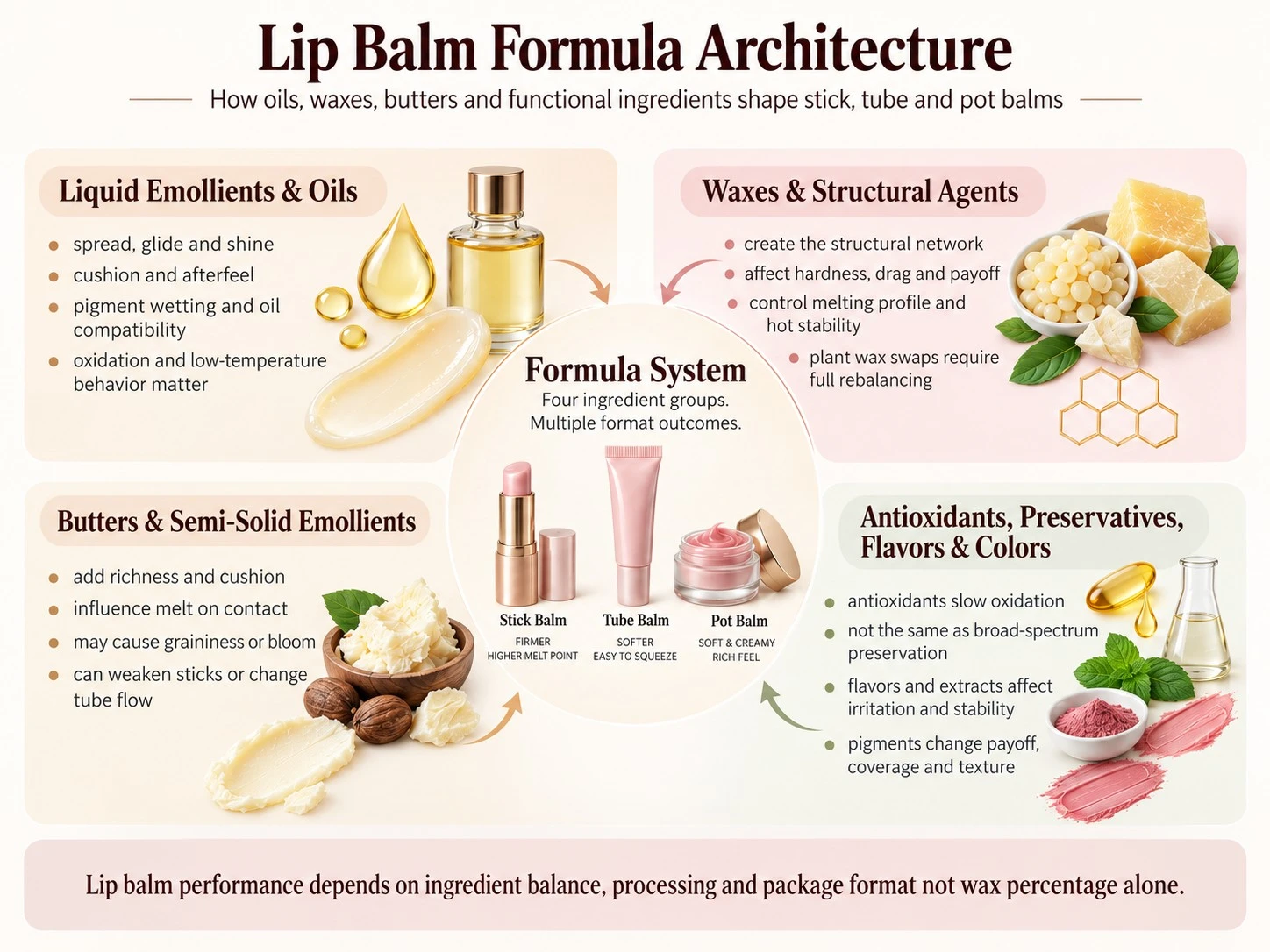
Most conventional lip balms are anhydrous systems built from liquid emollients, structural materials, semi-solid emollients, and small amounts of functional ingredients. Each group has a different job, and changing one material can alter several properties at once.
Liquid emollients and oils
Liquid oils and esters control spread, glide, shine, cushion, pigment wetting, and afterfeel. A lighter ester can reduce greasiness, while a more substantive oil can improve cushion and residence on the lips. Polarity also affects how well oils interact with waxes, flavors, pigments, and oil-soluble actives.
Do not select oils only from a “natural” or “luxury” story. Review oxidation sensitivity, odor, color, supply consistency, low-temperature behavior, regulatory status, and compatibility with the desired wax network. Highly unsaturated oils can support an attractive label story but may require tighter oxidation control and shelf-life monitoring.
Waxes and structural agents
Waxes create the network that holds liquid oils in place. They influence hardness, melting profile, payoff, drag, brittleness, gloss, contraction during cooling, and stability at elevated temperature. Beeswax, candelilla wax, carnauba wax, rice bran wax, sunflower wax, synthetic waxes, hydrogenated oils, and polymeric oil gellants are not one-for-one substitutes.
A harder or higher-melting wax does not automatically create a better hot-climate stick. An overly rigid network can snap, crumble, drag, or release oil when the crystal system is poorly balanced. Plant-wax conversions often require a complete rebalancing of wax blend, liquid emollients, and cooling conditions rather than a direct beeswax replacement.
For squeeze tubes, structure is still needed, but the product must yield when the user presses the pack. The development target is not simply “softer than a stick”; it is a controlled relationship among extrusion force, flow through the orifice, shape retention on exit, and clean cut-off when pressure stops.
Butters and semi-solid emollients
Butters can add cushion, richness, and a lower-temperature melt during application. Their natural triglyceride composition can also create polymorphic changes: crystals may reorganize during storage and produce graininess, bloom, or a changing melt profile. Processing history and temperature cycling therefore matter as much as the ingredient name.
Pot balms often tolerate a softer butter-rich structure, but a formula that melts pleasantly under a fingertip may slump or leak during hot transport. In sticks, excessive low-melting butter can weaken the bullet or increase sweating. In squeeze tubes, crystallization can change extrusion force over time.
Antioxidants, preservatives, flavors and colors
Antioxidants such as tocopherol can slow oxidation in suitable oil systems, but they do not function as broad-spectrum antimicrobial preservatives. An anhydrous balm may have low microbial growth potential, yet raw-material bioburden, wet fingers, water-based extracts, and package use still belong in the risk assessment. If water or a water-containing ingredient is introduced, the preservation strategy and test plan must be reconsidered rather than assuming the original anhydrous logic still applies.
Flavor, fragrance, cooling agents, sweeteners, and botanical extracts can change more than taste. They may affect irritation potential, oxidation, color, solubility, regulatory status, or package interaction. Use materials documented for the intended lip application and market; “food grade” alone does not establish that a flavor is appropriate at the proposed cosmetic use level.
Tinted balms require approved color additives for the intended area of use and market. Pigments also change viscosity, payoff, stick strength, coverage, and surface appearance. Dispersion quality must be controlled so the shade remains even and the formula does not feel gritty.
How to Develop a Lip Balm Formula for the Chosen Format
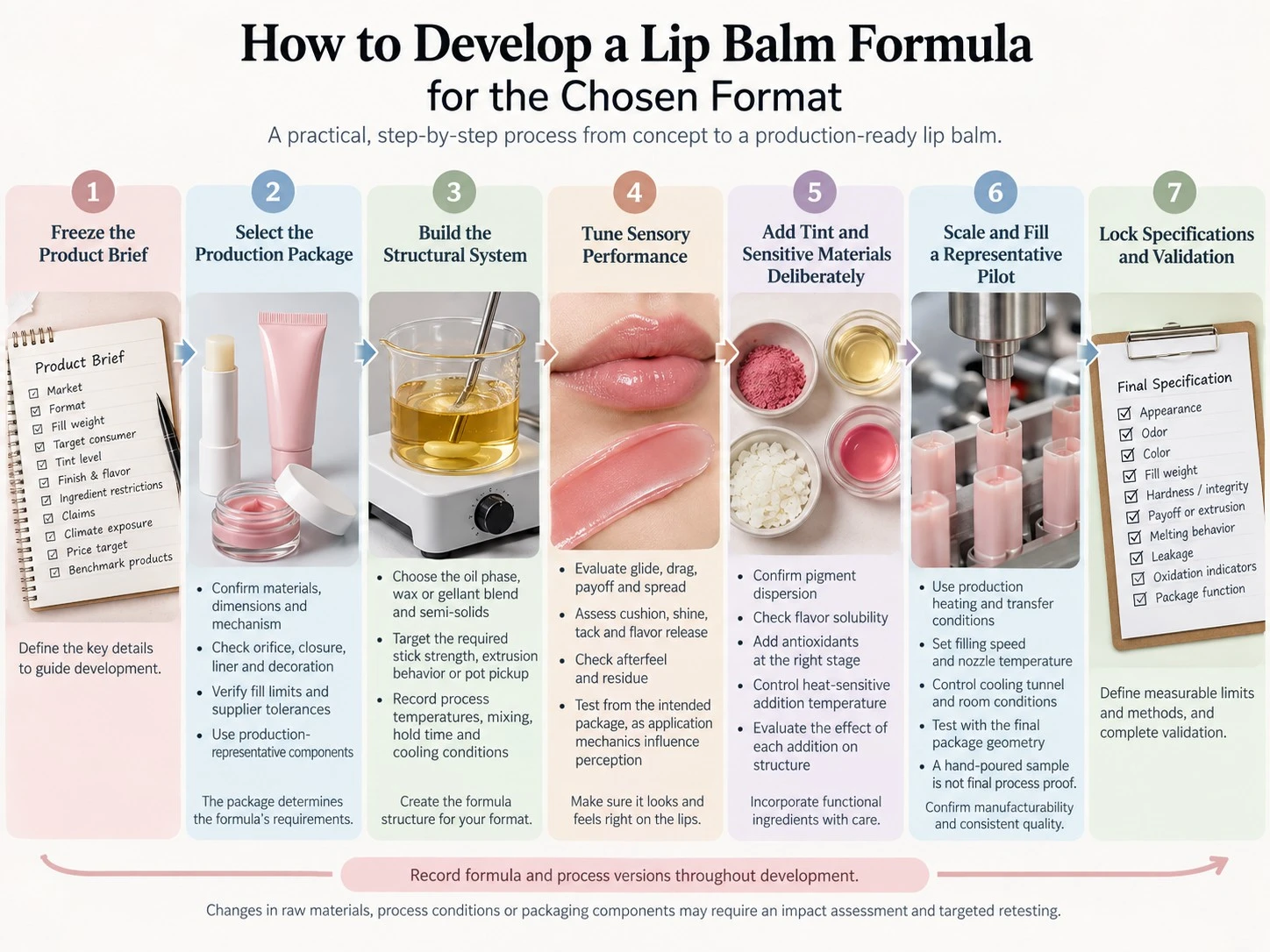
A disciplined development sequence prevents teams from optimizing a beautiful bench sample that cannot be manufactured or packaged reliably.
- Freeze the product brief. Define the market, format, fill weight, target consumer, tint level, finish, flavor, vegan or ingredient restrictions, claim boundary, climate exposure, price target, and benchmark products.
- Select the production package. Confirm contact materials, dimensions, mechanism, orifice, closure, liner, decoration, fill limits, and supplier tolerances. Obtain production-representative components rather than relying only on visual samples.
- Build the structural system. Choose the oil phase, wax or gellant blend, and semi-solids for the required stick strength, extrusion behavior, or pot pickup. Record actual process temperatures, mixing, hold time, and cooling conditions.
- Tune sensory performance. Evaluate glide, drag, payoff, spread, cushion, shine, tack, flavor release, afterfeel, and residue. Test the product from its intended package because application mechanics influence perception.
- Add tint and sensitive materials deliberately. Confirm pigment dispersion, flavor solubility, antioxidant placement, heat-sensitive addition temperature, and the effect of each addition on structure.
- Scale and fill a representative pilot. Production heating, transfer, filling speed, nozzle temperature, cooling tunnel, room conditions, and pack geometry can change crystallization and appearance. A hand-poured laboratory sample is not final process proof.
- Lock specifications and validation. Define measurable limits and methods for appearance, odor, color, fill weight, hardness or mechanical integrity, payoff or extrusion, melting or softening behavior where relevant, leakage, oxidation indicators, and package function.
Record formula and process versions throughout development. A change in wax supplier, oil grade, pigment dispersion, cooling profile, component resin, or fill temperature can require an impact assessment and targeted retesting.
Common Lip Balm Failures and What They Mean
Defects are signals, not diagnoses. Investigate the formula, process, package, and test method before assuming that one ingredient is responsible.
| Observed failure | Possible contributors | Useful checks |
|---|---|---|
| Stick breaks or bends | Weak or brittle crystal network, excessive projection, package geometry, temperature, poor cup adhesion | Break force, application angle, hot and cold conditioning, mechanism and cup inspection |
| Stick drags or gives low payoff | Excess structure, unsuitable wax blend, low surface melt, poor oil release, pigment load | Payoff by mass, glide panel, repeated strokes, conditioned-temperature comparison |
| Sweating or oil droplets | Poor oil binding, temperature cycling, incompatible oil–wax balance, fragrance or flavor addition | Orientation study, cycling, raw-material review, surface microscopy where useful |
| Grainy pot balm | Butter polymorphism, slow or uneven cooling, repeated partial melting, incompatible crystal systems | Controlled cooling trials, thermal history, microscopy, hot–cold cycling |
| Squeeze tube leaks | Formula too mobile at heat, poor seal, cap or orifice mismatch, overfill, package distortion | Inverted storage, elevated temperature, torque or seal checks, fill-volume review |
| Tube is hard to dispense | Yield stress too high, cold crystallization, orifice too small, wall stiffness, aging of the structure | Extrusion force at multiple temperatures and time points, orifice and resin comparison |
| Rancid odor or flavor | Oxidation-prone oils, heat exposure, oxygen or light ingress, contaminated raw materials, weak antioxidant strategy | Odor panel, peroxide or other justified chemistry, package barrier review, raw-material age |
Corrective work should target the failure mechanism. Raising the wax level may stop one hot-storage leak but create poor payoff, cracking, or an unacceptable cold-temperature extrusion force.
Stability, Compatibility and Quality Tests
Lip balm testing should reflect the marketed formula, final package, intended markets, shipping conditions, and consumer use. ISO/TR 18811 provides a framework for cosmetic stability assessment but does not prescribe one universal protocol, condition, or acceptance limit for every cosmetic.[1]
Build a risk-based program that may include:
- Ambient and real-time storage: Follow appearance, odor, flavor, color, texture, fill condition, package function, and chemistry over the intended shelf life.
- Elevated and low temperatures: Challenge softening, leakage, sweating, brittleness, crystallization, extrusion, and component distortion without treating one severe condition as a universal shelf-life conversion.
- Thermal cycling: Detect crystal reorganization, graininess, oil migration, shrinkage, seal stress, and loss of package function.
- Orientation and leakage: Store packs upright, inverted, and horizontally where relevant; inspect caps, liners, seams, threads, mechanisms, and secondary packaging.
- Mechanical and dispensing tests: Measure stick break or bend behavior, cup retention, twist-up and retraction, payoff, extrusion force, cut-off, dose consistency, and cap cleanliness using defined methods.
- Oxidation and sensory monitoring: Track odor, flavor, color, and justified chemical indicators for oxidation-sensitive formulas.
- Microbiological risk controls: Review raw-material quality, manufacturing hygiene, water activity or anhydrous status, consumer contact, and any water-containing additions. A pot used with fingers presents a different exposure pattern from a closed squeeze tube.
The United States does not impose one fixed test list for every cosmetic. The manufacturer or distributor remains responsible for ensuring safety under labeled or customary conditions of use, and testing should be scientifically sound.[2] Passing stability also does not replace safety substantiation, package compatibility, manufacturing controls, or claim support.
Test bulk in production-representative packaging. ZICAIL’s packaging compatibility testing guide explains why formula and component interactions must be evaluated together. Approved limits should also connect to the finished cosmetic product specification and remain traceable through documented batch codes.
Claims, Color and U.S. Regulatory Boundaries
Define the U.S. claim strategy before finalizing ingredients, tests, and labeling. A cosmetic lip balm can be positioned around appearance and ordinary cosmetic conditioning, but intended use determines whether a product is regulated as a cosmetic, drug, or both. Claims to treat or prevent disease or affect the structure or function of the body can move the product into drug regulation.[3]
Sun-protection claims are a clear example. A lip product carrying an SPF or sun-protection claim is regulated as a drug in the United States; a product positioned as both makeup and sunscreen must meet both cosmetic and drug requirements.[4] “Skin protectant” or therapeutic claims for chapped lips also require regulatory review rather than being added as casual marketing language.
For tinted balms, every color additive must be permitted for the intended cosmetic use. Approval for one application area does not automatically authorize use on the lips, and some color additives require certification. Shade development must therefore begin with a market-specific permitted-color review, not only a visual brief.[2][4]
Final responsibilities may include ingredient and finished-product safety substantiation, compliant ingredient naming, net contents, warnings where required, responsible-person information, adverse-event procedures, facility registration and product listing where applicable, and market-specific label review.[3] Assign these responsibilities in writing among the brand, manufacturer, responsible person, safety assessor, testing laboratory, and packaging suppliers.
Develop a Lip Balm Project With ZICAIL
ZICAIL can discuss stick, squeeze-tube, and pot lip balm development within a private-label or custom-formulation project, including texture direction, ingredient restrictions, tint and flavor goals, packaging options, pilot filling, stability planning, and finished-product specifications.
Prepare the target markets, claims, benchmark products, format, fill weight, shade or flavor range, vegan or ingredient requirements, target price, launch quantity, packaging direction, expected climate and distribution conditions, and schedule. Then contact ZICAIL to define which formula, package, testing, documentation, and compliance responsibilities belong in the project scope.


