
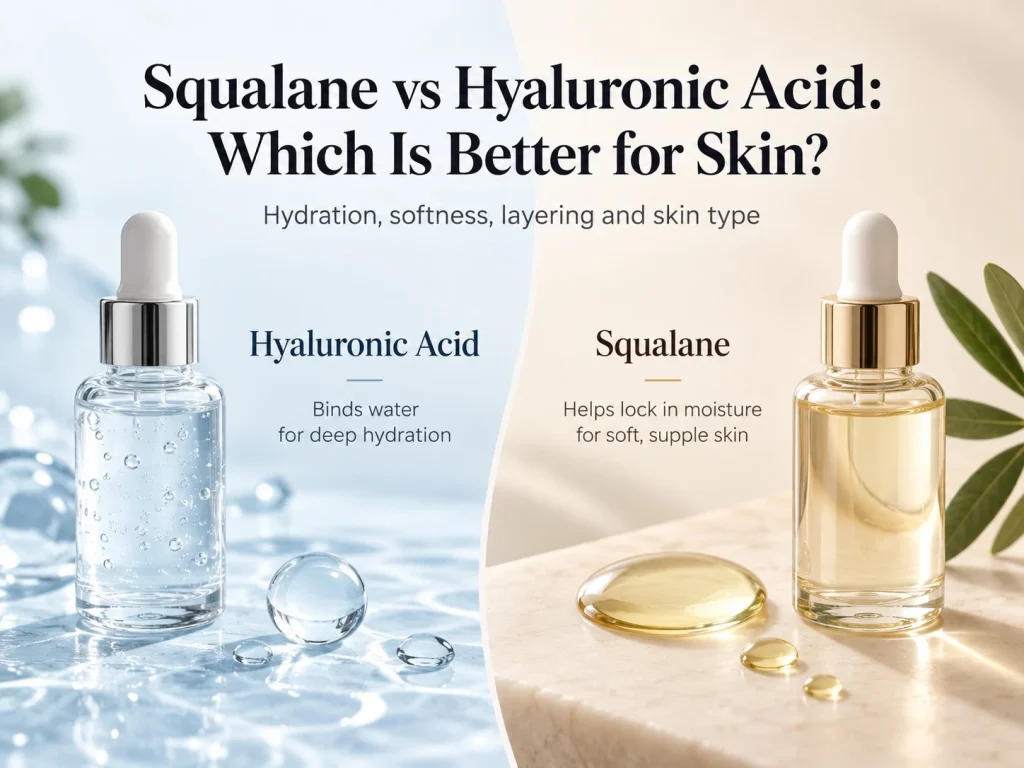

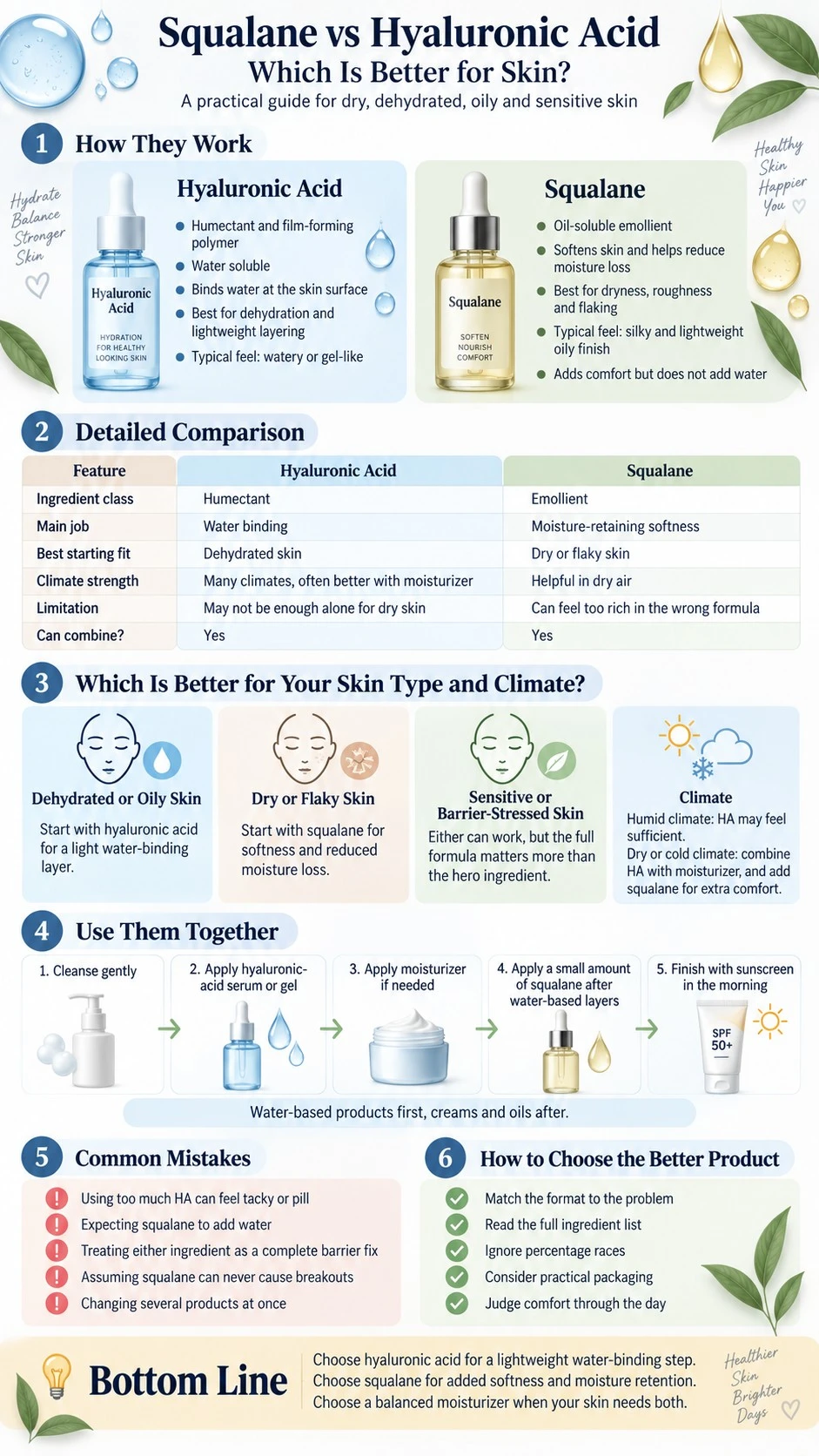
Squalane and hyaluronic acid are often compared as “oil versus water-based hydration,” but the ingredient name alone does not determine the whole product. Pure squalane is an anhydrous oil, while squalane can also be included in a water-based emulsion. Hyaluronic acid is water soluble and normally appears in an aqueous serum, gel, lotion, or cream.
The more useful question is what your skin is missing. Dehydrated skin needs help holding water; dry skin also lacks enough surface lipids and usually benefits from an emollient-rich product. Many people have both problems at the same time.
What Squalane and Hyaluronic Acid Actually Do
Moisturizers work through more than one ingredient class. Humectants bind water, emollients smooth and soften rough spaces in the outer skin, and more occlusive materials slow water evaporation. Well-designed creams and lotions often combine these functions because lasting moisturization depends on both water and the lipid-rich barrier around it.[1]
Hyaluronic acid binds water
Hyaluronic acid is a glycosaminoglycan naturally present in skin and connective tissue. In a topical product, it acts mainly as a humectant and film-forming polymer. It increases water content at the skin surface, which can make skin feel smoother and make fine dehydration lines look temporarily softer.
Ingredient lists may use hyaluronic acid, sodium hyaluronate, hydrolyzed hyaluronic acid, or modified derivatives. Their molecular size and chemistry affect viscosity, film formation, sensory feel, and skin interaction, but “multi-weight” marketing does not prove that a formula hydrates every skin layer. A clinical study of one multi-weight hyaluronic-acid serum found improvements in hydration and several appearance measures, but those results belong to the complete tested formula rather than every product that contains HA.[2]
Squalane softens skin and limits moisture loss
Squalane is the saturated, more oxidation-stable form of squalene, a lipid associated with human sebum. Cosmetic squalane is oil soluble and functions mainly as a lightweight emollient: it improves slip, reduces rough feel, and supports moisture retention at the surface. It does not attract water in the same way as hyaluronic acid.
Squalane can be sourced from plant-derived feedstocks or other sources, so shoppers who want a particular origin should check the supplier or brand statement rather than assuming the source from the INCI name. A cosmetic-ingredient safety review reaffirmed that squalane and squalene are safe in the reported practices of use and concentrations, but that conclusion does not guarantee that every finished product will suit every user.[3]
Squalane vs Hyaluronic Acid: Detailed Comparison
| Comparison point | Hyaluronic acid | Squalane |
|---|---|---|
| Ingredient class | Humectant and film-forming polymer | Emollient hydrocarbon |
| Solubility | Water soluble | Oil soluble |
| Main hydration job | Binds water at and near the skin surface | Softens skin and helps slow moisture loss |
| Typical product feel | Watery, gel-like, sometimes tacky | Silky, oily, usually lightweight |
| Best starting fit | Dehydration, lightweight layering, temporary plumping | Dryness, roughness, flaking, added comfort |
| Climate strength | Useful in many climates but may need a moisturizer over it | Especially useful when dry air increases moisture loss |
| Main limitation | A humectant serum alone may not be enough for dry skin | Adds no water and may feel too rich in an unsuitable formula |
| Breakout prediction | The complete formula matters | The complete formula matters; “non-comedogenic” is not guaranteed by one ingredient |
| Can they be combined? | Yes—apply the water-based layer first | Yes—apply after the thinner layer or use a combined moisturizer |
The comparison is functional, not a contest over which ingredient “hydrates more.” Skin can contain more water yet still feel uncomfortable if the routine lacks enough emollient or occlusive support. It can also feel softer after an oil while remaining dehydrated because oil does not supply water.
Which Is Better for Your Skin Type and Climate?
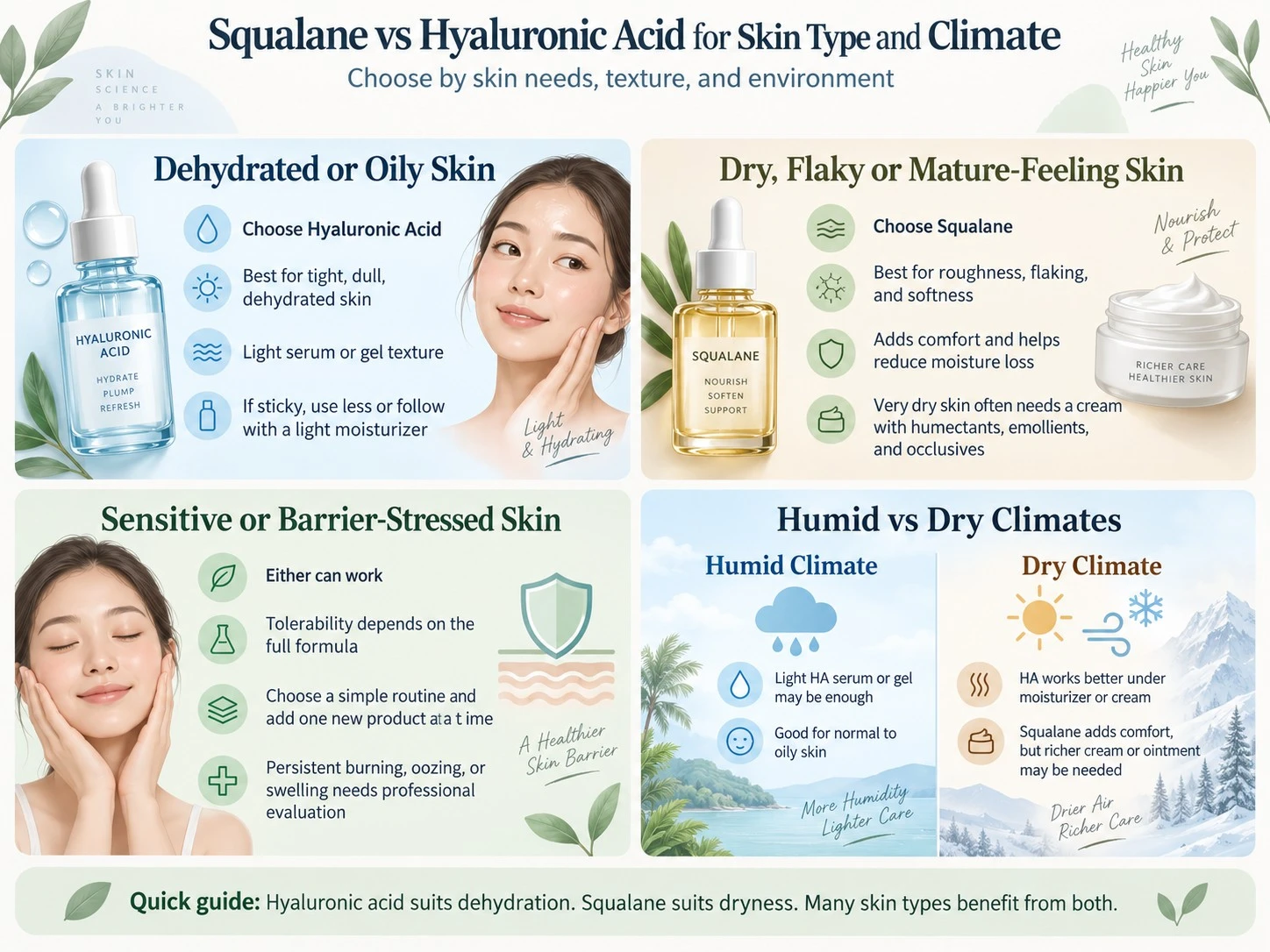
Choose according to the problem you want the product to solve, then use texture and tolerability as tie-breakers.
Dehydrated or oily skin
Start with hyaluronic acid when skin feels temporarily tight or looks dull while still producing oil. A low-residue serum or gel can add water-binding support without a rich finish. Oily skin can be dehydrated, so visible shine does not automatically mean that a humectant is unnecessary.
If a hyaluronic-acid serum feels sticky or tight, use less, apply it to slightly damp skin, or follow it with a light moisturizer. The sensation does not prove that HA is pulling all the water out of your skin; product amount, polymer load, climate, and the rest of the formula can all affect the finish.
Dry, flaky or mature-feeling skin
Squalane is often the more immediately comfortable choice when the main problem is roughness, flaking, or a lack of suppleness. It can improve spread and soften the skin surface without the heavier feel of some butters or ointments.
Very dry skin usually needs more than pure squalane. A cream that combines humectants, emollients, barrier lipids, and an appropriate occlusive can be more complete than either a single-ingredient HA serum or face oil. If visible lines mainly reflect dehydration, HA may temporarily soften their appearance, but neither ingredient reverses structural wrinkles.
Sensitive or barrier-stressed skin
Either ingredient can fit a simple sensitive-skin routine, but the whole formula determines tolerability. Fragrance, essential oils, exfoliating acids, retinoids, preservatives, and solvents can matter more than whether HA or squalane appears on the label.
Choose a short, familiar routine and add one new product at a time. If the skin is cracked, persistently burning, oozing, swollen, or inflamed, adding more cosmetic layers is not a substitute for professional evaluation.
Humid vs dry climates
In humid conditions, a light hyaluronic-acid serum or gel moisturizer may feel sufficient for normal or oily skin. In cold, windy, air-conditioned, or low-humidity conditions, HA often performs better inside a moisturizer or under a cream that also contains emollient and occlusive components.
Squalane can add comfort in dry air, but it is not the strongest possible occlusive. If moisture still escapes quickly, a richer cream or ointment may work better than repeatedly adding more face oil.
Can You Use Squalane and Hyaluronic Acid Together?
Yes. There is no routine-level conflict between squalane and hyaluronic acid. They can appear in the same emulsion, or you can layer separate products.
- Cleanse gently and leave the skin slightly damp rather than dripping wet.
- Apply the water-based hyaluronic-acid serum or gel.
- Apply moisturizer if your skin needs a fuller mix of humectants, emollients, and occlusives.
- Smooth on a small amount of squalane after the water-based layers, or mix it with the moisturizer if the product directions allow.
- Finish with sunscreen in the morning.
The order follows texture: water-based products first, then creams and oils. No long waiting period is required. If one moisturizer already contains both ingredients and feels comfortable, separate HA and squalane products may only add cost, stickiness, or pilling. ZICAIL’s guide to face serum explains how serum texture and product purpose fit into a complete routine.
Side Effects, Breakouts and Common Mistakes
Both ingredients are generally well tolerated in cosmetics, but any finished product can cause irritation or breakouts. Common problems include:
- Using too much HA serum: a thick polymer film can feel tacky, pill under sunscreen, or leave a tight sensation.
- Expecting squalane to add water: an oil can soften the surface but cannot replace the water phase of a moisturizer.
- Treating either ingredient as a complete barrier treatment: persistent dryness may require a better-balanced moisturizer rather than another single-ingredient layer.
- Assuming squalane cannot cause breakouts: pore-clogging behavior depends on the user, amount, product vehicle, and other ingredients.
- Confusing squalane with squalene: squalene is less saturated and more prone to oxidation; they are related but not interchangeable names.
- Changing several products at once: this makes it difficult to identify the cause of redness, bumps, or burning.
Patch testing cannot predict every reaction, but it can identify an obvious problem before full-face use. Stop the product if burning, itching, redness, swelling, or a rash persists. Seek prompt medical care for facial swelling, hives, blistering, breathing difficulty, or a rapidly spreading reaction.
How to Choose the Better Product, Not Just the Ingredient
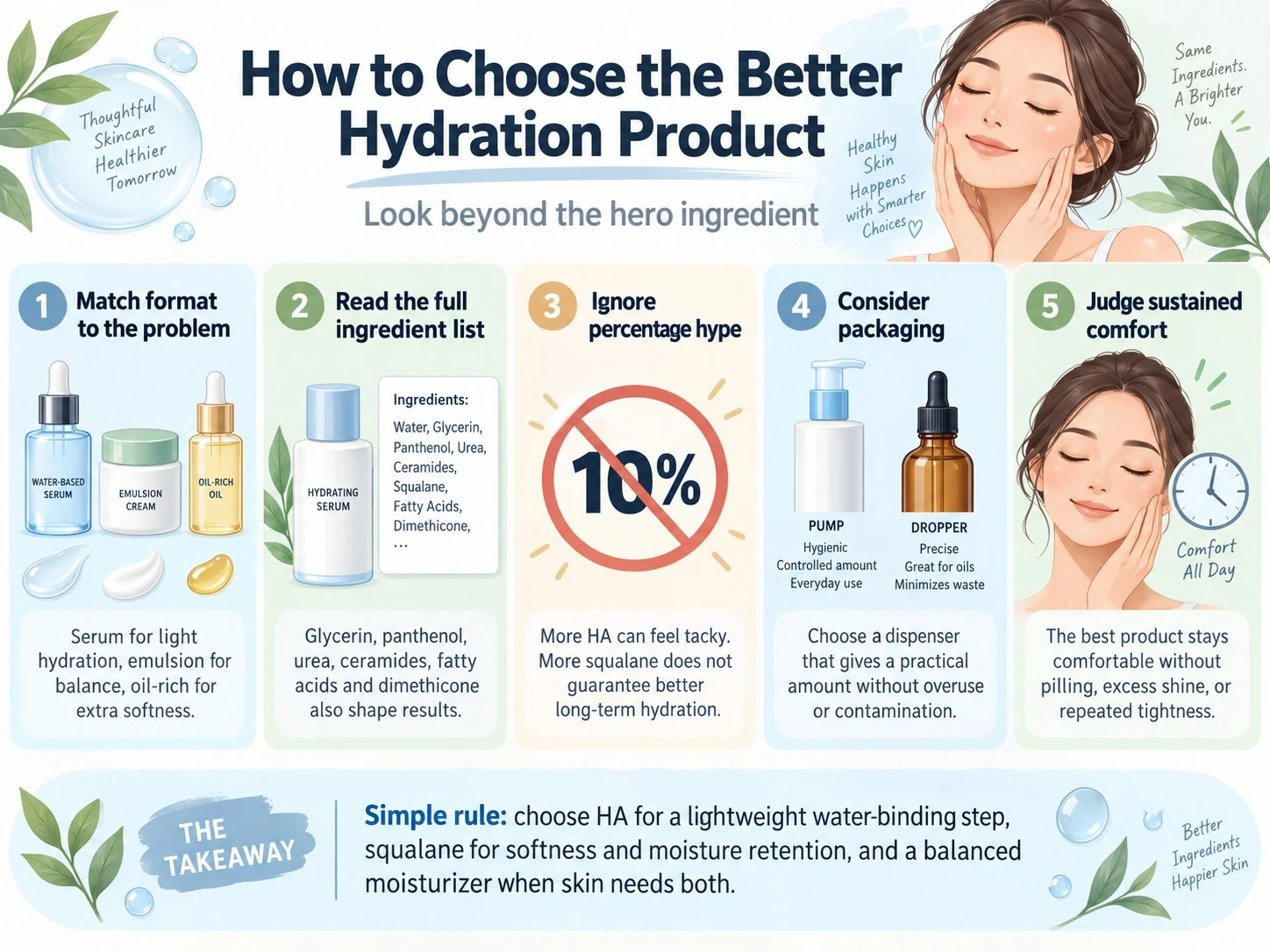
The ingredient comparison is only the first filter. Use these checks before buying:
- Match the format to the problem. Choose a water-based serum for a light hydration layer, an emulsion for balanced hydration, or an oil-rich product for extra softness.
- Read the complete ingredient list. Glycerin, panthenol, urea, ceramides, fatty acids, petrolatum, dimethicone, and other moisturizers may determine performance as much as HA or squalane. ZICAIL’s panthenol vs hyaluronic acid comparison provides another useful hydration decision framework.
- Ignore unsupported percentage races. More HA can increase tack, and a high squalane position does not prove better long-term hydration.
- Consider packaging. A pump or dropper should dispense a practical amount without encouraging overuse or contamination.
- Judge sustained comfort. The better product is the one that keeps skin comfortable through the day without pilling, excessive shine, or repeated tightness.
If you want one simple decision: choose HA for a lightweight water-binding step, squalane for added softness and moisture retention, and a balanced moisturizer when your skin needs both.
FAQs About Squalane and Hyaluronic Acid
Is squalane better than hyaluronic acid for wrinkles?
Neither ingredient treats structural wrinkles. Hyaluronic acid can temporarily plump the surface and soften fine dehydration lines, while squalane can make dry skin look smoother by improving softness and reducing roughness. Sunscreen and evidence-based wrinkle treatments address different jobs.
Can hyaluronic acid dry out your skin?
Hyaluronic acid does not inherently remove moisture from skin. A humectant-heavy serum may feel tight when too much is applied, the climate is dry, or the routine lacks emollient and occlusive support. Use less and apply moisturizer over it.
Is squalane suitable for acne-prone skin?
It can be, especially in a lightweight and well-tolerated formula, but no single ingredient guarantees that a product will not clog pores or trigger breakouts. Patch test, introduce it gradually, and stop if congestion consistently increases.
Should squalane go before or after moisturizer?
Apply pure squalane after water-based serums and usually after moisturizer. If the moisturizer is very rich or the squalane is already part of the formula, no extra oil may be necessary. Follow the product directions when they specify another order.
What is the difference between squalane and squalene?
Squalene is an unsaturated lipid naturally associated with human sebum and found in other biological sources. Squalane is its hydrogenated, saturated form, chosen in cosmetics for greater oxidative stability. Check the ingredient list carefully because the names differ by one letter.
Sources
[1] Barnes TM et al. Vehicles for Drug Delivery and Cosmetic Moisturizers: Review and Comparison
[2] Draelos ZD et al. Efficacy Evaluation of a Topical Hyaluronic Acid Serum in Facial Photoaging
[3] Fiume M et al. Squalane and Squalene


