


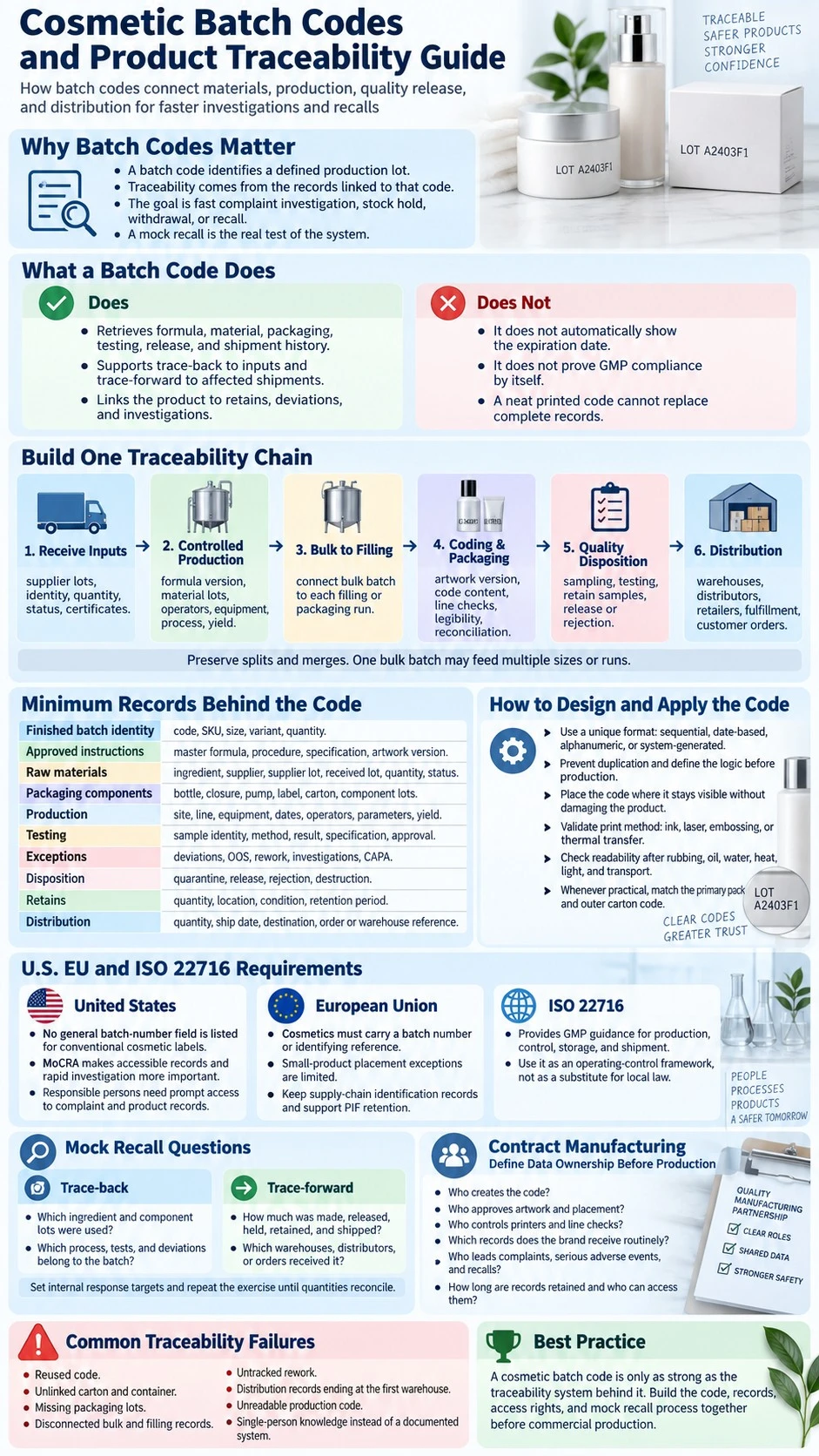
A batch code may occupy only a few millimetres on a bottle or carton, yet it can become the starting point for a complaint investigation, stock hold, withdrawal, or recall. Its value depends on everything behind it. If the code cannot retrieve the right manufacturing, testing, packaging, release, and distribution records, it is only an identifier printed on a package.
For brands using a contract manufacturer, traceability is also a data-access problem. The brand may receive the complaint while the factory holds the batch record and a third-party warehouse holds shipment history. Connect those parties before an incident occurs.
What a Cosmetic Batch Code Does—and Does Not Do
A batch code, often called a lot number or lot code, is a unique reference assigned to a defined quantity of product made under documented conditions. Companies may define “batch” and “lot” differently, so the quality agreement should state whether the terms are interchangeable and what event creates a new identifier.
The visible code should let an authorized user retrieve the batch’s history: formula version, material and component lots, processing, tests, disposition, deviations, retained samples, and shipments.
A batch code does not automatically tell a consumer when a product expires. It may contain a date element, but its structure is company-defined unless a market-specific rule says otherwise. An expiration date or period-after-opening symbol communicates durability; a batch code supports identification and investigation. One should not be presented as the other.
Nor does a code prove GMP compliance. A neat laser mark cannot compensate for missing reconciliation, uncontrolled spreadsheets, undocumented rework, or shipment records that cannot be tied back to the finished batch.
Build One Traceability Chain From Materials to Distribution
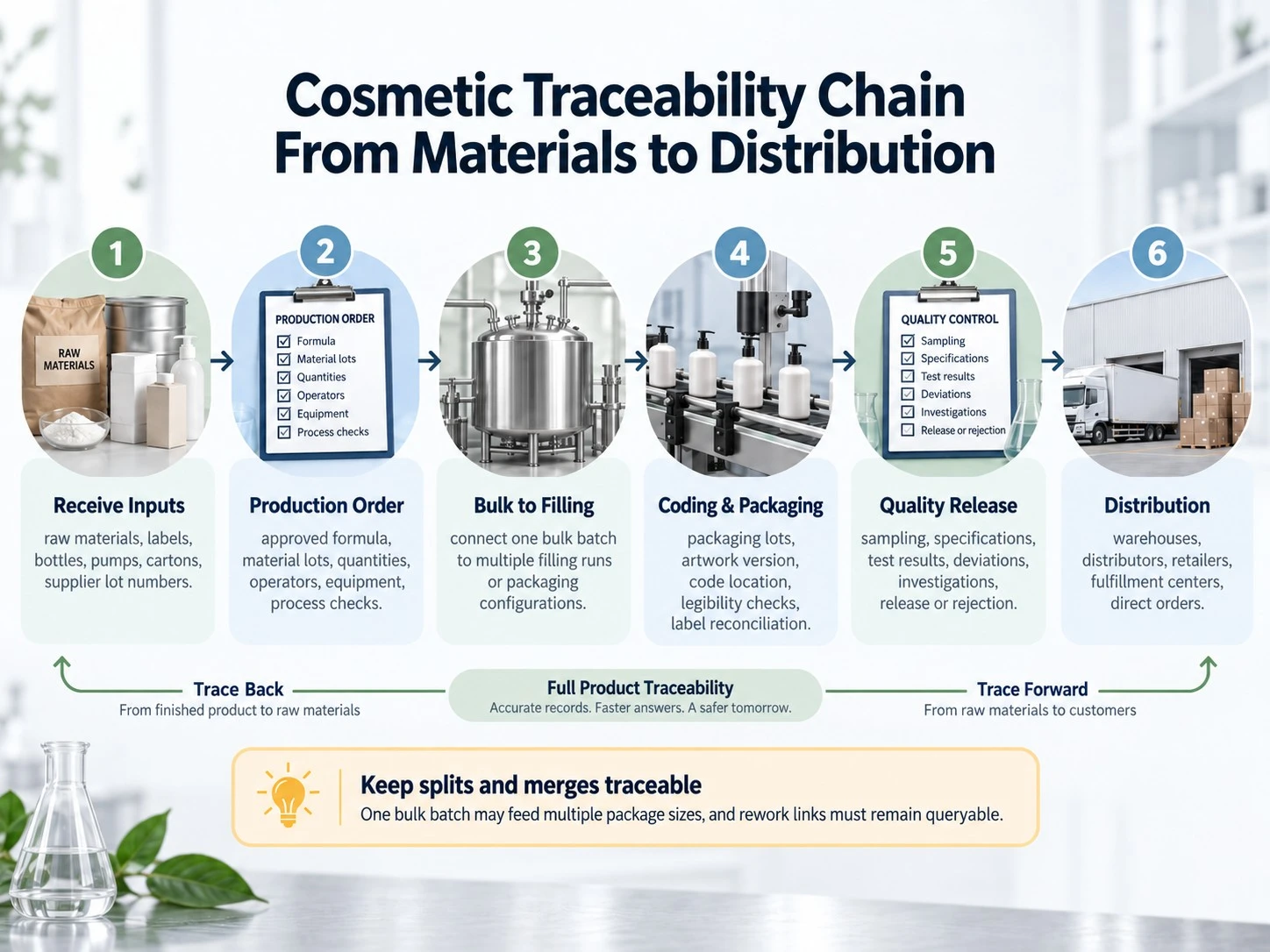
Effective cosmetic traceability works in both directions. Trace-back starts with a finished product and identifies the inputs and operations used to make it. Trace-forward starts with a raw-material, component, or finished-product lot and identifies every affected unit, location, or customer record.
A practical chain usually includes these six links:
- Receive and identify inputs. Assign or capture supplier lot numbers for raw materials, labels, containers, closures, pumps, cartons, and other components. Preserve supplier identity, receipt date, quantity, status, and inspection or certificate records.
- Issue inputs to a controlled production order. Record the approved formula or manufacturing instruction version, actual material lots and quantities, operators, equipment, processing parameters, in-process checks, yield, and any deviation or rework.
- Connect bulk and filling activity. If one bulk batch is filled on multiple days, lines, or packaging configurations, retain the relationship between the bulk identifier and each filling or packaging run.
- Verify coding and packaging. Record the packaging-component lots, approved artwork version, code content, code location, line-clearance checks, start-up approval, and periodic legibility checks. Reconcile issued, used, rejected, and returned labels or coded components where appropriate.
- Control quality disposition. Link sampling, specifications, analytical and microbiological results, deviations, investigations, retained samples, and the authorized release or rejection decision to the finished batch.
- Capture distribution. Connect released batch quantities to warehouses, distributors, retailers, fulfillment centres, or direct customer orders as the business model permits.
Preserve splits and merges. One bulk batch may feed two package sizes, and rework may combine more than one source. Those relationships must remain queryable rather than being flattened into one field.
Minimum Records Behind a Cosmetic Batch Code
The exact record set depends on the product, process, market, and quality system. The following fields form a useful baseline for a brand-manufacturer discussion.
| Record group | Information to connect | Why it matters |
|---|---|---|
| Finished batch identity | Unique code, product name, SKU, size, shade or variant, batch quantity | Defines the population under investigation |
| Approved instructions | Master formula, manufacturing procedure, specification, artwork and version status | Shows what should have been made and tested |
| Raw materials | Ingredient name, internal item number, supplier, supplier lot, received lot, quantity and status | Enables backward tracing and supplier-lot impact checks |
| Packaging components | Container, closure, pump, liner, label and carton item and lot numbers | Helps isolate leakage, dispensing, migration, print and mix-up issues |
| Production | Dates, site, room, line, equipment, operators, process parameters, actual additions, yield | Reconstructs how and where the batch was made |
| In-process and finished testing | Sample identity, method, result, specification, analyst and approval | Connects release to documented evidence |
| Exceptions | Deviation, nonconformance, out-of-specification result, rework, investigation and CAPA references | Prevents unusual events from disappearing outside the batch history |
| Disposition | Quarantine, release, rejection, destruction or conditional decision; approver and date | Confirms which quantity was legally or procedurally available for sale |
| Retained samples | Sample quantity, storage location, condition and retention period | Supports later examination and comparative testing |
| Distribution | Quantity, ship date, destination, warehouse, distributor or order reference | Enables forward tracing and recovery reconciliation |
Brands need not receive every confidential manufacturing detail. They do need a contractually defined route to information required for complaints, regulatory requests, market action, and responsible-person duties. Distinguish routine documents supplied with each batch from controlled records released for an investigation.
The finished-product specification is an important anchor because it defines the identity and acceptance criteria used for release. Review the related ZICAIL guide to finished cosmetic product specifications when setting the quality record package.
How to Design and Apply the Code
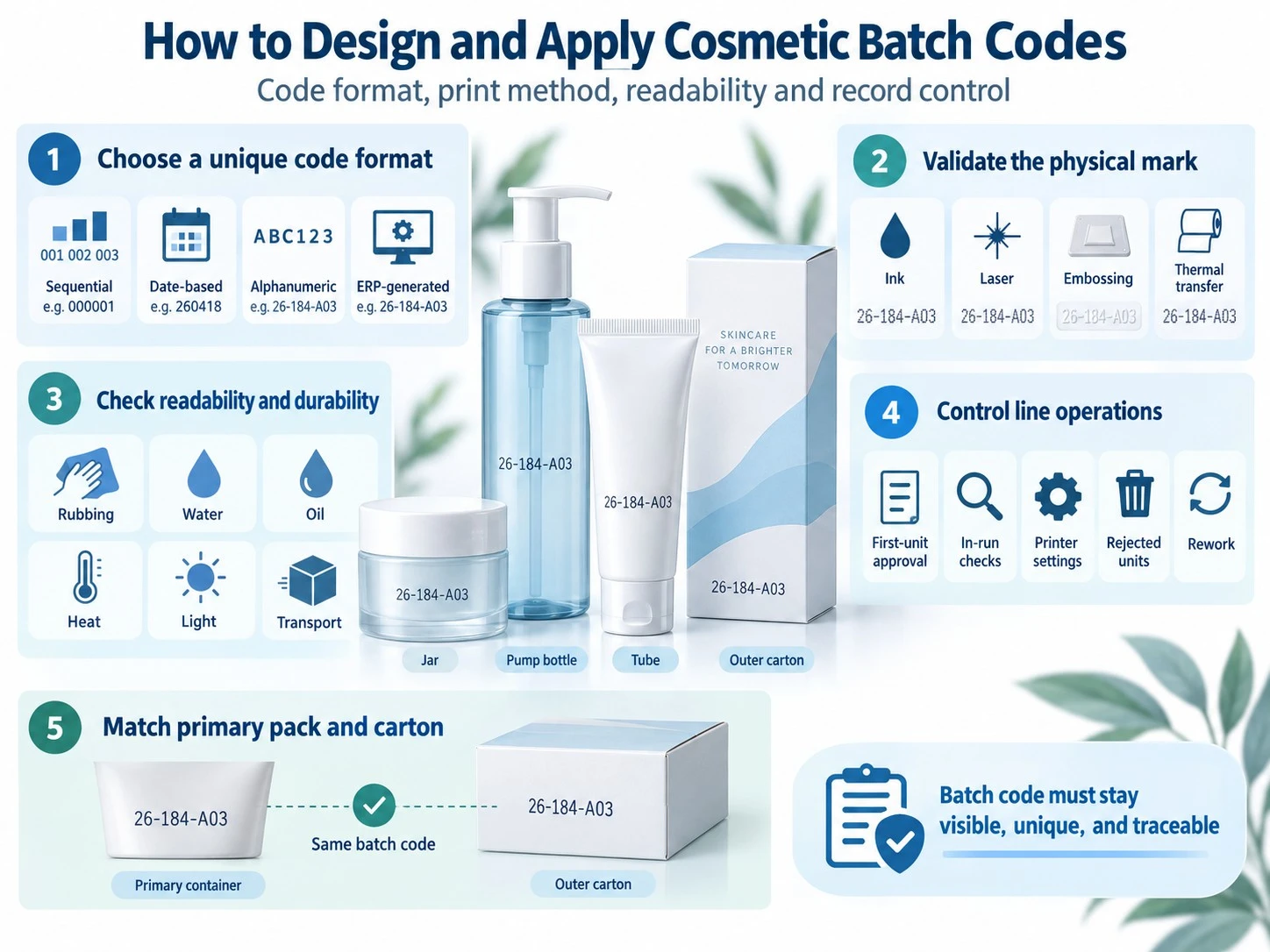
There is no universal cosmetic batch-code syntax. A code can be sequential, date-based, alphanumeric, or generated by an enterprise system. Choose a format that is unique within the defined retention horizon, cannot be confused with another product or site, and remains stable after it is issued.
For example, 26-184-A03 might encode a year, production day, line, and sequence, but that is only an illustration. Document the company’s logic, control code generation, and prevent reuse or duplication.
Then validate the physical mark:
- place it where it remains visible without opening or damaging the product;
- choose ink, laser, embossing, thermal transfer, or another method compatible with the substrate and line speed;
- challenge the mark against rubbing, oil, water, cleaning, condensation, heat, light, transport, and expected handling as relevant;
- set objective acceptance criteria for character completeness, contrast, position, and scan or read success;
- approve the first coded units and conduct documented checks during the run;
- control printer settings, code changes, line clearance, rejected units, and rework.
Whenever practical, the primary container and outer carton should carry the same finished-batch identifier. If operational constraints require different identifiers, the relationship must be one-to-one or otherwise unambiguous in the records. Packaging trials should include code adhesion and readability alongside leakage, dispensing, decoration, and material interaction; see ZICAIL’s guide to packaging compatibility testing.
U.S., EU and ISO 22716 Requirements
The legal status of batch identification is market-specific. A brand should define target markets before approving artwork or record-retention rules.
| Framework | What it says | Practical implication |
|---|---|---|
| United States—cosmetic labeling | FDA’s listed information for conventional cosmetic labels includes identity, net quantity, business name and address, material facts, applicable warnings, and ingredients; the list does not establish a general batch-number field.[1] | A batch code is a strong operational control, but do not describe it as a universal U.S. cosmetic-label mandate. Products that are also drugs have additional rules. |
| United States—MoCRA | FDA has conditional records-access authority.[3] It also has mandatory-recall authority, and responsible persons must report serious adverse events within 15 business days and provide a label copy.[2] | The brand and manufacturer should be able to connect a complaint and label to the relevant product and records promptly. |
| European Union—Regulation (EC) No 1223/2009 | Article 19 requires the batch number of manufacture or a reference for identifying the cosmetic product; where a product is too small for practical placement, it may appear only on the packaging. Article 7 requires specified supply-chain identification for three years after the batch is made available to a distributor.[4] | Artwork, primary/secondary placement, and distributor records must support the EU requirement. |
| European Union—GMP and PIF | Article 8 requires manufacture in accordance with GMP. Article 11 requires the responsible person to keep the PIF for ten years after the last batch is placed on the market.[4] | The PIF period is not a substitute for a complete record-retention matrix, but it is a key EU planning input. |
| ISO 22716:2007 | The standard provides GMP guidelines for the production, control, storage, and shipment of cosmetic products. ISO states that the 2007 edition was reviewed and confirmed in 2022.[5] | Use it to assess the manufacturer’s operating controls; do not present ISO 22716 itself as legislation in every market. |
MoCRA does not make every record subject to unrestricted FDA access at all times. FDA’s 2026 draft-guidance announcement describes access to adverse-event records during inspections and broader manufacturing, receipt, analytical, recall, complaint, and distribution records when statutory conditions involving a potential serious health threat are met.[3] It also describes six-year retention for adverse-event records, or three years for qualifying small businesses. Do not apply that period to every batch record.
For the EU, keep separate timelines straight. Article 7’s supply-chain identification duty applies for three years after a batch is made available to a distributor, while Article 11’s PIF retention runs for ten years after the last batch of the product is placed on the market.[4] Additional national, tax, contractual, insurance, customer, or quality-system requirements may also apply.
Test the System Before a Recall
A mock recall turns a written procedure into measurable evidence. Select a finished batch without giving the operating team advance knowledge of the exact record. Ask the team to trace backward to its raw-material and packaging lots, then forward to all stock and shipments.
The exercise should answer:
- How much was manufactured, rejected, sampled, retained, destroyed, held, released, and shipped?
- Which ingredient and component lots were used, and where else were those lots used?
- Which warehouses, distributors, retailers, or orders received the finished batch?
- Can the team retrieve the approved label and determine whether the visible code is readable?
- Are deviations, complaints, test results, and retain locations connected?
- Can quantities be reconciled, with documented reasons for normal loss or unexplained gaps?
Set an internal completion target appropriate to the organization’s risk and response plan. Record elapsed time, missing data, workarounds, incorrect contacts, and unreconciled quantities. Assign corrective actions and repeat the exercise until it meets approved criteria.
A second scenario should start with an input rather than a finished product—for example, a packaging-component lot suspected of cracking. The team should identify every finished batch and shipment that could contain it. This catches one-way systems that perform well only when the investigation starts from the consumer code.
Contract Manufacturing: Define Data Ownership Before Production
Outsourcing production does not remove the brand’s market obligations, and placing the brand name on the label may make the brand the U.S. “responsible person” under MoCRA depending on the labeling facts.[2] Responsibilities should therefore be written into the manufacturing or quality agreement rather than assumed.
| Decision or task | Questions to settle before the first batch |
|---|---|
| Code creation | Who generates the identifier, what defines a new batch, and how are duplicates prevented? |
| Artwork and placement | Who approves the code area, font or machine-readable format, substrate, and market-specific placement? |
| Line control | Who sets the printer, verifies the first unit, performs in-run checks, clears the line, and manages rejects? |
| Record package | Which batch, test, release, deviation, and packaging records does the brand receive routinely? |
| Investigation access | Who can authorize access to confidential source records, in what format, and within what response time? |
| Complaints and adverse events | Who receives reports, determines seriousness, preserves labels, investigates, and makes regulatory submissions? |
| Market action | Who can place stock on hold, notify warehouses, contact distributors, communicate with authorities, and approve withdrawal or recall messages? |
| Retention and continuity | How long is each record class retained, where is it backed up, and what happens if the business relationship ends? |
Address subcontracting too. If filling, printing, testing, sterilization, or warehousing goes to another party, preserve that activity and its records in the traceability chain.
Use the manufacturer’s documented skincare project process as a starting point, then add product-specific quality gates and document deliverables to the commercial timeline.
Common Traceability Failures
- Reused code: Add controlled sequence or site/product logic and verify uniqueness before issue.
- Unlinked carton and container: Match identifiers or maintain a verified relationship between them.
- Missing packaging lots: Treat pumps, liners, labels, inks, adhesives, and other critical components as traceable inputs.
- Disconnected bulk and filling records: Record every split, partial fill, repack, and continuation run.
- Untracked rework: Link the receiving batch to source material, quantity, approval, and risk assessment.
- Distribution ending at the first warehouse: Define and test downstream retrieval from distributors and fulfillment providers.
- Unreadable production code: Include coding in line qualification and packaging compatibility work.
- Single-person knowledge: Maintain procedures, training, backup contacts, and periodic exercises.
Build a Traceable Cosmetic Project With ZICAIL
Batch coding works best when formula control, packaging, production records, quality release, and distribution planning are designed together. ZICAIL supports private-label and OEM/ODM skincare projects across product development, packaging coordination, production, and quality control.
Before requesting a quotation, prepare your target markets, sales channels, packaging format, expected document package, preferred code location, record-retention needs, and complaint contacts. Then contact ZICAIL to discuss how those requirements fit the project scope. Regulatory obligations remain product- and market-specific, so final artwork and compliance decisions should be reviewed by qualified advisers for each destination.


