
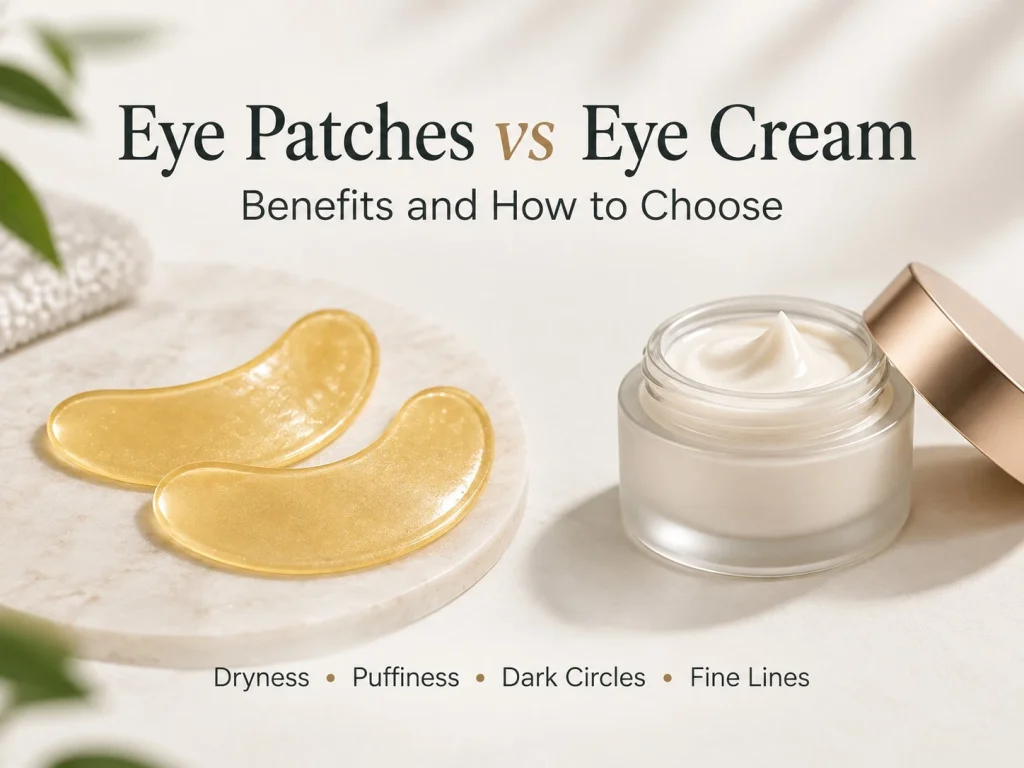


Eye patches and eye cream often share ingredients and claims, but they fit different routines. Compare the actual formulas, how they are used, and the result you want—not simply a gel crescent versus a small jar.
Here, eye patches means cosmetic under-eye masks, mainly pre-soaked hydrogel or sheet patches. Reusable silicone covers are a separate case because they are usually used with a cream or serum rather than instead of one.
Eye Patches vs Eye Cream: Key Differences
Under-eye masks hold a formula against a small area during a timed session. Pre-soaked versions already contain their skincare liquid and are removed after use. For example, one hydrogel product specifies 10–15 minutes on clean, dry skin, followed by disposal and patting in the remaining serum.[1] That is a product-specific direction, not a universal wear time.
Eye cream is a leave-on formula you spread in the permitted eye area. Reusable silicone patches change the comparison: some are designed to sit over a separate eye cream or serum, then be cleaned and reused.[2] The table compares pre-soaked patches with cream; do not apply its disposable-patch instructions to reusable covers.
| Comparison point | Pre-soaked eye patches | Eye cream |
|---|---|---|
| Format | Hydrogel or sheet carrying a liquid formula | Leave-on cream or cream-like emulsion |
| Contact time | Timed wear, then remove as directed | Leave on unless the directions say otherwise |
| Routine fit | A separate session when you have time | A brief application within regular skincare |
| Ingredients | Examples include glycerin, hyaluronic acid, and caffeine; formulas vary | Can combine moisturizing ingredients and targeted actives; the category does not establish potency |
| Layering | Often used before heavier creams; follow the patch directions | Used as directed, without needing a patch on top |
| Handling | Discard single-use patches; keep multi-pair jars clean | Keep the container and any applicator clean |
| Main limitation | A timed covering does not prove better or lasting results | Regular use does not guarantee correction of every eye concern |
Choosing for Dryness, Puffiness, Dark Circles and Fine Lines
Dryness and Makeup Preparation
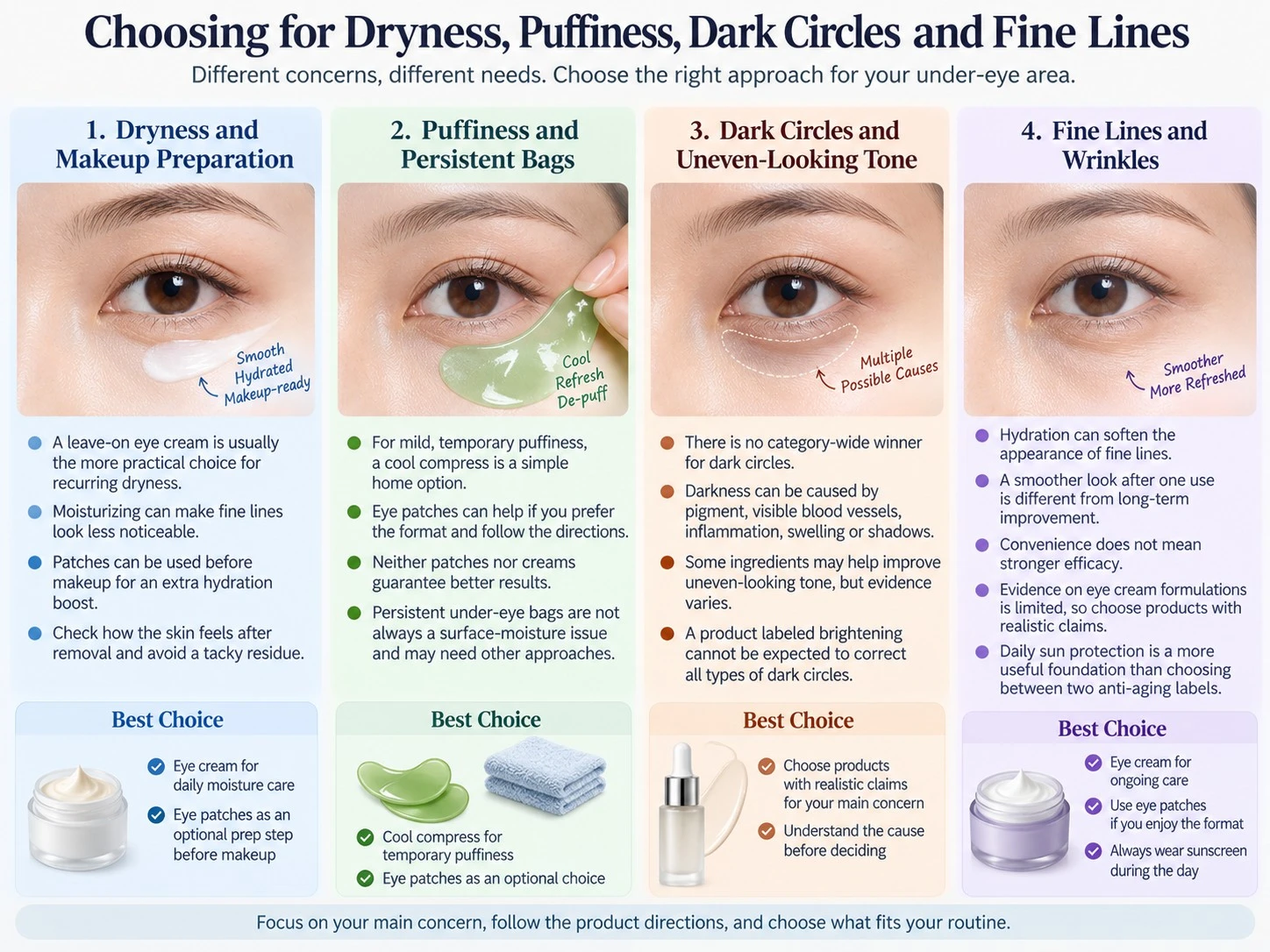
For recurring dryness, a comfortable leave-on cream is usually the more practical first choice. It does not require a separate wear-and-remove session. Moisturizing can also make fine lines look less noticeable, so visible smoothing is not exclusive to patches.[3] This is one of the simplest eye cream benefits, not proof that every anti-aging claim on the package is true.
Patches are an optional way to prepare dry-looking under-eyes before concealer. Check how the finished formula feels after removal: a comfortable surface is useful, while a tacky residue or heavy layer may not suit your makeup. Try the combination on an ordinary day rather than discovering a poor fit before an event. Do not assume that more serum will improve the result.
Temporary Puffiness and Persistent Bags
For mild, temporary puffiness, cooling is an option—not a benefit reserved for a purchased patch. A clean washcloth dampened with cool water and applied gently around the eyes is a simple home measure.[4] A patch is worth considering if you prefer the format and its directions permit the way you plan to use it.
Neither a cool feeling nor a “de-puffing” label establishes that patches outperform cream. The cause of the swelling matters, and persistent bags are not always a surface-moisture problem. Some under-eye bags require approaches beyond cosmetic skincare; simply adding more cream or longer patch sessions does not address that distinction.[4] Do not buy both products on the assumption that their effects must add up.
Dark Circles and Uneven-Looking Tone
There is no category-wide winner for dark circles. Darkness can reflect pigment, visible blood vessels, inflammation, swelling, or shadows from the tear trough and surrounding anatomy. Several factors can occur together.[5] A moisturizing product cannot be expected to correct all of these causes just because it is labeled brightening.
Some ingredients used in eye care show potential for improving uneven-looking tone, but evidence varies across concentrations, study designs, and finished formulas.[6] Choose a product with realistic claims for your goal rather than assuming every cream provides lasting brightening or every patch delivers an instant fix. If the main issue is a structural shadow, changing the skincare format is unlikely to be the decisive step.
Fine Lines and Wrinkles
Separate surface smoothing from a lasting change in wrinkles. Hydration can soften the appearance of fine lines, but that does not establish that the product has rebuilt collagen or permanently changed the skin.[3] A smoother look after one application is a different outcome from improvement measured after a repeated-use regimen.
A cream is convenient when you want to follow an ongoing routine, but convenience is not evidence of superior efficacy. Research on eye-care ingredients is promising in places, yet trials on complete eye-cream formulations remain limited.[6] Look for evidence relevant to the actual product and concern. Do not assume a patch delivers ingredients deeper, or that an expensive cream guarantees long-term repair. Daily sun protection remains a more useful foundation than choosing between two anti-aging labels.[3]
Cost and Convenience: Compare the Routine, Not the Jar
Compare what you will spend using the product as intended. For disposable patches, divide the price by the number of pairs. For cream, consider how long the package lasts at the instructed amount; dividing milliliters by an invented “standard dose” can give a misleading comparison.
Include the effort you will actually maintain. Patches require placement, a wear period, removal, and disposal. Reusable silicone covers add cleaning and storage, plus the cost of any separate skincare product. Cream is faster to apply, but an uncomfortable or makeup-incompatible formula is still poor value.
Higher price does not automatically mean better results.[3] If your existing moisturizer is suitable and comfortable around the eyes, the eye cream versus moisturizer question may matter more than buying patches as well. Add a dedicated product only when it solves a need your current routine does not meet.
Can You Use Eye Patches and Eye Cream Together?
Yes, when both products suit the eye area and the combination stays comfortable, but layering is optional. A routine with both formats is not automatically better than one well-chosen product.
With pre-soaked patches, follow their preparation instructions and wear time first. Remove them, handle the remaining serum as directed, and then apply eye cream if you still need it. Do not add a thick layer merely because the patch step is finished. If the patch formula already leaves the skin comfortable, extra cream may add little beyond another texture.
Reusable silicone patches usually belong over the compatible cream or serum specified by their instructions. One system directs a thin layer of eye product underneath, followed by 10–20 minutes of wear and cleaning after removal.[2] This is not permission to cover any face treatment or combine several active products under a patch.
In a morning routine, complete the patch step before sunscreen and makeup. Avoid lifting patches off a finished sunscreen layer. Keep your routine simple enough to tell which product is helping and which one causes discomfort.
How to Avoid Irritation With Either Option
Introduce one new product at a time and test a new skincare product on a small area away from the eyes before regular use. Home testing can help reveal a reaction, but it does not guarantee tolerance in the eye area.[7] Follow the product’s precautions rather than assuming “eye care” or “gentle” means irritation is impossible.
- Check the permitted area: Keep products out of the eye itself. Do not assume under-eye directions also permit the waterline, inner corner, or movable upper eyelid.
- Keep handling clean: Wash hands, use clean applicators, and do not share eye cosmetics.[8] Discard single-use patches instead of returning them to a jar.
- Respect the schedule: Follow the exact wear time and frequency. Longer patch sessions or extra cream applications are not substitutes for a suitable formula.
Stop using eye cosmetics that cause irritation, and seek medical advice if irritation persists. Avoid applying them over an eye infection or inflamed surrounding skin.[8] Repeated burning, redness, or swelling is a reason to stop and reassess—not to buy a stronger version of the same product.
FAQs About Eye Patches and Eye Cream
Can eye patches replace eye cream?
They can serve as your optional eye-care step, but pre-soaked patches are not used like a leave-on moisturizer. If you need ongoing dryness relief, a suitable cream is usually easier to use regularly. Reusable silicone patches normally require a separate compatible cream or serum.
Are eye patches better than eye cream for dark circles?
Not as a general rule. The cause of the darkness and the finished formula matter more than the format. Neither product reliably corrects every source of dark circles, especially shadows from structural hollows.
Should eye cream go before or after eye patches?
For many pre-soaked patches, cream comes afterward if needed. Reusable silicone covers often go over a compatible cream or serum. Follow both products’ directions rather than using one order for every type of patch.
Do you need eye cream if you already use face moisturizer?
Not necessarily. If the moisturizer is suitable for the eye area, feels comfortable, and meets your hydration needs, a separate eye cream may be redundant. Choose an additional product for a specific unmet need, not simply because a routine includes an eye-care step.
Sources
[1] Peter Thomas Roth. Water Drench Hyaluronic Cloud Hydra-Gel Eye Patches
[2] Dieux. Forever Eye Mask
[3] American Academy of Dermatology. How to select anti-aging skin care products
[4] Mayo Clinic. Bags under eyes: Diagnosis and treatment
[5] Sarkar R, et al. Periorbital Hyperpigmentation: A Comprehensive Review
[6] Hamie H, et al. A review of the efficacy of popular eye cream ingredients
[7] American Academy of Dermatology. How to test skin care products
[8] U.S. Food and Drug Administration. Eye Cosmetic Safety


