


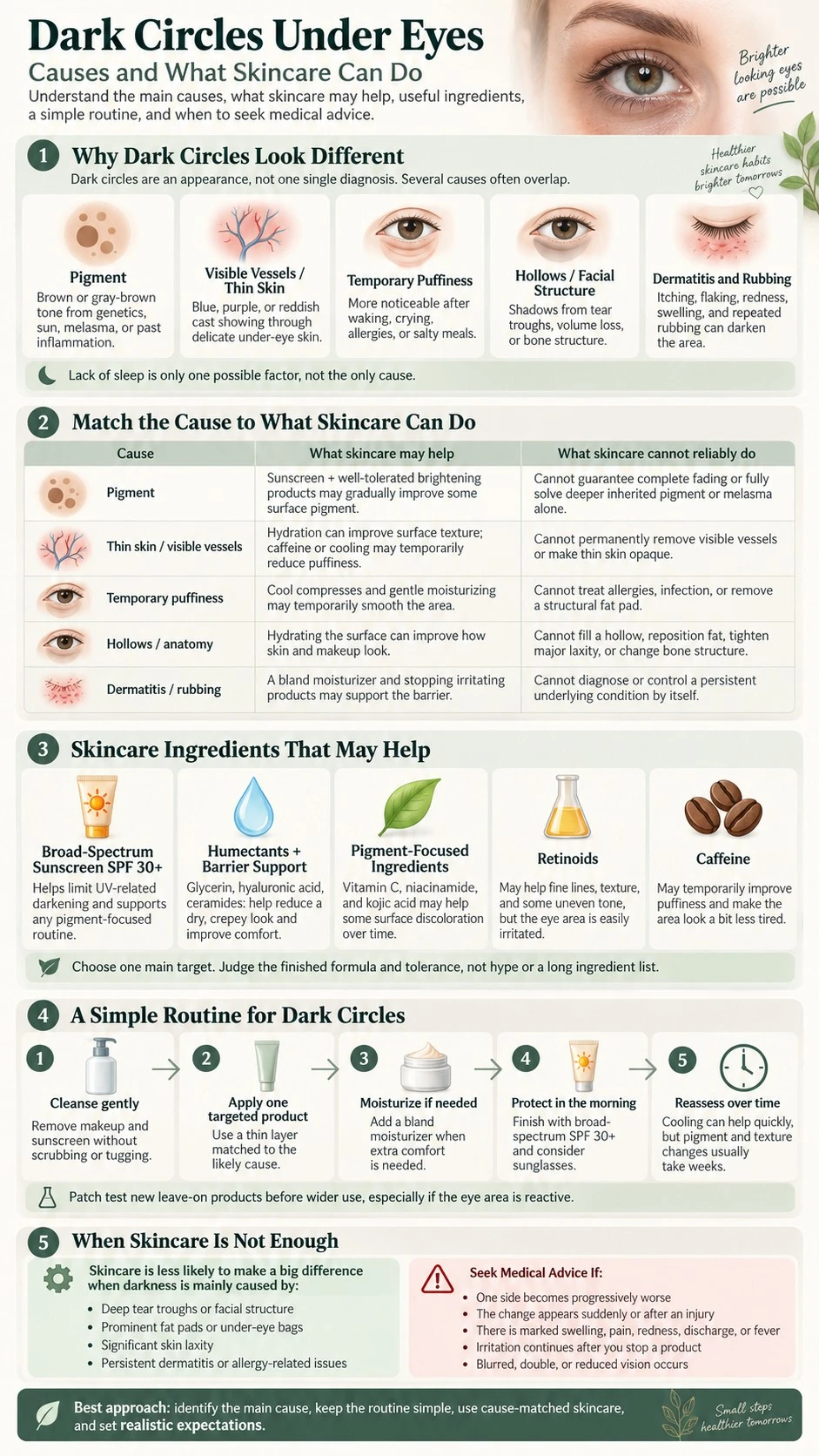
“Dark circles” describes an appearance, not one diagnosis. The area may look brown, gray, blue-purple, hollow, puffy, or several of these at once. That is why a product that brightens one person’s under-eyes may do little for someone whose darkness is mainly a shadow.
Most dark circles are not a medical problem. Still, skincare works best when it addresses a surface-level contributor and does not irritate the thin skin around the eyes. The first task is to separate what a topical product can reasonably influence from pigment, vessels, anatomy, inflammation, or health issues that need a different approach.
Why Dark Circles Have Different Causes
Under-eye darkness is multifactorial. Deep facial anatomy, changes in fat and supporting tissues, thin skin, blood vessels, melanin, and surface inflammation can all affect the way light reflects from the lower eyelid.[2] Genetics and aging can shape several of these features, while sun exposure, fatigue, rubbing, eczema, contact dermatitis, smoking, alcohol use, and stress may make the appearance more noticeable.[1]
Mixed dark circles are common. For example, a person may have inherited under-eye pigment plus an age-related hollow, or allergy-related rubbing plus post-inflammatory darkening. Skin color also matters: melasma and post-inflammatory hyperpigmentation are more common in brown and Black skin, and irritation from an aggressive routine can deepen visible discoloration.[1] Treat these observations as a starting point, not a reason to diagnose yourself from a mirror.
Match the Cause to What Skincare Can Do
The most useful product depends on which contributor is dominant.[2] Color, timing, and lighting changes can offer clues, but they do not confirm a cause.[1] Temporary changes in puffiness can provide additional context.[4] This matrix keeps the likely benefit and the main limitation together.
| Main contributor | Common clues | What skincare may do | What skincare cannot reliably do |
|---|---|---|---|
| Pigment from genetics, sun, melasma, or past inflammation | Brown or gray-brown tone that stays visible across lighting; may extend onto the eyelid | Help prevent further UV-related darkening and gradually improve some surface pigment with a well-tolerated brightening formula | Guarantee complete fading, remove deeper inherited pigment, or control melasma without an appropriate treatment plan |
| Thin skin or visible vessels | Blue, purple, or reddish cast; vessels may be easier to see through the lower eyelid | Improve hydration and surface texture; caffeine or cooling may briefly make the area look less puffy or prominent | Permanently remove visible vessels or make naturally thin skin opaque |
| Temporary puffiness or fluid buildup | More noticeable after waking, crying, allergy symptoms, or a salty meal; appearance changes during the day | A cool compress or chilled eye product may temporarily reduce swelling; gentle moisturizing can smooth the surface | Treat an allergy, infection, or persistent swelling, or remove a structural fat pad |
| Tear trough, bone structure, or age-related volume change | A hollow or curved shadow that becomes stronger or weaker with lighting; may coexist with bags | Hydrate the overlying skin and improve how makeup sits | Fill a hollow, reposition fat, tighten significant laxity, or change facial anatomy |
| Eczema, contact dermatitis, or repeated rubbing | Itching, stinging, flaking, redness, swelling, or a history of rubbing the eyes | Support the barrier with a bland moisturizer and remove a suspected irritating cosmetic | Diagnose or control the underlying condition when symptoms persist |
The table is not a home diagnostic test. Under-eye color is affected by lighting, skin tone, makeup, camera processing, and more than one mechanism. If pigment seems important, the broader guide to hyperpigmentation explains why inflammation control and sun protection matter as much as the brightening ingredient.
Which Skincare Ingredients May Help?
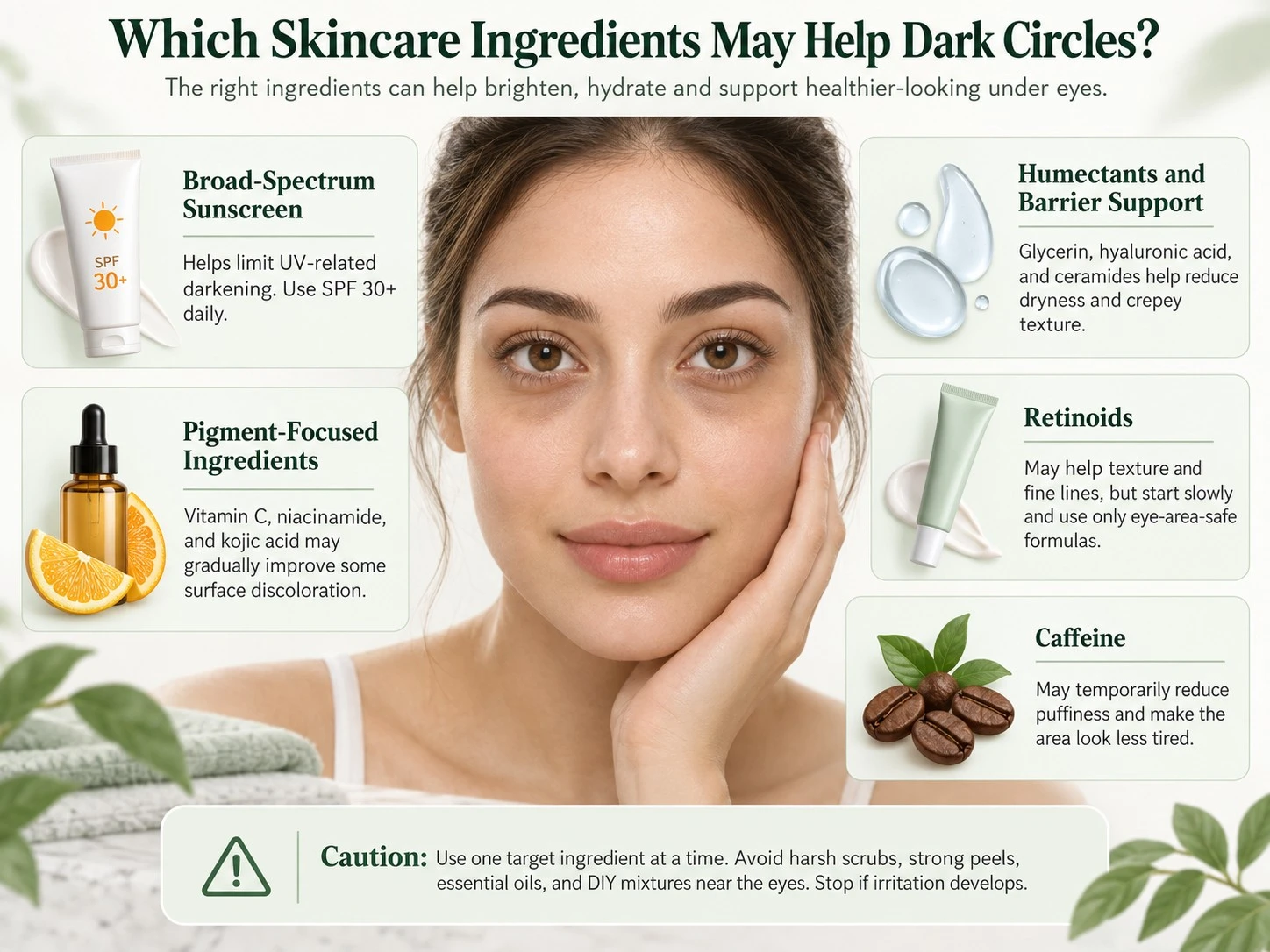
Choose one main target and judge the finished formula, not just the ingredient list. Research suggests that several common eye-cream ingredients have potential for hydration, texture, wrinkles, or pigmentation, but eye-area trials are limited and vary in formula, concentration, and study design.[3] An ingredient with general facial-skin evidence is not guaranteed to work in every under-eye product.
- Broad-spectrum sunscreen: Daily SPF 30 or higher helps limit UV-related darkening and supports any pigment-focused routine.[1] Use a formula you can apply around the orbital bone without stinging or migrating into the eyes. Sunglasses and shade provide useful extra protection. For application and reapplication basics, see Sunscreen 101.
- Humectants, emollients, and barrier-supporting ingredients: Glycerin, hyaluronic acid, ceramides, and similar ingredients can reduce a dry, crepey look and help concealer sit more smoothly. They do not remove vessels, pigment, or hollows, but a healthier surface can make the area look less tired.
- Pigment-focused ingredients: Vitamin C and niacinamide may help some surface discoloration over time.[3] Kojic acid is another ingredient used in products for dark circles.[1] Start with one eye-area-compatible formula. More actives are not automatically more effective, and burning or peeling can worsen post-inflammatory pigment.
- Retinoids: Retinol and related ingredients may improve fine lines, texture, and some uneven tone with continued use, but the eyelid area is easily irritated. Use only a product intended for that area, begin slowly, keep it out of the eyes, and follow its directions. A stronger face retinoid should not be moved close to the lash line simply to speed results.
- Caffeine: Caffeine has potential to improve some periorbital concerns.[3] A cool product or compress may also briefly reduce mild puffiness.[4] Expect a temporary cosmetic change rather than permanent vessel removal or correction of a tear trough.
The words “eye cream” do not guarantee a unique active or stronger result. A simple facial moisturizer may be enough for hydration if it is comfortable near the eyes, while a dedicated product can be useful when its texture, packaging, or tested directions make application easier. The guide to whether eye cream works explains this format-versus-formula distinction in more detail.
Avoid harsh scrubs, strong peels, essential oils, undiluted DIY mixtures, and products not intended for use near the eyes. Stop immediately if a cosmetic causes eye-area irritation, and do not use cosmetics around an eye infection or inflamed skin.[5]
A Simple Routine for Dark Circles
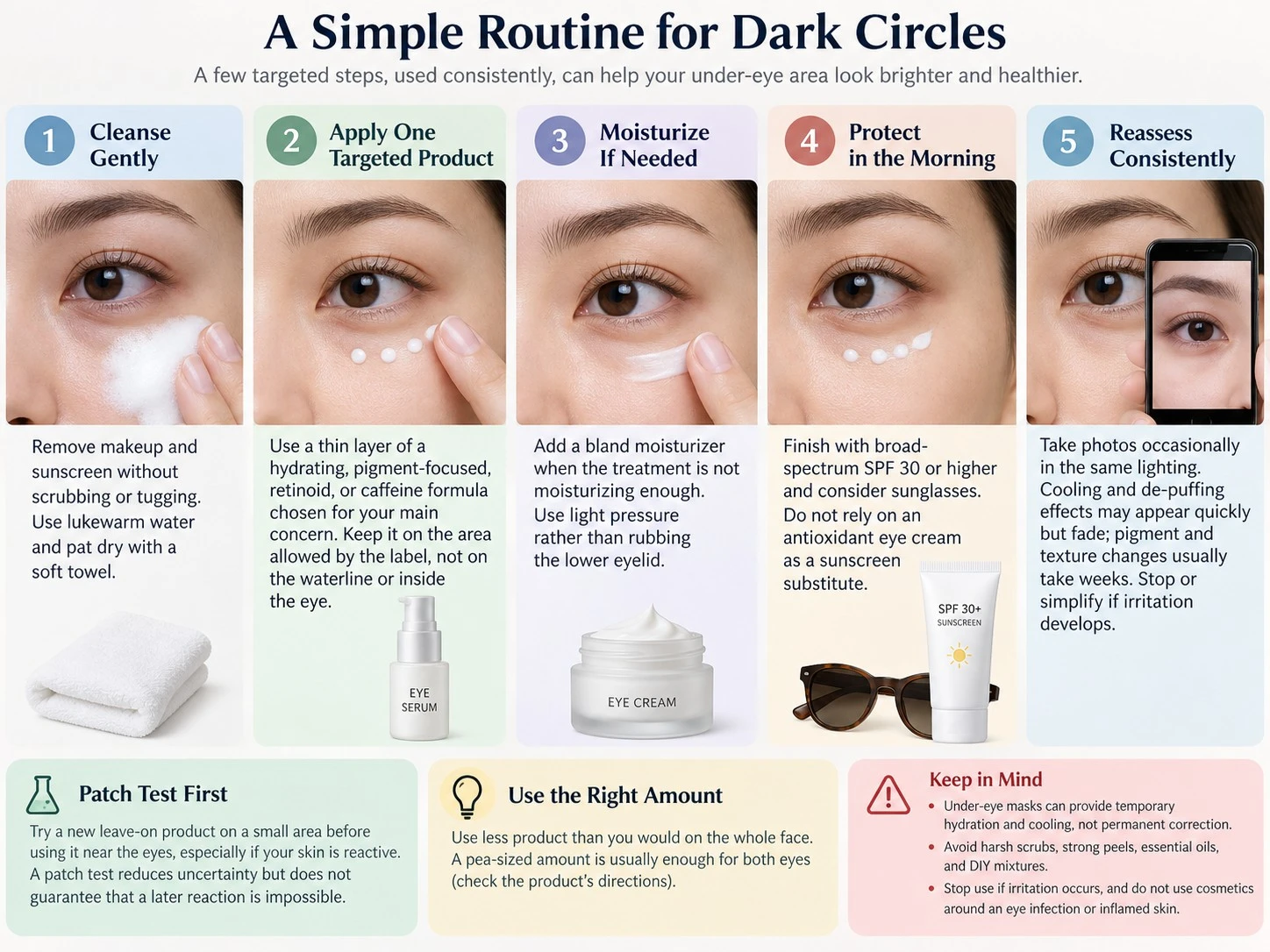
Use a small routine long enough to judge one change at a time:
- Cleanse gently. Remove makeup and sunscreen without scrubbing, tugging, or using very hot water. Pat dry with a soft towel.
- Apply one targeted product. Use a thin layer of a hydrating, pigment-focused, retinoid, or caffeine formula chosen for the likely contributor. Keep it on the area allowed by the label, not on the waterline or inside the eye.
- Moisturize if needed. Add a bland moisturizer when the treatment is not moisturizing enough. Use light pressure rather than rubbing the lower eyelid.
- Protect in the morning. Finish with broad-spectrum SPF 30 or higher and consider sunglasses. Do not rely on an antioxidant eye cream as a sunscreen substitute.
- Reassess consistently. Photograph the area occasionally in the same lighting. Cooling and de-puffing effects may appear quickly but fade; pigment and texture changes generally require consistent use over weeks. Stop or simplify if irritation develops.
Patch test a new leave-on product before broad use, especially if the eye area is reactive. Apply it to a small test area at the normal frequency before moving closer to the eyes; a clear patch test lowers uncertainty but does not guarantee that a later reaction is impossible.[6] The patch-testing guide gives the full method.
Use less product than you would on the whole face. The guide to applying eye cream covers amount, placement, and layering. If you use a chilled patch for short-term smoothing, remember that under-eye masks mainly provide temporary hydration and cooling rather than permanent correction.
When Skincare Is Not Enough
Skincare is unlikely to make a major difference when the darkness is mostly caused by a deep tear trough, prominent fat pads, significant skin laxity, or facial bone structure. Moisturizer can improve the surface over those features, but it cannot restore volume or reposition tissue. Cause-matched professional options may include prescription topicals, lasers, chemical peels, fillers, or surgery, and each has different risks and suitability across skin tones.[2] These require assessment by a qualified dermatologist, ophthalmologist, or appropriately trained clinician.
Treating a medical contributor also falls outside an eye cream’s job. Persistent itching, scaling, or redness may reflect dermatitis. Nasal congestion and allergies may contribute to puffiness or a darker vascular look. Fatigue with other symptoms should be discussed with a healthcare professional rather than assumed to be an iron or vitamin deficiency from appearance alone.
Seek medical advice rather than experimenting with more cosmetics when the change has any of these features:
- affects one eye and becomes progressively worse;[1]
- appears suddenly or follows an injury;
- comes with marked swelling, pain, redness, warmth, discharge, or fever;[4]
- causes eye irritation that continues after you stop the product;[5]
- occurs with blurred vision, double vision, reduced vision, or another visual change.[4]
Dark circles under both eyes that have been stable for years are usually cosmetic, but a clinician can still help identify whether pigment, vessels, dermatitis, puffiness, or anatomy is driving the appearance. That assessment prevents spending months on a brightening cream when the main issue is a shadow that skincare cannot remove.
FAQs About Dark Circles Under Eyes
Does lack of sleep cause dark circles?
Short sleep can make existing circles and shadows more obvious, but it is rarely the only possible cause. Genetics, aging, pigment, visible vessels, puffiness, rubbing, dermatitis, sun exposure, and facial structure may also contribute.[1]
Can dark circles go away permanently?
Some temporary darkness from puffiness or irritation can improve when the trigger resolves. Pigment may fade gradually, but genetic pigment, visible vessels, and structural shadows can persist. A lasting result depends on identifying and treating the dominant cause rather than using one universal eye cream.
Do you need a separate eye cream for dark circles?
Not always. A gentle facial moisturizer may provide enough hydration if it is comfortable and safe around the eyes. A separate eye product is useful when it delivers a suitable active, texture, or applicator for your goal without causing irritation.
Can dark circles be a sign of a health problem?
Most stable dark circles are cosmetic and are not a medical problem.[1] Do not diagnose anemia, allergy, or another condition from under-eye color alone. Seek medical advice for one-sided worsening, sudden change, persistent swelling or rash, pain, discharge, vision changes, or other concerning symptoms.[4]
Sources
[1] Mayo Clinic. Dark Circles Under Eyes
[2] Vrcek I, Ozgur O, Nakra T. Infraorbital Dark Circles: A Review of the Pathogenesis, Evaluation and Treatment
[3] Hamie H, Yassine R, Shoukfeh R, et al. A Review of the Efficacy of Popular Eye Cream Ingredients
[4] Cleveland Clinic. Dark Circles or Bags Under Your Eyes? How To Get Rid of Them
[5] U.S. Food and Drug Administration. Cosmetics Safety Q&A: Eye Cosmetic Safety
[6] American Academy of Dermatology Association. How to Test Skin Care Products


