

Choosing a milky toner starts with two checks: whether you need another moisturizing layer, and whether its ingredients fit the products you already use.
What Makes a Toner Milky?
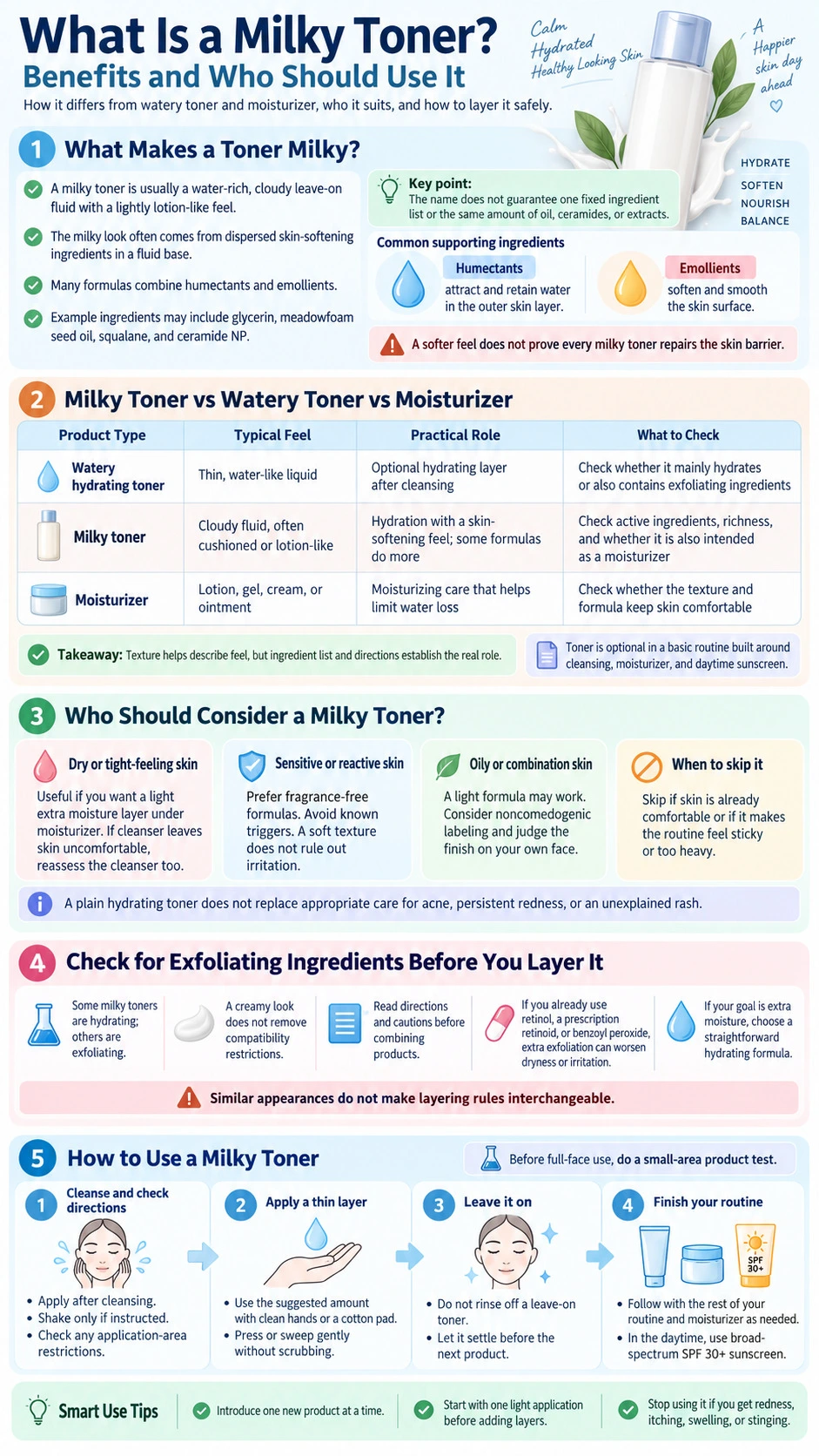
The milky look often comes from a water-rich formula containing dispersed skin-softening ingredients. For example, one milky toner lists water, glycerin, meadowfoam seed oil, squalane and ceramide NP.[1] The name does not specify one fixed ingredient list or tell you how much of each ingredient is present.
Two ingredient roles help explain the appeal. Humectants, such as glycerin, attract and retain water in the outer skin layer. Emollients soften and smooth the surface. A milky toner can combine these roles in a light fluid, while more protective moisturizing products also help reduce evaporative water loss.[2]
Check the actual formula rather than assuming every bottle contains ceramides, rice extract or the same amount of oil. A softer feel after application is a useful comfort result; it does not prove that every milky toner repairs a damaged skin barrier.
Milky Toner vs Watery Toner vs Moisturizer
A clear toner can hydrate, and a milky toner can contain exfoliating ingredients. Texture helps describe how a product feels, but its ingredient list and directions establish its role.
| Product type | Typical feel | Practical role | What to check |
|---|---|---|---|
| Watery hydrating toner | Thin, water-like liquid | An optional hydrating layer after cleansing | Whether it mainly hydrates or also contains exfoliating ingredients |
| Milky toner | Cloudy fluid, often more cushioned or lotion-like | Hydration with a skin-softening feel; some formulas do more | Active ingredients, richness and whether it is also intended as a moisturizer |
| Moisturizer | Lotion, gel, cream or ointment | Moisturizing care that helps limit water loss | A texture and formula that keep your skin comfortable |
Toner is optional in a basic routine built around cleansing, moisturizer and daytime sunscreen.[3]
Some toner-moisturizer hybrids explicitly allow use as a standalone lightweight moisturizer.[1] That permission belongs to the individual product. Do not assume every milky toner replaces your cream, particularly if skin still feels dry or tight after using it.
Who Should Consider a Milky Toner?
Choose according to a need your current routine is not meeting:
- Dry or tight-feeling skin: A hydrating milky toner is worth considering if you enjoy a light moisture layer under your moisturizer. If your cleanser consistently leaves skin uncomfortable, reassess the cleanser too instead of adding more layers to compensate.
- Sensitive or reactive skin: Prefer a fragrance-free formula and avoid ingredients you know cause reactions. “Natural” or a soft texture does not rule out irritation; introduce the product cautiously.[4]
- Oily or combination skin: Choose a light formula, consider noncomedogenic labeling and judge the finish on your face. Oily skin still needs moisturizing care, but a rich toner is not required.[5]
Skip the toner if your skin is comfortable already, or if it makes your routine feel sticky or overly heavy. A plain hydrating toner does not replace appropriate care for acne, persistent redness or an unexplained rash.
Check for Exfoliating Ingredients Before You Layer It
Exfoliating formulas: One milky toner is explicitly sold as an exfoliating formula and carries a direction not to combine it with direct acids.[6] Its creamy-looking texture does not remove that compatibility restriction.
Choose between hydrating and exfoliating toners according to your goal, then read the product’s directions and cautions. Similar appearances do not make their layering rules interchangeable.
If you already use retinol, a prescription retinoid or benzoyl peroxide, adding exfoliation can worsen dryness or irritation.[7] Choose a straightforward hydrating option when your goal is extra moisture, and follow the instructions for your treatment products. Do not assume a milky toner makes an otherwise irritating combination safe.
How to Use a Milky Toner
Before full-face use, a small-area product test can help identify a reaction. Stop using the product if it causes redness, itching or swelling.[4] Introduce one new product at a time so changes in comfort are easier to assess.
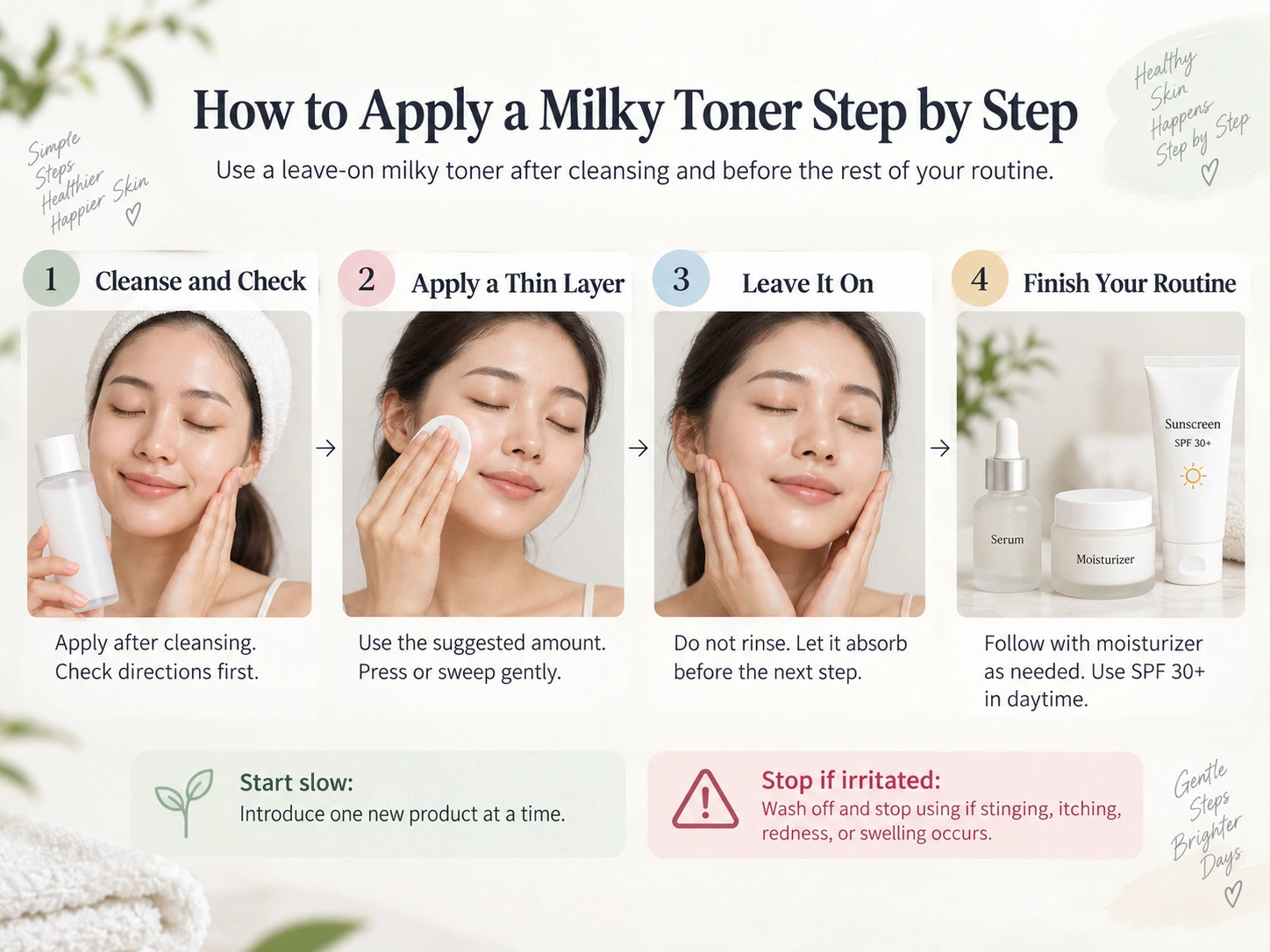
Use this sequence when applying a leave-on milky toner:
- Cleanse and check the directions: Apply after cleansing. Shake the bottle only when instructed, and check any application-area restrictions.[6]
- Apply a thin layer: Use the label’s suggested amount with clean hands or a cotton pad, as directed. Gently press or sweep it across the intended area without scrubbing.[8]
- Leave it on: Do not rinse off a leave-on toner during normal use.[6] Allow it to settle before applying your next product.
- Finish your routine: Follow with your remaining products in their instructed order and moisturizer as needed. For daytime protection, use broad-spectrum sunscreen with SPF 30 or higher.[5]
Start with one light application and assess the complete routine before adding layers. A less dewy appearance alone is not a reason to keep reapplying toner.
If the toner stings or produces an uncomfortable reaction, gently wash it off and stop using it. Seek medical advice for a severe or persistent reaction.[4]
FAQs About Milky Toner
Does milky toner contain milk?
Not necessarily. “Milky” describes the appearance and feel; some formulas are labeled vegan.[6] Check the complete ingredient list if you need to avoid milk-derived ingredients rather than relying on the name.
Can you use a milky toner every day?
Use it at the frequency allowed by its directions and tolerated by your skin. Daily use is not a requirement. An exfoliating milky toner needs its own schedule and compatibility checks.
Do you need both a watery toner and a milky toner?
No. If both mainly hydrate, their jobs may overlap. Choose the one that fits your skin and routine rather than adding two toner steps automatically.
Can you use milky toner with retinol?
A purely hydrating formula may fit a retinol routine, but check its ingredients and both products’ instructions. An exfoliating milky toner can add irritation; its appearance does not establish compatibility.[7]
Sources
[1] LANEIGE. Cream Skin Milky Toner
[2] DermNet. Emollients and Moisturizers (Moisturisers)
[3] Cleveland Clinic. The Correct Order for Skin Care Products
[4] American Academy of Dermatology. How to test skin care products
[5] American Academy of Dermatology. How to control oily skin
[6] The Ordinary. Saccharomyces Ferment 30% Milky Toner
[7] American Academy of Dermatology. How to safely exfoliate at home
[8] Thayers. Hydrating Milky Toner


