
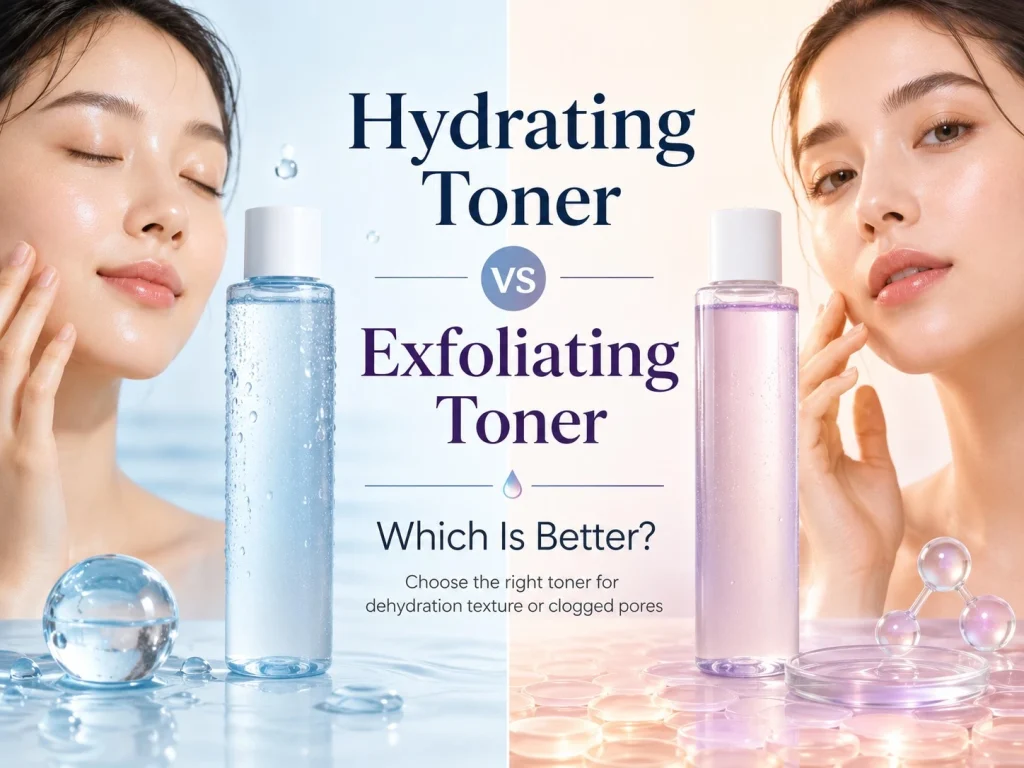


Both products may be thin liquids used after cleansing, but they do different jobs. The name on the front of the bottle is only a starting point: the ingredient list, directions, strength, pH, and complete formula determine how a toner behaves on your skin.
Hydrating Toner vs Exfoliating Toner: Key Differences
A hydrating toner adds a light layer of water-binding and skin-conditioning ingredients. An exfoliating toner uses acids to loosen or shed surface cells. Neither type is essential for healthy skin, and neither is automatically better. The useful choice is the one that addresses a real concern without duplicating or destabilizing the rest of your routine.
| Feature | Hydrating toner | Exfoliating toner |
|---|---|---|
| Main purpose | Increase surface hydration and improve comfort | Remove surface buildup and target roughness, dullness, or clogged pores |
| Common ingredients | Glycerin, hyaluronic acid, panthenol, beta-glucan, aloe | Glycolic acid, lactic acid, mandelic acid, salicylic acid, PHA |
| Best fit | Tight, dehydrated, or easily dried-out skin; routines using drying actives | Rough or dull-looking skin, blackheads, clogged pores, or excess surface oil |
| Typical frequency | Often once or twice daily if the label permits and skin remains comfortable | Usually introduced less often and increased only within label directions and skin tolerance |
| Main limitation | May not provide enough emollient or occlusive support to replace moisturizer | Can cause irritation, dryness, or over-exfoliation when too strong or used too often |
Most facial toners are leave-on products used after cleansing and before serum or moisturizer.[1] That shared placement does not make the two categories interchangeable. If you need the basic application method first, see how to use toner.
How Hydrating Toner Works and Who It Helps
Hydrating toners mainly supply water plus humectants, which attract and hold water in the outer skin layer. Glycerin and hyaluronic acid are common examples. Some formulas also include soothing or skin-conditioning ingredients, but the benefit of the finished product depends on the complete formula rather than one highlighted ingredient.[2]
A hydrating toner may be useful when:
- Skin feels tight after cleansing: A light hydrating layer can improve immediate comfort without adding a rich finish.
- Skin is oily but dehydrated: Oiliness does not rule out low water content. The distinction between dehydrated and dry skin can help identify what the routine is missing.
- Drying treatments are already in the routine: A simple hydrating step may be easier to tolerate than adding another active product.
- You want light hydration under moisturizer or sunscreen: A thin toner can add water without functioning as the final sealing layer.
Hydrating does not mean irritation-proof. Fragrance, botanical extracts, preservatives, or another active can still cause problems for an individual user. It also does not mean the toner can replace moisturizer. A watery formula may add hydration but provide little emollient softness or protection against water loss. If skin stays comfortable without a separate moisturizer, you may not need one at that moment; if tightness returns quickly, toner alone is probably not enough.
How Exfoliating Toner Works and Which Acid Fits
An exfoliating toner is a leave-on chemical exfoliant in toner form. Alpha hydroxy acids and beta hydroxy acids promote shedding of surface cells, and an AHA product’s effect varies with the acid type, concentration, pH, and the rest of the formula.[3] Treat the product according to its active ingredients and directions, not according to the reassuring word “toner.”
- AHAs for surface roughness and dullness: Glycolic and lactic acid are common AHAs. They act mainly at the skin surface and may suit uneven-feeling or dull-looking skin. Glycolic acid is not automatically “better,” and lactic acid is not guaranteed to be gentle; strength, pH, vehicle, frequency, and individual tolerance still matter.
- BHA for oil and clogged pores: In cosmetics, BHA usually means salicylic acid.[4] It exfoliates the stratum corneum and has comedolytic properties, which helps explain its use for blackheads and clogged pores.[6]
- PHA for a potentially milder option: Polyhydroxy acids are often marketed to users who want surface exfoliation with less irritation, but a category name cannot guarantee tolerance.
The comparison of AHA vs BHA goes deeper into acid selection. Do not borrow the strength or schedule of one acid toner for another. A formula designed for occasional use, a daily toner, and a professional peel are not equivalent even when they share an acid name.
Which Toner Should You Choose?

Start with the problem you actually want to solve, then check the products already doing similar work.
- Choose hydrating toner if tightness, dehydration, or comfortable layering is the priority.
- Choose an AHA toner if rough surface texture or a dull appearance is the main concern and your skin tolerates acids.
- Choose a salicylic acid toner if blackheads, clogged pores, or oilier areas are the target.
- Choose neither for now if skin is burning, actively peeling, sunburned, or reacting to several products. Adding another toner will not repair an overloaded routine.
- Default to hydrating toner or skip toner if you already use a retinoid, benzoyl peroxide, an exfoliating cleanser, peel pads, or a leave-on acid serum. Exfoliating while using products that already increase peeling or sensitivity can worsen dryness and irritation.[5]
Combination skin does not require one toner over the whole face. You can use an exfoliating toner only on congested areas and a hydrating toner elsewhere, provided the label permits localized use. Judge the result by lasting comfort and progress toward the intended concern—not by tingling, a “squeaky” finish, or residue on a cotton pad.
How to Use Hydrating and Exfoliating Toners Together
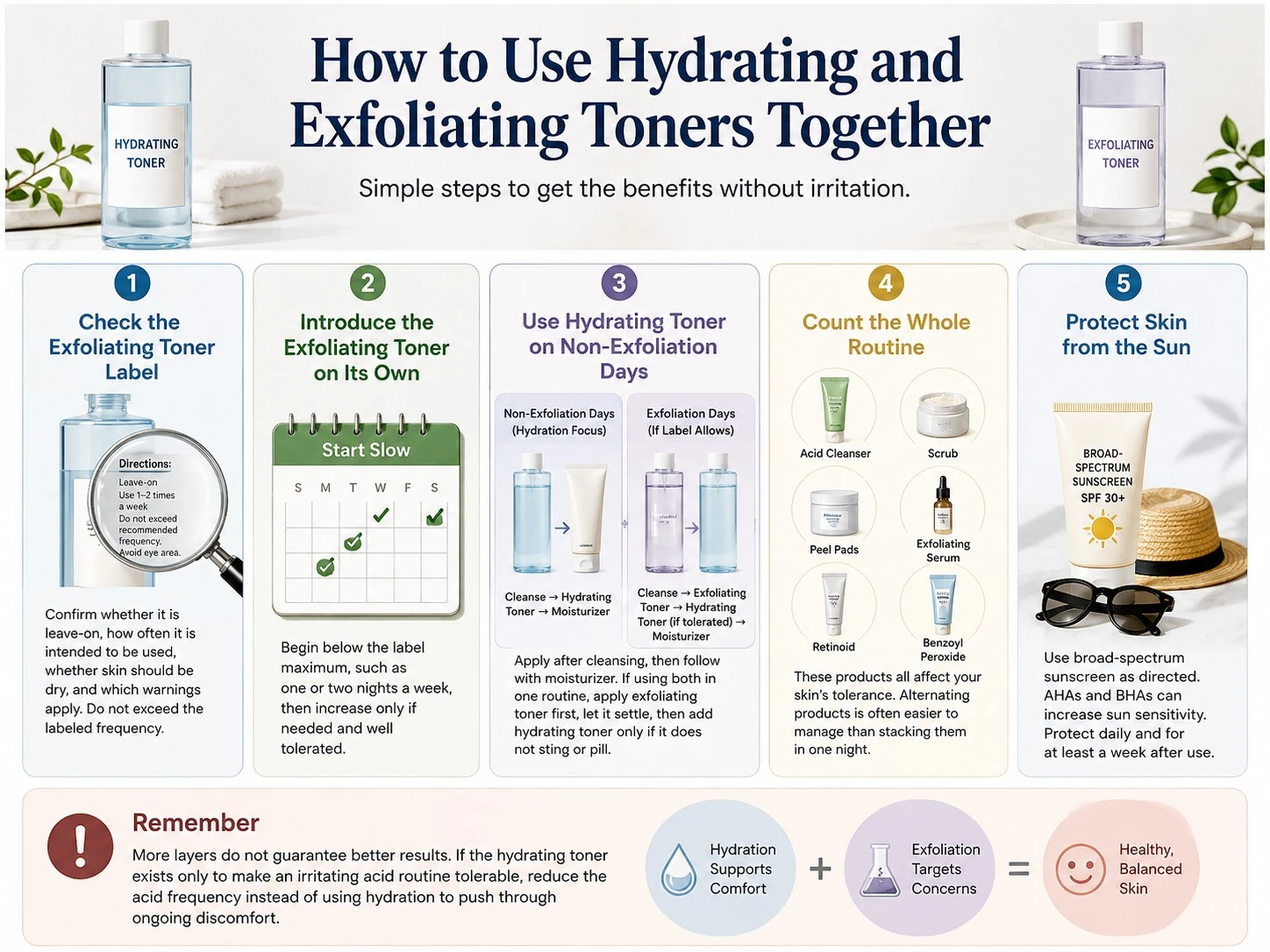
The simplest approach is to let the hydrating toner be the frequent support step and reserve the exfoliating toner for selected days. You do not have to use both in the same routine to receive benefits from both.
- Check the exfoliating toner label. Confirm whether it is leave-on, how often it is intended to be used, whether skin should be dry, and which warnings apply. Do not exceed the labeled frequency.
- Introduce the exfoliating toner on its own. Begin below the label maximum, such as one or two nights a week, then increase only if needed and well tolerated. There is no universal schedule for every acid strength and skin type; the guide to how often to exfoliate your face explains the variables.
- Use hydrating toner on non-exfoliation days. Apply it after cleansing, then follow with moisturizer. If you use both in one routine and both labels allow it, apply the exfoliating toner first, let it spread and settle, then add the hydrating toner only if it does not sting or pill.
- Count the whole routine. An acid cleanser, scrub, peel, exfoliating serum, retinoid, and benzoyl peroxide all affect the skin’s tolerance. Alternating products is often easier to manage than stacking them in one night.
- Protect skin from the sun. Use broad-spectrum sunscreen as directed. AHAs can increase sensitivity to sunlight and the possibility of sunburn; FDA advises sun protection during use and for a week afterward.[3] Sun protection is also advised with BHA products.[4]
More layers do not guarantee better results. If the hydrating toner exists only to make an irritating acid routine tolerable, reduce the acid frequency instead of using hydration to push through ongoing discomfort.
Signs Your Exfoliating Toner Is Too Strong or Too Frequent
A brief mild sensation can occur with some acid formulas, but persistent discomfort is a warning, not proof of effectiveness. Look at the pattern over the next several hours and days.
- Burning or stinging that is strong, prolonged, or returns with every application
- Diffuse redness, tenderness, itching, or swelling
- New flaking, rough patches, or tightness that persists after moisturizing
- Products that were previously comfortable suddenly sting
- A shiny surface that still feels tight or dehydrated
- More visible dark marks after irritation, particularly if your skin tends to develop post-inflammatory pigmentation
Stop the exfoliating toner and simplify the routine if these signs appear. Use a gentle cleanser, moisturizer, and daytime sunscreen while the skin settles; do not immediately replace the toner with another scrub or acid. The guide to over-exfoliated skin explains the recovery priorities. Seek medical care for severe pain, marked swelling, blistering, eye involvement, signs of infection, or a reaction that persists after stopping the product.
FAQs About Hydrating and Exfoliating Toners
Can hydrating toner replace moisturizer?
Sometimes a hydrating toner is enough for skin that remains comfortable, especially in humid weather or under a moisturizing sunscreen. However, many toners lack the emollient and occlusive ingredients that soften skin and slow water loss. If tightness returns or dry patches remain, follow with moisturizer.
Can you use exfoliating toner every day?
Only when the product directions allow daily use and your complete routine remains well tolerated. Daily use is not a goal or proof of progress. Stronger formulas, sensitive or dry skin, and routines containing other irritating actives usually need a lower frequency.
Should exfoliating toner sting?
It does not need to sting to work. A short mild sensation may occur with some formulas, but burning, prolonged stinging, redness, swelling, or worsening flakes means you should stop or reduce use. Follow the label and do not increase the amount to chase a sensation.
Should you use toner in the morning or at night?
A hydrating toner can usually fit morning, evening, or both if the label permits. Many people prefer exfoliating toner at night because it is easier to separate from other actives, but nighttime use does not remove the need for daytime sunscreen. Product directions take priority.
Is exfoliating toner the same as an exfoliant?
Yes. If a toner contains exfoliating acids at an active level and is marketed for exfoliation, count it as a chemical exfoliant. The watery texture and toner label do not make it a neutral preparation step, so include it when calculating the routine’s total exfoliation frequency.
Sources
[1] Cleveland Clinic. Do You Need a Face Toner?
[2] Harwood A, Nassereddin A, Krishnamurthy K. Moisturizers
[3] U.S. Food and Drug Administration. Alpha Hydroxy Acids
[4] U.S. Food and Drug Administration. Beta Hydroxy Acids
[5] American Academy of Dermatology Association. How to Safely Exfoliate at Home
[6] Arif T. Salicylic Acid as a Peeling Agent: A Comprehensive Review


