


Ferulic acid appears on many antioxidant-serum labels, often next to vitamin C, but its name creates two common misunderstandings. It is not an AHA or BHA that removes dead surface cells, and it is not a sunscreen filter that can replace SPF. Its job is mainly to support antioxidant defense within a properly formulated product.
That distinction matters when judging benefits. Research on topical ferulic acid is promising, but many human studies test products that also contain vitamin C, vitamin E, phloretin, lasers, microneedling, or other active ingredients. The results therefore describe the finished regimen—not ferulic acid acting alone.[1]
What Is Ferulic Acid in Skincare?
Ferulic acid is a phenolic compound found naturally in the cell walls of grains, fruits, vegetables, and other plants.[1] Cosmetic ferulic acid may be plant-derived or produced through controlled manufacturing; its source does not by itself tell you whether the finished product will be effective or gentle.
In skincare, ferulic acid functions mainly as an antioxidant. Oxidative stress occurs when reactive molecules, often called free radicals, overwhelm the skin’s protective systems. UV exposure and pollution can contribute to this process. Antioxidants can donate or stabilize electrons, helping interrupt reactions that damage cellular components.
Despite its name, ferulic acid is not used like glycolic acid, lactic acid, or salicylic acid. Those ingredients are selected primarily for exfoliation or pore-related effects. A normal ferulic-acid antioxidant serum should not be expected to peel the skin or produce visible shedding. A product can still sting if it has a low pH, strong vitamin C, alcohol, fragrance, or other active ingredients.
Ferulic acid also has a formulation role. A foundational study found that adding 0.5% ferulic acid to a solution containing 15% L-ascorbic acid and 1% alpha-tocopherol improved the chemical stability of those vitamins and increased the formula’s measured photoprotective effect under solar-simulated radiation.[2] That result belongs to the tested formula; it does not prove that every product containing ferulic acid performs identically.
Ferulic Acid Benefits: What the Evidence Supports
Ferulic acid has credible antioxidant potential, but benefit claims should reflect how the research was conducted. A 2025 systematic review found promising results across topical uses while also identifying small samples, limited diversity, varying formulas, and too few robust randomized trials. Those differences make it difficult to isolate ferulic acid’s contribution or name one universally effective concentration.[1]
| Potential benefit | What supports it | Realistic interpretation |
|---|---|---|
| Antioxidant defense | Laboratory, formulation, and human UV-exposure research | Helps support the skin against oxidative stress; does not block UV like sunscreen |
| Better vitamin C and E performance | Direct stability and combination-formula studies | Ferulic acid can be useful in a well-designed C-and-E serum; the full formula matters |
| Additional daytime photoprotection | Small human studies of combination antioxidant formulas | Can supplement a sun-protection routine but cannot replace sunscreen, shade, or clothing |
| Brighter, more even-looking skin | Small studies using mixed formulations, procedures, or higher-strength peels | Promising but not proof that an ordinary ferulic-acid serum will fade every dark spot |
| Smoother-looking photoaged skin | Limited clinical studies and combination regimens | Results are formula- and routine-dependent; prevention support is more established than reversal |
| Reduced appearance of redness | Antioxidant and anti-inflammatory rationale with limited clinical evidence | Possible supportive benefit, not a treatment for rosacea, dermatitis, or another skin disease |
Antioxidant and UV-Damage Support
The clearest human evidence concerns combination antioxidants. In one small clinical trial, a formula containing 15% L-ascorbic acid, 1% alpha-tocopherol, and 0.5% ferulic acid was applied before controlled solar-simulated UV exposure. Treated skin showed less erythema and fewer molecular and cellular markers of UV injury than vehicle-treated skin.[3]
This is useful evidence for supplemental antioxidant protection, not permission to use less sunscreen. The tested product did not work by forming the regulated UV-filtering film expected from sunscreen.
Dark Spots, Dullness, and Visible Aging
Oxidative stress contributes to pathways involved in uneven tone and visible aging, so antioxidant support is relevant. However, ferulic acid is often studied inside multi-ingredient serums or alongside procedures. Improvements in pigmentation, texture, or fine lines cannot automatically be assigned to ferulic acid alone.[1]
For established dark spots, melasma, or significant photoaging, ferulic acid is better viewed as a supporting ingredient than a complete treatment. Daily sun protection and a correctly targeted active usually matter more. A changing, bleeding, irregular, or rapidly growing spot should be assessed by a clinician rather than treated as routine pigmentation.
Who Should Use Ferulic Acid—and Who Should Be Careful?
Ferulic acid may suit someone who wants a daytime antioxidant serum and already understands that sunscreen remains essential. It is particularly logical when the formula also contains vitamin C and vitamin E, because that combination has the strongest direct human evidence.
It may be worth considering if you:
- want antioxidant support against environmental oxidative stress;
- already use vitamin C and want a formula designed for antioxidant stability;
- are focused on preventing additional visible sun damage rather than expecting rapid reversal;
- can apply sunscreen consistently; or
- prefer one combination serum instead of layering several antioxidant products.
Introduce it carefully if you have very reactive skin, rosacea, eczema, an impaired skin barrier, or current burning and peeling from retinoids, exfoliating acids, or acne treatments. The problem may be the complete serum rather than ferulic acid itself. Many ferulic-acid products also contain acidic L-ascorbic acid, solvents, fragrance, or other ingredients that change tolerability.
Do not apply a new antioxidant serum to sunburned, freshly shaved, broken, or procedure-recovering skin unless your clinician or procedure provider approves it. Restore a comfortable basic routine first.
How to Use Ferulic Acid in Your Skincare Routine
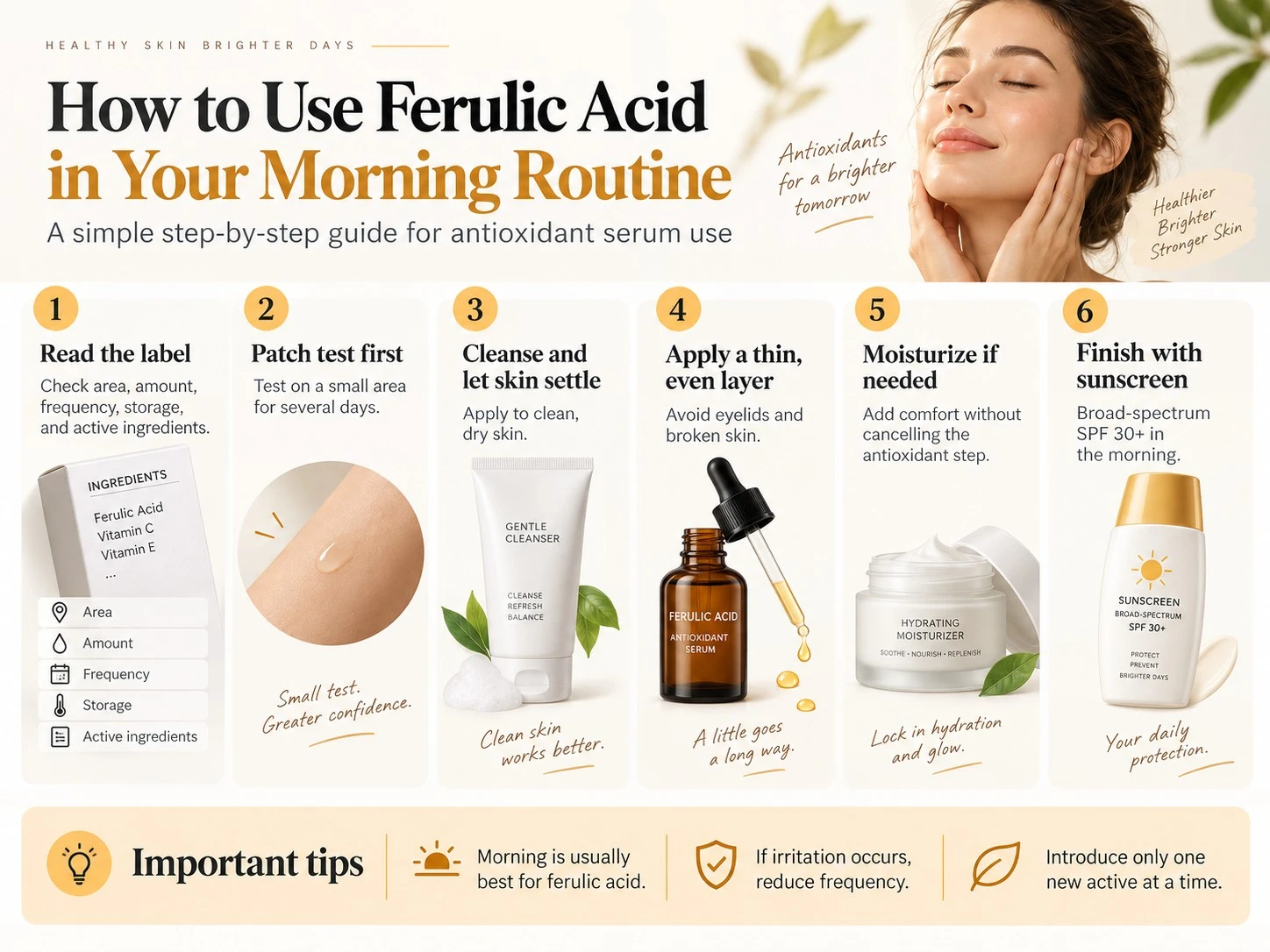
Follow the finished product’s directions because ferulic acid appears in different vehicles and combinations. For a leave-on antioxidant serum intended for morning use, this is the usual order:
- Read the label. Check the intended area, amount, frequency, storage instructions, and whether the formula contains other active ingredients.
- Test a small area first. Use the normal amount on a limited patch for several days before applying it across the face, especially if your skin reacts easily.
- Cleanse and let skin settle. Unless the product says otherwise, apply the serum to clean, dry skin to reduce running into the eyes and creases.
- Apply a thin, even layer. Use the labeled amount or just enough to cover the intended area. Avoid the eyelids and broken skin unless the product is made for those areas.
- Add moisturizer if needed. This can improve comfort without cancelling the antioxidant step.
- Finish with sunscreen in the morning. Choose broad-spectrum, water-resistant SPF 30 or higher and apply it to exposed skin.[5]
Morning is the most practical time because antioxidant support can complement daytime sun protection. Night use is not wrong when the label allows it, but it does not eliminate the need for sunscreen the next day. If a once-daily product makes skin uncomfortable, use it less often while assessing tolerance instead of forcing daily application.
Add only one new active product at a time. This makes it easier to identify the cause if redness, clogged pores, or itching develops. For general amount, order, and layering rules, use ZICAIL’s guide to how to use face serum.
What Can You Use With Ferulic Acid?
Ferulic acid does not have a universal list of forbidden pairings. Compatibility depends on the complete formulas, their pH and solvents, the number of active products used, and your skin’s tolerance.
| Ingredient or product | Can it be used with ferulic acid? | Practical approach |
|---|---|---|
| Vitamin C | Yes; this is the best-known pairing | Use one properly formulated combination serum rather than mixing powders or separate products in your palm |
| Vitamin E | Yes | Commonly paired with vitamin C and ferulic acid for complementary antioxidant support |
| Sunscreen | Yes; essential in the morning | Apply the antioxidant serum first, then sunscreen as the final skincare step |
| Niacinamide | Usually yes | Use together if comfortable or separate into different routines if the combined products sting |
| Hyaluronic acid or glycerin | Yes | Add hydration but do not replace moisturizer when more barrier support is needed |
| Ceramides and moisturizers | Yes | Useful when an acidic antioxidant serum feels drying |
| Retinoids | Usually yes, but irritation can add up | A simple option is ferulic acid in the morning and retinoid at night |
| AHAs, BHAs, or exfoliating products | Use cautiously | Separate routines if the skin becomes tight, red, or sensitive |
| Benzoyl peroxide | Use cautiously | Different routines may be easier to tolerate, especially with an acidic vitamin C combination |
The strongest reason to choose ferulic acid is often its relationship with vitamin C and E rather than a need to layer more products. ZICAIL’s vitamin C guide explains how vitamin C forms, strength, stability, and irritation risk change the routine.
Avoid DIY combinations made from raw ferulic-acid or vitamin-C powders. Solubility, pH, concentration, preservation, and oxidation control determine whether a formula stays uniform, safe, and usable. A mixture that looks clear on day one has not necessarily passed stability or microbial testing.
Ferulic Acid Side Effects and When to Stop
Ferulic acid is often well tolerated in cosmetic formulas. In a short-term skin-delivery study, the tested ferulic acid and related compounds did not produce irritation over 24 hours, but that finding does not guarantee tolerance with every product or repeated use.[4]
Possible reactions include:
- temporary tingling, especially from an acidic combination formula;
- persistent stinging or burning;
- redness, tightness, dryness, or flaking;
- itching, hives, or a rash;
- swelling around the eyes or face; or
- breakouts caused by the vehicle or another ingredient.
Brief sensation from an acidic serum is not proof that it is working. If discomfort continues after application, wash the product off and stop using it until the skin is comfortable. Do not try to “build tolerance” through repeated burning.
Persistent itching, a spreading rash, swelling, blistering, weeping, or worsening eczema needs medical advice. Seek urgent help for trouble breathing or rapidly developing facial, lip, tongue, or throat swelling.
When a reaction occurs, assess the complete ingredient list. Ferulic-acid serums may also contain L-ascorbic acid, vitamin E, botanical extracts, fragrance, alcohol, propylene glycol, preservatives, or other actives. Reactions cannot be attributed to ferulic acid from the front-label name alone.
How to Choose a Ferulic Acid Product
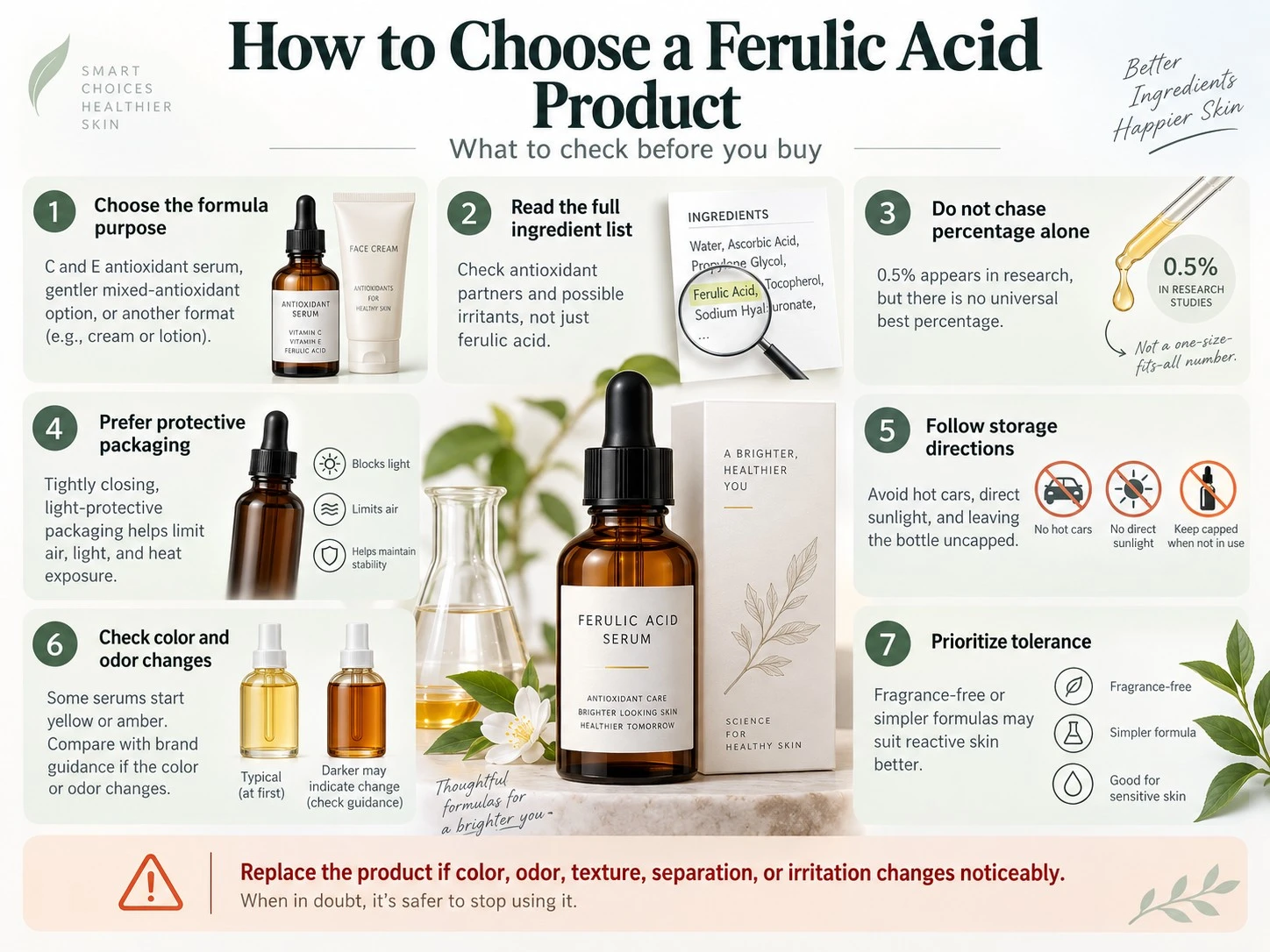
A useful ferulic-acid product is stable, comfortable, and easy to use consistently. Percentage alone cannot tell you that.
Check these points before buying:
- Formula purpose: Decide whether you want a C-and-E antioxidant serum, a gentler mixed-antioxidant product, or another format. Do not assume all ferulic-acid products target the same concern.
- Complete ingredient list: Look for the antioxidant partners and possible irritants, not only the featured ingredient.
- Concentration context: Research often includes 0.5% ferulic acid in combination serums, while other studies use different strengths and delivery systems. There is no proven universal “best” percentage for every skin type or formula.[1][2]
- Protective packaging: A tightly closing, light-protective container and sensible bottle size can reduce exposure to air, light, and heat.
- Storage directions: Follow the label. Do not leave the product in a hot car, direct sunlight, or an uncapped bottle.
- Expected color and odor: Some antioxidant formulas are naturally yellow or amber. Compare changes with the product’s starting appearance and the brand’s guidance rather than judging by color alone.
- Tolerance: Fragrance-free or simpler supporting formulas may be easier for reactive skin, although “fragrance-free” does not guarantee zero irritation.
Do not transfer the product to a decorative clear bottle, and keep the dropper from touching skin. If the serum changes sharply in color, odor, texture, or separation—or begins irritating skin after previously feeling comfortable—follow the manufacturer’s guidance and consider replacing it.
FAQs About Ferulic Acid for Skin
Is Ferulic Acid an Exfoliating Acid?
No. Ferulic acid is used mainly as an antioxidant, not as an AHA or BHA exfoliant. It should not be expected to dissolve dead surface cells, clear pores, or make the skin peel. A ferulic-acid product can still sting because of its overall pH or other ingredients.
Can You Use Ferulic Acid Every Day?
Many finished products are designed for daily use, but the label and your tolerance control frequency. Start less often if your skin is reactive or the product also contains strong L-ascorbic acid. Reduce use or stop if redness, burning, itching, or flaking persists.
Is Ferulic Acid Better in the Morning or at Night?
Morning is usually the most practical time because ferulic acid is used for antioxidant support alongside sunscreen. It can be used at night when the product directions allow it, but night application does not replace morning sun protection.
Can Ferulic Acid Replace Vitamin C or Sunscreen?
No. Ferulic acid and vitamin C perform overlapping but different antioxidant roles, and evidence supports using them together in a stable formula. Neither ingredient replaces sunscreen. Use a broad-spectrum, water-resistant SPF 30 or higher as part of daytime protection.[5]
Can Sensitive Skin Use Ferulic Acid?
Possibly, but judge the whole formula. A fragrance-free product without several strong actives may be easier to tolerate than an acidic vitamin C serum. Patch test first, start slowly, and do not apply it while the skin is already burning, peeling, or inflamed.
Sources
[1] Journal of Clinical and Aesthetic Dermatology. Ferulic Acid Use for Skin Applications: A Systematic Review
[2] Journal of Investigative Dermatology. Ferulic Acid Stabilizes a Solution of Vitamins C and E and Doubles Its Photoprotection of Skin
[3] Journal of the American Academy of Dermatology. A Topical Antioxidant Solution Containing Vitamins C and E Stabilized by Ferulic Acid Provides Protection for Human Skin Against Damage Caused by Ultraviolet Irradiation
[4] International Journal of Pharmaceutics. A Comparison of Skin Delivery of Ferulic Acid and Its Derivatives: Evaluation of Their Efficacy and Safety
[5] American Academy of Dermatology. How to Apply Sunscreen


