

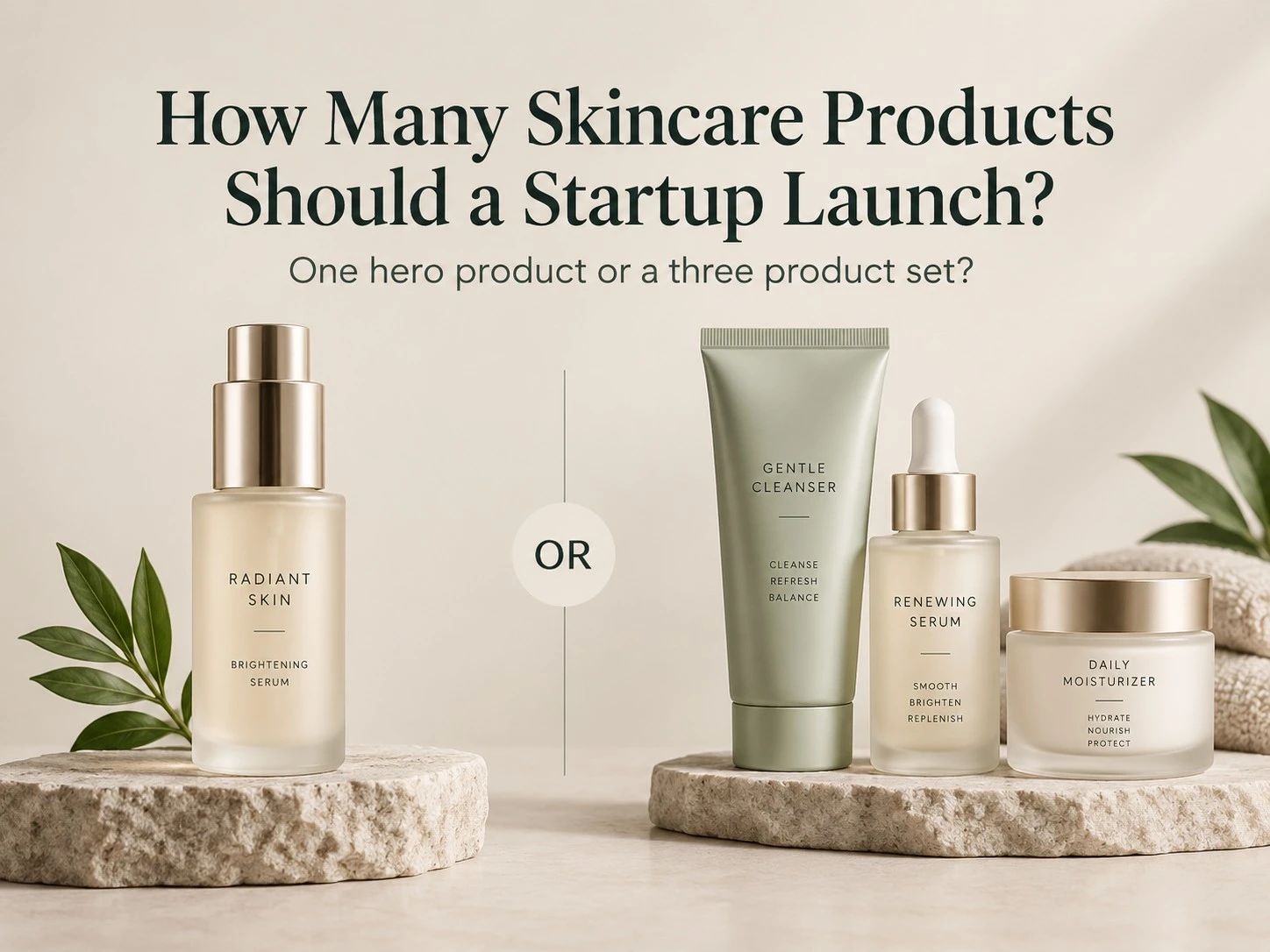
How many skincare products should a startup launch? The correct number is the smallest assortment that can deliver a clear customer promise and support the brand’s sales model. For some founders, that means one distinctive serum or moisturizer. For others, it means a coordinated cleanser, serum, and moisturizer that customers can understand as one routine.
Product count is a strategic decision, not a branding preference. Each additional SKU creates another formula or formula selection, component forecast, label, product page, content plan, inventory position, and reorder decision. A focused launch can make learning faster, while a coherent set can create a stronger routine and more ways to buy.
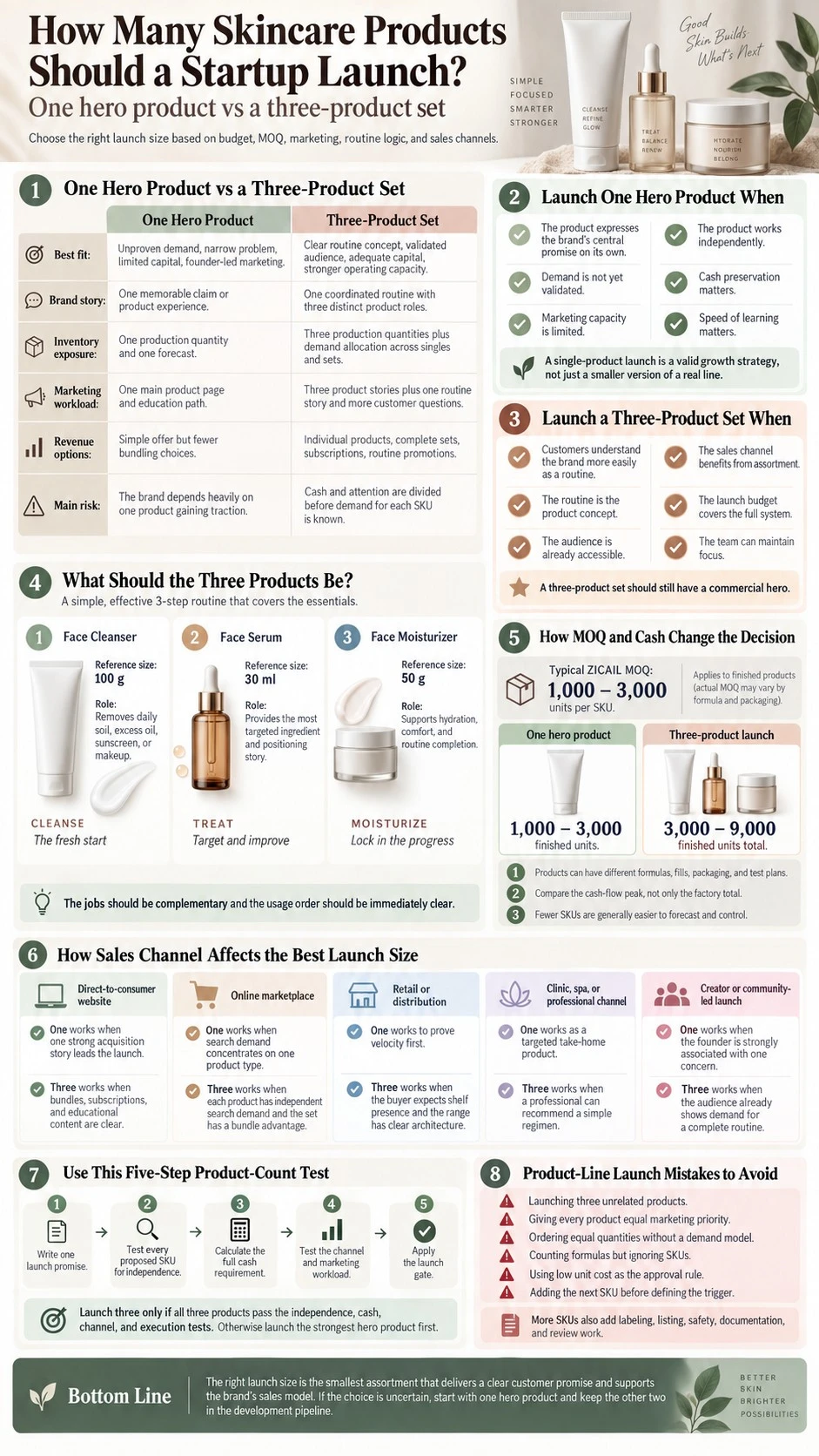
One Hero Product vs a Three-Product Set: Key Differences
The choice is mainly between concentration and coverage. A hero product concentrates cash, attention, and customer feedback on one offer. A three-product set covers more of a routine but requires the brand to make three products commercially ready at the same time.
| Decision area | One hero product | Three-product set |
|---|---|---|
| Best fit | Unproven demand, narrow problem, limited capital, or founder-led marketing | Clear routine concept, validated audience, adequate capital, and stronger operating capacity |
| Brand story | One memorable claim, format, or product experience | One coordinated routine with three distinct product roles |
| Inventory exposure | One production quantity and one finished-goods forecast | Three production quantities plus demand allocation across individual products and sets |
| Marketing workload | One main product page, offer, education path, and creative system | Three product stories, one routine story, bundles, and more customer questions |
| Revenue options | Simple offer but fewer bundling and cross-selling choices | Individual products, complete sets, subscriptions, and routine-based promotions |
| Main risk | The brand depends heavily on one product gaining traction | Cash and attention are divided before demand for each SKU is known |
| Expansion logic | Add the next product after the first reveals a clear adjacent need | Improve the set and add products only when customers expose a missing routine step |
Neither model is automatically safer. One product concentrates market risk, while three products multiply execution risk. The better launch is the one whose biggest risk the startup is equipped to manage.
When Should a Startup Launch One Hero Product?
Launch one hero product when the product can express the brand’s central promise without requiring companion products to make sense. The strongest candidates address a recognizable need, offer a noticeable or memorable user experience, support repeat purchase, and can be explained in one sentence without relying on vague “clean,” “premium,” or “advanced” positioning.
- Demand is not yet validated. One product lets the founder test positioning, price, creative concepts, reviews, and channel response without interpreting performance across several SKUs.
- Marketing capacity is limited. The brand can concentrate education, sampling, creator outreach, paid media, and product-page optimization on one offer.
- The product works independently. A barrier moisturizer, targeted serum, cleansing balm, or other clearly positioned product does not need a full branded routine to deliver its intended cosmetic benefit.
- Cash preservation matters. One production run leaves more capital available for photography, compliance, freight, customer acquisition, and reorders.
- Speed of learning matters. Reviews, returns, repeat purchase, and customer questions all point to the same product, making the next development decision easier to interpret.
A single-product launch is a valid growth strategy, not merely a smaller version of a “real” line. Hero Cosmetics, for example, initially launched with one Mighty Patch product before expanding, although one company’s outcome should not be treated as a guarantee for another.[1] The limitation is concentration: weak demand, quality problems, or supply disruption affect the entire catalog. The brand should therefore keep a second-product concept ready and define a staged skincare product-line plan without committing to commercial inventory too early.
When Should a Startup Launch a Three-Product Set?
Launch three products when customers understand the brand more easily as a routine than as a standalone item. The set should solve one connected use case, while every product still has a distinct job and a credible reason to be purchased individually.
- The routine is the product concept. The brand promise depends on preparation, targeted care, and moisture support working as a simple sequence.
- The audience is already accessible. A creator, clinic, retailer, distributor, or existing community provides evidence about the customer and the concerns the line will address.
- The channel benefits from assortment. Sets, consultations, gifting, wholesale presentations, or professional recommendations may work better with a small routine than with one isolated product.
- The launch budget covers the full system. The founder can fund three finished products plus packaging, testing, compliance, freight, marketing, and reorder reserves without weakening product quality.
- The team can maintain focus. Marketing can lead with one hero SKU while presenting the other two as logical companions rather than giving every product equal and confusing prominence.
A three-product set should still have a commercial hero. That product gives advertising, sampling, press, affiliates, and retailer conversations a clear entry point. The other two products increase routine completeness and provide cross-sell opportunities. Without a hero, a startup can spend three times on development yet give customers no obvious reason to enter the brand.
What Should the Three Products Be?
For a facial skincare startup, cleanser, serum, and moisturizer are often a practical three-product architecture because they perform different jobs and create a familiar sequence. They are not mandatory. The exact lineup should follow the customer problem, target market, and channel rather than a template.
| Product | Reference size | Role in the routine | Commercial question |
|---|---|---|---|
| Face cleanser | 100 g | Removes daily soil, excess oil, sunscreen, or makeup according to the formula and directions | Does it suit the target customer’s cleansing habits and preferred texture? |
| Face serum | 30 ml | Provides the most targeted ingredient and positioning story | Is this the hero product, and is its benefit easy to understand without exaggerated claims? |
| Face moisturizer | 50 g | Supports hydration, comfort, and routine completion | Does the texture fit the target climate, skin preference, and packaging? |
The three formulas should not repeat the same hero ingredients and claims without a product-specific reason. Repetition may make the range look coordinated, but it can also reduce differentiation and make customers question why all three products are needed. A set is stronger when the jobs are complementary and the usage order is immediately clear.
How Do MOQ and Cash Requirements Change the Decision?
MOQ usually applies to each SKU. At ZICAIL, a typical MOQ of 1,000–3,000 units per SKU means one hero product generally represents 1,000–3,000 finished units, while a cleanser, serum, and moisturizer launch represents 3,000–9,000 finished units in aggregate. Formula, packaging, decoration, and component requirements can change those quantities.
The three-product budget is not simply three times one unit price. Products can have different formulas, fill weights, packaging costs, test plans, and component MOQs. The brand also needs a demand plan for individual sales and set sales. The complete three-product skincare line cost guide explains the cost groups, while the private label skincare MOQ guide explains why finished-product and packaging quantities may differ.
Compare the cash-flow peak, not only the factory total. Record deposits, balance payments, freight, duties, launch expenses, and the capital needed for a reorder before the first batch sells out. Fewer SKUs are generally easier to forecast and control; uncontrolled SKU expansion can increase storage, fulfillment, and inventory-management complexity.[2] A founder should also calculate margin at the single-product, bundle, wholesale, and promotional price levels using the same skincare product cost and profit framework.
How Does the Sales Channel Affect the Best Launch Size?
The same product concept can require a different launch architecture in different channels. Decide where the first meaningful sales will come from before approving the number of SKUs.
| Primary channel | One hero product may work when | Three products may work when |
|---|---|---|
| Direct-to-consumer website | The brand has one strong acquisition story and can build a clear landing page and offer | The routine supports bundles, subscriptions, and enough educational content without confusing first-time visitors |
| Online marketplace | Search demand maps closely to one product type and reviews can concentrate on one listing | Each product has independent search demand and the set provides a clear bundle advantage |
| Retail or distribution | A distinctive item can prove velocity before line expansion | The buyer expects shelf presence, the range has clear architecture, and the brand can support inventory across accounts |
| Clinic, spa, or professional channel | One take-home product supports a specific service or customer need | A professional can recommend a simple regimen and explain the role of every step |
| Creator or community-led launch | The audience strongly associates the founder with one concern or product idea | Audience feedback already shows demand for a complete routine and the creator can produce sustained education for all three SKUs |
A retailer asking for “more products” is not enough reason to launch three. Confirm expected opening orders, store count, replenishment logic, testers, promotional requirements, and payment terms. Likewise, a large audience does not prove that three formulas will sell in the same proportions.
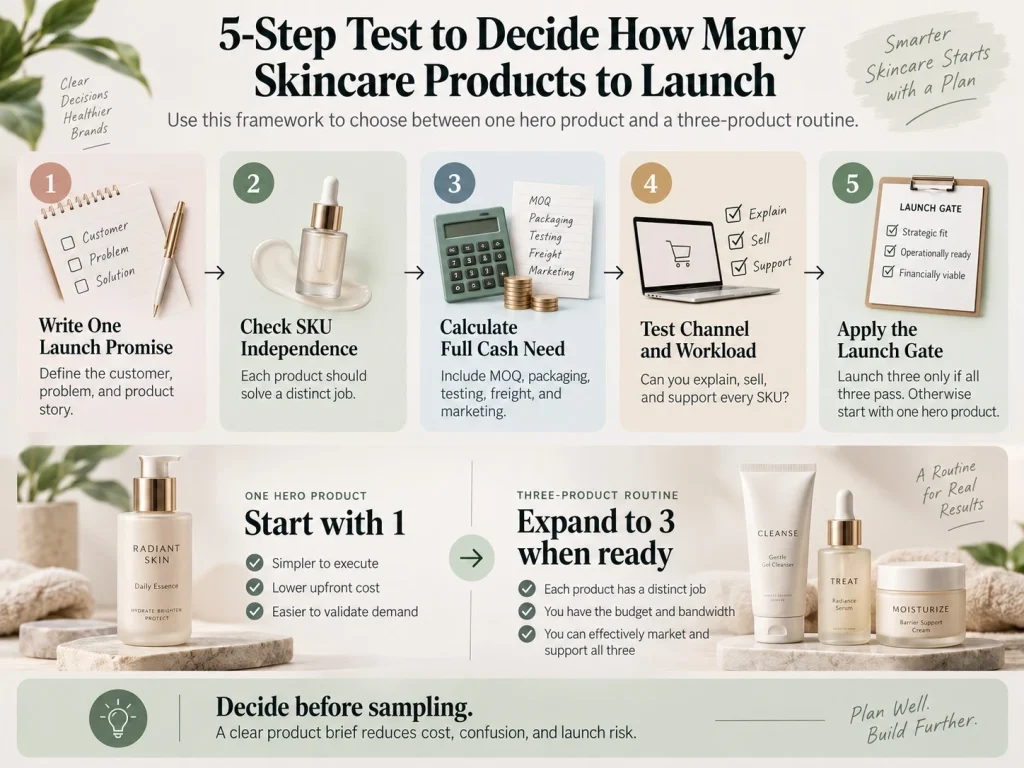
Use This Five-Step Product-Count Test
- Write one launch promise. State the customer, concern, product experience, and reason to choose the brand in one or two sentences. If the promise depends on a routine, define the role of each step.
- Test every proposed SKU for independence. Each product must solve a distinct job, remain understandable when sold alone, and avoid unnecessary overlap with the other products.
- Calculate the full cash requirement. Price development, per-SKU MOQ, packaging, testing, compliance, freight, marketing, and reorder timing instead of comparing unit prices only.
- Test the channel and marketing workload. Confirm how every SKU will be discovered, explained, sampled, sold, reviewed, and replenished in the primary channel.
- Apply the launch gate. Launch three only if all three products pass the independence, cash, channel, and execution tests. Otherwise launch the strongest hero product and retain the other briefs for staged expansion.
Document the decision before sampling begins. A precise skincare product brief for the manufacturer reduces ambiguity about formula route, texture, ingredients, claims, pack size, packaging, target market, and order quantity.
Which Product-Line Launch Mistakes Should You Avoid?
- Launching three unrelated products. A random cleanser, eye cream, and body oil may increase catalog size without creating a clear routine or customer story.
- Giving every product equal marketing priority. A three-product set still needs one entry product and a clear path from discovery to the rest of the routine.
- Ordering equal quantities without a demand model. Identical MOQs do not mean customers will buy the products at the same rate, especially when sets and individual items are both offered.
- Counting formulas but ignoring SKUs. Different sizes, fragrances, shades, or packaging variants can create additional inventory records and forecasting work even when the base formula is shared.
- Using low unit cost as the approval rule. A product that lacks positioning, margin, or channel demand can be expensive even when its factory price is low.
- Adding the next SKU before defining the trigger. Expansion should respond to repeat purchase, customer requests, channel evidence, or a clear routine gap—not a desire to keep posting new launches.
In the United States, the responsible person must list each marketed cosmetic product with FDA and update listings annually unless an exemption applies.[3] Each product also needs compliant labeling for its own identity, net quantity, ingredient declaration, business information, and applicable warnings.[4] Companies marketing cosmetics remain responsible for product safety, and any testing used to support that safety should be scientifically sound.[5] More SKUs therefore add documentation and review work as well as inventory.
Plan the Right-Sized Skincare Launch with ZICAIL
ZICAIL can evaluate a one-product hero concept or a coordinated cleanser, serum, and moisturizer set against your target market, formula route, packaging direction, claims, quantities, and timeline. Send the customer profile, primary sales channel, product concepts, target prices, destination market, and available launch budget. The project can then be scoped by SKU so you can compare a focused first launch with a staged three-product plan before committing to samples and commercial production.


