

Why Oily and Acne-Prone Skin Struggles With Sunscreen
Oily and acne-prone skin often struggles with sunscreen because some formulas feel heavy, shiny, sticky, or hard to layer. What looks like a breakout may also be texture discomfort, pilling, makeup separation, sweat mixing with SPF, or residue left after incomplete cleansing.
The problem is not always “sunscreen clogs pores.” It often comes from formula texture, film feel, layering, skin sensitivity, cleansing, or routine fit.
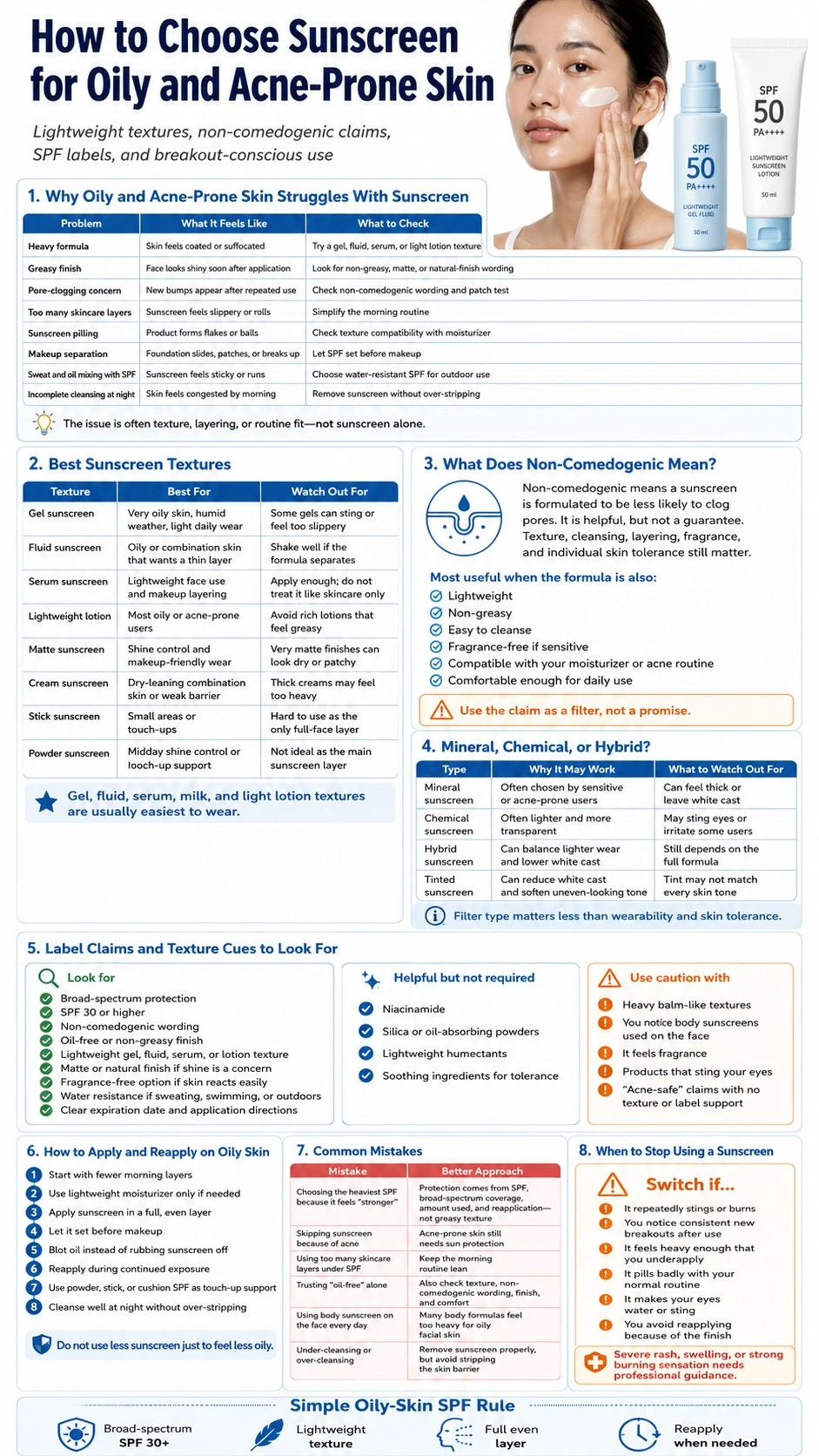
| Problem | What It Feels Like | What to Check |
|---|---|---|
| Heavy formula | Skin feels coated or suffocated | Try a gel, fluid, serum, or light lotion texture |
| Greasy finish | Face looks shiny soon after application | Look for non-greasy, matte, or natural-finish wording |
| Pore-clogging concern | New bumps appear after repeated use | Check non-comedogenic wording and patch test |
| Too many skincare layers | Sunscreen feels slippery or rolls | Simplify the morning routine |
| Sunscreen pilling | Product forms flakes or balls | Check texture compatibility with moisturizer |
| Makeup separation | Foundation slides, patches, or breaks up | Let SPF set before makeup |
| Sweat and oil mixing with SPF | Sunscreen feels sticky or runs | Choose water-resistant SPF for outdoor use |
| Incomplete cleansing at night | Skin feels congested by morning | Remove sunscreen without over-stripping |
Best Sunscreen Textures for Oily and Acne-Prone Skin
Texture is one of the biggest factors for oily and acne-prone skin. A good sunscreen should feel light enough to wear in the right amount. Gel, fluid, serum, milk, and lightweight lotion textures are often easier to tolerate than thick creams, balms, or rich body sunscreens used on the face.
Matte finishes can help reduce shine, but very dry matte formulas may cling to texture or makeup. Natural finishes are usually more flexible for daily use. Oil-control finishes can work well, but they should still feel comfortable, not tight or chalky.
| Texture | Best For | Watch Out For |
|---|---|---|
| Gel sunscreen | Very oily skin, humid weather, light daily wear | Some gels can sting or feel too slippery |
| Fluid sunscreen | Oily or combination skin that wants a thin layer | Shake well if the formula separates |
| Serum sunscreen | Lightweight face use and makeup layering | Apply enough; do not treat it like skincare only |
| Lightweight lotion | Most oily or acne-prone users | Avoid rich lotions that feel greasy |
| Matte sunscreen | Shine control and makeup-friendly wear | Very matte finishes can look dry or patchy |
| Cream sunscreen | Dry-leaning combination skin or weak barrier | Thick creams may feel too heavy |
| Stick sunscreen | Small areas or touch-ups | Hard to use as the only full-face layer |
| Powder sunscreen | Midday shine control or touch-up support | Not ideal as the main sunscreen layer |
What Does Non-Comedogenic Sunscreen Mean?
Non-comedogenic sunscreen is formulated to be less likely to clog pores. For oily or acne-prone skin, this claim is useful because heavy or pore-clogging products can make the skin feel congested. Dermatology guidance for acne-prone skin often recommends non-comedogenic sunscreen with broad-spectrum protection and SPF 30 or higher. [1]
But non-comedogenic does not mean “breakout-proof.” A sunscreen can still feel wrong for your skin if it is too greasy, strongly fragranced, hard to cleanse, or layered over too many products. Sweat, makeup, incomplete cleansing, and individual sensitivity can also affect how your skin responds.
Non-comedogenic wording is most useful when the formula is also:
- Lightweight
- Non-greasy
- Easy to cleanse
- Fragrance-free if sensitive
- Compatible with your moisturizer or acne routine
- Comfortable enough for daily use
Use the claim as a filter, not a guarantee. If a sunscreen repeatedly causes bumps or irritation, switch formulas.
Mineral, Chemical, or Hybrid: Which Is Better for Oily or Acne-Prone Skin?
No sunscreen filter type is automatically best for oily or acne-prone skin. Finish, texture, non-comedogenic positioning, and skin tolerance usually matter more. Mineral formulas may suit sensitive users but can feel thick; chemical formulas often feel lighter but may sting some eyes; hybrid formulas can balance wearability and lower white cast.
| Type | Why It May Work | What to Watch Out For |
|---|---|---|
| Mineral sunscreen | Often chosen by sensitive or acne-prone users | Can feel thick or leave white cast |
| Chemical sunscreen | Often lighter and more transparent | May sting eyes or irritate some users |
| Hybrid sunscreen | Can balance lighter wear and lower white cast | Still depends on the full formula |
| Tinted sunscreen | Can reduce white cast and soften uneven-looking tone | Tint may not match every skin tone |
Sunscreen Label Claims and Texture Cues to Look For
For oily and acne-prone skin, the label should show both protection and wearability. Broad-spectrum SPF 30 or higher is the protection base; non-comedogenic, oil-free, non-greasy, gel, fluid, matte, or fragrance-free claims help you judge comfort. [1][2]
Water resistance matters if you sweat, swim, exercise, or spend time outdoors. In the U.S., water-resistant sunscreens must state whether they remain effective for 40 or 80 minutes while swimming or sweating. [3]
Look for:
- Broad-spectrum protection
- SPF 30 or higher
- Non-comedogenic wording
- Oil-free or non-greasy finish
- Lightweight gel, fluid, serum, or lotion texture
- Matte or natural finish if shine is a concern
- Fragrance-free option if skin reacts easily
- Water resistance if sweating, swimming, or outdoors
- Clear expiration date and application directions
Helpful but not required:
- Niacinamide
- Silica or oil-absorbing powders
- Lightweight humectants
- Soothing ingredients for tolerance
Use caution with:
- Heavy balm-like textures
- Very rich body sunscreens used on the face
- Strong fragrance
- Products that sting your eyes
- “Acne-safe” claims with no texture or label support
How to Apply and Reapply Sunscreen on Oily Skin
Application cannot fix a sunscreen that is too heavy for your skin, but it can reduce greasy buildup, pilling, patchiness, and makeup separation. Do not use less sunscreen just to feel less oily. Instead, keep the routine lean and apply SPF in a full, even layer.
- Start with fewer morning layers
Use only the skincare steps your skin actually needs before sunscreen. - Use lightweight moisturizer only if needed
Very oily skin may not need a rich moisturizer under SPF. If your skin feels tight or dry from acne treatments, use a light gel or lotion. - Apply sunscreen in a full, even layer
Do not “spot apply” or use a tiny amount to avoid shine. Uneven sunscreen gives uneven protection. - Let it set before makeup
Give sunscreen time to settle before primer, foundation, or powder. - Blot oil instead of rubbing sunscreen off
Use blotting paper or a light tissue press. Avoid wiping or dragging. - Reapply during continued exposure
Reapply when outdoors for extended time, especially with sweat or sun exposure. [2][3] - Use powder, stick, or cushion SPF as touch-up support
These can help over makeup, but they should not replace the main sunscreen layer. - Cleanse well at night without over-stripping
Remove sunscreen fully, but avoid harsh cleansing that leaves skin tight or irritated.
See also: Skincare Routine for Acne-Prone Skin: Clearer Skin Steps
Common Mistakes That Make Sunscreen Feel Greasy or Breakout-Prone
- Mistake: Choosing the heaviest SPF because it feels “stronger”
Correction: Protection comes from SPF, broad-spectrum coverage, amount used, and reapplication—not greasy texture. - Mistake: Skipping sunscreen because of acne
Correction: Acne-prone skin still needs sun protection, especially when using acne treatments that can increase sun sensitivity. [1] - Mistake: Using too many skincare layers under SPF
Correction: Keep the morning routine lean. - Mistake: Trusting “oil-free” alone
Correction: Also check texture, non-comedogenic wording, finish, and comfort. - Mistake: Using body sunscreen on the face every day
Correction: Body sunscreen can work, but many formulas feel too heavy for oily facial skin. - Mistake: Under-cleansing or over-cleansing
Correction: Remove sunscreen properly at night, but avoid stripping the skin barrier.
When to Stop Using a Sunscreen
A little shine does not always mean a sunscreen is wrong. But repeated burning, eye stinging, clear new breakouts, severe heaviness, or a finish that makes you avoid SPF is a reason to switch. This is a comfort and tolerance judgment, not an acne diagnosis.
Stop or switch if:
- It repeatedly stings or burns
- You notice consistent new breakouts after use
- It feels heavy enough that you underapply
- It pills badly with your normal routine
- It makes your eyes water or sting
- You avoid reapplying because of the finish
If you get a severe reaction, rash, swelling, or strong burning sensation, stop using the product and seek professional guidance.
Final Takeaway: Sunscreen for Oily and Acne-Prone Skin
Oily and acne-prone skin still needs sunscreen. Choose broad-spectrum SPF 30 or higher, lightweight, non-greasy, and non-comedogenic when possible. Texture often matters more than filter type because heavy, shiny, or hard-to-clean formulas are easier to underapply or skip. Avoid thick, waxy, strongly fragranced formulas if they make your skin feel congested. The right SPF protects well and fits your daily routine.


