


A moisturizer, serum, toner, balm, or mask may look simple when it reaches the shelf, but commercial skincare production involves much more than combining ingredients in a tank. The manufacturer has to translate a formula into a repeatable process, control raw materials and equipment, keep the batch within specification, fill it into compatible packaging, document what happened, and decide whether the finished batch can be released.
There is no single manufacturing recipe for every skincare product. An oil serum may be blended at room temperature, a cream may require separate phases and emulsification, and a gel may depend on a specific hydration and mixing sequence. The common principle is controlled, documented production. ISO 22716 covers good manufacturing practice for the production, control, storage, and shipment of cosmetic products, while individual markets can add their own legal requirements.[1]
1. Start With the Product Brief and Formula Route

Manufacturing begins before anyone weighs an ingredient. The first task is to define exactly what is being made. For a new project, the product brief may specify the format, target user, skin concern, texture, fragrance direction, benchmark product, preferred and excluded ingredients, target claims, packaging, target markets, cost ceiling, and planned order quantity.
The brand also needs to choose a development route. A private label or existing formula can reduce early formulation work, while a custom project requires more laboratory development and approval before production. Neither route removes the need for controlled manufacturing once the batch enters the factory.
This distinction matters because product development and manufacturing are related but not identical. Development decides what the product should be. Manufacturing defines how the approved product will be reproduced at production scale.
2. Develop and Approve the Formula at Lab Scale

For a custom project, formulators normally begin with small laboratory batches. They adjust the formula until the product reaches the intended appearance, skin feel, spread, absorption, fragrance, color, viscosity, and other relevant targets. Measurements such as pH are important for many water-based formulas, but not every product has the same applicable parameters.
Sample approval should be version-controlled. The manufacturer and brand need to know which formula version, sample, fragrance, color, and packaging direction were approved. Without a clear approved reference, later production disputes become difficult to diagnose because there is no shared target.
Formula development also has to account for the product’s intended package and testing plan. A formula that looks good in a lab beaker is not automatically ready for commercial filling. Our Skincare Formulation Guide covers the development side in more detail.
3. Prepare Raw Materials and Packaging Components

Before a production batch starts, the factory needs the approved ingredients and packaging components in the correct quantities. Raw materials should be identified by lot and control status, stored under suitable conditions, and checked or tested according to the manufacturer’s procedures before use. Cosmetic GMP guidance addresses material identification, storage, sampling, testing, rejection control, and protection against mix-ups or contamination.[2]
Packaging is prepared in parallel. Pumps, bottles, jars, tubes, droppers, caps, liners, labels, cartons, and decoration must match the approved bill of materials. Packaging is not just decoration: it affects filling, dosing, product protection, leakage risk, and the way the customer uses the formula. See our Skincare Packaging Guide for the main packaging decisions brands make before production.
4. Scale Up the Formula for Production

One of the most misunderstood stages is scale-up. A 500 g laboratory sample cannot always be converted into a 500 kg production batch by multiplying every number and using the same mixing time.
Larger equipment changes how ingredients move, how quickly heat enters or leaves the batch, how powders disperse, and how much shear the formula receives. The manufacturer therefore converts the lab method into production instructions that define the equipment, batch size, addition order, mixing speed or range, temperatures, hold times, cooling sequence, and other process parameters that matter for that formula.
This is why scale-up is part of process development, not just arithmetic. A manufacturer may use a pilot or intermediate batch when the product, equipment, or risk profile makes that useful. The goal is to reproduce the approved characteristics reliably before routine commercial production.
5. Manufacture the Bulk Skincare Product
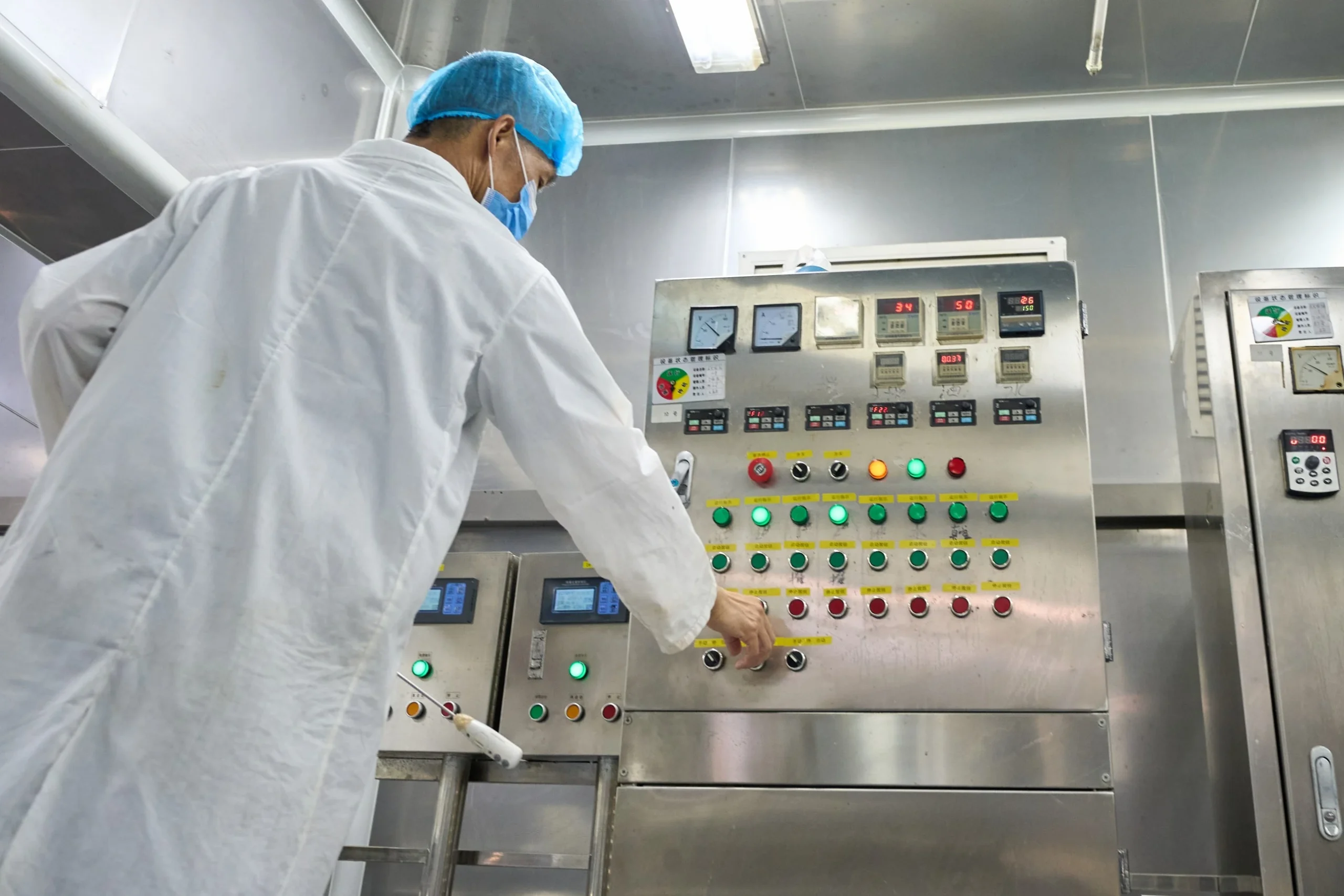
Once materials, equipment, and batch instructions are ready, production can begin. The exact operations depend on the product format.
| Product Type | Typical Manufacturing Logic | What Needs Control |
|---|---|---|
| Creams and lotions | Water-soluble and oil-soluble materials may be prepared separately, brought to suitable processing conditions, combined, emulsified, then cooled before selected heat-sensitive ingredients are added. | Phase preparation, emulsification, temperature, mixing, cooling, viscosity, and homogeneity. |
| Water-based serums and gels | Humectants, solvents, thickeners, actives, and other ingredients are dissolved, dispersed, or hydrated in a controlled sequence. | Hydration, dispersion, pH where applicable, viscosity, clarity or appearance, and air incorporation. |
| Oil serums | Oil-soluble ingredients are weighed and blended, often without an aqueous phase. | Ingredient solubility, uniformity, oxidation control, appearance, and filling behavior. |
| Balms | Waxes, butters, oils, and other oil-phase materials may be melted, blended, and cooled under controlled conditions. | Melting sequence, temperature, crystal behavior, texture, and cooling conditions. |
| Suspensions and masks | Powders, pigments, clays, or insoluble materials may need controlled dispersion and suspension within the base. | Particle dispersion, settling risk, viscosity, uniformity, and filling consistency. |
Not every cream is made with the same temperature, not every serum is cold processed, and not every formula needs high-shear homogenization. A credible manufacturing description should therefore explain the process principle without pretending there is one universal recipe.
6. Check the Batch During Production

Quality control does not begin only after the bottles are filled. Manufacturers use in-process checks to confirm that the batch is behaving as expected while there is still an opportunity to investigate a deviation.
Depending on the product and specification, checks can include appearance, color, odor, pH, viscosity, density, homogeneity, temperature, batch weight, or other defined parameters. Cosmetic GMP guidance also describes sampling during or after processing and laboratory checks on raw materials, in-process samples, and finished products against established specifications.[2]
The important distinction is between a measurement and a release decision. A single pH or viscosity result does not prove that the whole product is acceptable. The batch has to be evaluated against the full specification and quality plan relevant to that product. ZICAIL’s R&D, Production & Quality Control page explains how these functions connect operationally.
7. Fill, Close, Code, and Pack the Product

After the bulk product reaches the required manufacturing stage and passes the appropriate in-process checks, it can move to filling. The product is transferred to filling equipment suitable for its viscosity and package format, then dispensed into the approved containers.
The next operations can include inserting pumps or plugs, capping, sealing, crimping, applying labels, printing lot or batch codes, cartoning, and case packing. Controls are needed to avoid package mix-ups and to keep filled units consistent. Cosmetic GMP guidance addresses written filling instructions, equipment identification, label checks, and permanent code marks on finished packages.[2]
Packaging compatibility matters here. A serum can be chemically acceptable but still fail commercially if a pump cannot dose it, a closure leaks, a formula discolors the package, or the product becomes difficult to dispense over time.
8. Review Finished-Product Quality Before Batch Release

Filling is not automatically the end of manufacturing. Finished units may still need inspection, sampling, documentation review, and product-specific laboratory testing before the batch is released under the manufacturer’s quality system.
The exact release package varies by formula, market, risk profile, customer specification, and manufacturing system. Physical and chemical checks, microbiological testing, package inspection, fill-weight verification, coding checks, and record review can all be relevant. Harmful microorganisms can enter cosmetics through contaminated raw materials or water, poor manufacturing conditions, ineffective preservation, unsuitable packaging, or poor storage conditions.[3]
Some testing belongs to development rather than routine batch release. Stability, packaging compatibility, preservative effectiveness, safety assessment, claims substantiation, and routine production QC answer different questions. Our Skincare Product Testing Guide separates these categories so brands do not treat every test as interchangeable.
Why Can a Production Batch Feel Different From a Lab Sample?
A well-controlled scale-up should aim to reproduce the approved product within defined specifications, but “identical in every sensory detail” is not always a realistic way to judge a commercial batch.
- Scale changes processing: larger vessels alter mixing, heat transfer, cooling, and shear.
- Raw materials have specifications, not perfect sameness: some ingredients, especially naturally derived materials, can show acceptable lot-to-lot variation.
- Sample age matters: a fresh lab sample and a production unit that has rested for days or weeks may not feel identical at the same moment.
- Packaging changes the experience: a pump, dropper, tube, or jar affects dose size, aeration, and how the product is perceived during use.
- Process deviations matter: incorrect temperature, addition order, mixing, or cooling can create a genuine production problem rather than normal variation.
The solution is not to rely only on memory of the sample. Brands and manufacturers should agree on an approved reference plus measurable specifications and a clear deviation process before production.
How Does Private Label Change the Manufacturing Process?
Private label mainly shortens the early development path. It does not eliminate controlled production, filling, quality checks, or batch documentation.
| Stage | Private Label | Custom Formula |
|---|---|---|
| Formula development | Usually starts with an existing approved manufacturer formula. | Requires a new or substantially modified formulation process. |
| Sampling | Often focuses on formula selection, package fit, fragrance, shade, or permitted options. | Usually includes multiple formula-development rounds. |
| Scale-up | The manufacturer may already have an established production process for the formula. | The new formula may require additional process development or scale-up work. |
| Commercial production | Still requires controlled batching, filling, coding, QC, and records. | Requires the same manufacturing controls after the process is established. |
If you are deciding which route fits a new brand or product extension, compare the commercial tradeoffs in Private Label vs Custom Skincare.
What Should a Brand Confirm Before Mass Production?

Before approving production, make sure the project has one clear, controlled version of the product. At minimum, confirm the items that affect what will actually be manufactured and released.
- Approved formula: formula code or version, approved sample, fragrance, color, and any permitted tolerances.
- Approved packaging: bottle, tube, jar, pump, cap, liner, label, carton, decoration, and pack sizes.
- Product specifications: the physical, chemical, sensory, microbiological, or other acceptance criteria relevant to the formula.
- Testing plan: which development tests are complete and which routine batch tests or inspections are required.
- Artwork and coding: final labels, lot coding, dates where applicable, and market-specific information.
- Order and production details: batch size, order quantity, expected production loss or overage policy, and filling configuration.
- Change control: what happens if a raw material, formula, supplier, package component, or production process must change.
- Release documents: which batch records, certificates, test reports, or other documents the brand will receive.
A full skincare project includes more than the factory production window. Formula development, testing, packaging procurement, artwork, regulatory work, production scheduling, and shipping can all affect the launch date. See How Long Does Skincare Product Development Take? for the wider timeline.
Final Thoughts
Skincare products are made by converting an approved formula and product specification into a repeatable manufacturing process. The visible steps—mixing and filling—are only the middle of that chain. Raw-material control, scale-up, in-process checks, packaging, testing, records, and release decisions are what make commercial production different from simply preparing a sample.
For brands, the most useful question is not only “Can this factory make my formula?” It is “Can this factory reproduce the approved product consistently, document the process, control changes, and support the testing and packaging required for my target markets?”
If you are preparing a skincare project, ZICAIL can help map the route from formula selection or custom formulation through scale-up, testing, packaging, production, and final delivery. Share your product type, target market, packaging direction, expected quantity, claims, and launch timing through our project inquiry page so the manufacturing path can be defined before production begins.


