


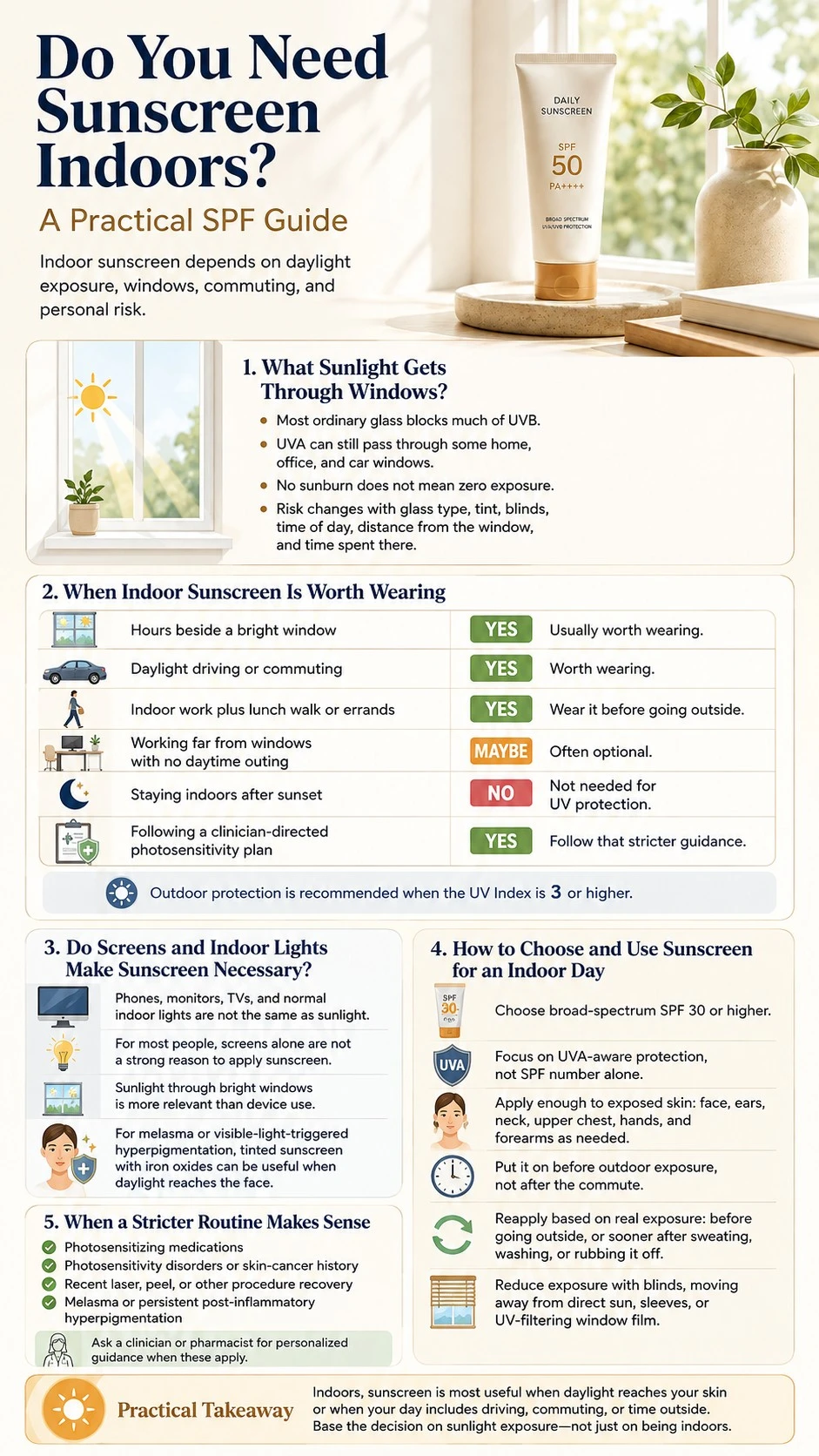
Indoor life does not create one fixed level of sun exposure. A windowless office, a desk beside floor-to-ceiling glass, and several hours behind a car’s side window are different situations. The useful question is not simply whether you are inside, but how much solar radiation reaches your uncovered skin and for how long.
What Sunlight Gets Through Windows?
Ordinary glass changes sunlight rather than blocking all of it. Most home, office, and car windows block much of the ultraviolet B (UVB) radiation that causes sunburn, but ultraviolet A (UVA) can pass through some window glass. UVA contributes to premature skin aging and skin cancer risk, so the absence of a burn does not prove that exposure is zero.[1]
The practical risk still varies. Glass type, coatings, tint, blinds, the direction of the window, cloud cover, time of day, distance from the glass, and time spent there all change the dose. For most people, occasional exposure through a window is not the same as sitting beside direct sunlight for hours; prolonged time close to a sunlit window is the situation that deserves more attention.[2]
Applying SPF every morning is a convenient habit when plans change, but habit and exposure are different questions. A person who stays well away from windows and does not go outside has little indoor solar exposure, so sunscreen is not automatically necessary for that day.[3]
When Indoor Sunscreen Is Worth Wearing
Use your actual day as the decision tool. The table classifies common situations rather than treating every indoor environment as equal.
| Situation | Likely exposure | Practical choice |
|---|---|---|
| Working far from windows with no daytime outing | Low solar exposure | Sunscreen is optional; normal clothing and the building already provide substantial separation from sunlight |
| Sitting beside a bright window for several hours | Repeated window-filtered daylight, including possible UVA | Apply broad-spectrum sunscreen to exposed skin, or reduce exposure with blinds, UV-filtering film, clothing, or a different seat |
| Driving or riding in a car during daylight | Exposure through the windshield and side windows varies | Protect the face, neck, hands, and any arm beside the window; do not assume every side window blocks UVA equally |
| Working inside but taking a commute, lunch walk, or errands | Indoor exposure may be low, but outdoor exposure is real | Apply before the outdoor portion, especially when the local UV Index is 3 or higher |
| Staying indoors after sunset | No solar UV exposure | Sunscreen is not needed for UV protection |
| Following a clinician-directed photosensitivity plan | A small exposure may matter more than it does for the average person | Follow the medical plan even if generic indoor advice is less strict |
The U.S. UV Index is designed for outdoor exposure, not for calculating the dose at a desk behind glass. It is still useful when deciding whether a commute, dog walk, school pickup, or quick errand turns an indoor day into a sun-exposure day. A UV Index of 3 or higher calls for protection when outside.[4]
Do Screens and Indoor Lights Make Sunscreen Necessary?
Why a screen is not the same as sunlight
For most people, no. Phones, monitors, televisions, and ordinary indoor lights emit visible light, but they do not expose skin to the same intensity or spectrum as sunlight. A systematic review did not identify blue light from electronic devices at representative exposure levels as a hazard for skin pigmentation, redness, yellowing, or photoaging; the authors also noted limits in the available evidence.[5]
This distinction matters because “blue light” can refer to visible light from very different sources. Research showing pigment changes after controlled, high-dose visible-light exposure does not prove that eight hours at a normal laptop produces the same result. Screen-use claims should not be used to frighten people into applying more sunscreen.
When visible light matters for pigmentation
Sunlight through a bright window is a different issue. Solar visible light can worsen hyperpigmentation in some people, particularly those with darker skin tones or pigmentary conditions such as melasma. When that is your concern and meaningful daylight reaches your face, a broad-spectrum tinted sunscreen formulated with iron oxides can add visible-light protection that an untinted sunscreen may not provide.[6] The target is solar exposure; ordinary screen use alone does not establish the need.
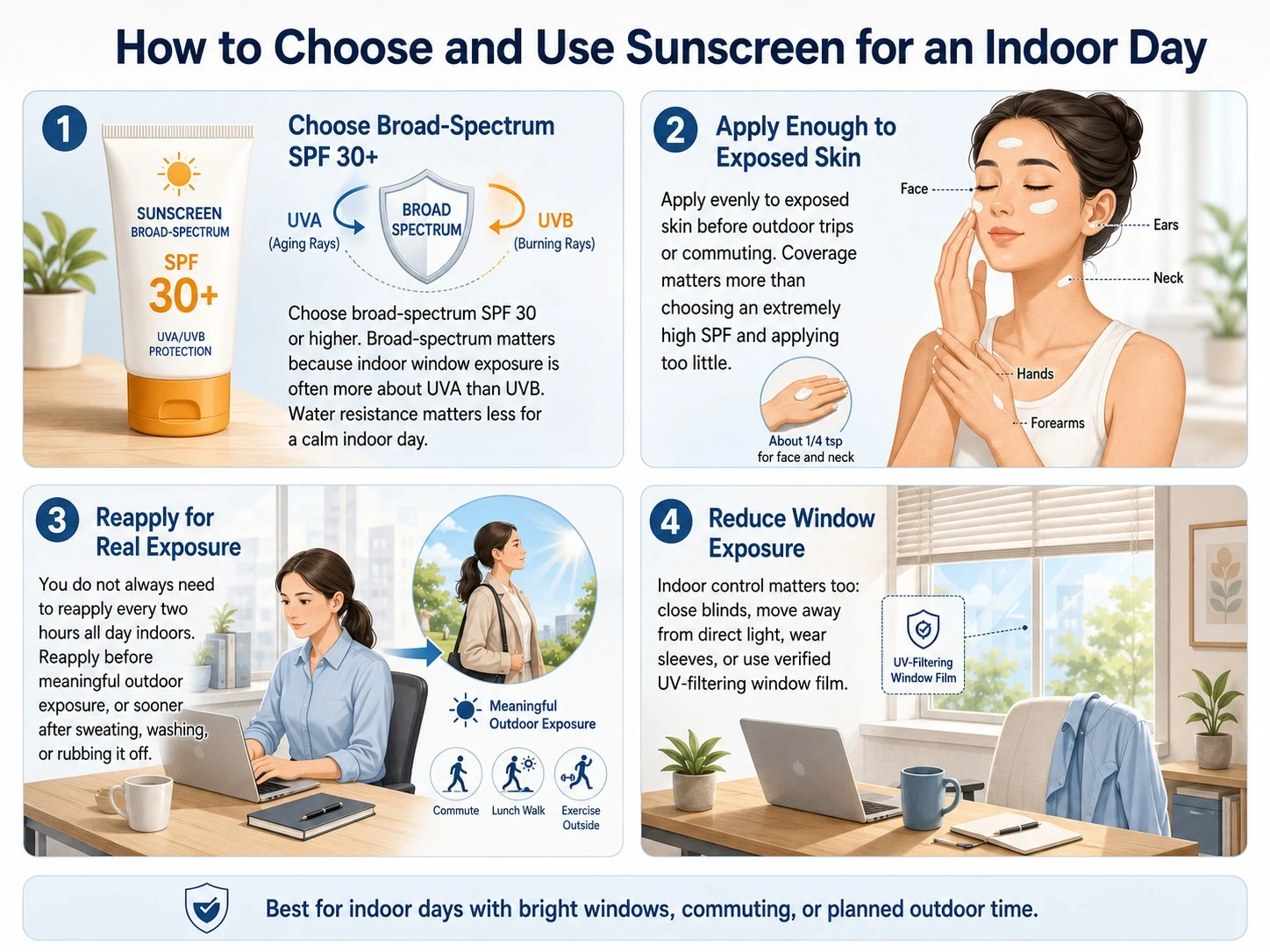
How to Choose and Use Sunscreen for an Indoor Day
Choose broad-spectrum SPF 30 or higher
If your exposure justifies sunscreen, choose a broad-spectrum sunscreen with SPF 30 or higher. “Broad-spectrum” matters because SPF mainly describes protection from sunburn-producing UVB, while an indoor window concern is often UVA. Water resistance is useful when you will sweat or spend time outdoors, but it is less important for a calm day at a desk.
Apply enough to exposed skin
Apply the product evenly to skin that daylight or an outdoor trip will expose. This usually includes the face, ears, neck, upper chest, hands, and forearms, depending on clothing. Put it on before you go outdoors; applying after a commute does not protect the exposure that already happened. Using the right amount of sunscreen on your face and spreading it evenly matter more than choosing an unusually high SPF and applying only a thin cosmetic layer.[7]
Reapply for the exposure you actually have
A rigid “reapply every two hours all day indoors” rule is not necessary for every situation. The two-hour recommendation is written for continued outdoor protection. If you are away from windows and remain inside, the sunscreen film has not been challenged by the same UV exposure, swimming, sweating, or towel drying. Follow the label and reapply sunscreen before meaningful outdoor exposure, or sooner after sweating, washing, or rubbing the product off.[7]
Reduce exposure at the window
Sunscreen is also not the only indoor control. Closing blinds, moving the desk away from direct light, wearing sleeves, or installing verified UV-filtering window film can reduce exposure without adding another skincare layer. These options are especially useful at a fixed workstation or in a vehicle where the same side of the body receives daylight repeatedly.
When a Stricter Sun-Protection Routine Makes Sense
General indoor advice may be too relaxed when your skin or treatment changes the consequence of exposure. Ask the prescribing clinician or procedure provider for specific instructions when any of these applies:
- Medicine warnings: A label warns about photosensitivity or an increased sunburn risk.
- Photosensitive conditions: You have a photosensitive condition, a history of skin cancer, or instructions to limit UVA exposure.
- Procedure recovery: You recently had a laser, peel, or other procedure and received instructions about sun avoidance.
- Pigment concerns: You are treating melasma or persistent post-inflammatory hyperpigmentation and spend time in strong daylight near windows.
Do not stop a prescribed medicine because it may increase sun sensitivity. Check its label and ask a pharmacist or clinician how much protection you need; broad-spectrum SPF 30 or higher, protective clothing, and exposure reduction are common parts of photosensitivity advice.[8]
Final Thoughts
You do not need sunscreen merely because you are indoors. Wear it when daylight reaches you for long periods, when driving or outdoor time is part of the day, or when a medical or pigment-related reason calls for stricter protection. If you are far from windows and remain inside, skipping sunscreen is a reasonable choice.
FAQs About Wearing Sunscreen Indoors
Do you need sunscreen indoors at night?
No. Sunscreen protects against solar ultraviolet radiation, which is absent after sunset. Indoor lamps and screens do not create a routine need for nighttime SPF. Remove sunscreen as part of your normal evening cleansing routine rather than sleeping in it for protection.
Is moisturizer with SPF enough for an indoor day?
It can be, if it is labeled broad-spectrum SPF 30 or higher and you apply enough to cover the exposed area evenly. The main practical failure is using only the small amount normally used for hydration rather than an adequate sunscreen layer.
Do closed curtains remove the need for sunscreen?
Opaque curtains or blinds can greatly reduce daylight reaching your skin, but the result depends on the material, coverage, and gaps. If the room stays away from direct daylight and you will not go outside, sunscreen is usually optional. Sheer curtains should not be assumed to block UVA.
Should you apply sunscreen in the morning if you will go outside later?
You may apply it as part of your morning routine, but check the layer before leaving. Reapply if you washed, sweated heavily, rubbed the area, or the label directs you to do so. Applying shortly before the outdoor period gives you better control over coverage.
Does dark window tint guarantee UVA protection?
No. Visible darkness and ultraviolet filtration are not the same property. Window construction, laminate, coatings, and film specifications determine UVA transmission. Check verified product or vehicle information rather than judging protection from color alone.
Sources
[1] American Academy of Dermatology Association. Sunscreen FAQs
[2] American Cancer Society. What Factors Affect UV Risk?
[3] Cancer Council Australia. Should I Wear Sunscreen When Indoors?
[4] U.S. Environmental Protection Agency. UV Index Scale
[5] Ceresnie MS, Couture M, Lim HW. The Cutaneous Effects of Blue Light From Electronic Devices
[6] Krutmann J, et al. Photoprotection for People With Skin of Colour
[7] American Academy of Dermatology Association. How to Apply Sunscreen
[8] U.S. Food and Drug Administration. The Sun and Your Medicine


