


Skincare Brand Startup Roadmap at a Glance
Use this roadmap to understand the path from idea to launch. Some steps can move in parallel, but the order matters. A product line should not enter production before the brand has confirmed the customer, product direction, manufacturer, label, compliance needs, packaging, and pricing model.
| Stage | What to Decide | Why It Matters |
|---|---|---|
| Niche and customer | Who the brand serves and what problem it solves | Gives the brand a clear reason to exist |
| Product category | Cleanser, serum, cream, sunscreen, mask, lip care, or set | Shapes formula, packaging, MOQ, and price |
| Product development path | Private label, custom formula, or hybrid | Controls cost, timeline, and differentiation |
| Manufacturer selection | Factory capability, MOQ, quality system, documents, and communication | Reduces product and supply risk |
| Formula and sample review | Texture, scent, finish, skin feel, and performance direction | Confirms whether the product fits the customer |
| Packaging and MOQ | Container, outer box, minimum order, and unit cost | Affects cash flow and launch pricing |
| Testing and documentation | Stability, COA, SDS, ingredient list, claim support, and batch files | Supports quality, traceability, and launch readiness |
| Labeling and claims | Product name, directions, warnings, ingredient list, and marketing claims | Reduces mislabeling and claim risk |
| Pricing and sales channel | DTC, marketplace, spa, salon, distributor, or retail | Determines margin and marketing strategy |
| Launch and feedback | Launch offer, review collection, reorder plan, and product improvement | Turns the first launch into real market learning |
The goal is not to finish every step at once. The goal is to avoid building a product before the brand has a clear customer, safe formula path, and realistic launch plan.
Choose Your Niche, Customer, and Brand Positioning
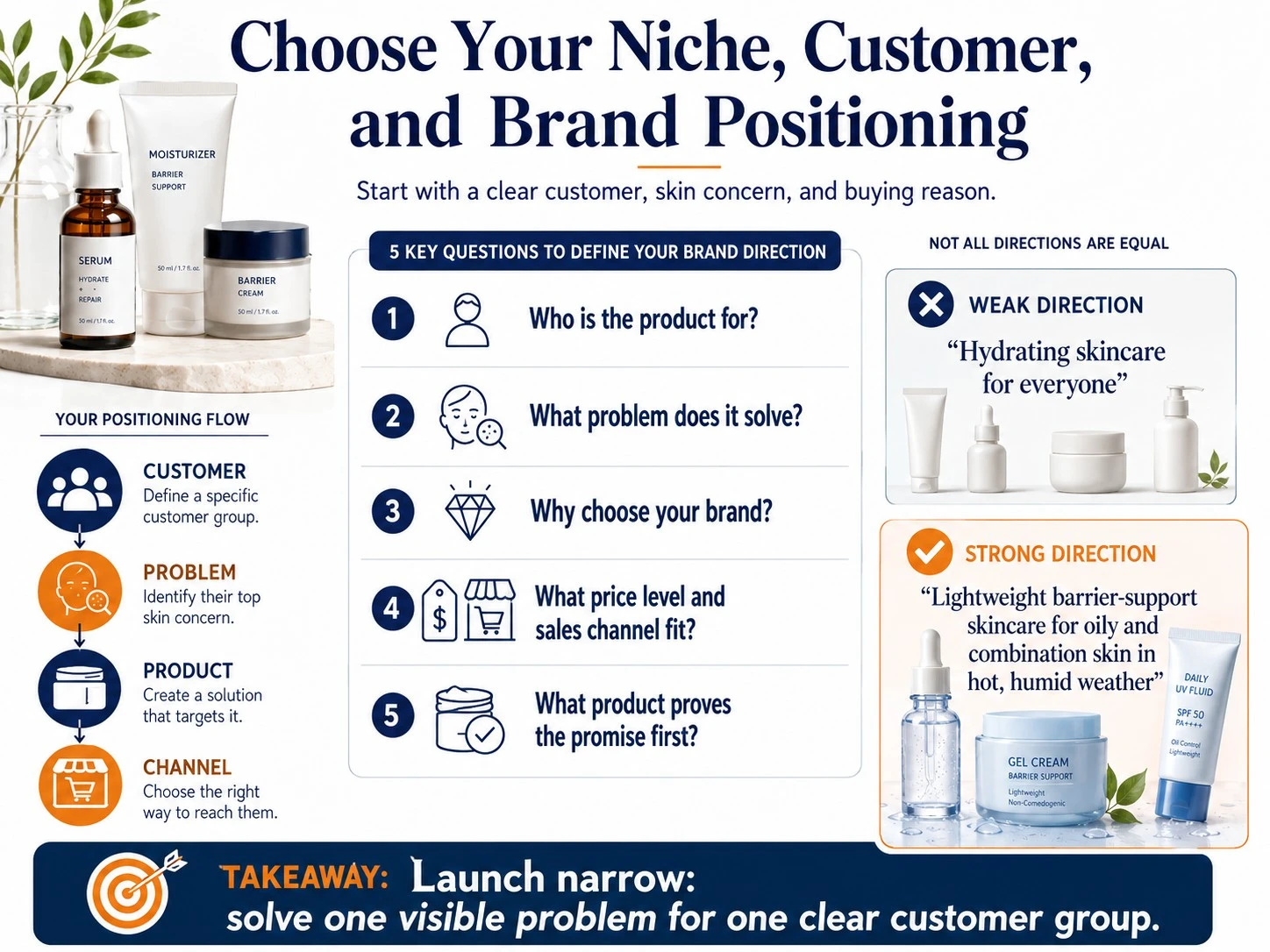
A skincare brand should not start with “I want to sell skincare.” That is too broad. Start with the customer, skin concern, routine problem, and buying reason. A clear niche helps you choose better formulas, packaging, claims, price points, and sales channels.
A strong niche should answer:
- Who is the product for?
- What skin concern or routine problem does it solve?
- Why would this customer choose your brand over an existing brand?
- What price level and sales channel fit this customer?
- What product can prove the brand promise first?
Clear brand directions include lightweight skincare for oily skin in humid climates, simple barrier-support routines for sensitive skin, spa retail skincare for professional clients, or sunscreen-led daily care for outdoor users.
A weak direction is “hydrating skincare for everyone.” A stronger direction is “lightweight barrier-support skincare for oily and combination skin in hot, humid weather.” The second version gives the manufacturer a clearer formula target and gives the customer a clearer reason to care.
Do not try to serve every skin type at launch. New brands usually perform better when the first product line solves one visible problem for one clear customer group.
Plan Your Business Setup, Budget, and Launch Costs
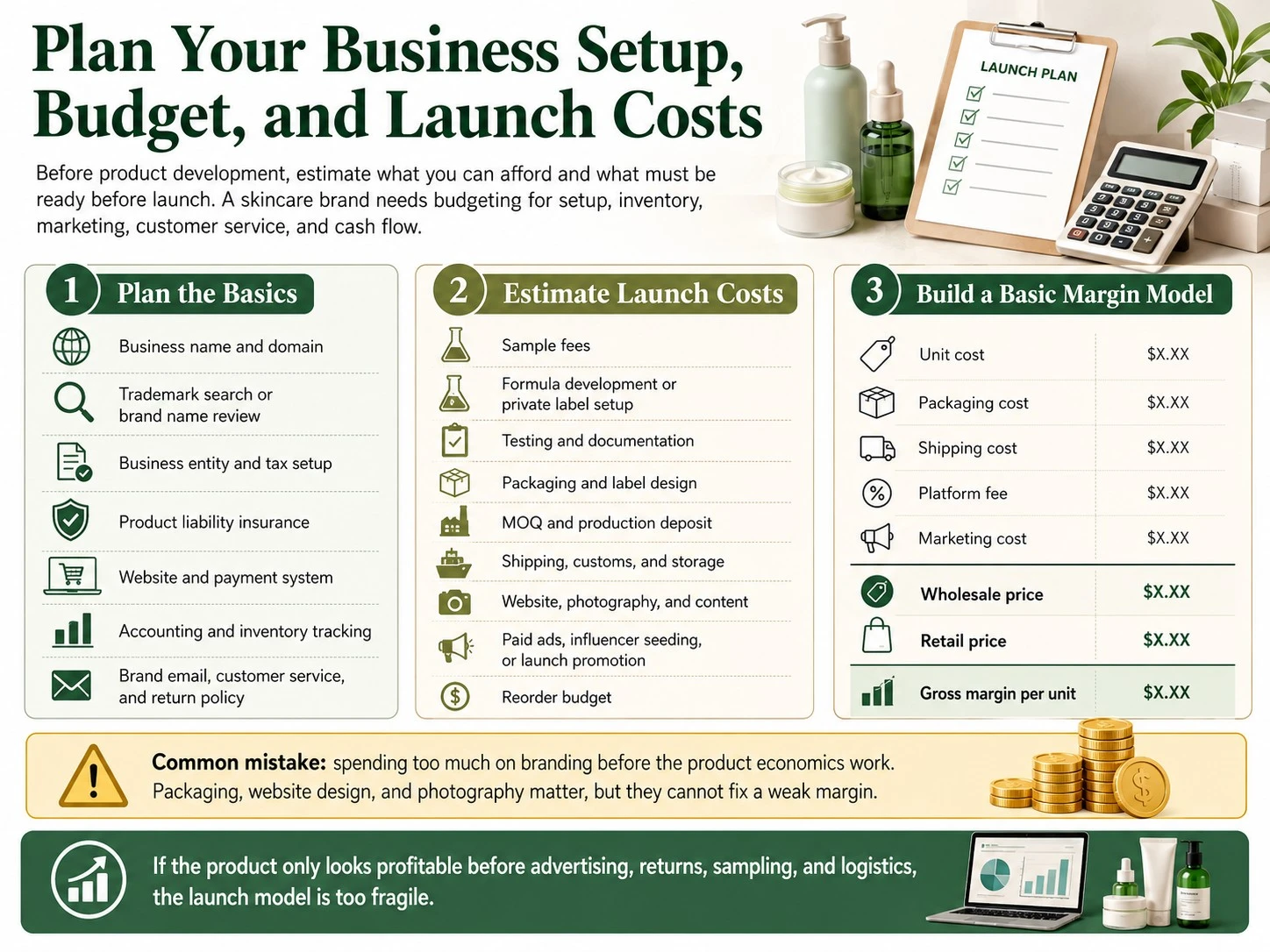
A skincare brand is a business with costs, responsibilities, inventory, marketing, customer service, and cash-flow pressure. Before product development, estimate what you can afford and what must be ready before launch.
Plan the basics:
- Business name and domain
- Trademark search or brand name review
- Business entity and tax setup
- Product liability insurance
- Website and payment system
- Accounting and inventory tracking
- Brand email, customer service, and return policy
Then estimate launch costs:
- Sample fees
- Formula development or private label setup
- Testing and documentation
- Packaging and label design
- MOQ and production deposit
- Shipping, customs, and storage
- Website, photography, and content
- Paid ads, influencer seeding, or launch promotion
- Reorder budget
A common mistake is spending too much on branding before the product economics work. Packaging, website design, and photography matter, but they cannot fix a weak margin.
Build a basic margin model before production. Know your unit cost, packaging cost, shipping cost, platform fee, marketing cost, wholesale price, and retail price. If the product only looks profitable before advertising, returns, sampling, and logistics, the launch model is too fragile.
Decide Your Product Path: Private Label, Custom Formula, or Hybrid
Your product development path affects cost, speed, uniqueness, and risk. The right path depends on your budget, launch timeline, product goal, and need for differentiation.
| Path | Best For | Pros | Watch Out For |
|---|---|---|---|
| Private label skincare | New brands testing demand quickly | Faster launch, lower development cost, existing formula base | Less formula exclusivity and more need for brand differentiation |
| Semi-custom / hybrid formula | Brands needing some uniqueness without full custom cost | Can adjust texture, fragrance, hero ingredients, or packaging | Changes may still require review and testing |
| Full custom formulation | Brands with a clear product concept or technical need | Stronger differentiation and formula control | Longer timeline, higher cost, more sampling and testing |
| Stock formula with custom packaging | Brands focused on visual identity and faster launch | Good balance of speed and brand presentation | Packaging compatibility and MOQ still matter |
| Sunscreen or functional skincare project | Brands selling SPF, brightening, acne-prone, sensitive-skin, or active-focused products | Strong market value when well planned | Claims, testing, labels, and documents need stricter review |
Private label is not automatically low quality. Custom formulation is not automatically better. A strong private label product with clear positioning can outperform a custom formula with weak market fit. For many startups, the best first step is a focused private label or hybrid product, then deeper custom development after the brand has real sales data.
Build a Focused First Product Line
New skincare brands should usually start with a focused product line, not a full catalog. One to three strong SKUs are easier to explain, fund, manufacture, test, and improve. A long product list creates more formulas, packaging, labels, inventory, content, and customer education before demand is proven.
| Starter Line Type | Example Products | Best For | Risk |
|---|---|---|---|
| Single hero product | Serum, cream, cleanser, sunscreen, or mask | Brands with one clear product promise | Harder to build a full routine |
| 2-step routine | Cleanser + moisturizer, serum + cream, sunscreen + cleanser | Simple routines and startup launches | Must feel complete enough for the customer |
| 3-product routine | Toner + serum + cream, cleanser + serum + sunscreen | Brands selling routine value | Higher MOQ and more inventory |
| Concern-based set | Hydration set, oily-skin set, sensitive-skin set | Clear skin concern positioning | Claims must stay accurate and supported |
| Sunscreen-led line | Sunscreen + cleanser, sunscreen + moisturizer | Daily SPF or outdoor-care positioning | SPF products need stronger document and label review |
| Spa / salon retail set | Cleanser, toner, serum, cream | Professional resale and client routines | Requires clear staff education and reorder plan |
The best first line is not the largest line. It is the line that proves your brand promise with the fewest moving parts. If your customer cannot understand the routine in a few seconds, simplify it.
Find and Evaluate a Skincare Manufacturer
The manufacturer you choose affects product quality, communication speed, launch timing, packaging options, documentation, and long-term supply stability. Do not choose only by the lowest MOQ or fastest quote. A poor manufacturer can cost more later through unstable formulas, weak documents, delayed packaging, poor communication, or label problems.
Ask about:
- Product categories they can make
- Private label, OEM, ODM, and custom formulation support
- MOQ and lead time
- Sample process and revision policy
- Formula ownership or stock formula rules
- GMP / ISO / quality system evidence
- Testing and documentation support
- Packaging options
- Label and claim support
- Export experience
- Communication speed and project management process
A good manufacturer should ask questions before giving final answers. If a supplier quotes immediately without asking about target market, product type, packaging, claims, MOQ, and formula direction, the project may lack proper planning.
Low MOQ is useful for startups, but it should not override product safety, documentation, formula stability, and communication. Choose a manufacturer that can help you move from idea to sample, production, and repeat orders.
See also:
How to Choose a Skincare Manufacturer
questions
Questions to Ask a Skincare Manufacturer Before You Start
Plan Product Development, Testing, and Documentation
Product development is where the brand promise becomes a real formula, package, label, and production plan. This stage should be structured, not random. The clearer your product brief is, the fewer sample rounds you waste.
| Item | Why It Matters | When to Plan It |
|---|---|---|
| Product brief | Defines customer, product type, texture, claims, and target market | Before sampling |
| Formula sample | Shows skin feel, scent, finish, color, and user experience | Early development |
| Sample revision | Improves texture, fragrance, viscosity, or performance direction | After internal review |
| Stability / compatibility check | Helps confirm formula and packaging fit | Before mass production |
| Microbiological quality | Supports product quality and safety expectations | Before launch or batch release |
| Claim support | Helps avoid unsupported marketing claims | Before label and artwork approval |
| COA / SDS | Supports batch quality, handling, and shipment needs | Before shipment |
| INCI / ingredient list | Supports label and market review | Before label approval |
| Batch release documents | Support traceability and finished product release | Before shipment |
| Sunscreen / SPF testing, if applicable | Supports SPF, Broad Spectrum, and water-resistance claims | Before sunscreen label approval |
Ordinary skincare and sunscreen do not have the same timeline or documentation needs. In the U.S., sunscreen is regulated as an OTC drug, and FDA sunscreen guidance covers SPF, Broad Spectrum, and Water Resistant testing and labeling requirements. [4]
Do not use product development to chase every trend. Use it to build a formula that matches your customer, market, packaging, claim plan, and launch budget.
Understand Compliance, Labeling, and Claims Before Launch
Compliance should be planned before packaging is printed, not after the product is filled. For the U.S., FDA states that cosmetic products and ingredients generally do not need premarket FDA approval, except for color additives. But cosmetic firms are still responsible for product safety and labeling, and products must not be adulterated or misbranded. [1]
MoCRA also introduced facility registration and product listing requirements for many cosmetic businesses. FDA’s registration and listing page explains current requirements and notes that certain small businesses may be exempt, while some product categories do not qualify for the exemption. [2]
Before launch, review:
- Product name
- Net content
- Ingredient list
- Directions
- Warning statements, if needed
- Responsible company information
- Claims and marketing wording
- Batch or lot coding
- Country-specific label needs
- Product documents from the manufacturer
Cosmetic labels must be truthful and not misleading. FDA labeling resources cover core cosmetic labeling requirements, including identity, net quantity, ingredient declaration, and warning statements where required. [3]
This matters for skincare claims. “Hydrates dry skin” is different from “treats eczema.” “Helps skin look clearer” is different from “cures acne.” “Brightening” claims need careful wording. SPF claims require sunscreen-specific support.
If you plan to sell in the EU, ask about Responsible Person, Product Information File, safety assessment, label review, and CPNP notification. The European Commission describes CPNP as the notification portal created for Regulation (EC) No 1223/2009. [6]
Plan Packaging, MOQ, Pricing, and Profit Margin
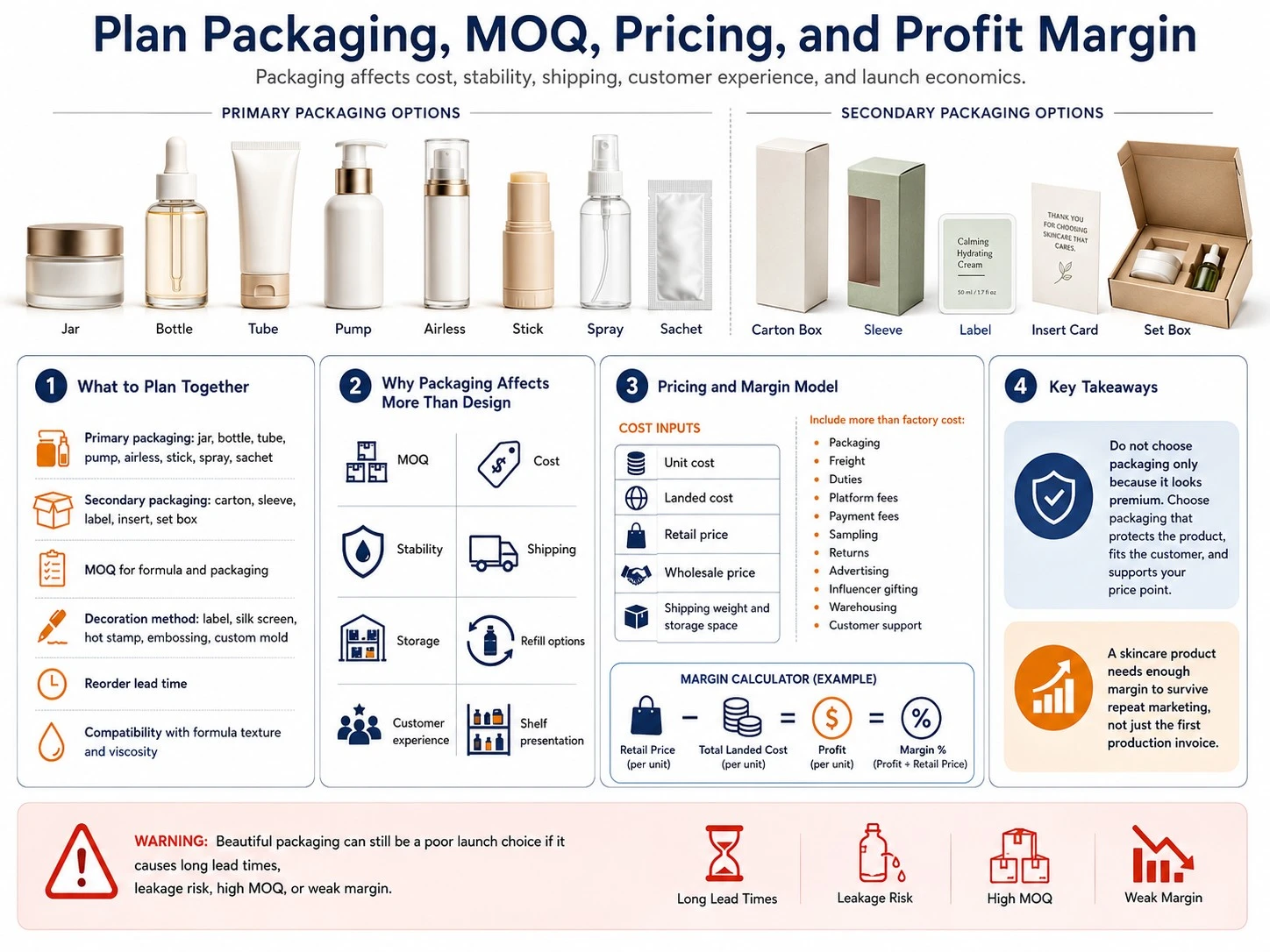
Packaging is not only a design decision. It affects MOQ, cost, stability, shipping, storage, refill options, customer experience, and shelf presentation. A beautiful package can still be a poor launch choice if it creates long lead times, leakage risk, high MOQ, or weak margin.
Plan these items together:
- Primary packaging: jar, bottle, tube, pump, airless, stick, spray, or sachet
- Secondary packaging: carton, sleeve, label, insert, or set box
- MOQ for formula and packaging
- Decoration method: label, silk screen, hot stamp, embossing, or custom mold
- Unit cost and landed cost
- Retail price and wholesale price
- Shipping weight and storage space
- Reorder lead time
- Compatibility with formula texture and viscosity
Do not choose packaging only because it looks premium. Choose packaging that works with the formula, protects the product, fits the customer, and supports your price point.
For pricing, calculate beyond factory cost. Include packaging, freight, duties, platform fees, payment fees, sampling, returns, advertising, influencer gifting, warehousing, and customer support. A skincare product needs enough margin to survive repeat marketing, not just the first production invoice.
Build Your Sales Channels, Website, and Launch Plan

Your sales channel affects product choice, packaging, price, content, and inventory. A DTC website gives more control over brand story and margin. Marketplaces can bring search traffic but add fees and competition. Spa, salon, distributor, and retail channels can create trust but often require wholesale pricing, training, and reorder planning.
Common skincare sales channels include:
- DTC website
- Amazon or marketplace
- TikTok Shop or social commerce
- Spa and salon resale
- Distributor or wholesaler
- Boutique retail
- Professional treatment center
- Influencer or KOL-led launch
Build only the launch assets you need for the first channel. At minimum, prepare product photos, product pages, ingredient explanation, usage directions, FAQ, shipping policy, return policy, customer service email, and basic email capture.
If you use influencers, creators, or affiliate partners, disclosure matters. FTC business guidance covers endorsements, influencers, reviews, and the need to disclose a material connection to a brand. [5]
For the first launch, focus on education and conversion. Explain who the product is for, how to use it, what results to expect, what it does not claim to do, and why your product is different. Avoid exaggerated before-and-after promises unless you have proper support.
Plan Fulfillment, Inventory, and Customer Feedback
Many new skincare brands plan the launch but forget the post-launch workflow. Once orders come in, you need storage, shipping, batch tracking, customer service, return handling, complaint review, and reorder timing.
Plan:
- Where inventory will be stored
- Who packs and ships orders
- How batches and expiry dates are tracked
- How damaged goods are handled
- How returns and complaints are recorded
- How customer feedback is collected
- When to reorder
- When to revise packaging or formula
- When to add the next SKU
Customer feedback can reveal texture problems, packaging issues, confusing directions, weak positioning, or a mismatch between marketing and real use.
Track feedback by theme: scent, texture, breakouts, irritation, packaging, shipping damage, usage confusion, price, and repurchase intent. Do not reformulate after one complaint, but do not ignore repeated patterns. The first launch should help you improve the second batch.
Common Mistakes New Skincare Brands Should Avoid
Starting a skincare brand is easier when you avoid mistakes that create wasted inventory, weak positioning, or launch delays.
Avoid these mistakes:
- Starting with too many SKUs
- Choosing trend ingredients before choosing the customer
- Picking a manufacturer only because the MOQ is low
- Ignoring product margin until after production
- Printing packaging before label review
- Making treatment claims without proper support
- Changing formula direction after sampling starts
- Choosing custom packaging too early
- Launching without a reorder plan
- Spending all budget on branding and no budget on marketing
- Treating compliance as a final checklist instead of an early planning step
The strongest new skincare brands are not always the ones with the most products. They are the ones with clear positioning, reliable products, clean claims, strong supplier support, and enough margin to keep selling after the first launch.
Need Help Starting a Skincare Brand?
Starting a skincare brand is easier when product direction, manufacturing path, packaging, testing, documents, and launch timing are planned together. ZICAIL supports private label skincare, custom formulation, packaging customization, and OEM/ODM skincare manufacturing for brands at different stages.
ZICAIL can support:
- Private label skincare product planning
- Custom formulation development
- Face care, eye care, lip care, and sunscreen product development
- Formula sample and revision coordination
- Packaging selection and customization
- Product specification, COA, SDS, and batch document support
- Label and claim review support for target markets
- Production and shipment planning
Manufacturing support does not replace the brand owner’s final regulatory responsibility, but it can reduce sourcing risk and help the project move from idea to launch with fewer avoidable delays.
If you are planning to start a skincare brand, contact ZICAIL to discuss your target market, product direction, first product line, packaging needs, MOQ, and launch timeline.


