
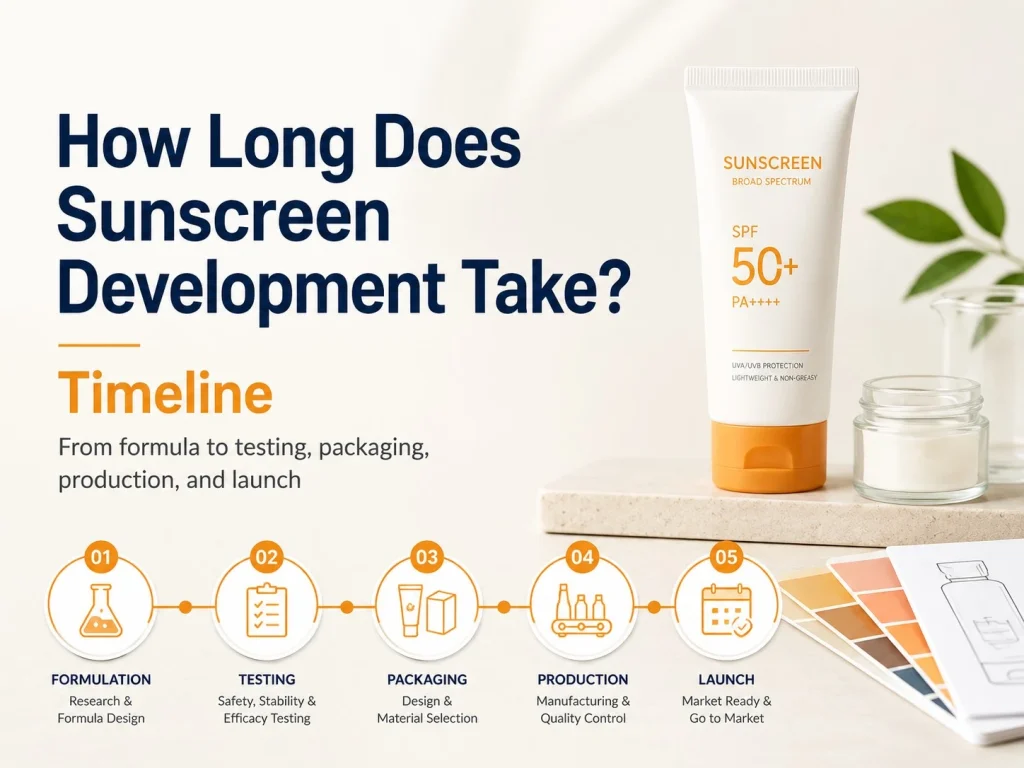

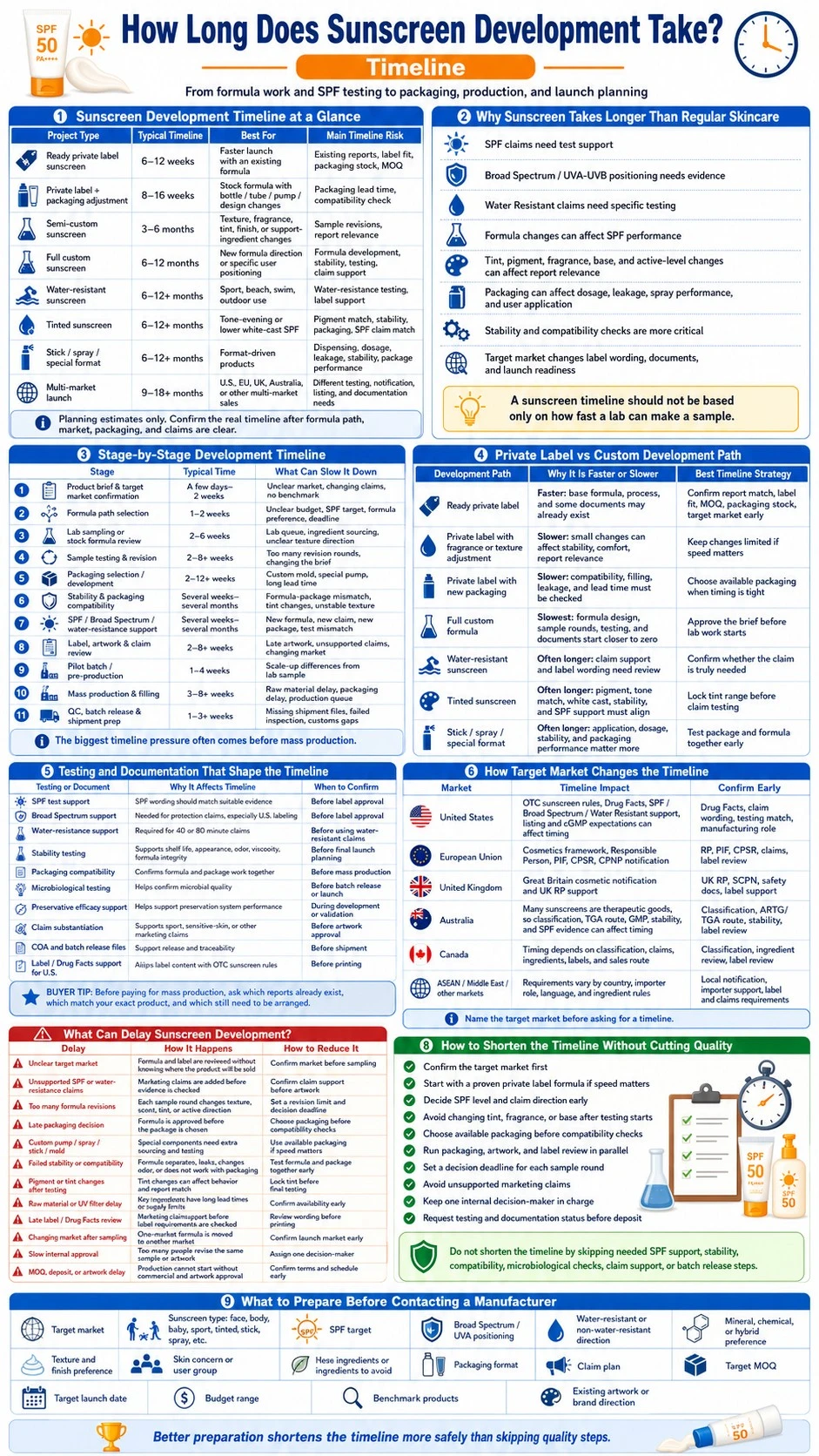
Sunscreen Development Timeline at a Glance
Use this table as a planning guide before starting a sunscreen project. A short timeline usually means the formula, packaging, documents, and label direction are already clear. A longer timeline usually means more formula work, testing, packaging development, or market review.
| Project Type | Typical Timeline | Best For | Main Timeline Risk |
|---|---|---|---|
| Ready private label sunscreen | 6–12 weeks | Brands that need a faster launch with an existing formula | Existing reports, label fit, packaging stock, MOQ |
| Private label sunscreen with packaging adjustment | 8–16 weeks | Brands using a stock formula but changing bottle, tube, pump, or design | Packaging lead time and compatibility check |
| Semi-custom sunscreen formula | 3–6 months | Brands adjusting texture, fragrance, tint, finish, or support ingredients | Sample revisions and test report relevance |
| Full custom sunscreen formula | 6–12 months | Brands that need a new formula direction or specific user positioning | Formula development, stability, testing, and claim support |
| Water-resistant sunscreen | 6–12+ months | Sport, beach, swim, outdoor, or sweat-focused products | Water-resistance testing and label support |
| Tinted sunscreen | 6–12+ months | Tone-evening or white-cast-reducing SPF | Pigment matching, stability, packaging, and SPF claim match |
| Sunscreen stick, spray, or special format | 6–12+ months | Format-driven products with a specific application experience | Dispensing, dosage, leakage, stability, and package performance |
| Multi-market sunscreen launch | 9–18+ months | Brands selling across the U.S., EU, UK, Australia, or other markets | Different label, testing, notification, listing, or documentation needs |
These ranges are planning estimates, not delivery guarantees. Confirm the real timeline with the manufacturer after the formula path, target market, packaging, and claim plan are clear.
Why Sunscreen Development Takes Longer Than Regular Skincare
Sunscreen is not developed like a basic moisturizer or cleanser. A face cream may focus on texture, stability, packaging, safety, and user experience. Sunscreen must also support protection claims such as SPF, Broad Spectrum, UVA / UVB positioning, and Water Resistant wording.
Sunscreen development often takes longer because:
- SPF claims need suitable support
- Broad Spectrum and UVA / UVB positioning need evidence
- Water Resistant claims need specific testing support
- Formula changes can affect SPF performance
- Tint, pigment, fragrance, base, and active level changes can affect test relevance
- Packaging can affect viscosity, leakage, dosage, spray performance, and user application
- Stability and compatibility checks matter more for claim-heavy products
- Target market affects label wording, documents, and launch readiness
For the U.S. market, sunscreen is regulated as an OTC drug. FDA sunscreen labeling and effectiveness testing guidance covers SPF, Broad Spectrum, and Water Resistant testing and labeling, including 40- or 80-minute water-resistance wording.[1][7]
That is why a sunscreen timeline should not be based only on how fast a lab can make a sample.
Stage-by-Stage Sunscreen Development Timeline
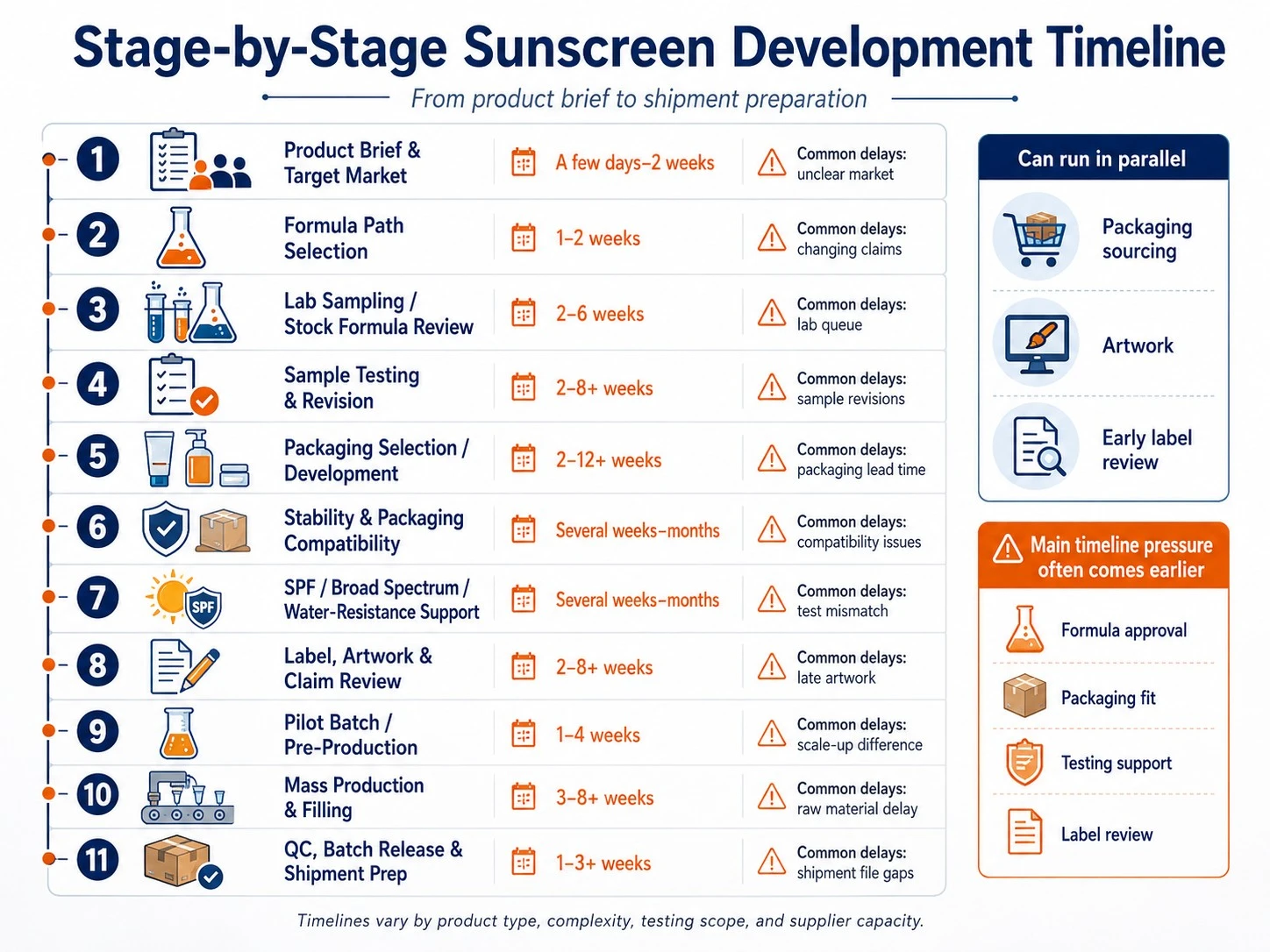
A sunscreen project usually moves through several stages. Some work can run in parallel, such as packaging sourcing, artwork, and early label review. Other parts should not be rushed, especially testing, stability, compatibility, and final claim review.
| Stage | What Happens | Typical Time | What Can Slow It Down |
|---|---|---|---|
| Product brief and target market confirmation | Buyer confirms market, product type, SPF target, user group, texture, format, and claims | A few days to 2 weeks | Unclear market, changing claims, no benchmark product |
| Formula path selection | Manufacturer decides whether to use ready formula, semi-custom formula, or full custom development | 1–2 weeks | Unclear budget, SPF target, formula preference, or launch deadline |
| Lab sampling or stock formula review | Buyer reviews existing samples or receives first lab samples | 2–6 weeks | Lab queue, ingredient sourcing, unclear texture direction |
| Sample testing and revision | Buyer tests skin feel, finish, white cast, pilling, fragrance, tint, and packaging fit | 2–8+ weeks | Too many revision rounds or changing the brief after each sample |
| Packaging selection or development | Team selects tube, bottle, pump, airless, spray, stick, or other format | 2–12+ weeks | Custom mold, special pump, long packaging lead time |
| Stability and packaging compatibility checks | Formula is checked with the package for leakage, viscosity, separation, odor, color, and shelf-life support | Several weeks to several months | Formula-package mismatch, tint changes, unstable texture |
| SPF, Broad Spectrum, and water-resistance testing support | Existing reports are reviewed or new tests are arranged if needed | Several weeks to several months | New formula, new claim, new package, or test mismatch |
| Label, artwork, and claim review | Label, Drug Facts where needed, claims, directions, warnings, and market wording are checked | 2–8+ weeks | Late artwork, unsupported claims, changing target market |
| Pilot batch or pre-production confirmation | Factory confirms scale-up, process, filling behavior, and final specifications | 1–4 weeks | Scale-up difference from lab sample |
| Mass production and filling | Sunscreen is manufactured, filled, coded, and packed | 3–8+ weeks | Raw material delay, packaging delay, production queue |
| QC, batch release, and shipment preparation | COA, inspection, batch release, packing, and export documents are prepared | 1–3+ weeks | Missing shipment files, failed inspection, customs document gaps |
A common mistake is counting only mass production. For sunscreen, the main timeline pressure often comes earlier: formula approval, packaging fit, testing support, and label review.
Private Label vs Custom Sunscreen Development Timeline
Some manufacturers say sunscreen can launch quickly, while others estimate several months or more. Both can be true. The difference is usually the development path.
| Development Path | Why It Is Faster or Slower | Best Timeline Strategy |
|---|---|---|
| Ready private label sunscreen | Faster because the base formula, process, and some documents may already exist | Confirm report match, label fit, MOQ, packaging stock, and target market early |
| Private label formula with fragrance or texture adjustment | Slower because small changes can affect stability, comfort, or report relevance | Keep changes limited if speed matters |
| Private label formula with new packaging | Slower because compatibility, filling, leakage, and lead time must be checked | Choose available packaging when launch timing is tight |
| Full custom sunscreen formula | Slowest because formula design, sample rounds, testing, and documentation start closer to zero | Approve the brief before lab work starts |
| Water-resistant sunscreen | Often longer because claim support and label wording need review | Confirm whether the claim is truly needed before development |
| Tinted sunscreen | Often longer because pigment, skin-tone match, white cast, stability, and SPF support must align | Lock tint range before claim testing starts |
| Sunscreen stick, spray, or special format | Often longer because format affects application, dosage, stability, and packaging performance | Test package and formula together early |
Private label is faster, but it is not automatically simple. A stock sunscreen still needs target-market review, label review, and document review. Custom sunscreen gives more control, but each change can affect stability, claim support, and scale-up.
See also: Private Label vs Custom Sunscreen: Which Is Better?
Testing and Documentation That Shape the Timeline
Testing and documentation can change the timeline more than buyers expect. The key is to know which reports already exist, which ones match the product, and which ones still need to be arranged.
| Testing or Document | Why It Affects Timeline | When to Confirm It |
|---|---|---|
| SPF test support | SPF wording should match suitable test evidence | Before label approval |
| Broad Spectrum test support | Broad Spectrum claims need support, especially for U.S. labeling | Before label approval |
| Water-resistance test support | Water Resistant 40 or 80 minutes requires relevant support | Before using water-resistant claims |
| Stability testing | Helps support shelf life, appearance, odor, viscosity, and formula integrity | Before final launch planning |
| Packaging compatibility testing | Checks whether formula and package work together | Before mass production |
| Microbiological testing | Helps confirm microbial quality | Before batch release or launch |
| Preservative efficacy support, where needed | Helps support preservation system performance | During development or validation |
| Claim substantiation | Supports performance, sensitive-skin, sport, or other marketing claims | Before artwork approval |
| COA and batch release files | Support finished product release and traceability | Before shipment |
| Label and Drug Facts support for U.S. market | Helps align label content with OTC sunscreen requirements | Before printing |
SPF, Broad Spectrum, and Water Resistant claims should not rely only on a product name, sample label, or supplier catalog. If the formula, active level, base, tint, fragrance, process, or packaging changes, old reports may not match the final sunscreen.[1]
For U.S. OTC sunscreen projects, drug manufacturing quality also matters. FDA’s CGMP regulations include Part 210 for drug manufacturing, processing, packing, or holding, and Part 211 for finished pharmaceuticals.[2]
Buyer tip: Before paying for mass production, ask which reports already exist, which ones match your exact product, and which ones still need to be arranged.
How Target Market Changes the Sunscreen Development Timeline
Sunscreen timelines change by destination market. The same SPF product may need different label wording, test support, notification files, registration or listing steps, safety documents, and importer information.
| Market | Timeline Impact | What to Confirm Early |
|---|---|---|
| United States | Sunscreen is regulated as an OTC drug, so Drug Facts, SPF, Broad Spectrum, Water Resistant support, drug listing, establishment registration where applicable, and cGMP expectations can affect timing[1][2][7] | Drug Facts, SPF claim, Broad Spectrum wording, water-resistance claim, testing match, and manufacturing role |
| European Union | Sunscreens are generally handled under the cosmetics framework. CPNP notification is used under Regulation (EC) No 1223/2009, and after a product is notified in CPNP, no further national EU notification is needed.[3] | Responsible Person, PIF, CPSR, CPNP notification, claims, and label review |
| United Kingdom | Cosmetic products available to consumers in Great Britain are notified through the OPSS cosmetic notification service.[4] | UK Responsible Person, SCPN notification, safety documentation, claims, and label support |
| Australia | Many sunscreens are therapeutic goods. TGA guidance explains therapeutic sunscreen regulation, and TGA also states that sunscreen stability testing is mandatory and should be defined in a GMP agreement.[5][6] | Product classification, ARTG / TGA route, GMP, stability, SPF evidence, and label review |
| Canada | Timeline depends on product classification, claims, ingredients, labels, and sales route | Classification, ingredient review, label review, notification or licensing support where applicable |
| ASEAN / Middle East / other markets | Requirements vary by country, importer role, language, label claims, and ingredient rules | Local notification, importer support, language, ingredient, label, and claims requirements |
The safest first step is to name the target market before asking for a timeline. A manufacturer cannot estimate accurately if the buyer has not confirmed where the product will be sold.
What Can Delay Sunscreen Development?
Most sunscreen delays come from late decisions, claim changes, packaging changes, or target-market changes, not only from the lab working slowly. The best way to reduce delay is to lock the key decisions before testing and packaging work go too far.
| Delay | How It Happens | How to Reduce It |
|---|---|---|
| Unclear target market | Formula and label are reviewed without knowing where the product will be sold | Confirm market before sampling |
| Unsupported SPF or water-resistance claims | Marketing claims are added before evidence is checked | Confirm claim support before artwork |
| Too many formula revisions | Each sample round changes texture, scent, tint, or active direction | Set a revision limit and decision deadline |
| Late packaging decision | Formula is approved before the package is chosen | Choose packaging before compatibility checks |
| Custom pump, spray, stick, or mold development | Special components need extra sourcing, testing, and lead time | Use available packaging if speed matters |
| Failed stability or compatibility checks | Formula separates, leaks, changes odor, or does not work with packaging | Test formula and package together early |
| Pigment or tint changes after testing | Tint changes can affect formula behavior and report match | Lock tint before final testing |
| Raw material or UV filter sourcing delay | Key ingredients have long lead times or supply limits | Confirm availability before final formula approval |
| Late label or Drug Facts review | Packaging is designed before label requirements are checked | Review label wording before printing |
| Changing market after sampling | A formula made for one market is moved to another | Confirm launch market before development |
| Slow internal approval | Too many people revise the same sample or artwork | Assign one decision-maker |
| MOQ, deposit, or artwork delay | Production cannot start without commercial and artwork approval | Confirm commercial terms and artwork schedule early |
Not every delay can be avoided. Most avoidable delays come from unclear decisions, not from the sunscreen itself.
How to Shorten the Timeline Without Cutting Quality
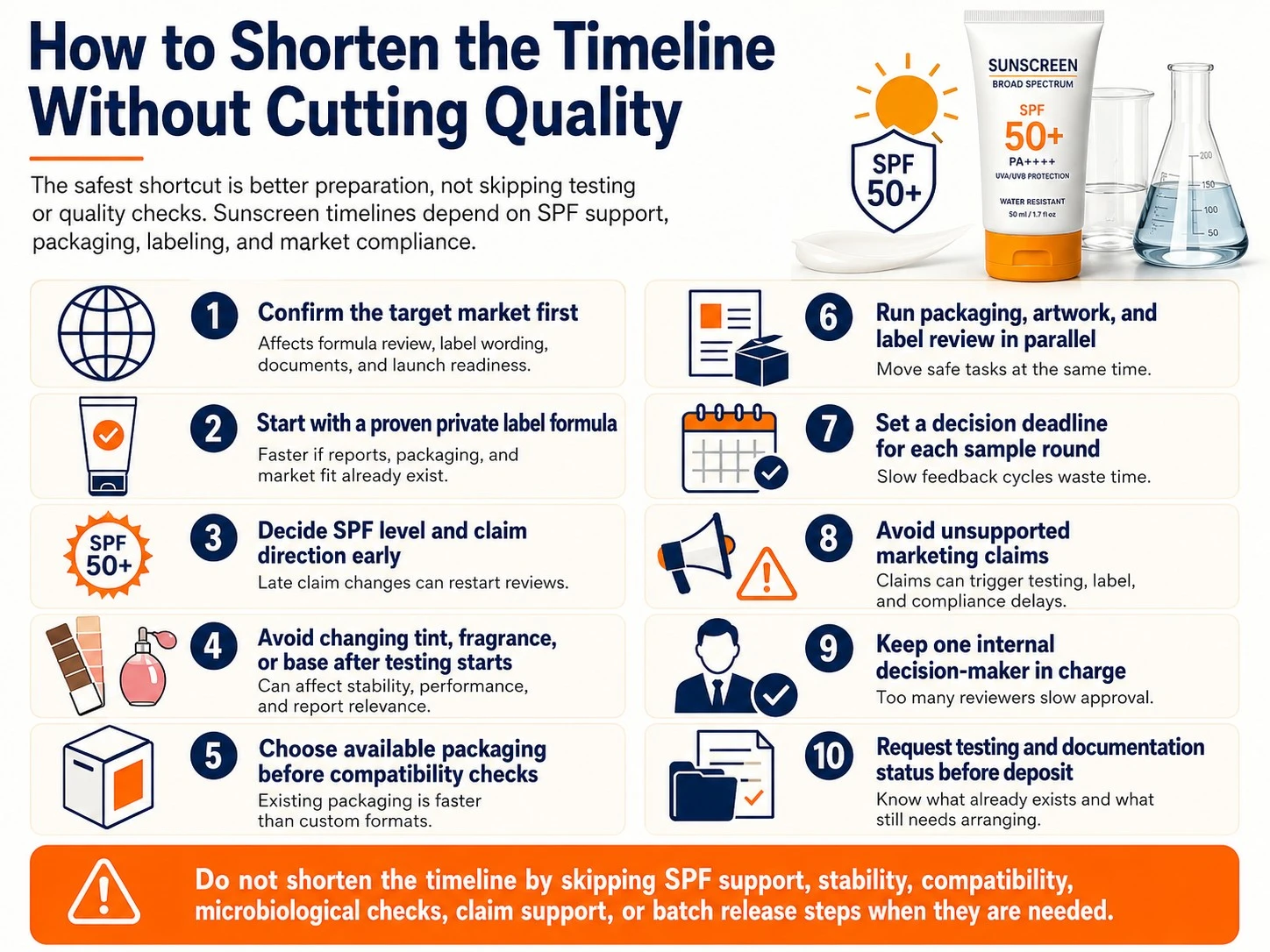
The safest shortcut is better preparation, not skipping needed testing or quality checks. Sunscreen has stricter limits than ordinary skincare because SPF, water-resistance, label, packaging, and market claims must be supported.
To shorten the timeline:
- Confirm the target market first
Market choice affects formula review, label wording, documents, and launch readiness. - Start with a proven private label formula if speed matters
A ready formula can save time if the reports, packaging, and target-market fit are suitable. - Decide SPF level and claim direction early
Changing SPF, Broad Spectrum, Water Resistant, sport, tinted, or sensitive-skin claims late can restart reviews. - Avoid changing tint, fragrance, or base after testing starts
These changes can affect stability, performance, and report relevance. - Choose available packaging before compatibility checks
Existing packaging is faster than custom molds, special pumps, sprays, or sticks. - Run packaging, artwork, and label review in parallel
Do not wait for one task to finish if another can move safely at the same time. - Set a decision deadline for each sample round
Long feedback cycles are one of the easiest ways to lose time. - Avoid unsupported marketing claims
Claims that sound good can create testing, label, and compliance delays. - Keep one internal decision-maker in charge
Too many reviewers slow texture, fragrance, tint, and artwork approval. - Request testing and documentation status before deposit
Know what already exists and what still needs to be arranged.
Do not shorten the timeline by skipping SPF support, stability, compatibility, microbiological checks, claim support, or batch release steps when they are needed.
What to Prepare Before Contacting a Sunscreen Manufacturer
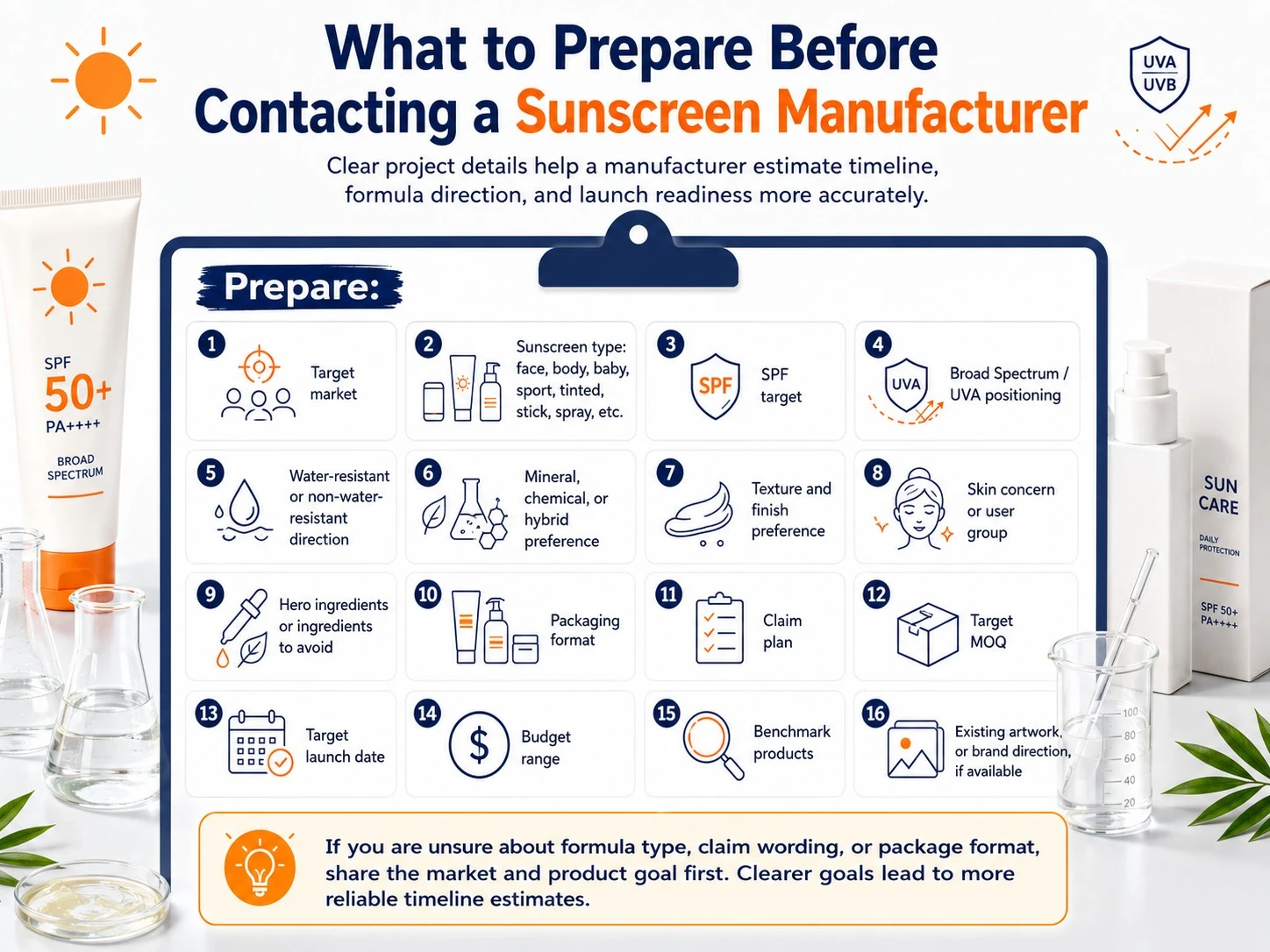
A manufacturer can estimate the sunscreen timeline more accurately when the target market, SPF claim, packaging format, and formula direction are clear. You do not need every detail before the first conversation, but partial information is better than a vague idea.
Prepare:
- Target market
- Sunscreen type: face, body, baby, sport, tinted, stick, spray, etc.
- SPF target
- Broad Spectrum / UVA positioning
- Water-resistant or non-water-resistant direction
- Mineral, chemical, or hybrid preference
- Texture and finish preference
- Skin concern or user group
- Hero ingredients or ingredients to avoid
- Packaging format
- Claim plan
- Target MOQ
- Target launch date
- Budget range
- Benchmark products
- Existing artwork or brand direction, if available
If you are unsure about formula type, claim wording, or package format, share the market and product goal first. A good manufacturer can help narrow the path, but unclear goals make timeline estimates less reliable.
Need Help Planning Your Sunscreen Development Timeline?
Sunscreen development timing depends on formula path, SPF testing, stability, packaging, labeling, documentation, target market, and production planning. A faster launch is possible when these decisions are clear early, but speed should not create claim, label, batch, or import risk.
ZICAIL can support:
- Private label sunscreen planning
- Custom sunscreen formula development
- SPF, Broad Spectrum, and water-resistance testing coordination
- Stability and packaging compatibility planning
- Sunscreen packaging selection
- Labeling, documentation, and claim review support
- Production and shipment schedule planning
Documentation, testing, and label support do not replace the buyer’s final regulatory responsibility, but they can reduce sourcing risk and prevent avoidable delays.
If you are planning a private label or custom sunscreen, contact ZICAIL to discuss your target market, SPF goal, formula direction, packaging format, claim plan, and expected launch timeline.


