

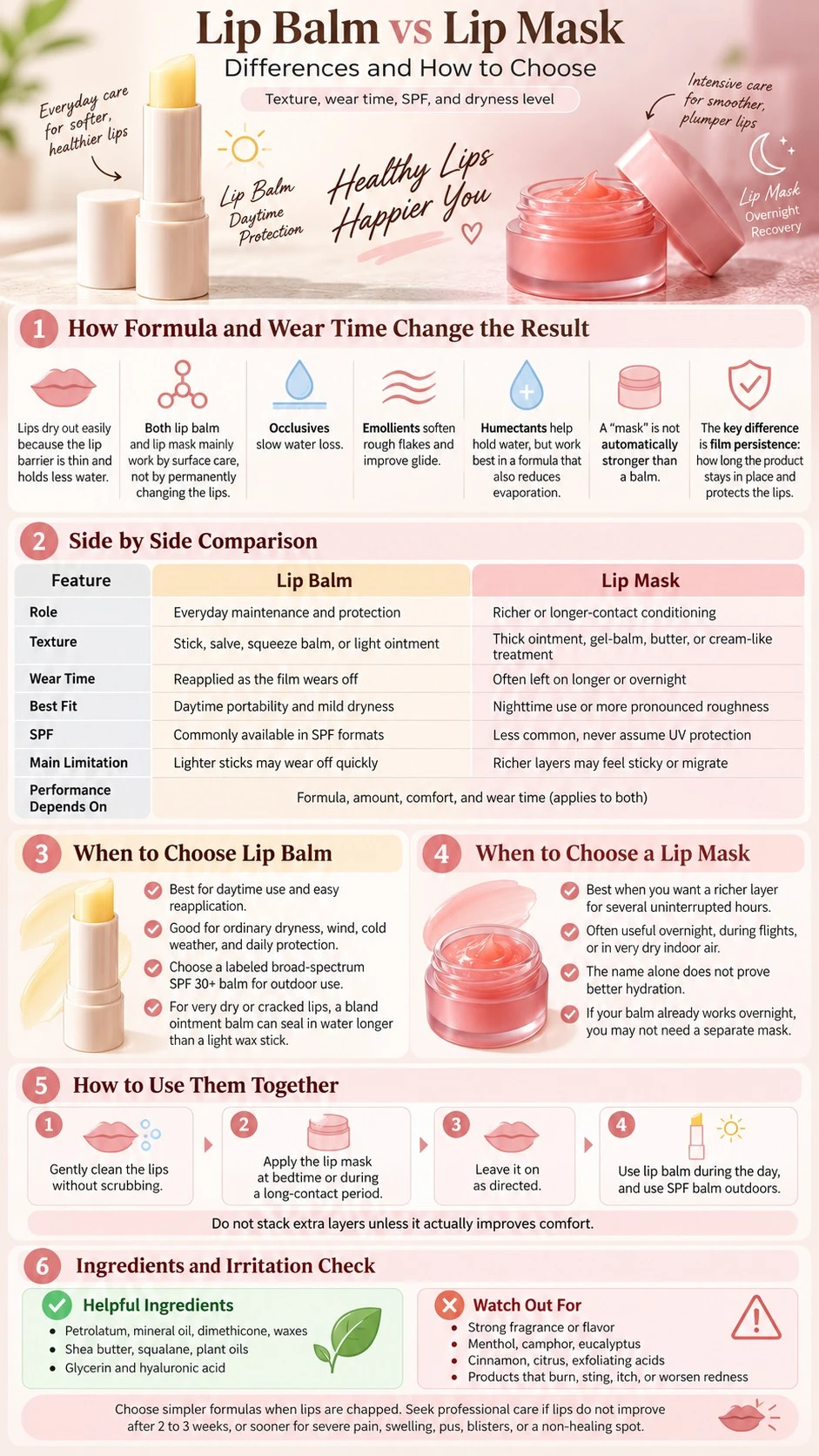
Lip balm and lip mask often sit beside each other as if they were separate levels of care. In practice, there is no fixed ingredient recipe that makes every mask stronger than every balm. Both may contain waxes, petrolatum, plant oils, butters, silicones, humectants, flavors, and color. Compare how they feel, how long they stay in place, whether they fit daytime or overnight use, and whether they provide a separately labeled function such as sun protection.
How Formula and Wear Time Change the Result
The lip surface has a relatively weak barrier and low water-holding capacity, which helps explain why it dries and scales easily.[1] Lip care works mainly by changing conditions at that surface, not by permanently teaching the lips to produce more moisture.
Most balms and masks combine three familiar moisturizer roles. Occlusives form a film that slows water loss. Emollients fill spaces between rough surface cells, improving softness and glide. Humectants attract and hold water near the surface, but they work best in a complete formula that also limits evaporation.[2] The guide to humectants, emollients, and occlusives explains these roles in more detail.
This mechanism is why “mask” does not automatically mean deeper hydration. A rich mask may use more film-forming material or may simply be applied more generously, helping it remain on longer. A slim balm stick may leave a lighter film. Yet a dense petrolatum balm can outlast a glossy mask, and a fluid mask can disappear quickly after talking, eating, or wiping.
The practical variable is film persistence: how well the product keeps the outer lip layer from losing water during the period you need protection. A controlled study of one highly occlusive lip formula found improved roughness, with benefits maintained after the treatment period.[3] That supports occlusion as a useful mechanism, but one formula cannot prove that every product labeled “lip mask” performs better than every balm.
Lip Balm vs Lip Mask: Side-by-Side Comparison
The labels provide a starting point, but the ingredient list, directions, texture, and actual wear are more useful for choosing between products.
| Comparison point | Lip balm | Lip mask |
|---|---|---|
| Typical role | Everyday maintenance and protection | Richer or longer-contact conditioning |
| Common texture | Stick, salve, squeeze balm, or light ointment | Thick ointment, gel-balm, butter, or cream-like treatment |
| Usual wear time | Reapplied as the film wears off | Commonly left on for an extended period or overnight |
| Best fit | Daytime portability, mild dryness, weather exposure | Nighttime use, pronounced roughness, or times when reapplication is inconvenient |
| Application amount | Thin, even coat | Often a somewhat more generous but still comfortable coat |
| SPF availability | Commonly available in labeled SPF formats | Less common; never assume a mask provides UV protection |
| Main limitation | A light stick may wear off quickly or drag on cracked lips | A rich layer may feel sticky, migrate beyond the lip line, or stain bedding |
| What predicts performance | Formula, amount, comfort, and reapplication | Formula, amount, comfort, and uninterrupted contact time |
Packaging also changes use. A stick is easy to apply without touching the product. A pot may encourage a thicker application but requires clean hands or an applicator. A squeeze tube can provide a richer texture with less direct contact. None of these packages guarantees better moisturization; they mainly change portability, dosing, and hygiene.
When Should You Choose Lip Balm?
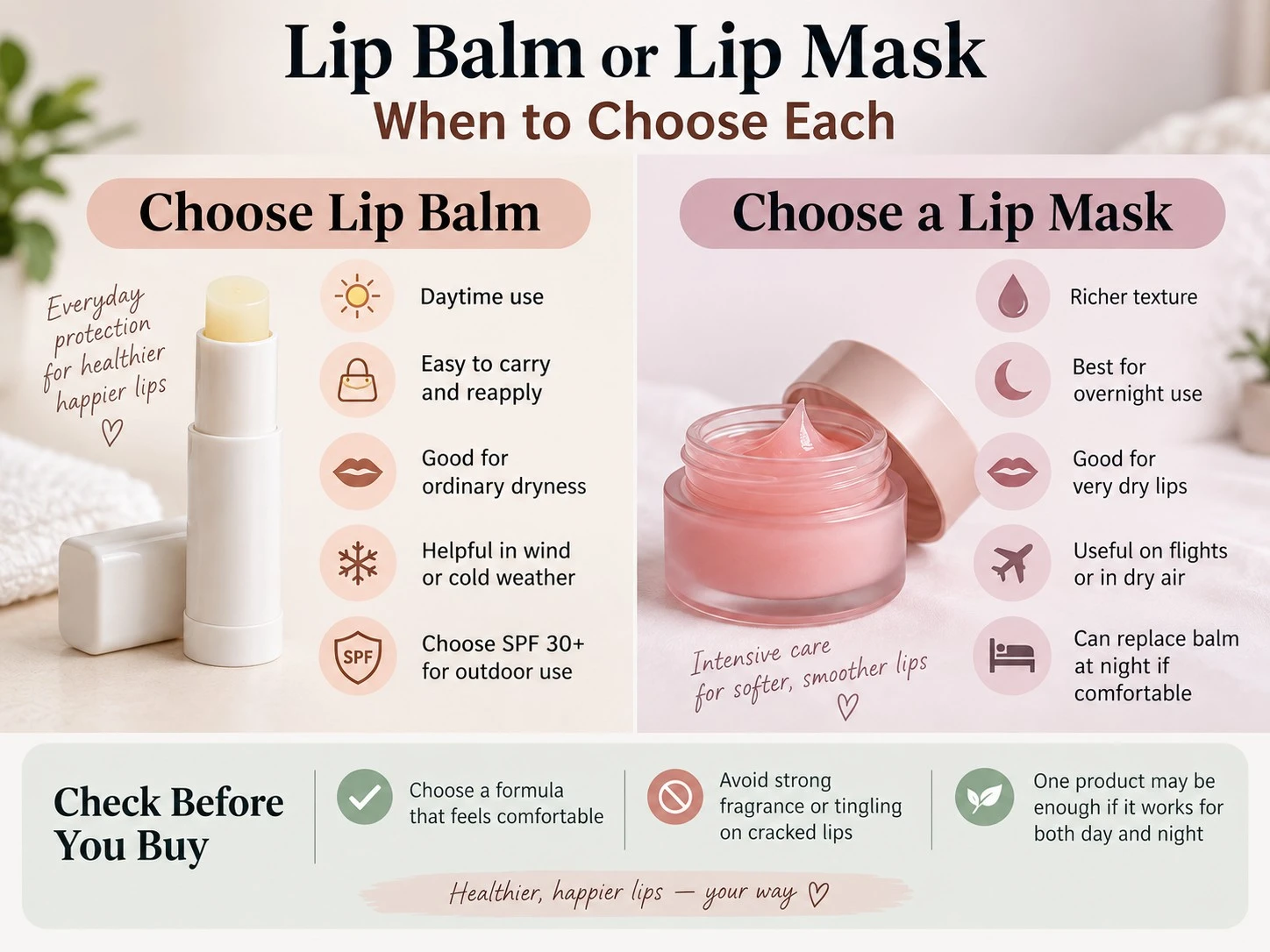
Choose lip balm when you need a practical protective layer that travels well and can be reapplied during the day. It is usually the easier option for ordinary dryness, windy or cold conditions, frequent talking, and use under or over compatible lip color.
For very dry or cracked lips, the word “balm” does not mean the product must be lightweight. A thick, bland ointment such as white petroleum jelly can seal in water longer than many waxes or oils.[4] A soft ointment may also create less tug than a hard stick on tender flakes.
Lip balm is also the more useful category for outdoor protection because many balms carry tested sunscreen labeling. Choose a broad-spectrum SPF 30 or higher lip product and reapply at least every two hours outdoors, as well as after eating, drinking, swimming, sweating, or wiping it away.[4] Ordinary oils, waxes, shine, or a lip mask without an SPF label should not be treated as sunscreen. For the wider protection routine, see Sunscreen 101.
When Should You Choose a Lip Mask?
Choose a lip mask when a richer texture makes it easier to maintain an even film for several uninterrupted hours. Nighttime is convenient because there is less eating, drinking, speaking, and wiping to remove the product. A mask can also be useful during flights, in very dry indoor air, or when a thin daytime balm does not last long enough.
A lip mask is a product format, not an essential treatment step. The name alone does not prove longer wear, a specific level of featured ingredients, or deeper penetration. If your current balm remains comfortable overnight, a slightly thicker layer may already perform the same practical job.
Look for a mask that spreads without aggressive rubbing and stays within the lip area. If it is heavily flavored, strongly fragranced, cooling, tingling, or intentionally exfoliating, it may be a poor choice when the lips are already raw or cracked. Richness cannot compensate for an ingredient that irritates you.
How to Use Lip Balm and a Lip Mask Together
Using both products can be simple. They do not need to be stacked every time, and using more layers does not guarantee better results.
- Prepare the lips gently. After eating or brushing your teeth, rinse or wipe away residue without scrubbing, peeling, or using a rough towel.
- Apply the lip mask for the long-contact period. At bedtime, spread an even layer over the lips according to the product directions. Use enough to maintain a film, but not so much that it migrates onto surrounding skin.
- Leave it undisturbed as directed. Most overnight masks are leave-on products, but the label controls. Do not assume every lip patch, peel, or treatment is designed for overnight wear.
- Switch to balm for daytime needs. In the morning, remove only uncomfortable excess, then use lip balm when the protective film wears away. Choose a labeled SPF balm before outdoor exposure.
Applying balm on top of a rich lip mask is usually unnecessary because the mask may already contain occlusives. If a water-rich gel mask dries down quickly, a thin layer of a bland occlusive balm on top may improve staying power. Stop combining them if the mixture becomes irritating, slips beyond the lip line, or makes you lick your lips more often.
Ingredients and Irritation: What Should You Check?
Read the complete ingredient list rather than shopping by “balm,” “mask,” “natural,” or “clean” alone. Petrolatum, mineral oil, dimethicone, waxes, shea butter, squalane, and plant oils can contribute occlusive or emollient effects. Glycerin and hyaluronic acid are common humectants. The finished formula and your tolerance matter more than the reputation of one featured ingredient.
When lips are chapped, simpler is often easier to tolerate. Strong flavor, fragrance, menthol, camphor, eucalyptus, cinnamon, citrus, and exfoliating acids can sting or encourage licking. “Unscented” is not necessarily the same as fragrance-free because a product can use fragrance ingredients to mask another odor; the label distinction is explained in fragrance-free vs unscented skincare.
Stop using a product that consistently burns, stings, itches, or worsens redness. Allergic contact cheilitis can appear as dry, scaly, cracked, itchy, or painful lips, and fragrance or flavorings and preservatives are recognized allergen groups.[5] Swelling, hives, or breathing or swallowing difficulty requires prompt medical attention.
Lip care cannot correct every cause of persistent peeling. Seek professional evaluation if the lips do not improve after two to three weeks of gentle care, or sooner for severe pain, spreading swelling, pus, fever, blisters, recurrent sores, or one area that repeatedly bleeds or does not heal.[4]
FAQs About Lip Balm vs Lip Mask
Can you use a lip mask every night?
Yes, you can use a non-irritating leave-on lip mask nightly when its directions allow daily use and your lips remain comfortable. Reduce the frequency or stop if you develop burning, itching, redness, scaling, or bumps around the mouth. A formula containing exfoliating acids or another active ingredient may have different frequency directions.
Should you apply lip balm after a lip mask?
Usually not. Many lip masks already contain oils, waxes, silicones, or petrolatum that create the final protective layer. Adding balm is useful only when the mask is relatively light and a compatible bland occlusive improves wear. If you layer them, apply the lighter product first and the more occlusive product last.
Can a lip mask replace lip balm?
It can replace a plain moisturizing balm if the mask is comfortable, portable enough, and suitable for repeat daytime use. It cannot replace a labeled SPF lip balm outdoors unless the mask itself carries appropriate broad-spectrum SPF labeling and directions. Product function matters more than the category name.
Do lip masks exfoliate your lips?
Not all lip masks exfoliate. Many only soften and reduce moisture loss. Some contain acids, enzymes, or scrubbing particles, so check the label. Avoid picking or aggressively exfoliating cracked lips; removing attached flakes can deepen fissures and prolong irritation.
Sources
[2] Kang et al. Moisturizer in Patients with Inflammatory Skin Diseases
[3] Tamura et al. The Efficacy of a Highly Occlusive Formulation for Dry Lips
[4] American Academy of Dermatology. 7 Dermatologists’ Tips for Healing Dry, Chapped Lips
[5] DermNet. Allergic Contact Cheilitis


