
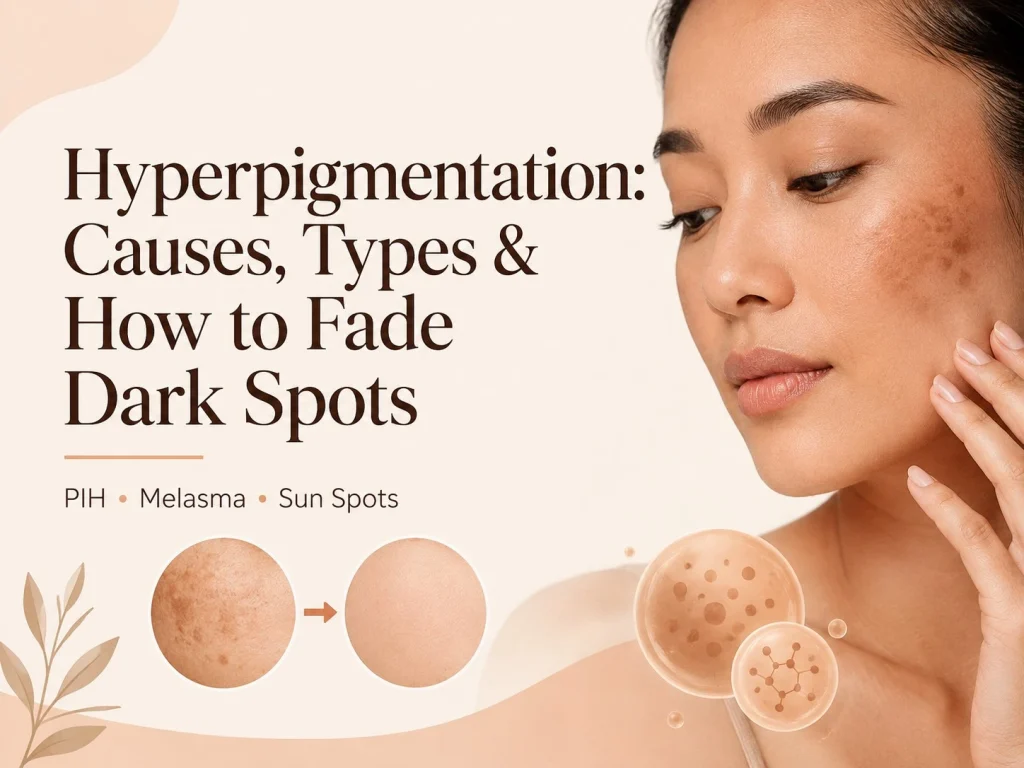


“Hyperpigmentation” sounds like one skin problem, but it is really an umbrella term. A post-acne mark, a symmetrical melasma patch, and a solar lentigo can all look darker than the surrounding skin while developing for different reasons and responding differently to treatment.
That is why the most useful question is not simply “What ingredient fades dark spots?” It is “What type of pigmentation am I treating, and what is still causing it?” If the trigger continues—active acne, irritation, hormonal melasma, or repeated sun exposure—a strong brightening serum can spend months treating marks while new ones continue to appear.
What Is Hyperpigmentation?
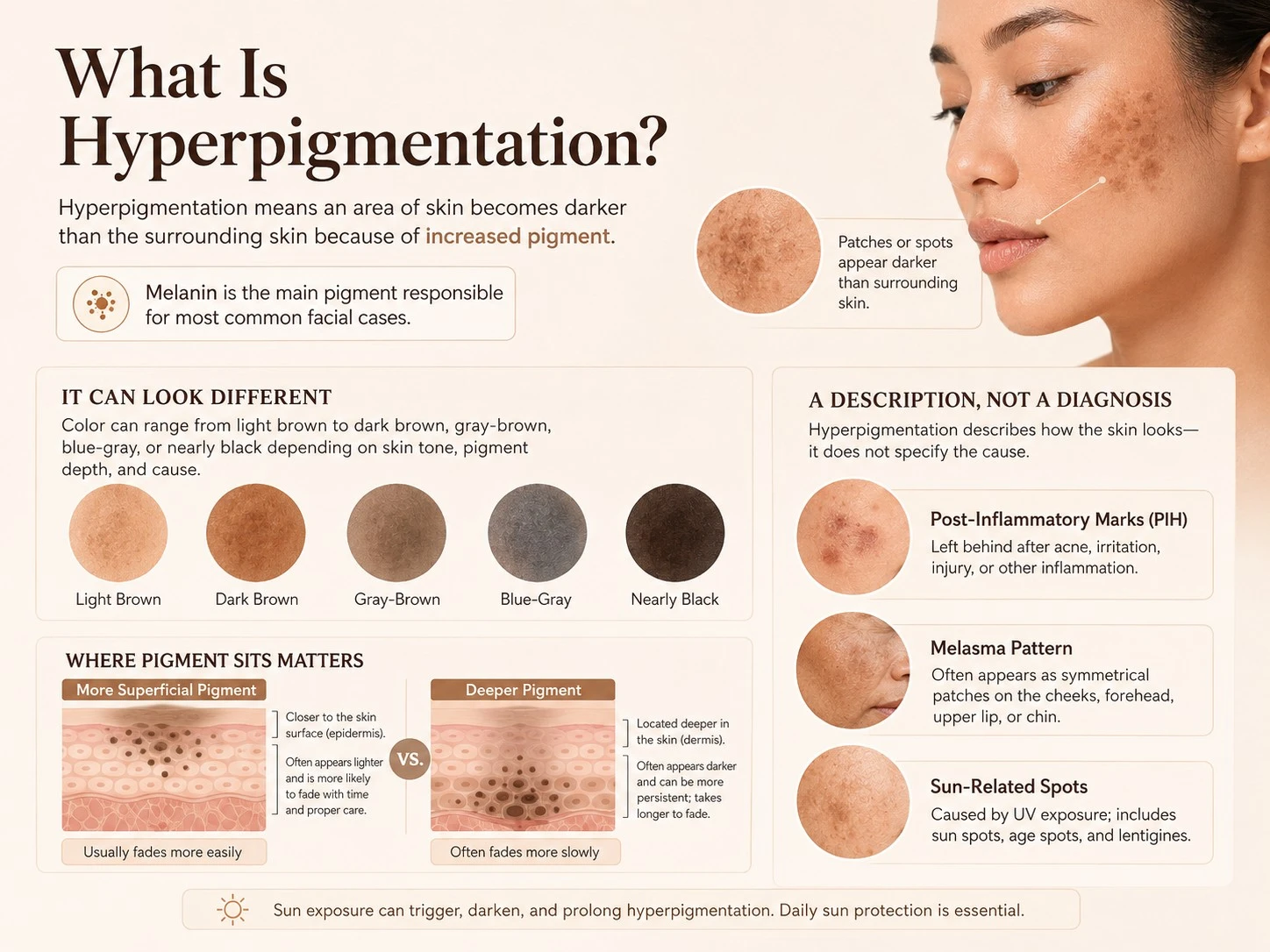
Hyperpigmentation means an area of skin has become darker than the surrounding skin because of increased pigment. Melanin is the main pigment involved in the most common facial forms of hyperpigmentation.
The color can range from light brown to dark brown, gray-brown, blue-gray, or nearly black depending on skin tone, pigment depth, and the underlying condition. Superficial pigment generally fades more readily than pigment located deeper in the skin.[1]
Hyperpigmentation itself is a description, not a complete diagnosis. The treatment plan changes once you know whether the pigment followed inflammation, developed in a melasma pattern, accumulated through long-term sun exposure, or has another medical cause.
Main Types of Hyperpigmentation
Three forms account for many of the dark spots and patches people try to treat with skincare: post-inflammatory hyperpigmentation, melasma, and solar lentigines. They can look similar at first glance, but the trigger, pattern, and treatment priority are different.
| Type | Typical Clue | Main Driver | First Priority |
|---|---|---|---|
| Post-inflammatory hyperpigmentation (PIH) | Flat brown, dark-brown, gray, or blue-gray marks where inflammation or injury occurred | Acne, irritation, eczema, picking, burns, cuts, or procedures | Stop new inflammation or injury, then fade the remaining pigment[1][3] |
| Melasma | Broader, irregular, often symmetrical facial patches | Light exposure combined with hormonal, genetic, and individual factors | Use long-term photoprotection plus appropriate pigment-targeting treatment[2] |
| Solar lentigines | Discrete, well-defined tan or brown spots on chronically sun-exposed skin | Cumulative ultraviolet exposure | Prevent further photodamage and confirm that the lesion is appropriate for cosmetic treatment[5] |
Post-Inflammatory Hyperpigmentation
PIH deserves particular attention in medium to darker skin tones because pigment changes after inflammation can be more noticeable and persistent.[3] The practical priority is to stop whatever is still creating inflammation. A brightening product cannot keep up if active acne, dermatitis, picking, aggressive exfoliation, or another source of irritation continues to generate new marks.
Melasma
Melasma is better understood as a recurrent pigment disorder than as a few unusually stubborn dark spots. Some cases persist for years or return when triggers continue, so management often depends on sustained photoprotection and long-term pigment control rather than a short fading treatment.[2]
This is why a routine designed for a few post-acne marks may be inadequate for recurrent melasma.
Sun Spots or Solar Lentigines
Unlike many superficial post-inflammatory marks, solar lentigines often persist unless treated.[5] More importantly, a new or unusual pigmented lesion should not automatically be assumed to be a harmless sun spot because some precancerous lesions and melanomas can resemble lentigines.[5][6]
What Causes Hyperpigmentation?
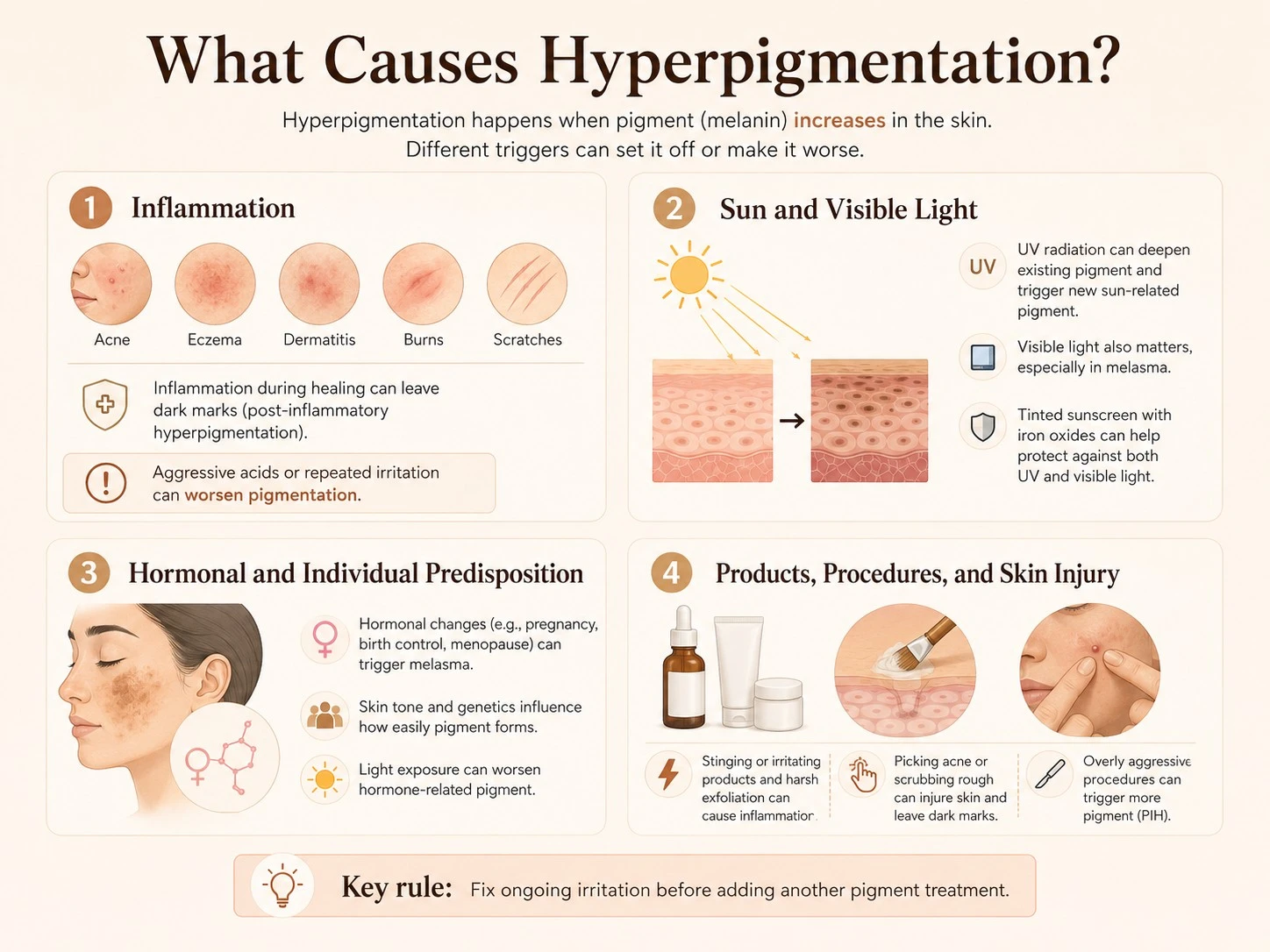
The immediate process is increased pigment, but the reason that pigment production increased can vary substantially.
Inflammation
Inflammation can stimulate pigment production as skin heals. Acne, eczema, dermatitis, burns, scratches, and other inflammatory injuries can therefore leave pigmentation even after the original lesion is gone.[1][3]
This creates an important practical rule: treatment that repeatedly irritates the skin can work against your pigmentation goal. An aggressive acid routine that causes ongoing burning and inflammation may create new discoloration while trying to remove the old marks.
Sun and Visible Light Exposure
Ultraviolet exposure can darken existing pigmentation and contribute to new sun-related pigment. Photoprotection is therefore a basic part of treatment across several pigment disorders.[1][2][5]
Visible light also matters in melasma and some pigment-prone skin. Pigmented sunscreens containing iron oxides can provide visible-light protection that ordinary transparent UV filters do not necessarily provide.[2][7]
Hormonal and Individual Predisposition
Melasma is associated with hormonal influences, including pregnancy and hormonal medications in some people, but hormones are only one part of the condition. Light exposure, skin tone, genetics, and other triggers can also affect its appearance and persistence.[2]
Products, Procedures, and Skin Injury
A product that repeatedly stings or irritates the skin can contribute to PIH. Picking acne, harsh scrubbing, overly aggressive exfoliation, and poorly selected procedures can also create additional inflammation.[1][3]
If your current routine burns, peels, or leaves persistent sensitivity, solve the irritation before adding another pigment treatment. Our Skin Barrier: Signs of Damage and How to Repair It guide can help distinguish productive treatment from a routine that is becoming too aggressive.
How to Fade Hyperpigmentation

A useful pigmentation routine has three jobs: stop new pigment triggers, reduce preventable light exposure, and gradually treat the pigment that is already present.
1. Control What Is Creating New Dark Spots
If acne is causing PIH, control the breakouts. If a fragranced or aggressive product repeatedly causes inflammation, remove the irritation. If you continue picking at blemishes, changing that behavior may be as important as adding another active.
For acne-related congestion, Clogged Pores: Causes, Signs & How to Clear Them explains how to address the follicular problem rather than only treating the mark it leaves behind.
2. Make Photoprotection Part of the Treatment
Broad-spectrum sunscreen is not merely a preventive extra when you are treating pigmentation. It reduces light exposure that can maintain or deepen pigment and helps protect the progress made by other treatments.[1][2]
If you need to rebuild the sunscreen part of your routine, start with Sunscreen 101: How to Choose, Apply, and Reapply SPF.
For melasma or pigmentation strongly affected by visible light, a tinted sunscreen containing iron oxides can provide additional visible-light protection.[2][7] Our What Is Tinted Sunscreen? Benefits, SPF, and Skin Tips article explains how tinted formulas differ from ordinary untinted sunscreen.
3. Add One Pigment-Targeting Treatment
Choose the treatment according to the type of pigmentation, the other concerns you need to address, and how much irritation your skin can tolerate. Different ingredients target pigmentation through different mechanisms, so the most useful starting point is the formula that fits your diagnosis and routine rather than the longest combination of brightening actives.[1][4]
| Ingredient Direction | Where It May Fit | Main Limitation |
|---|---|---|
| Azelaic acid | Useful when pigmentation overlaps with acne, inflammation, or uneven tone | Can sting or irritate when introduced too aggressively |
| Retinol and other retinoids | Can support pigment treatment while also addressing acne or photoaging | Dryness and irritation can limit tolerance; stronger retinoids may require professional guidance[4] |
| Vitamin C | Can provide antioxidant and brightening support in a daytime routine | Performance depends on the vitamin C form, concentration, formulation, and stability |
| Glycolic acid and other exfoliating acids | Can support improvement of superficial pigmentation and uneven tone | Over-exfoliation can create irritation and potentially worsen PIH |
| Niacinamide | Can fit into a gentler brightening routine and may support barrier tolerance | Usually works better as one part of a pigmentation routine than as a rapid spot-removal treatment[8] |
| Prescription pigment treatments | May be appropriate for persistent melasma, deeper pigmentation, or cases that do not respond adequately to cosmetic routines | Choice and availability depend on the diagnosis and market and should be guided by a qualified clinician |
A Simple Skincare Routine for Hyperpigmentation

A pigmentation routine does not need several brightening serums at once. Simplicity helps you maintain consistency and identify irritation before it becomes another source of discoloration.
Morning
- Gentle cleanser or a simple rinse if that suits your skin.
- Optional pigment-targeting serum such as a well-tolerated vitamin C or niacinamide formula.
- Moisturizer if needed.
- Broad-spectrum sunscreen. If melasma or visible-light-sensitive pigmentation is a concern, consider an appropriate tinted formula with iron oxides.[1][2][7]
Evening
- Cleanse thoroughly without aggressive scrubbing.
- Use one main treatment such as azelaic acid, a retinoid, or another pigment-targeting product appropriate for your skin.
- Moisturize to support treatment tolerance.
How Long Does Hyperpigmentation Take to Fade?
There is no single timeline because different pigment disorders behave differently.
- Superficial PIH: once the cause has stopped, a spot only a few shades darker than the surrounding skin may take roughly 6–12 months to fade naturally.[1]
- Deeper PIH: darker brown, slate-gray, or blue-gray discoloration can take much longer and sometimes persists for years.[1]
- Melasma: may improve, recur, or persist for years, especially when triggers continue.[2]
- Solar lentigines: frequently persist rather than fading like a temporary post-inflammatory mark.[5]
This is another reason not to compare two people’s “dark spot routines” without knowing what type of pigmentation they have. A product can appear ineffective when the real problem is that the expected timeline was based on a different condition.
When Skincare Is Not Enough
Some pigmentation benefits from dermatologist-directed treatment. Prescription topical therapy, chemical peels, lasers, light devices, microneedling, and other procedures can be used selectively depending on the diagnosis and pigment depth.[2][3][5]
Procedures are not automatically stronger versions of skincare. In pigment-prone skin, inflammation created by an overly aggressive procedure can itself cause or worsen PIH.[3] The procedure, settings, skin tone, diagnosis, and provider experience all matter.
Melasma in particular often requires a long-term management plan rather than one procedure intended to permanently remove the pigment.[2]
Hyperpigmentation Mistakes That Can Slow Progress
- Treating every dark spot as the same condition. PIH, melasma, and solar lentigines do not have identical causes or treatment priorities.
- Ignoring the trigger. Fading post-acne marks while new acne continues creates a cycle of old spots fading as new ones appear.
- Skipping sunscreen because you use brightening actives. Light exposure can maintain or deepen pigmentation.[1][2]
- Using several strong acids at once. More exfoliation is not necessarily faster, especially if irritation creates additional PIH.
- Picking blemishes. Repeated injury increases inflammation and can leave darker post-inflammatory marks.
- Expecting overnight results. Pigment often changes over months rather than days.
- Assuming a dark spot is harmless without checking unusual features. Some pigmented lesions can resemble ordinary age spots or sun spots.[5][6]
When Should You See a Dermatologist?
Professional evaluation is useful when pigmentation is widespread, persistent, rapidly worsening, difficult to identify, or not improving despite a well-tolerated routine. Melasma and deeper PIH can also benefit from a treatment plan tailored to pigment depth and skin tone.
A single pigmented spot deserves particular attention if it is new and unusual, changes in appearance, or does not look like the surrounding spots. Pigmented skin cancers and precancerous lesions can sometimes be mistaken for benign age spots or lentigines.[5][6]
Medical review is also appropriate when the pigmentation appears suddenly without an obvious skin trigger, affects large areas, or may be associated with medication or another health condition.
Final Thoughts
The most important step in treating hyperpigmentation is identifying the pattern before choosing the product. PIH usually asks, “What caused the inflammation?” Melasma asks, “Which triggers are maintaining pigment over time?” Solar lentigines point more strongly toward cumulative photodamage.
Once the cause is clearer, the routine becomes simpler: control the trigger, protect the skin from light, choose one appropriate pigment-targeting treatment, and avoid creating new inflammation through aggressive skincare. That approach is slower than chasing a different “dark spot remover” every few weeks, but it is much more useful for preventing a cycle of fading old pigment while creating new marks.
FAQs About Hyperpigmentation
Is Hyperpigmentation the Same as Acne Scarring?
No. Post-acne hyperpigmentation is a flat color change left after inflammation. A true acne scar involves a structural change in the skin, such as a depression, raised scar, or altered tissue. A person can have both pigment changes and acne scars at the same time.
Can Hyperpigmentation Go Away Completely?
Some PIH can fade completely once the trigger stops, especially when the pigment is relatively superficial. Melasma can recur or persist, and solar lentigines often remain unless treated. The answer therefore depends on the type and depth of pigmentation.[1][2][5]
What Is the Best Ingredient for Hyperpigmentation?
There is no single best ingredient for every type. Azelaic acid, retinoids, glycolic acid, vitamin C, and other pigment-targeting treatments can help in appropriate situations.[1][4] The better starting point is identifying whether you are treating PIH, melasma, sun-related pigmentation, or another condition.
Does Exfoliating Remove Hyperpigmentation?
Exfoliating acids can help some superficial pigmentation, but stronger or more frequent exfoliation is not automatically better. Irritation from excessive exfoliation can create additional inflammation and potentially worsen PIH.
Why Is My Hyperpigmentation Getting Darker?
Common reasons include continued inflammation, repeated picking or irritation, ultraviolet exposure, visible-light exposure in melasma-prone skin, or an unresolved underlying trigger.[1][2] If the pigmentation is changing unexpectedly, professional evaluation can help confirm the diagnosis.
Do Dark Spots Fade Faster With Sunscreen?
Sunscreen does not directly erase pigment like a treatment active, but it reduces light exposure that can darken existing spots and undermine treatment. Consistent photoprotection is therefore a core part of managing PIH, melasma, and sun-related pigmentation.[1][2][5]
Sources
[1] American Academy of Dermatology. How to Fade Dark Spots in Darker Skin Tones
[2] American Academy of Dermatology. Melasma: Diagnosis and Treatment
[3] Kashetsky N, Feschuk A, Pratt ME. Post-inflammatory Hyperpigmentation: A Systematic Review of Treatment Outcomes
[4] Sadick N, Pannu S, Abidi Z, Arruda S. Topical Treatments for Melasma and Post-inflammatory Hyperpigmentation
[5] DermNet. Solar Lentigo
[6] American Academy of Dermatology. What Can Get Rid of Age Spots?
[7] Tran R et al. Iron Oxides in Tinted Sunscreen for Hyperpigmentation: A Product Analysis and Literature Review
[8] Sofen B et al. Topical Treatment for Postinflammatory Hyperpigmentation: A Systematic Review


