


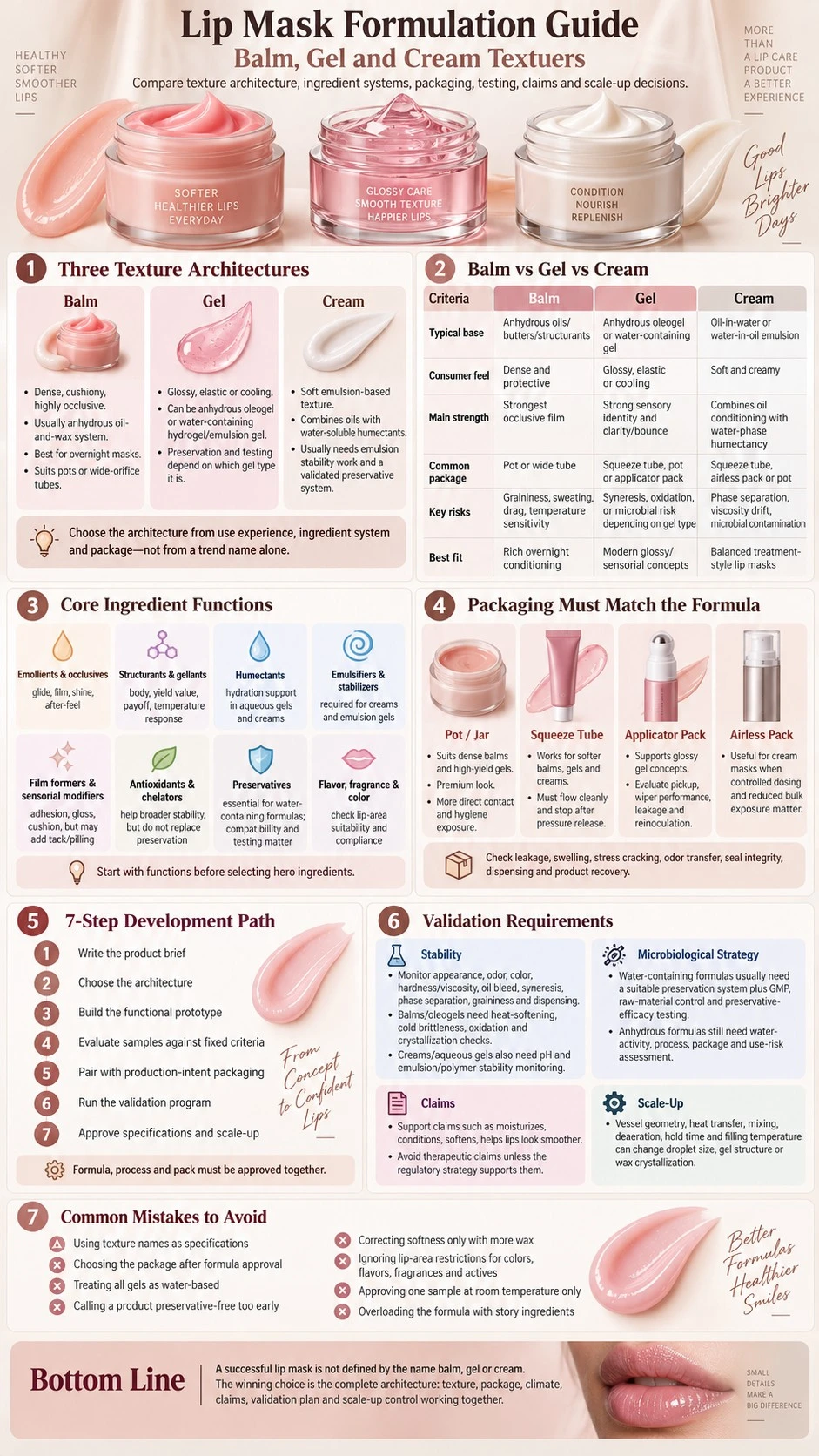
Lip masks sit between treatment-style skincare and sensory lip care. A successful formula must spread comfortably over a small, highly mobile area, remain pleasant near the mouth and protect its intended texture through filling, transport and consumer use. “Balm,” “gel” and “cream” therefore describe starting architectures, not interchangeable levels of thickness.
Human lips have lower stratum-corneum water content and higher transepidermal water loss than nearby cheek skin. In a small four-week study, a more occlusive oil-and-wax lip formula improved measured lip condition more than a less occlusive comparator, supporting occlusion as a meaningful formulation lever rather than a purely sensory choice. [1]
Balm, Gel and Cream Are Formulation Architectures, Not Fixed Recipes
Balm Lip Mask
A balm mask is usually an anhydrous blend of liquid emollients, semi-solid butters and crystalline or polymeric structurants. It forms a persistent film and can deliver the dense “sleeping mask” feel consumers expect. The architecture is comparatively simple, but texture control is not: wax crystal behavior, oil compatibility, cooling rate and storage temperature can change payoff, gloss and hardness.
Typical failure modes include graininess, oil sweating, wax bloom, excessive drag and a product that becomes brittle in cold conditions or slumps in heat. More wax is not automatically the answer. Increasing structure may reduce payoff, create tugging or trap a less elegant after-feel. The oil phase and structuring network should be balanced as a system.
Gel Lip Mask
“Gel” is the least precise texture label in a development brief. An anhydrous oleogel structures oils with a polymer, silica, dextrin ester or another oil-compatible gellant. It can look clear or translucent and feel glossy, elastic and less waxy than a balm. Because it has no intentionally added water, its microbial profile differs from that of an aqueous gel, although oxidation, raw-material bioburden and contamination during use still require assessment.
A water-containing hydrogel or emulsion gel uses water-phase thickeners and may provide a cooler, lighter initial feel. It can carry water-soluble humectants and actives, but it also creates preservation, pH and packaging questions. A brief that says only “gel lip mask” leaves the most consequential technical choice unresolved.
Cream Lip Mask
A cream mask is an emulsion, commonly oil-in-water for a lighter break or water-in-oil for a richer, more protective feel. It can combine occlusive emollients with humectants and water-soluble ingredients, making it useful when the desired experience is conditioning without a heavy wax payoff.
The tradeoff is a more complex stability problem. Emulsifier choice, phase ratio, droplet structure, viscosity, processing temperature and shear all affect separation resistance and sensory behavior. Because a cream contains water, its preservation system must be designed for the whole formula and confirmed in the final package.
Balm vs Gel vs Cream: Detailed Formulation Comparison
| Decision factor | Balm mask | Gel mask | Cream mask |
|---|---|---|---|
| Typical base | Anhydrous oils, butters and structurants | Anhydrous oleogel or water-containing hydrogel/emulsion gel | Oil-in-water or water-in-oil emulsion |
| Consumer feel | Dense, cushiony, protective | Glossy, elastic or cooling, depending on architecture | Soft, creamy and more readily absorbed |
| Main formulation strength | Persistent occlusive film | Distinctive clarity, bounce or gloss | Combines oil-phase conditioning with water-phase humectancy |
| Common package | Pot, jar or wide-orifice squeeze tube | Squeeze tube, pot or applicator pack matched to rheology | Squeeze tube, airless pack or pot |
| Key risks | Graininess, sweating, drag and temperature sensitivity | Syneresis, oxidation or microbial risk, depending on gel type | Phase separation, viscosity drift and microbial contamination |
| Best fit | Rich overnight or intensive-conditioning position | Modern glossy or sensorial position | Balanced treatment-style position with broad ingredient flexibility |
The table is a decision framework, not a recipe. A glossy anhydrous gel may be more occlusive than a light cream, and a low-wax balm may be softer than a structured gel. Benchmark samples and measurable specifications should define what the texture name means for the project.
Build the Functional Ingredient System
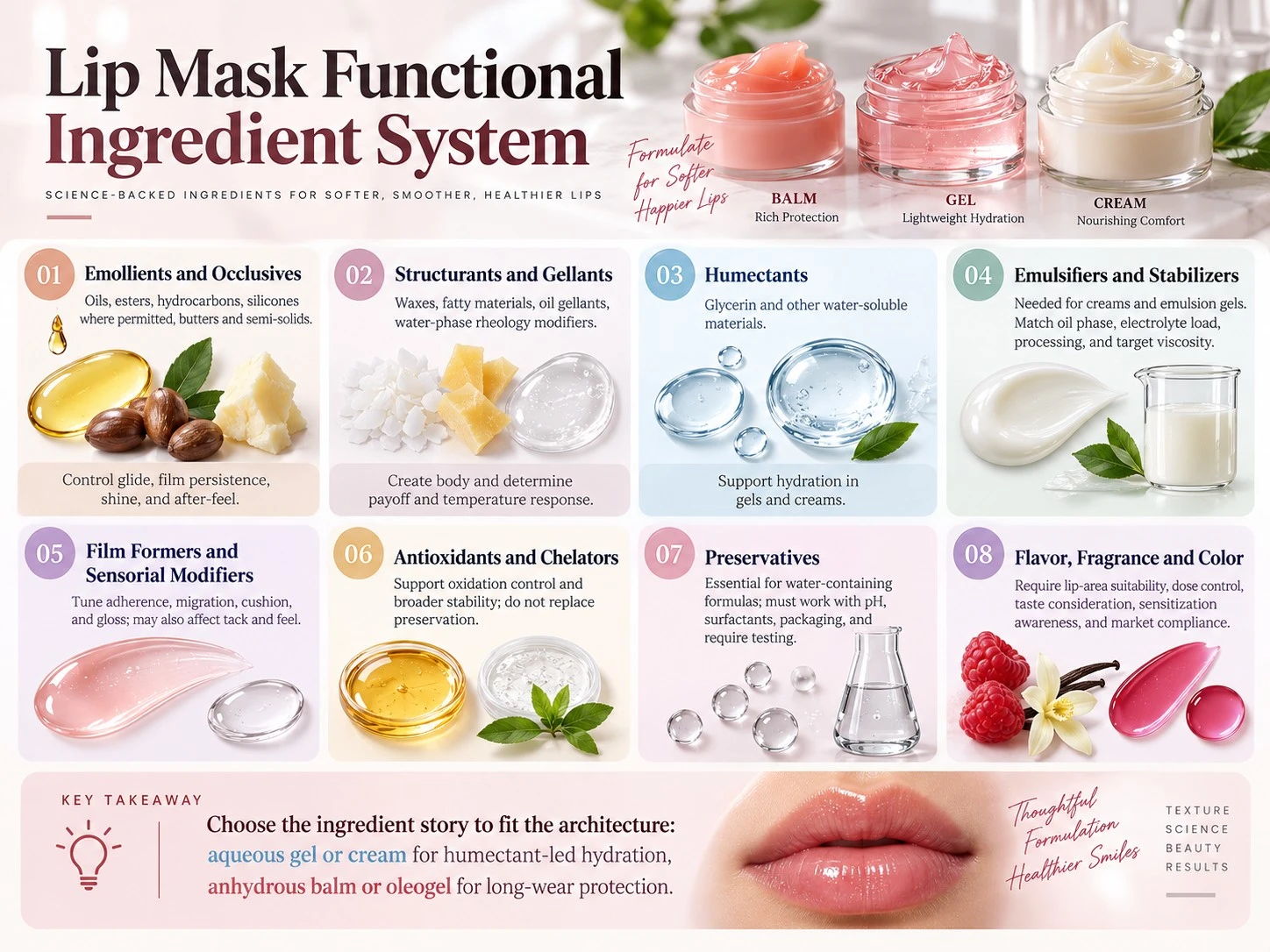
Start with functions before selecting hero ingredients. This prevents a crowded marketing list from undermining spread, stability or taste.
- Emollients and occlusives: Oils, esters, hydrocarbons, silicones where permitted, butters and semi-solids control glide, film persistence, shine and after-feel. Oxidative stability and flavor impact matter as much as skin feel.
- Structurants and gellants: Waxes, fatty materials, oil gellants or water-phase rheology modifiers create body and suspend dispersed materials. Their interactions determine yield value, payoff and temperature response.
- Humectants: Glycerin and related water-soluble materials can support hydration positioning in aqueous gels and creams. They do not disperse meaningfully into every anhydrous base without a suitable delivery strategy.
- Emulsifiers and stabilizers: Creams and emulsion gels need an interfacial system matched to the oil phase, electrolyte load, processing method and target viscosity.
- Film formers and sensorial modifiers: These can increase adherence, reduce migration or tune cushion and gloss, but may also create tack, pilling or an unpleasant coating near the mouth.
- Antioxidants and chelators: Antioxidants can slow oxidation of vulnerable oils; chelators may support broader stability in water-containing systems. Neither function replaces preservation.
- Preservatives: A water-containing formula needs a preservation strategy compatible with pH, surfactants, packaging and every other ingredient. Lowering water activity with humectants may contribute to protection, but effectiveness depends on formulation details and still requires testing. [2]
- Flavor, fragrance and color: These require special attention for lip-area suitability, regional rules, dose, taste and sensitization risk. In the United States, a color additive must be authorized for its intended use; approval for another cosmetic use does not automatically permit use on lips. [5]
If the product is positioned as a custom lip mask, the ingredient story should follow the chosen architecture. For example, a claim centered on water-soluble humectants points naturally toward an aqueous gel or cream, while a long-wear protective story may be better served by an anhydrous balm or oleogel.
Match Lip Mask Texture to Packaging and Use Experience
Packaging is part of the formula specification, not a decoration added after approval. The same bulk can feel different when scooped from a pot, squeezed through an orifice or wiped from an applicator.
- Pot or jar: Accommodates dense balm and high-yield-value gels, gives a visible premium presentation and allows generous pickup. Finger contact and a wide opening increase in-use exposure, so hygiene, water activity and preservation decisions must reflect actual use.
- Squeeze tube: Limits direct contact and can work for softer balms, gels and creams. The formula must flow through the selected orifice, stop cleanly after pressure is released and remain compatible with the tube, shoulder, seal and cap.
- Applicator pack: A doe-foot or similar system can reinforce a glossy gel concept. Wiper geometry, product pickup, reinoculation, leakage and applicator-material compatibility need evaluation.
- Airless pack: May suit a cream mask when controlled dosing and reduced bulk exposure are priorities, provided the viscosity and priming behavior match the mechanism.
Run packaging compatibility testing with the production-intent formula and components. Check leakage, paneling, swelling, stress cracking, staining, odor transfer, seal integrity, dispensing and product recovery under relevant temperatures and orientations.
The user experience also determines the right architecture. A bedside overnight mask can tolerate richer payoff and pot application; a travel product may need a clean-dosing tube; a glossy daytime hybrid may call for precise applicator pickup. These are different development briefs even if all three are sold as lip masks.
How to Develop and Approve a Lip Mask Formula
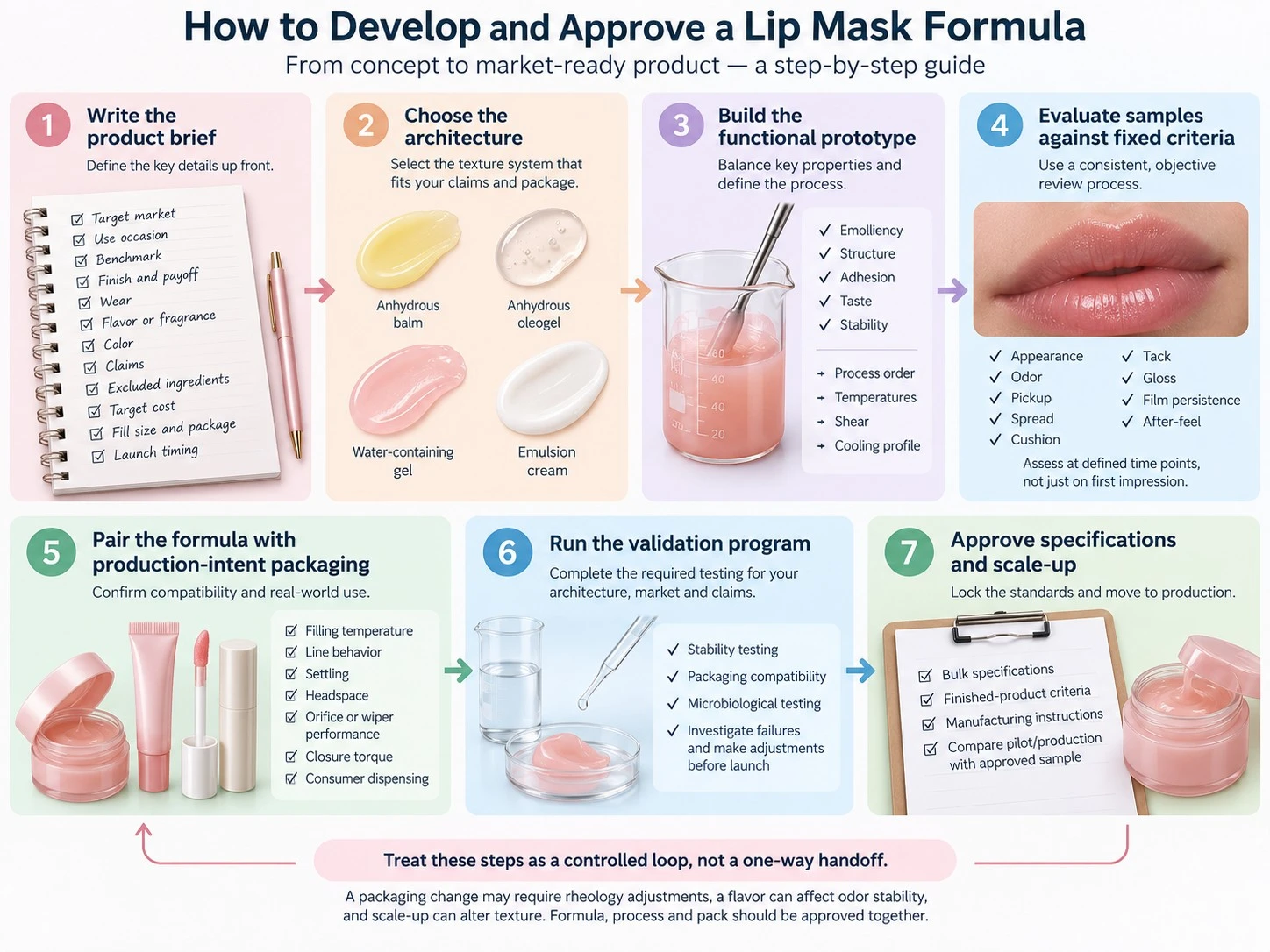
- Write the product brief. Define the target market, use occasion, benchmark, finish, payoff, wear, flavor or fragrance direction, color, claims, excluded ingredients, target cost, fill size, package and launch timing.
- Choose the architecture. Decide between an anhydrous balm, anhydrous oleogel, water-containing gel or emulsion cream. Record why the structure fits the claims and package.
- Build the functional prototype. Balance emolliency, structure, adhesion, taste and stability before adding nonessential hero ingredients. Establish the intended process order, temperatures, shear and cooling profile.
- Evaluate samples against fixed criteria. Score appearance, odor, pickup, spread, cushion, tack, gloss, film persistence and after-feel at defined time points. Use a consistent sample review process instead of approving from first impression.
- Pair the formula with production-intent packaging. Confirm filling temperature, line behavior, settling, headspace, orifice or wiper performance, closure torque and consumer dispensing.
- Run the validation program. Complete stability, compatibility and microbiological work appropriate to the architecture, market and claims. Investigate failures before locking artwork or launch quantities.
- Approve specifications and scale-up. Set measurable bulk and finished-product criteria, retain approved standards, confirm the manufacturing instructions and compare pilot or production output with the approved lab sample.
Treat these steps as a controlled loop rather than a one-way handoff. A packaging failure may require rheology changes; a flavor may alter odor stability; a scale-up cooling profile may change wax crystallization. Formula, process and pack should be approved together.
Testing, Claims and Scale-Up Requirements
Stability work should observe appearance, odor, color, hardness or viscosity, oil bleed, syneresis, phase separation, graininess and dispensing across justified conditions. Balm and oleogel programs should pay particular attention to heat-softening, cold brittleness, oxidation and crystallization after thermal cycling. Cream and aqueous-gel programs also need pH and emulsion or polymer stability monitoring.
Microbiological strategy depends on architecture and use. Cosmetics containing water normally need a suitable preservation system, supported by good manufacturing practice, controlled raw materials and preservative-efficacy testing. [3] ISO 11930 describes an approach for evaluating the antimicrobial protection of a cosmetic product. [4] ISO 22716 provides cosmetic GMP guidelines. [6] An anhydrous formula may not need a conventional preservative, but that conclusion should follow water-activity, raw-material, process, package and use-risk assessment rather than a marketing preference. For water-containing products, plan appropriate preservative challenge testing on the final formula.
Claims must match both the formula and the evidence. “Moisturizes,” “conditions,” “softens” or “helps lips look smoother” may be suitable cosmetic directions when supported. Claims to heal cracked lips, treat cheilitis or provide therapeutic action can change the regulatory position. Sun-protection claims require a separate product and testing strategy in markets where lip SPF products are regulated differently. Plan skincare claim support before choosing the final wording.
Scale-up can expose problems that do not appear in a lab beaker. Vessel geometry, heat-transfer rate, mixing energy, deaeration, hold time and filling temperature can change emulsion droplet size, gel structure or wax crystal formation. The manufacturing record should specify critical process parameters, and the pilot batch should be compared with the approved standard before commercial release.
Common Lip Mask Formulation Mistakes
- Using texture names as specifications: “Rich gel” or “buttery balm” is subjective. Add benchmark, rheology, payoff and temperature-response criteria.
- Choosing the package after formula approval: A dense balm may not fill or dispense from the selected tube, while a low-yield gel can leak through an unsuitable wiper.
- Treating all gels as water-based: This leads to wrong assumptions about humectants, pH, preservation and clarity.
- Calling a product preservative-free too early: Water activity, process hygiene and in-use contamination must be assessed before making this decision.
- Correcting softness only with more wax: This can solve hot-temperature slump while creating drag, brittleness or poor pickup.
- Ignoring lip-area restrictions: Colors, flavors, fragrances and actives must be checked for intended use and target-market compliance.
- Approving one sample at room temperature: Thermal history, package interaction and production scale can materially alter the final texture.
- Overloading the formula with story ingredients: Each addition can affect taste, color, oxidation, viscosity, preservation or claim burden.
For projects that blur daily care and overnight treatment, compare the intended use with a lip balm formulation. A mask usually emphasizes a richer treatment ritual or longer residence, but the distinction must be created by the total experience rather than the product name alone.
Develop Your Lip Mask Formula With ZICAIL
ZICAIL can help translate a lip mask concept into a development brief covering texture architecture, ingredient direction, sensory benchmarks, packaging and validation. Share the target market, use occasion, desired finish, benchmark products, claims, required or excluded ingredients, fill size, package preference and commercial timing.
Start with ZICAIL’s custom skincare formulation capabilities, then align the bulk with packaging customization. Early alignment reduces the risk of approving an attractive lab sample that cannot be filled, protected or reproduced at scale.


