


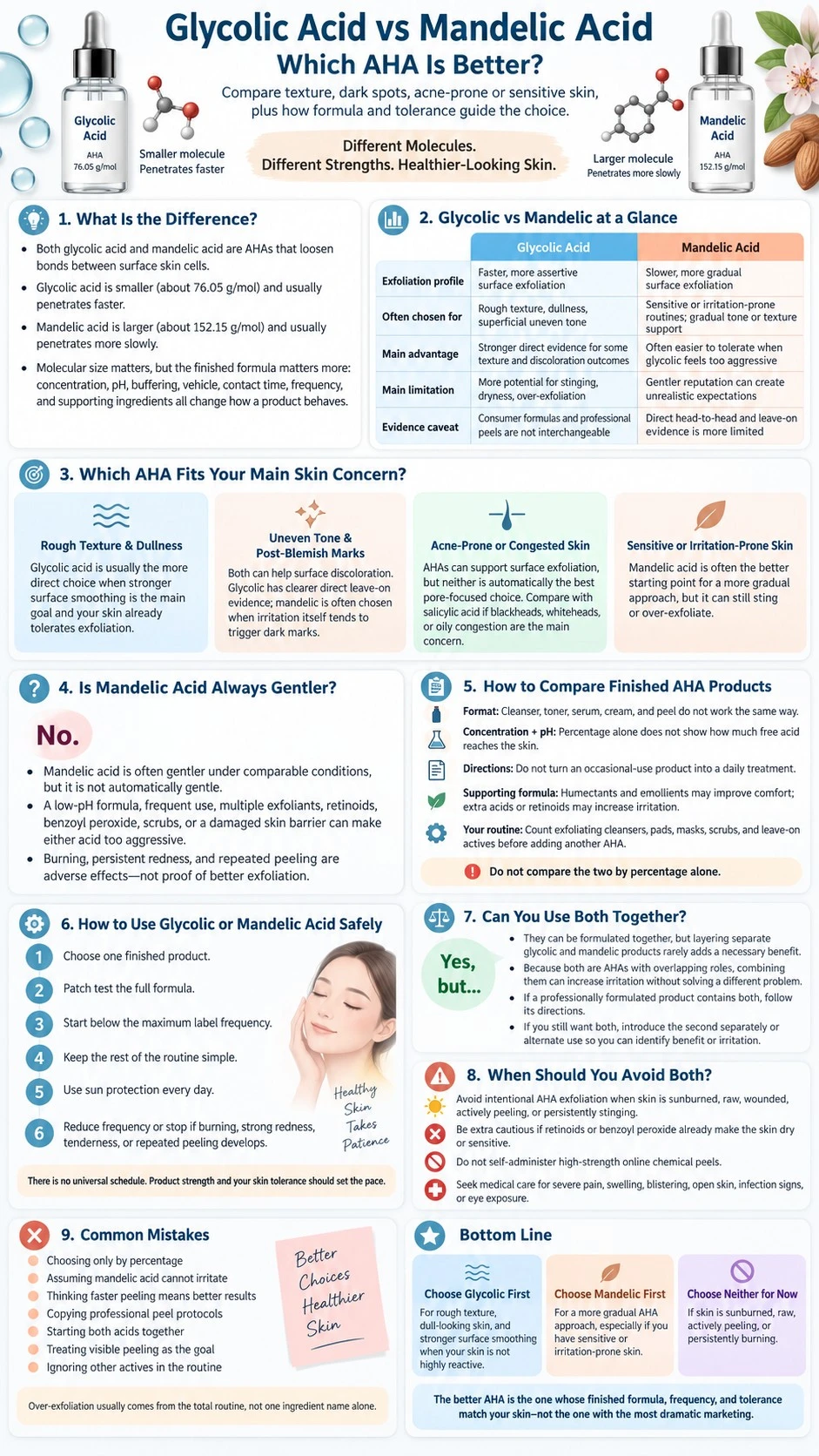
Glycolic acid and mandelic acid are both alpha hydroxy acids, or AHAs. They loosen the bonds between surface skin cells, helping rough or dull-looking cells shed more evenly. The choice is not simply “strong versus weak”: molecular size matters, but the finished formula and your skin’s response matter more.
Evidence also differs between the ingredients. Glycolic acid has relatively direct controlled evidence in leave-on skincare, while much of the mandelic-acid literature involves small studies, professional peels or combination formulas. That does not make mandelic acid ineffective; it means product claims should not outrun the exact formula and evidence.
What Is the Difference Between Glycolic and Mandelic Acid?
Glycolic acid is the smallest common AHA, with a molecular weight of about 76.05 g/mol.[3] Mandelic acid is roughly twice as large at about 152.15 g/mol.[4] The larger structure helps explain mandelic acid’s slower penetration and its reputation for milder exfoliation, while glycolic acid can act more quickly and can also irritate more readily in an aggressive formula.[5]
Molecular size is only one variable. The amount of free acid available to interact with skin depends on concentration, pH and buffering. The vehicle, contact time, rinse-off or leave-on format, frequency and supporting ingredients also affect performance. A low-pH mandelic product can be more irritating than a mild, buffered glycolic formula, so the ingredient name never predicts the complete experience.
For a full ingredient overview, see the guides to glycolic acid for skin and mandelic acid for skin.
Glycolic Acid vs Mandelic Acid Comparison
| Decision factor | Glycolic acid | Mandelic acid |
|---|---|---|
| Acid family | Alpha hydroxy acid | Alpha hydroxy acid |
| Molecular weight | About 76.05 g/mol | About 152.15 g/mol |
| Typical exfoliation profile | Faster, more assertive surface exfoliation | Slower, more gradual surface exfoliation |
| Often chosen for | Rough texture, dullness and superficial uneven tone | Sensitive or irritation-prone routines and gradual tone or texture support |
| Main advantage | Stronger direct evidence for some texture and discoloration outcomes | Often easier to tolerate when glycolic products feel too aggressive |
| Main limitation | Greater potential for stinging, dryness and over-exfoliation | Gentler reputation can create unrealistic expectations that it cannot irritate |
| Evidence caveat | Consumer formulas and professional peels are not interchangeable | Direct head-to-head and leave-on evidence is more limited |
Neither column describes every product. A cleanser, toner, serum and professional peel differ in contact time, acidity and intended supervision even when the front label names the same AHA.
Which AHA Fits Your Main Skin Concern?
Rough Texture and Dull-Looking Skin
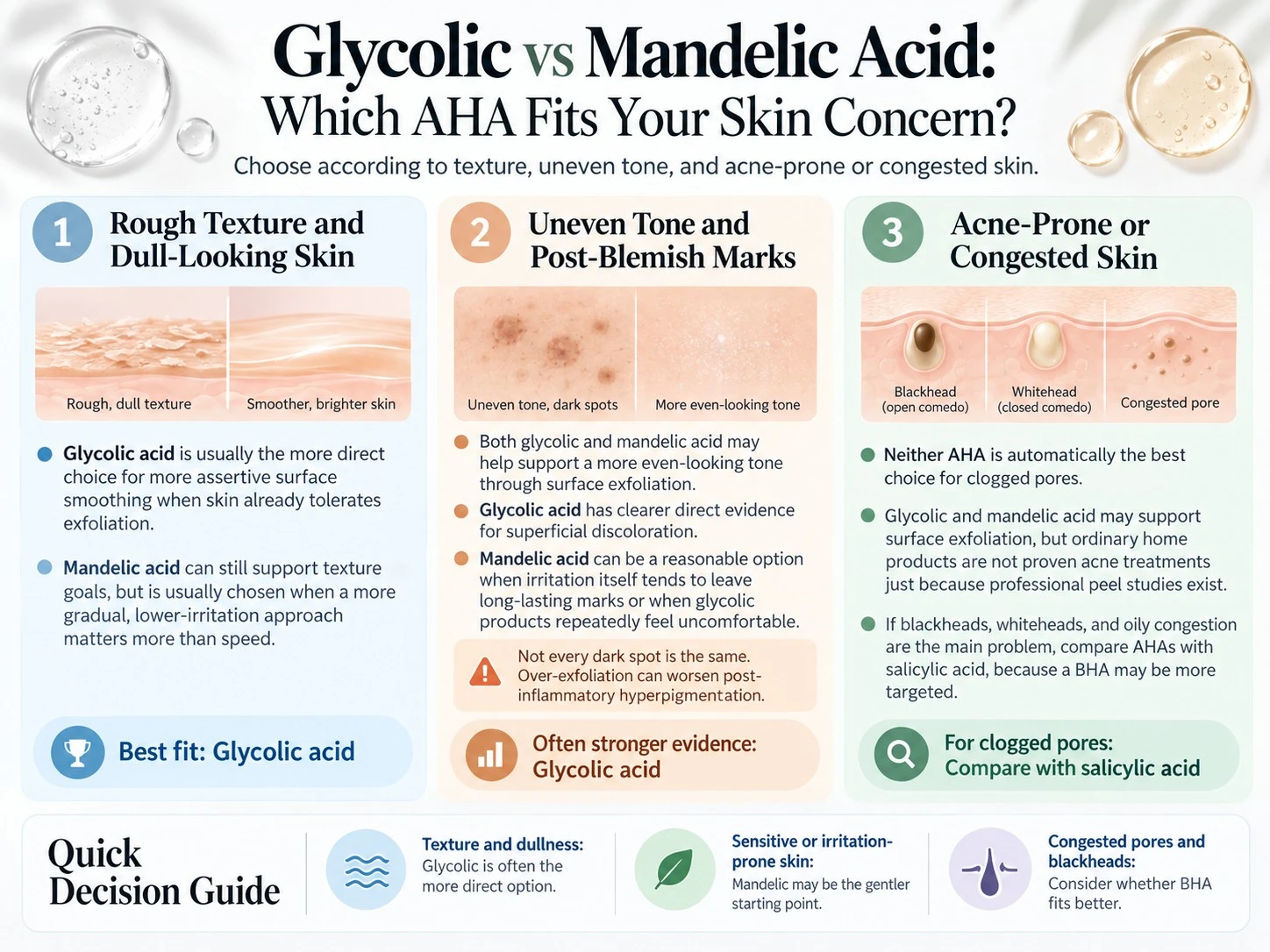
Glycolic acid is usually the more direct choice when more assertive surface smoothing is the goal and your skin already tolerates exfoliation. In a three-month randomized placebo-controlled trial, a daily 5% glycolic-acid cream significantly improved general skin texture and discoloration.[6]
That result applies to one finished cream, not every 5% glycolic product. Mandelic acid is used for the same broad surface-smoothing goal, but its direct leave-on evidence is less developed; it is usually chosen when a gradual approach and lower irritation risk matter more than speed.
Uneven Tone and Post-Blemish Marks
Both acids may support more even-looking tone by promoting surface exfoliation. Glycolic acid has the clearer direct evidence for superficial discoloration in a leave-on consumer-style formula.[6] Mandelic acid remains a reasonable option when irritation itself tends to leave long-lasting marks or when glycolic products repeatedly cause discomfort.
Do not treat either AHA as a universal answer for pigmentation. Dark marks have different causes and depths, and aggressive exfoliation can worsen post-inflammatory hyperpigmentation. This risk deserves particular attention in deeper skin tones and in anyone who develops dark marks after irritation.[2]
Acne-Prone or Congested Skin
Neither AHA is automatically the best choice for clogged pores. Glycolic and mandelic acid can support surface exfoliation, and professional peel studies have reported acne-related benefits, but those protocols do not prove that an ordinary home serum will treat acne.
If blackheads, whiteheads and oily follicular congestion are the main problem, compare AHAs with salicylic acid before deciding. The broader AHA vs BHA guide explains why a BHA may be the more targeted option. Persistent, painful or scarring acne deserves professional assessment rather than stronger home peeling.
Is Mandelic Acid Always Gentler Than Glycolic Acid?
No. Mandelic acid is often gentler under comparable conditions, but “mandelic” is not a guarantee of comfort. A comparative study found 10% glycolic acid produced faster exfoliation, more erythema and greater photosensitizing effects than the tested mandelic-acid and grape-acid mixtures; the formulations were not pure ingredient-for-ingredient twins, so the result supports a tendency rather than a universal ranking.[7]
Irritation depends on the whole product and routine. A low-pH formula, frequent application, multiple exfoliants, retinoids, benzoyl peroxide, scrubs or a damaged barrier can make either acid too aggressive. Burning, persistent redness and repeated peeling are adverse effects, not proof of better exfoliation.
How to Compare Finished AHA Products
Compare products that serve the same job instead of reading only the large percentage on the label.
- Format: A rinse-off cleanser has a shorter contact time than a leave-on toner, serum or cream.
- Concentration and pH: More acid and a lower pH can increase activity, but percentage alone does not reveal how much free acid reaches the skin.[1]
- Directions: A product designed for occasional use should not be converted into a daily treatment because the skin feels smooth after one application.
- Supporting formula: Humectants and emollients may improve comfort, while another acid or retinoid in the same formula can increase total exfoliating load.
- Your baseline routine: Count exfoliating cleansers, pads, masks, scrubs and leave-on actives before adding a new AHA.
The U.S. cosmetic safety discussion cited by the FDA for glycolic- and lactic-acid consumer products includes concentrations of 10% or less, a finished pH of 3.5 or higher and sun-protection measures.[1] This is not a home-formulation target or a guarantee that every product inside those parameters suits every person. High-strength chemical peel products should not be treated as stronger versions of routine skincare.
How to Use Glycolic or Mandelic Acid Safely
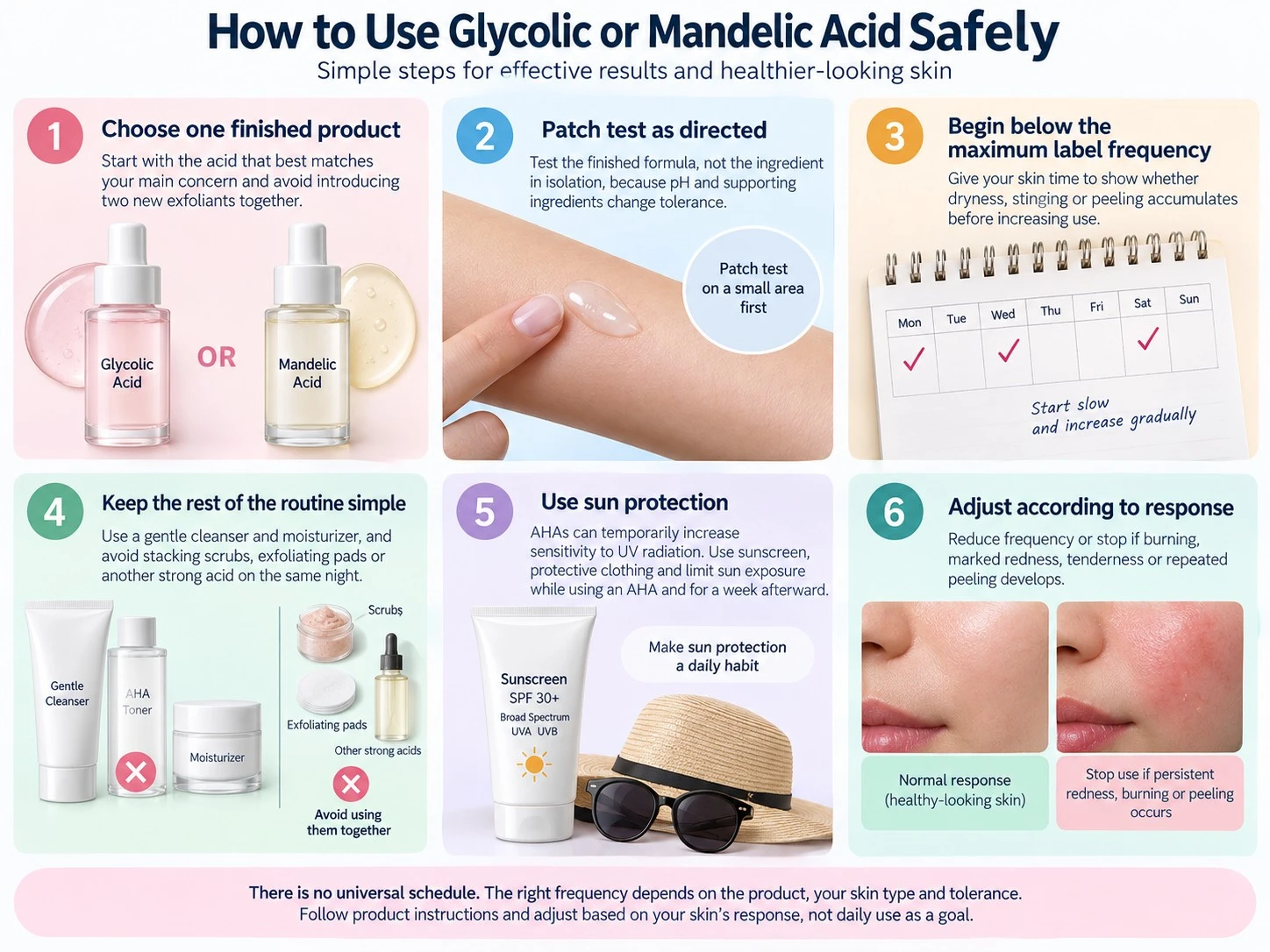
- Choose one finished product. Start with the acid that best matches your main concern and avoid introducing two new exfoliants together.
- Patch test as directed. Test the finished formula, not the ingredient in isolation, because pH and supporting ingredients change tolerance.
- Begin below the maximum label frequency. Give your skin time to show whether dryness, stinging or peeling accumulates before increasing use.
- Keep the rest of the routine simple. Use a gentle cleanser and moisturizer, and avoid stacking scrubs, exfoliating pads or another strong acid on the same night.
- Use sun protection. AHAs can temporarily increase sensitivity to ultraviolet radiation. The FDA advises sunscreen, protective clothing and limited sun exposure while using an AHA and for a week afterward.[1] Follow a consistent daily sunscreen routine rather than relying only on nighttime application.
- Adjust according to response. Reduce frequency or stop if burning, marked redness, tenderness or repeated peeling develops.
There is no universal schedule for either acid. The more aggressive the product, the less often it may need to be used, and skin type also changes tolerance.[2] Use the product instructions and the practical guide to how often to exfoliate your face as boundaries rather than chasing daily use.
Can You Use Glycolic and Mandelic Acid Together?
They can be formulated together, but layering separate glycolic and mandelic products rarely adds a necessary benefit. Because both are AHAs with overlapping surface-exfoliation roles, combining them can increase irritation without solving a different problem.
If a professionally formulated product contains both, follow its directions. If you already tolerate one acid and still have an unmet goal, introduce the second separately or alternate applications so you can identify which product helps or irritates. Do not add mandelic acid merely to “buffer” an aggressive glycolic routine; reduce the total exfoliating load instead.
When Should You Avoid Both Acids?
Pause intentional AHA exfoliation when skin is sunburned, raw, wounded, actively peeling or persistently stinging. Also be cautious when prescription retinoids, retinol or benzoyl peroxide already make the skin dry or sensitive; combining exfoliation may worsen irritation.[2]
Do not self-administer high-concentration chemical peels bought online. The FDA has warned that certain high-strength products can cause chemical burns, infection, skin-color changes and scarring and should not be used without appropriate professional supervision.[8]
If excessive exfoliation has already caused ongoing discomfort, simplify the routine and review the signs of over-exfoliated skin. Seek medical care for severe pain, swelling, blistering, open skin, signs of infection or eye exposure.
Common Glycolic Acid vs Mandelic Acid Mistakes
- Choosing only by percentage: A 10% mandelic product is not automatically stronger than a 7% glycolic product.
- Assuming mandelic acid cannot irritate: Slower penetration does not eliminate stinging, dryness or overuse.
- Using glycolic acid because faster must be better: A product that repeatedly inflames the skin is a poor match even if it produces rapid peeling.
- Copying professional peel protocols: Peel concentration, pH, exposure time, neutralization and supervision differ from routine home skincare.
- Starting both acids together: This makes benefits and adverse reactions harder to attribute.
- Treating peeling as the goal: Visible flaking is not required for an AHA product to exfoliate.
- Ignoring other actives: Retinoids, benzoyl peroxide, scrubs and exfoliating cleansers contribute to the same irritation budget.
FAQs About Glycolic Acid vs Mandelic Acid
Is mandelic acid weaker than glycolic acid?
Not in a universal numerical sense. Mandelic acid generally penetrates more slowly and often feels gentler, while glycolic acid tends to produce faster exfoliation. The finished product’s concentration, pH, vehicle, contact time and frequency determine how strong it behaves on your skin.
Which acid is better for beginners?
Mandelic acid is often the easier starting point for a cautious beginner or someone with reactive skin. A mild, well-formulated glycolic product can also be appropriate. Start with one product, use it less often than the maximum label frequency and increase only if the skin stays comfortable.
Can glycolic or mandelic acid be used every day?
Some finished products are designed for frequent use, but daily AHA exfoliation is not a universal goal. Follow the label and reduce frequency if dryness, burning, redness or peeling persists.
Which acid is better for dark skin tones?
Mandelic acid is often chosen when minimizing irritation is the priority because inflammation can trigger post-inflammatory hyperpigmentation. Glycolic acid is not automatically unsuitable for deeper skin tones, but conservative use and avoidance of aggressive peels are especially important if irritation tends to leave dark marks.
Sources
[1] U.S. Food and Drug Administration. Alpha Hydroxy Acids
[2] American Academy of Dermatology Association. How to Safely Exfoliate at Home
[3] National Center for Biotechnology Information. PubChem Compound Summary for CID 757, Glycolic Acid
[4] National Center for Biotechnology Information. PubChem Compound Summary for CID 1292, Mandelic Acid
[5] Almeman AA. Evaluating the Efficacy and Safety of Alpha-Hydroxy Acids in Dermatological Practice: A Comprehensive Clinical and Legal Review
[6] Thibault PK et al. A Double-Blind Randomized Clinical Trial on the Effectiveness of a Daily Glycolic Acid 5% Formulation in the Treatment of Photoaging
[7] Rona C et al. Comparative In Vivo Study of the Efficacy and Tolerance of Exfoliating Agents Using Reflectance Spectrophotometric Methods
[8] U.S. Food and Drug Administration. FDA Warns Against Purchasing or Using Chemical Peel Skin Products Without Professional Supervision


