
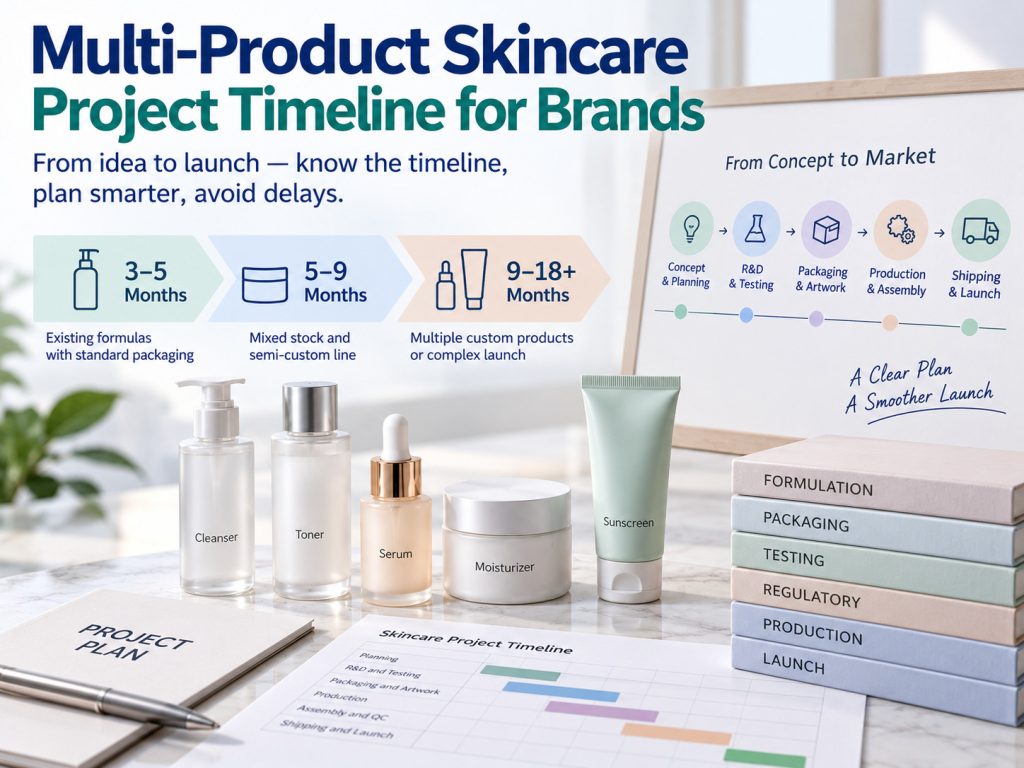

A cleanser, serum, and moisturizer can be developed at the same time, but they rarely move at exactly the same speed. Each SKU has its own formula, package, test status, artwork, specification, and production readiness. The line also has shared decisions—positioning, target markets, visual system, cartons, set configuration, launch date, and inventory allocation—that can hold every product even when one SKU is ready.
The useful question is therefore not “How many weeks does each product take?” It is “Which unfinished task can still delay the complete range?” This article uses that critical-path view to help brands build a realistic multi-product schedule.
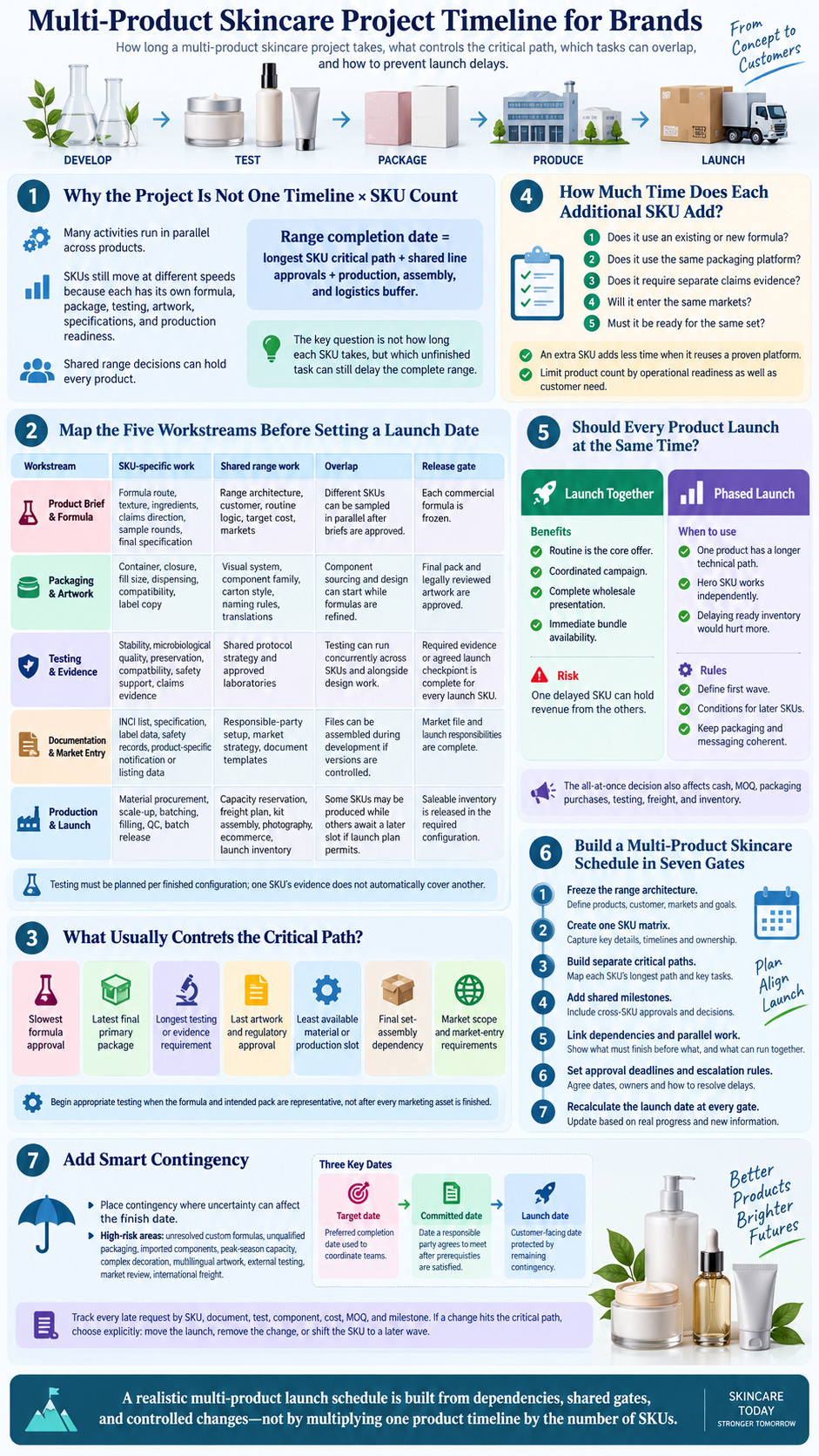
Why a Multi-Product Project Is Not One Timeline Multiplied by the SKU Count
Three products do not normally take three times as long as one product because many activities can run in parallel. The laboratory may work on a cleanser while packaging samples are sourced for the serum and artwork templates are prepared for the moisturizer. Brand naming, market selection, visual direction, supplier onboarding, and launch planning can also support the entire range at once.
However, parallel work does not make the SKUs interchangeable. A cleanser may reach formula approval quickly but need a pump adjustment. A serum may use a simple bottle but require more formula revisions or oxidation protection. A moisturizer may pass early stability checks but expose a filling problem during scale-up. If the commercial promise is a complete three-step set, the latest unresolved launch-critical issue becomes the range completion date.
Use this planning model:
Range completion date = longest SKU critical path + shared line approvals + production, assembly, and logistics buffer.
The existing ZICAIL guide to skincare product development timing explains the path for one product. A multi-product plan adds cross-SKU dependencies: common approval meetings, coordinated artwork, packaging-family decisions, production sequencing, balanced inventory, kit components, and one launch-readiness gate.
Map the Five Workstreams Before Setting a Launch Date
A useful master schedule separates tasks that belong to each SKU from tasks shared by the whole range. It also shows which activities can overlap and which approval must happen before the next task begins. Maintain three connected views: one path for every SKU, one path for shared range work, and one launch-level gate that confirms the required products are ready together.
| Workstream | SKU-specific work | Shared range work | What can overlap | Release gate |
|---|---|---|---|---|
| Product brief and formula | Formula route, texture, ingredients, claims direction, sample rounds, final specification | Range architecture, customer, routine logic, target cost, markets | Different SKUs can be sampled in parallel after their briefs are approved | Each commercial formula is frozen |
| Packaging and artwork | Container, closure, fill size, dispensing, compatibility, label copy | Visual system, component family, carton style, naming rules, translations | Component sourcing and design can start while formulas are refined | Final pack and legally reviewed artwork are approved |
| Testing and evidence | Stability, microbiological quality, preservation, compatibility, safety support, claims evidence | Shared protocol strategy and approved laboratories | Testing can run concurrently across SKUs and alongside design work | Required evidence or agreed launch checkpoint is complete for every launch SKU |
| Documentation and market entry | INCI list, specification, label data, safety records, product-specific notification or listing data | Responsible-party setup, market strategy, document templates | Files can be assembled during development if versions are controlled | Market file and launch responsibilities are complete |
| Production and launch | Material procurement, scale-up, batching, filling, QC, batch release | Capacity reservation, freight plan, kit assembly, photography, ecommerce and launch inventory | Some SKUs may be produced while others await a later slot, if the launch plan permits | Saleable inventory is released in the required configuration |
Formula route has the largest early effect. A line built from suitable existing formulas removes open-ended formulation work, while a mixed or custom range creates more revision and validation paths. Brands still need to verify what “stock,” “semi-custom,” and “custom” mean in the supplier’s proposal; the stock versus custom formula guide explains the commercial differences.
Testing should be planned per finished configuration rather than assumed to be one shared range task. Cosmetic stability programs are product-dependent, and one universal method cannot cover every formula, package, storage condition, and use pattern.[1] Antimicrobial protection also depends on the product’s risk and preservation system; ISO 11930 provides a reference framework for evaluating preservation efficacy and microbiological risk.[2] Shared protocols and laboratories can simplify coordination, but they do not make one SKU’s result automatically applicable to another.
What Usually Controls the Critical Path?

The critical path is the chain of unfinished tasks that directly controls the earliest possible launch date. In a multi-product skincare project, one or more of these issues usually becomes decisive:
- The slowest formula approval: one SKU continues through sample revisions after the others have been accepted.
- The latest final primary package: compatibility testing, decoration, tooling, or component availability cannot be finalized until the actual pack is selected.
- The longest testing or evidence requirement: a launch claim, preservation concern, package change, or market requirement needs data that cannot be completed instantly.
- The last artwork and regulatory approval: one changed INCI list, warning, translation, or claim can hold printing for the complete range.
- The least available material or production slot: a specialty ingredient, pump, carton, or filling line arrives later than the other inputs. A quoted manufacturing lead time normally starts only after the formula, materials, artwork, payment, and production instructions are ready under the supplier’s terms.
- The final set-assembly dependency: the complete kit cannot be packed when one product, insert, tray, pouch, carton, or label remains unavailable.
Testing is a common critical path because changing the formula or primary package can make earlier evidence partly inapplicable. A current industry development example places accelerated stability, compatibility, and microbiological work in overlapping but noninstant stages rather than treating them as a final administrative check.[4] The practical lesson is to begin appropriate testing when the formula and intended pack are representative, not after every marketing asset is finished.
Market scope can also control the schedule. In the United States, responsible persons must maintain adequate safety substantiation records and list marketed cosmetic products with FDA, subject to applicable requirements and exemptions.[3] In the EU, product notification through CPNP is product-specific and occurs before the product is placed on the market.[5] Decide markets early enough for ingredient review, safety files, label language, and notification data to develop with the product rather than after production.
How Much Time Does Each Additional SKU Add?
An extra SKU adds less calendar time when it reuses a proven platform and more calendar time when it introduces a new technical or commercial path. Evaluate the added product across five questions:
- Does it use an existing or new formula? A new emulsion, surfactant system, active concept, fragrance, or preservation environment creates its own approval and testing path.
- Does it use the same packaging platform? A shared bottle family can simplify design and sourcing, but each formula–pack combination still needs a compatibility decision.
- Does it require separate claims evidence? “Moisturizes,” “improves the appearance of uneven tone,” and a quantified performance claim do not create the same evidence workload.
- Will it enter the same markets? Different markets can change ingredients, language, label content, safety documentation, responsible-party tasks, and notification timing.
- Must it be ready for the same set? A separately sold extension can launch later; a required routine step can block the entire bundle.
The first extra SKU often adds more coordination than the fourth or fifth when the team is creating its naming system, artwork template, documentation process, and packaging family for the first time. Later products may reuse those systems, but only if the range was designed for reuse rather than assembled from unrelated choices.
Product count should therefore be limited by operational readiness as well as customer need. Before committing every concept to the same launch, compare the workload and inventory exposure in one hero product versus a three-product set. A smaller first wave can protect the main launch date without cancelling the longer-term range.
Should Every Product Launch at the Same Time?
Launch all products together when the routine is the core offer, each SKU is essential to the customer promise, and the brand can hold inventory until the complete set is ready. This approach supports one campaign, coordinated photography, a complete wholesale presentation, and immediate bundle availability. Its risk is that one delayed SKU can hold revenue from the others.
Use a phased launch when one product has a materially longer technical path, the hero SKU works independently, or delaying ready inventory would create greater commercial harm than launching the complete assortment later. The brand can release the hero product first, introduce companion products in planned waves, and assemble the complete set after all components are qualified and available.
A phased launch still needs discipline. Do not print claims, routine instructions, set cartons, or campaign copy that assumes an unapproved companion product will arrive on a fixed date. Define the minimum viable first wave, the conditions for each later SKU, and how packaging or messaging will remain coherent across releases.
The all-at-once decision also affects cash. Each product has its own MOQ, packaging purchases, testing, freight, and inventory position. Review the cost of a three-product skincare line before choosing synchronized production only for visual impact.
Build a Multi-Product Skincare Schedule in Seven Gates

Treat the schedule as a controlled sequence of approvals, not a list of optimistic completion dates.
- Freeze the range architecture. Confirm the launch SKUs, hero product, routine roles, formula route, target markets, channels, target cost, intended claims, pack sizes, and whether products must launch as one set.
- Create one SKU matrix. Give every product a code and record its formula status, package, artwork, testing, documents, MOQ, responsible owner, dependency, and current approval state.
- Build separate critical paths. Map formula selection or development, samples, final pack, testing, documentation, scale-up, production, and release for each SKU instead of hiding them inside one range-level bar.
- Add shared milestones. Mark naming approval, visual-system approval, target-market freeze, artwork release, production-capacity reservation, set-pack approval, campaign production, freight booking, and launch-readiness review.
- Link dependencies and parallel work. Show which tasks can start together and which require a locked formula, final package, approved copy, available component, or released batch first.
- Set approval deadlines and escalation rules. Name the person who approves samples, artwork, costs, deviations, and launch changes; define what happens when feedback or evidence misses the deadline.
- Recalculate the launch date at every gate. Update the critical path after formula approval, testing checkpoints, artwork release, component receipt, production booking, batch release, and kit assembly rather than protecting an obsolete date.
Before requesting a schedule, prepare the same commercial inputs needed for a useful quotation. The private label skincare RFQ guide helps organize SKU quantities, formula routes, packaging, markets, testing, documents, shipping terms, and the desired launch window.
Add Contingency Without Padding Every Task
Do not add the same arbitrary buffer to every line. Place contingency where uncertainty can affect the finish date: unresolved custom formulas, unqualified packaging, imported components, peak-season capacity, complex decoration, multilingual artwork, external testing, market review, and international freight.
Separate three date types in the schedule:
- Target date: the preferred completion date used to coordinate teams.
- Committed date: the date a responsible party agrees to meet after prerequisites are satisfied.
- Launch date: the customer-facing date protected by the project’s remaining contingency.
This distinction prevents a laboratory estimate from becoming a public promise. It also makes responsibility visible when the brand’s sample feedback, legal review, payment, artwork, or forecast is the missing input.
Keep a decision log and change-control rule. Every late request should show which SKU, document, test, component, cost, MOQ, and milestone it affects. When a change reaches the critical path, choose explicitly among moving the launch, removing the change, or moving the affected SKU to a later wave.
Plan Your Multi-Product Project With ZICAIL
ZICAIL can discuss a coordinated private label or custom skincare project when the brand has defined its proposed SKUs, formula route, packaging direction, target markets, quantities, claims direction, budget range, and preferred launch window. The useful output is a milestone plan that identifies what can run in parallel, what must be approved first, and which assumptions still prevent a firm date.
Contact ZICAIL with your product matrix and launch requirements to discuss sampling, packaging, testing, production, and the likely critical path for the range.


