

Start With Your Product Type and Brand Stage
Before comparing manufacturers, define what kind of skincare project you are building. A first-time private label launch does not need the same partner as a custom serum line, professional spa brand, sunscreen project, or export-focused skincare business.
The best manufacturer fit comes from matching your project stage with the right service model. If you skip this step, you may ask the wrong factory for the wrong type of support.
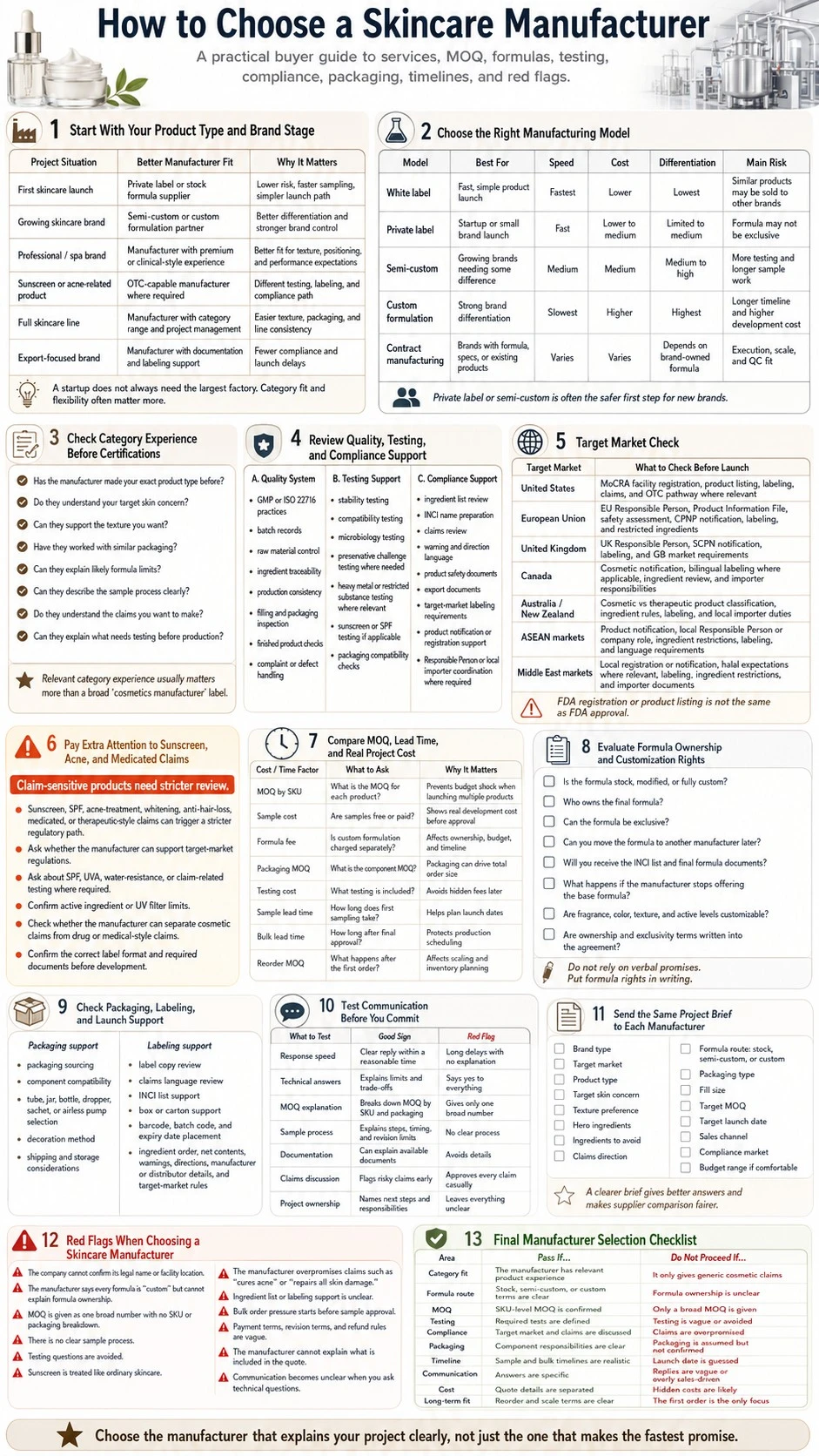
| Your Project Situation | Better Manufacturer Fit | Why It Matters |
|---|---|---|
| First skincare launch | Private label or stock formula supplier | Lower risk, faster sampling, simpler launch path |
| Growing skincare brand | Semi-custom or custom formulation partner | Better differentiation and stronger brand control |
| Professional / spa brand | Manufacturer with premium or clinical-style experience | Better fit for texture, positioning, and performance expectations |
| Sunscreen or acne-related product | OTC-capable manufacturer where required | Different testing, labeling, and compliance path |
| Full skincare line | Manufacturer with category range and project management | Easier texture, packaging, and line consistency |
| Export-focused brand | Manufacturer with documentation and labeling support | Fewer compliance and launch delays |
A startup should not automatically choose the largest manufacturer. A large factory may have strong systems, but higher MOQs and slower project intake. A smaller or mid-sized manufacturer with clear category experience may be a better first partner if communication, sampling, and flexibility matter more.
Choose the Right Manufacturing Model
Skincare manufacturers do not all work the same way. Some sell ready formulas with your label. Some adjust an existing base formula. Others create a formula from scratch or only manufacture formulas you already own.
Use the model below to choose the right path before asking for a quote.
| Manufacturing Model | Best For | Speed | Cost | Differentiation | Main Risk |
|---|---|---|---|---|---|
| White label | Fast, simple product launch | Fastest | Lower | Lowest | Similar products may be sold to other brands |
| Private label | Startup or small brand launch | Fast | Lower to medium | Limited to medium | Formula may not be exclusive |
| Semi-custom | Growing brands needing some difference | Medium | Medium | Medium to high | More testing and longer sample work |
| Custom formulation | Strong brand differentiation | Slowest | Higher | Highest | Longer timeline and higher development cost |
| Contract manufacturing | Brands with formula, specs, or existing products | Varies | Varies | Depends on brand-owned formula | Execution, scale, and QC fit |
For most first-time skincare brands, private label or semi-custom development is safer than full custom formulation. It helps you test the market without locking too much budget into formula development.
For brands with clear positioning, custom formulation gives stronger long-term value. It can support a more unique texture, ingredient story, performance direction, and brand identity. The trade-off is clear: more control usually means more time, testing, and cost.
Check Category Experience Before Certifications
Certifications matter, but they should not be your first filter. First, confirm whether the manufacturer has real experience with your exact product type.
A company that makes body lotion may not be the best choice for sunscreen, eye serum, acne care, sensitive skin products, or professional-use formulas. Skincare category depth matters more than a broad “cosmetics manufacturer” label.
Ask these questions before going deeper:
- Has the manufacturer made your exact product type?
- Do they understand your target skin concern?
- Can they support the texture you want?
- Have they worked with similar packaging?
- Can they explain likely formula limits?
- Can they describe the sample process clearly?
- Do they understand the claims you want to make?
- Can they explain what needs testing before production?
A relevant mid-sized manufacturer is often better than a larger manufacturer with weak category fit. Size can help with capacity, but category experience helps prevent wrong textures, weak claims support, packaging mismatches, and slow revisions.
Review Quality, Testing, and Compliance Support

A skincare manufacturer should be able to explain how quality is controlled before, during, and after production. You do not need to become a chemist, but you do need to know whether the manufacturer has a real quality system.
Quality System
Ask how the manufacturer manages:
- GMP or ISO 22716 practices where applicable
- Batch records
- Raw material control
- Ingredient traceability
- Production consistency
- Filling and packaging inspection
- Finished product checks
- Complaint or defect handling
A vague answer such as “we have good quality” is not enough. A serious manufacturer should be able to describe what happens during development, sampling, bulk production, and final inspection.
Testing Support
Testing depends on the product type and target market. Ask whether the manufacturer can support or coordinate:
- Stability testing
- Compatibility testing
- Microbiology testing
- Preservative challenge testing where needed
- Heavy metal or restricted substance testing where relevant
- Sunscreen or SPF testing if applicable
- Packaging compatibility checks
Not every test is required for every product. The key is whether the manufacturer can explain which tests matter for your product and why.
Compliance Support
A manufacturer should help you avoid label, claims, documentation, and market-entry mistakes. Compliance is not the same in every country, so the first question is always: Where will this product be sold?
Ask whether the manufacturer can support or coordinate:
- Ingredient list review
- INCI name preparation
- Claims review
- Warning and direction language
- Product safety documents
- Export documents
- Target-market labeling requirements
- Product notification or registration support where applicable
- Responsible Person or local importer coordination where required
Use this as a starting point:
| Target Market | What to Check Before Launch |
|---|---|
| United States | MoCRA facility registration, product listing, labeling, claims, and OTC pathway where relevant |
| European Union | EU Responsible Person, Product Information File, safety assessment, CPNP notification, labeling, and restricted ingredients |
| United Kingdom | UK Responsible Person, SCPN notification, labeling, and GB market requirements |
| Canada | Cosmetic notification, bilingual labeling where applicable, ingredient review, and importer responsibilities |
| Australia / New Zealand | Cosmetic vs therapeutic product classification, ingredient rules, labeling, and local importer duties |
| ASEAN markets | Product notification, local Responsible Person or company role, ingredient restrictions, labeling, and language requirements |
| Middle East markets | Local registration or notification, halal expectations where relevant, labeling, ingredient restrictions, and importer documents |
The manufacturer does not need to be a legal advisor for every market. But it should understand your target market, explain what documents it can provide, and tell you where third-party regulatory support is needed.
For U.S.-market cosmetics, remember that FDA registration or product listing is not the same as FDA approval. Treat it as a compliance step, not a quality guarantee or marketing claim.
Pay Extra Attention to Sunscreen, Acne, and Medicated Claims
Regular cosmetic skincare and regulated treatment products are not the same. Sunscreen, SPF, acne-treatment, whitening, anti-hair-loss, medicated, or therapeutic-style claims can move a product into a stricter regulatory path depending on the target market.
In the United States, sunscreen products are regulated as over-the-counter drug products, and FDA has specific guidance covering labeling and effectiveness testing for certain OTC sunscreen drug products. Other markets may treat sunscreen, UV filters, acne claims, whitening claims, or therapeutic claims differently, so the manufacturer must understand where the product will be sold.
Before starting a sunscreen, acne, or claim-sensitive skincare project, ask:
- Can the manufacturer support the target market’s regulatory path?
- Can they support SPF, UVA, water-resistance, or claim-related testing where required?
- Can they explain active ingredient or UV filter limits?
- Can they separate cosmetic claims from drug, therapeutic, or medical-style claims?
- Can they support the correct label format for your target market?
- Can they provide documents for local notification, registration, or importer review?
Do not accept a simple “yes, we can make sunscreen” answer. Ask how the testing, labeling, claims, and market-entry process works before paying for development.
Compare MOQ, Lead Time, and Real Project Cost
MOQ is not just one number. A manufacturer may give a general MOQ, but your real order quantity depends on formula type, SKU count, packaging, fill size, component supply, decoration method, and testing requirements.
Low MOQ is useful for market testing, but it is not always the lowest-cost path. A very small first order can have higher unit cost, fewer packaging options, and less room for customization.
| Cost / Time Factor | What to Ask | Why It Matters |
|---|---|---|
| MOQ by SKU | What is the MOQ for each product? | Prevents budget shock when launching multiple products |
| Sample cost | Are samples free or paid? | Shows real development cost before approval |
| Formula fee | Is custom formulation charged separately? | Affects ownership, budget, and timeline |
| Packaging MOQ | What is the component MOQ? | Packaging can drive total order size |
| Testing cost | What testing is included? | Avoids hidden fees later |
| Sample lead time | How long does first sampling take? | Helps plan launch dates |
| Bulk lead time | How long after final approval? | Protects production scheduling |
| Reorder MOQ | What happens after the first order? | Affects scaling and inventory planning |
Ask for timelines in stages:
- Initial consultation
- Formula selection or formula brief
- First sample
- Sample revisions
- Testing
- Packaging confirmation
- Bulk production
- Final inspection
- Shipping or fulfillment
A clear timeline is more useful than a fast promise. Skincare products often move slowly when packaging, testing, and claims review are not planned early.
Evaluate Formula Ownership and Customization Rights
Formula ownership is one of the most overlooked parts of choosing a skincare manufacturer. It affects your ability to scale, protect your brand, raise investment, and switch suppliers later.
A stock formula usually belongs to the manufacturer. A private label formula may be sold to other brands with different packaging or fragrance. A semi-custom formula may include your selected changes, but that does not automatically mean you own the base formula.
Ask these questions before you commit:
- Is the formula stock, modified, or fully custom?
- Who owns the final formula?
- Can the formula be exclusive?
- Can you move the formula to another manufacturer later?
- Will you receive the INCI list and final formula documents?
- What happens if the manufacturer stops offering the base formula?
- Are fragrance, color, texture, and active levels customizable?
- Are ownership and exclusivity terms written into the agreement?
Do not rely on verbal promises. If formula control matters to your long-term brand value, it must be written clearly in the contract or development agreement.
Check Packaging, Labeling, and Launch Support

Many skincare projects are delayed by packaging and labeling, not by the formula. A good manufacturer helps you identify these issues early.
Packaging affects formula stability, user experience, shipping safety, product cost, and brand perception. A serum in a dropper, a cream in a jar, a sunscreen in a tube, and a cleanser in a pump bottle all have different risks.
Ask what the manufacturer can support:
- Packaging sourcing
- Component compatibility
- Tube, jar, bottle, dropper, sachet, or airless pump selection
- Decoration method
- Label copy review
- Claims language review
- INCI list support
- Box or carton support
- Barcode, batch code, and expiry date placement
- Shipping and storage considerations
Labeling is not just graphic design. It includes ingredient order, net contents, warnings, directions, claims, manufacturer or distributor details, and target-market rules.
A manufacturer does not need to do everything in-house. But they should tell you clearly what they handle, what you must provide, and what third-party support may be needed.
Test Communication Before You Commit
The best manufacturer is not only the one with the best sample. It is the one that explains trade-offs clearly.
A manufacturer that cannot answer basic questions before sampling will usually be harder to work with during production. Good communication reduces reformulation, packaging delays, cost surprises, and launch mistakes.
Use this mini scorecard during early conversations:
| What to Test | Good Sign | Red Flag |
|---|---|---|
| Response speed | Clear reply within a reasonable time | Long delays with no explanation |
| Technical answers | Explains limits and trade-offs | Says yes to everything |
| MOQ explanation | Breaks down MOQ by SKU and packaging | Gives only one broad number |
| Sample process | Explains steps, timing, and revision limits | No clear process |
| Documentation | Can explain available documents | Avoids details |
| Claims discussion | Flags risky claims early | Approves every claim casually |
| Project ownership | Names next steps and responsibilities | Leaves everything unclear |
A lower price is not a red flag by itself. Unclear terms are.
Send the Same Project Brief to Each Manufacturer
Do not ask every manufacturer a vague question such as “What is your MOQ?” Send the same project brief to each one. This helps you compare answers fairly.
A good project brief gives the manufacturer enough information to recommend the right formula route, sample path, packaging direction, and MOQ range.
Use this checklist:
- Brand type
- Target market
- Product type
- Target skin concern
- Texture preference
- Hero ingredients
- Ingredients to avoid
- Claims direction
- Formula route: stock, semi-custom, or custom
- Packaging type
- Fill size
- Target MOQ
- Target launch date
- Sales channel
- Compliance market
- Budget range if comfortable
A clearer brief gives you better answers. It also helps you identify which manufacturers understand your project and which ones are only sending generic sales replies.
Red Flags When Choosing a Skincare Manufacturer

A skincare manufacturer does not need to be perfect. But certain warning signs should make you slow down before paying for samples or bulk production.
Watch for these red flags:
- The company cannot confirm its legal name or facility location.
- The manufacturer says every formula is “custom” but cannot explain formula ownership.
- MOQ is given as one broad number with no SKU or packaging breakdown.
- There is no clear sample process.
- Testing questions are avoided.
- Sunscreen is treated like ordinary skincare.
- The manufacturer overpromises claims such as “cures acne” or “repairs all skin damage.”
- Ingredient list or labeling support is unclear.
- Bulk order pressure starts before sample approval.
- Payment terms, revision terms, and refund rules are vague.
- The manufacturer cannot explain what is included in the quote.
- Communication becomes unclear when you ask technical questions.
Do not reject a manufacturer only because it is small, overseas, or less famous. Reject unclear terms, weak category fit, poor communication, and unsafe claims handling.
Final Manufacturer Selection Checklist
Before choosing a skincare manufacturer, use a final go/no-go check. The best choice is not always the cheapest one. It is the manufacturer that gives you the clearest path from idea to safe, stable, compliant production.
| Area | Pass If… | Do Not Proceed If… |
|---|---|---|
| Category fit | The manufacturer has relevant product experience | It only gives generic cosmetic claims |
| Formula route | Stock, semi-custom, or custom terms are clear | Formula ownership is unclear |
| MOQ | SKU-level MOQ is confirmed | Only a broad MOQ is given |
| Testing | Required tests are defined | Testing is vague or avoided |
| Compliance | Target market and claims are discussed | Claims are overpromised |
| Packaging | Component responsibilities are clear | Packaging is assumed but not confirmed |
| Timeline | Sample and bulk timelines are realistic | Launch date is guessed |
| Communication | Answers are specific | Replies are vague or overly sales-driven |
| Cost | Quote details are separated | Hidden costs are likely |
| Long-term fit | Reorder and scale terms are clear | The first order is the only focus |
Choose the manufacturer that can explain your project clearly, not just the one that gives the fastest promise.
Need Help Choosing a Skincare Manufacturer?
If you are comparing skincare manufacturers for private label, custom formulation, sunscreen-related products, or packaging development, ZICAIL can help you review product direction, formula needs, MOQ, sample process, packaging options, and launch timeline.
This is useful whether you are starting with an existing formula, adjusting a base formula, or developing a more customized skincare product.
Contact ZICAIL to discuss your skincare project and compare suitable manufacturing options.


