

Face masks are optional, targeted products—not a replacement for cleansing, moisturizing, sunscreen, or prescribed treatment. Correct use depends less on a universal ritual than on matching the application and removal method to the formula in front of you.
First, Identify What Type of Face Mask You Have
The word “mask” describes several product formats. Check the directions even when the product looks familiar: two clay masks can have different recommended amounts or wear times, and some hydrating masks are rinse-off while others stay on. If you use sheet formats mainly for a temporary hydration boost, the guide to sheet mask benefits explains what that format can and cannot realistically do.
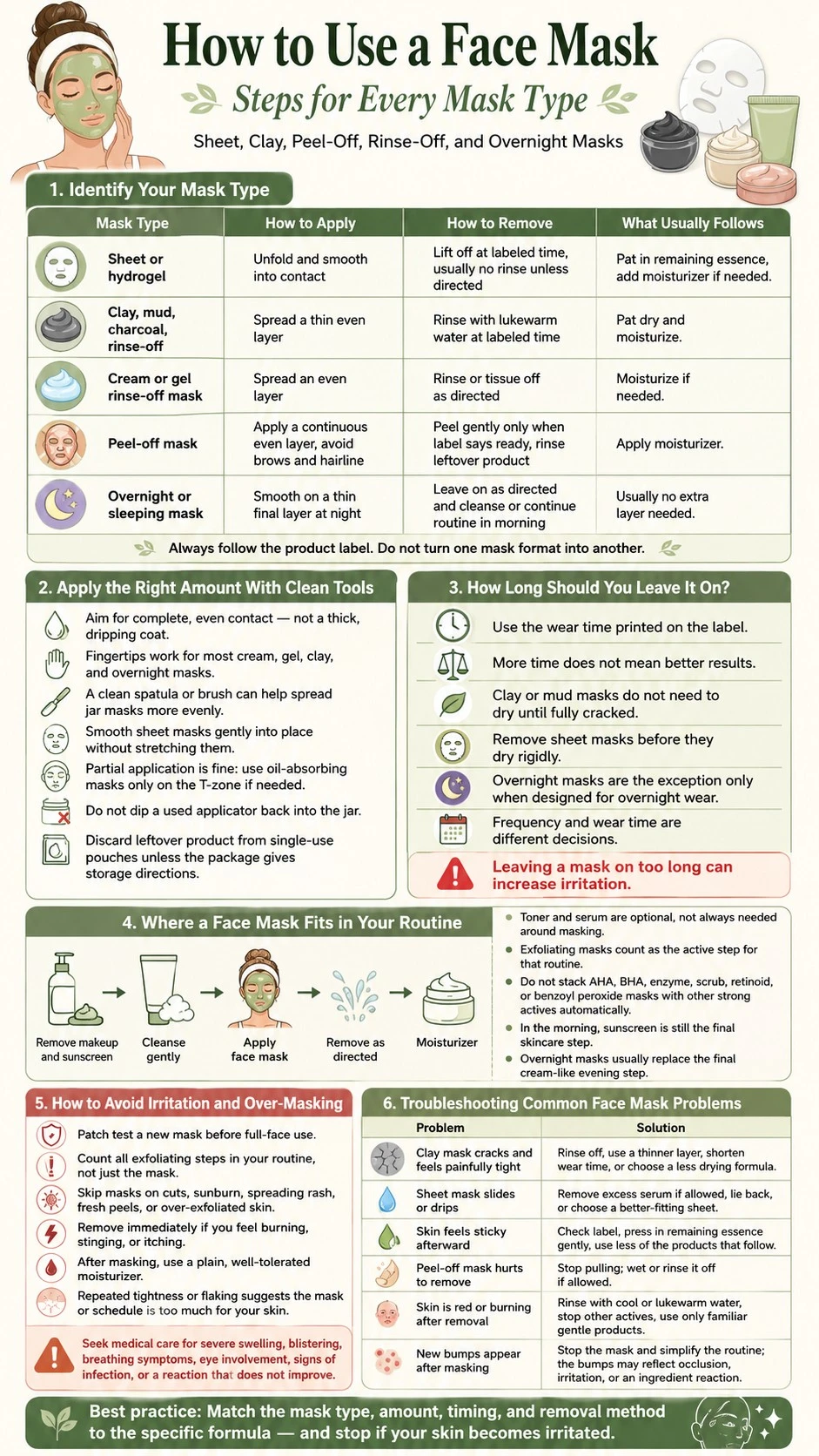
| Mask type | How to apply it | How to remove it | What usually follows |
|---|---|---|---|
| Sheet or hydrogel | Unfold and align the openings, then smooth the material into contact without stretching it | Lift it off at the labeled time; do not rinse unless directed | Pat in remaining serum gently, then add moisturizer if needed |
| Clay, mud, charcoal, or other rinse-off mask | Spread a thin, even layer over the intended area without scrubbing | Rinse with lukewarm water at the labeled time, before the layer becomes uncomfortably tight | Pat dry and apply moisturizer |
| Cream or gel rinse-off mask | Spread an even layer without repeatedly massaging it into the skin | Rinse or tissue off exactly as directed | Apply moisturizer if the product does not already serve that role |
| Peel-off mask | Create a continuous, even layer and keep it away from brows, hairline, lips, and delicate eye skin | Peel gently only when the label says it is ready; rinse away leftover product instead of picking | Apply moisturizer and avoid immediate exfoliation |
| Overnight or sleeping mask | Smooth on a thin layer as the final evening product unless directed otherwise | Leave it on only because the formula is designed for overnight wear; cleanse or continue as directed in the morning | No additional layer is usually needed unless the label says so |
Do not turn one format into another. A rinse-off mask is not safer or more effective when slept in, and an ordinary serum-soaked sheet is not designed to dry hard against the face. The product name, active ingredients, and directions together determine how it should be used.
Apply the Right Amount With Clean Tools
A thicker layer rarely creates a proportionally stronger result. The useful target is complete, even contact with the intended area—not a coat so heavy that it drips, cracks, or takes much longer than directed to set.
- Fingertips: Clean fingertips are the simplest tool for most cream, gel, clay, and overnight masks. Dot the product across the area, then spread gently without rubbing as if it were a scrub.
- Spatula or brush: A clean applicator can make a jar formula easier to distribute and helps limit repeated finger contact with the container. Wash and dry the tool after every use; a cosmetic brush with dried product in it is not a hygienic shortcut.
- Sheet or hydrogel: Start at the forehead or around the eye and nose openings, then smooth outward. Small folds and uncovered edges are normal. Do not pull the material tightly or patch gaps with serum from a different product.
- Partial application: A mask does not have to cover the whole face. Applying an oil-absorbing formula only to a shiny T-zone, for example, may be more comfortable than putting it on dry cheeks. Keep different products from overlapping if you multi-mask.
Avoid returning an applicator to a jar after it has touched your face. If the mask comes in a single-use pouch, discard the leftover product unless the manufacturer explicitly provides storage directions; contact with hands and air may compromise it.
How Long Should You Leave a Face Mask On?
There is no accurate universal wear time for every mask. Use the time printed on the label and set a timer rather than judging only by how the surface looks. Dermatologists warn that leaving a mask on longer than intended can cause irritation, and using it too often can create the same problem.[1]
For a clay or mud mask, “completely dry and cracked” is not a required finish. Remove it at the instructed time or sooner if it becomes uncomfortable. With a sheet mask, remove it before it dries rigidly against the skin; drying does not prove that every useful ingredient has transferred. An overnight mask is the exception only because its formula and directions are designed for extended contact.
Frequency is a separate decision from wear time. Do not repeat a ten-minute mask daily simply because each individual session is short. Follow the label, consider the active ingredients in the rest of your routine, and use the guide to how often you should use a face mask to set a schedule by mask type and skin response.
Where a Face Mask Fits in Your Skincare Routine
Most masks go on after makeup, sunscreen, and cleanser have been removed. Gentle cleansing gives the mask clean contact with the skin without adding the friction or residue of an aggressive scrub. Dermatologists recommend using a mild cleanser, lukewarm water, and fingertips rather than scrubbing.[4]
In a simple routine, the order is cleanser → face mask → moisturizer. Toner and serum are optional, and using them both before and after a mask usually adds complexity without a clear benefit. Apply a leave-on treatment only when its directions are compatible with the mask. The broader skincare routine order guide can help when several products compete for the same spot.
Treat an exfoliating mask as the active step for that routine. Do not automatically pair an AHA, BHA, enzyme, scrub, retinoid, or benzoyl peroxide mask with another strong exfoliant or drying treatment. In the morning, sunscreen remains the final skincare step; a mask does not provide sun protection unless it is separately labeled and used as sunscreen.
After a rinse-off mask, pat the skin dry instead of rubbing it with a towel, then moisturize. After a sheet mask, follow the label on whether to leave or rinse the remaining essence; if it stays on, press it in lightly and apply moisturizer if your skin needs it. An overnight mask normally replaces the final cream-like step rather than sitting underneath several more layers.
How to Avoid Irritation and Over-Masking

The same occlusion that makes a mask feel intensive can make an unsuitable formula harder to tolerate. A mask may also duplicate acids, retinoids, fragrance, or other ingredients already present in the routine.
- Patch test a new mask. For a wash-off cosmetic, apply the normal amount to a small test area and leave it on for the labeled duration, then repeat according to dermatology patch-testing guidance before full-face use. The full skincare patch test method explains the seven-to-ten-day process.[2]
- Count every exfoliating step. Retinoids, benzoyl peroxide, exfoliating cleansers, scrubs, and leave-on acids can make extra exfoliation more irritating.[3] If the mask contains acids or enzymes, include it when deciding how often to exfoliate your face.
- Skip compromised skin. Do not apply an ordinary cosmetic mask over cuts, sunburn, a fresh peel, a spreading rash, or skin that already burns with water. If you suspect over-exfoliated skin, pause optional active products instead of trying to mask the discomfort.
- Respond to warning signs. Mild cooling from a gel is different from escalating burning, itching, swelling, hives, or persistent redness. Remove the mask immediately when it stings or burns; continuing to the timer is not a tolerance test.[1]
- Protect the barrier afterward. Use a plain, well-tolerated moisturizer and avoid rubbing or another exfoliating step. Tightness and visible flaking after every use suggest that the mask or schedule is working against your skin barrier.
Seek medical care for severe swelling, blistering, breathing symptoms, eye involvement, signs of infection, or a reaction that does not improve after the product is removed. Persistent acne, eczema, rosacea, or dermatitis also deserves appropriate evaluation; a cosmetic mask should not replace treatment.
Troubleshooting Common Face Mask Problems
- The clay mask cracks and feels painfully tight: Rinse it off. Next time, use a thinner layer, shorten the session within the label directions, or choose a less drying formula. Cracking is not a performance target.
- A sheet mask slides or drips: Remove excess serum only if the directions allow, lie back, or choose a better-fitting sheet. Do not leave it on longer merely because it has not stayed in place.
- The face feels sticky afterward: Check whether the remaining essence should be left on. If it should, press it in rather than rubbing, use less of the products that follow, or rinse if the label offers that option. Stickiness is a finish issue, not proof that the mask failed.
- A peel-off mask hurts to remove: Stop pulling. Wet or rinse the product away if the label permits, especially around fine hair or delicate areas. Do not use force, tweezers, or another exfoliant to remove stubborn fragments.
- Skin is red or burning after removal: Rinse with cool or lukewarm water, stop other active products, and use only familiar gentle products. Do not immediately retry the mask for a shorter time if the reaction was significant.
- New bumps appear after masking: Stop the mask and simplify the routine long enough to observe the pattern. Bumps may reflect occlusion, irritation, an ingredient reaction, or an unrelated acne flare; repeatedly using the product is unlikely to “purge” unsuitable skin.
FAQs About Using a Face Mask
Should you use a face mask before or after a shower?
Use it when your face is clean, which may be after a shower if you have just removed makeup, sunscreen, sweat, and cleanser. A warm shower can make cleansing convenient, but you do not need hot water or steam to “open” pores. Pat the face as the mask directions require before applying it. Do not wear a mask in the shower unless the label is designed for that use.
Can you use two face masks in one routine?
You can sometimes use different masks on separate areas, such as clay on an oily T-zone and a hydrating formula on dry cheeks. Avoid overlapping them, and do not stack two full-face exfoliating or strongly active masks. Using more products in one session increases complexity and can increase irritation without improving the result.
Can you use a face mask in the morning?
Yes, if the formula is appropriate and you have time to remove or finish it as directed. A hydrating mask may leave a smoother cosmetic surface, but heavy residue can pill under makeup or sunscreen. Complete the routine with broad-spectrum sunscreen; morning use does not change the mask’s labeled wear time.
Sources
[1] American Academy of Dermatology Association. Do facial masks work, and should I add one to my skin care routine?
[2] American Academy of Dermatology Association. How to test skin care products
[3] American Academy of Dermatology Association. How to safely exfoliate at home
[4] American Academy of Dermatology Association. Face washing 101


