
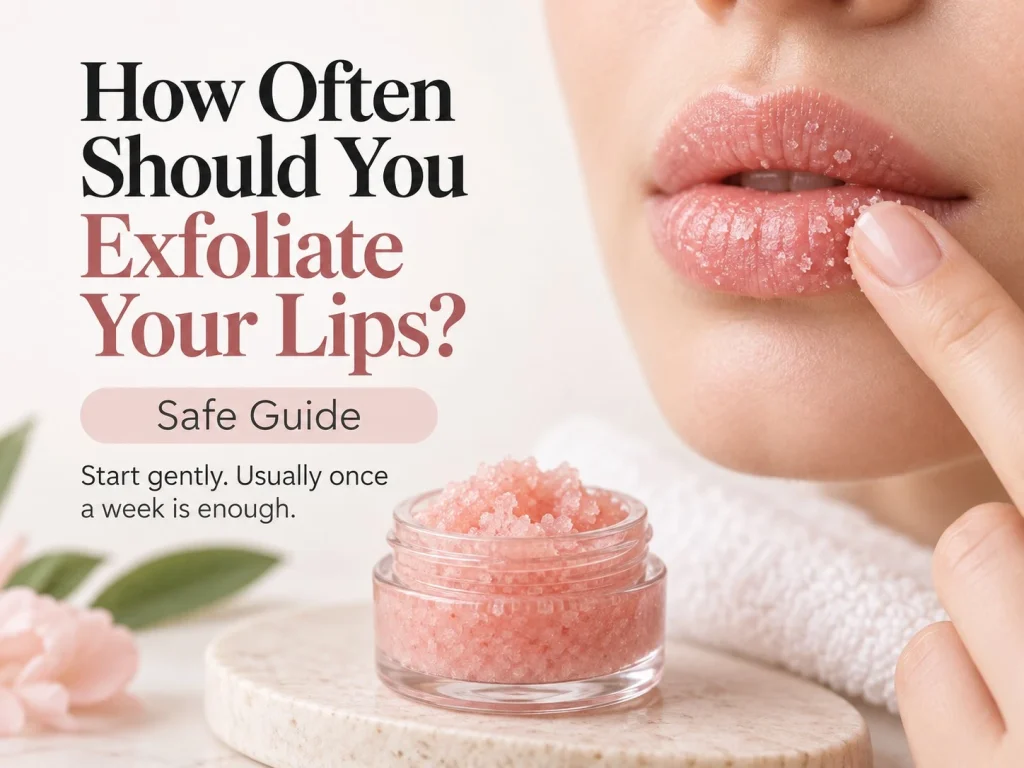

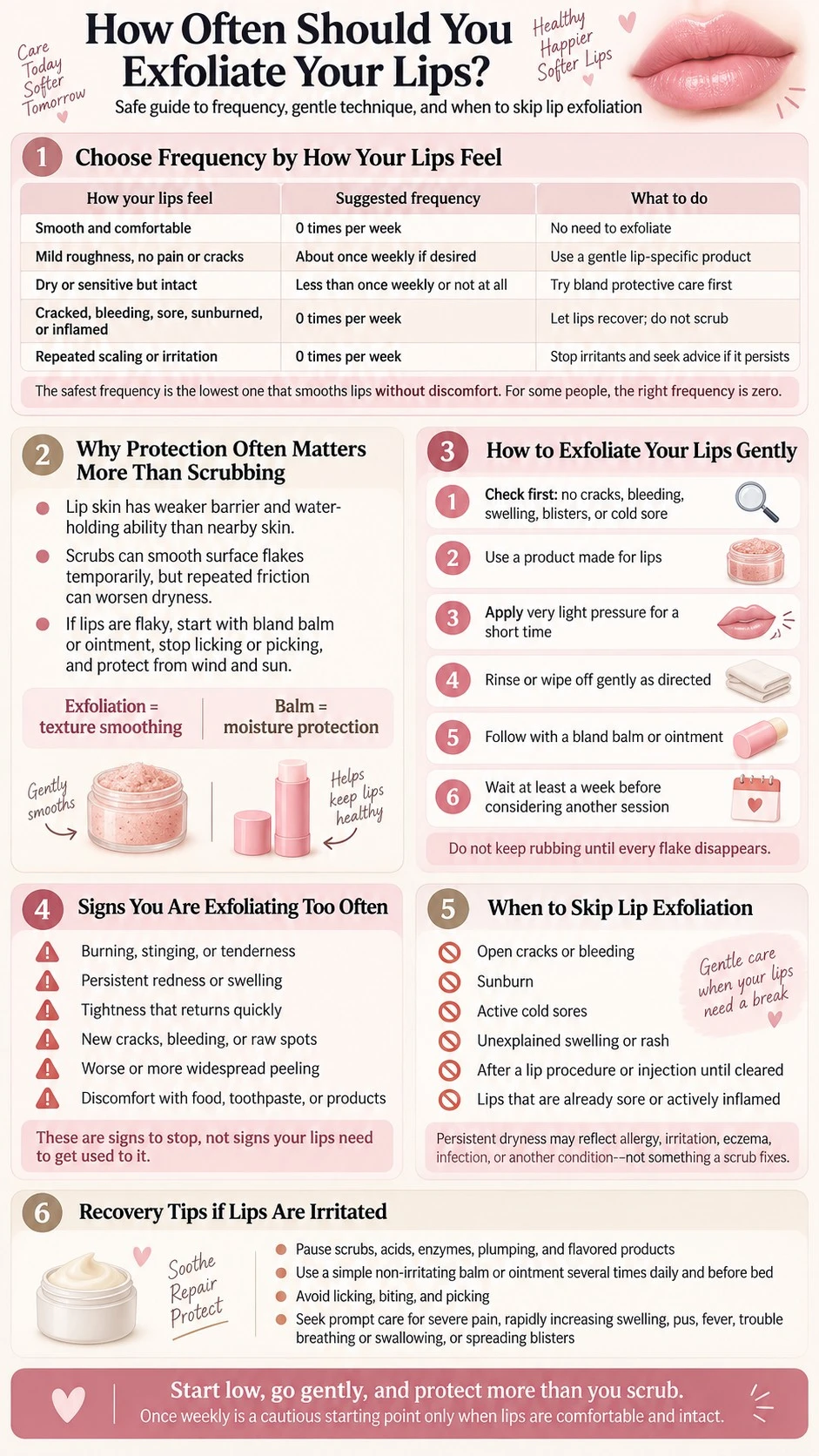
A calendar alone cannot tell you whether another exfoliation session is safe. Lip exfoliation can temporarily loosen dry surface flakes, but it is optional cosmetic care, not a cure for chapped lips. The safest frequency is the lowest one that gives a smoother feel without discomfort. Once weekly is a cautious starting point if you choose to exfoliate; for some people, the right frequency is zero.
Choose Lip Exfoliation Frequency by How Your Lips Feel
Your current lip condition matters more than whether seven days have passed. There is no well-established clinical schedule that everyone needs to follow, and the directions for a purpose-made product take priority over a general rule.
| Current lip condition | Practical starting frequency | Best decision |
|---|---|---|
| Smooth and comfortable | 0 times per week | Do not exfoliate just to maintain a routine |
| Mild roughness without pain or cracks | Once weekly if desired | Use a gentle lip-specific product and reassess the next day |
| Dry or sensitive but intact | Less than once weekly or not at all | Try bland protective care first |
| Cracked, bleeding, sore, swollen, sunburned, or actively inflamed | 0 times per week | Let the lips recover; do not scrub or peel |
| Repeated scaling or irritation around the mouth | 0 times per week | Stop possible irritants and seek advice if it persists |
Do not add extra sessions simply because flakes return. Recurring flakes often mean the protective surface is still being disrupted by weather, licking, picking, irritating products, or another cause. A scrub removes what you can see; it does not correct the reason the lips keep becoming dry.
The type of product also changes the decision. A rinse-off lip scrub creates friction, while an acid- or enzyme-containing product exfoliates through its formula. Do not stack the two methods in one session, and do not apply a facial peel or retinoid to the lips unless the product specifically says it is intended for that area.
Why Dry, Flaky Lips Usually Need Protection, Not More Scrubbing
The visible lip surface has weaker water-holding and barrier properties than nearby skin, which helps explain why it becomes rough or chapped easily.[1] Removing loose surface cells can make lips feel smoother for a short time, but repeated friction can also remove protection from an already vulnerable surface.
That distinction matters: exfoliation addresses texture, while balm addresses water loss and surface protection. If you are deciding between the two jobs, the guide to lip scrub vs lip balm explains why they are not substitutes.
Manual lip scrubs can be irritating by design and may worsen dryness by compromising the protective surface.[2] Dry flakes are therefore not an automatic signal to scrub. First stop licking, biting, or picking; apply a non-irritating balm or ointment; and protect the lips from wind and sun. Fragrance, flavor, menthol, camphor, phenol, eucalyptus, and salicylic acid can bother already-chapped lips, while petrolatum and other bland protective ingredients can support healing.[3]
How to Exfoliate Your Lips Gently
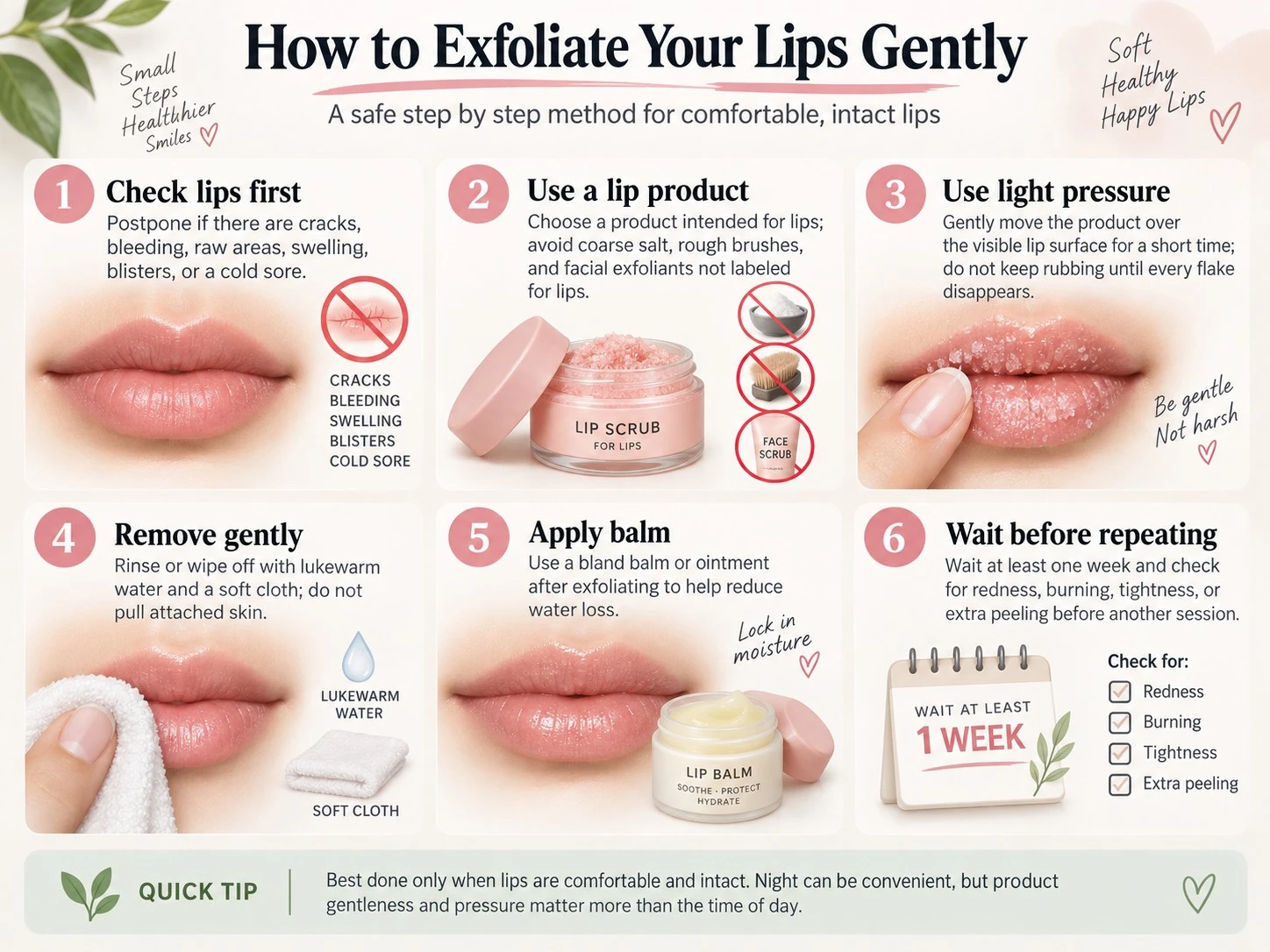
Use this method only when the lips are comfortable, intact, and free of active irritation. The product directions still control contact time and frequency.
- Check the lips first. Postpone the session if you see cracks, bleeding, raw areas, swelling, blisters, or a cold sore.
- Use a product intended for lips. Avoid coarse salt, rough brushes, and facial exfoliants that are not labeled for lip use.
- Apply light pressure for a short time. With clean hands, move the product gently over the visible lip surface. Do not keep rubbing until every flake disappears.
- Remove it as directed. Rinse or wipe gently with lukewarm water and a soft cloth. Do not pull attached skin.
- Apply a bland balm or ointment. A protective layer reduces water loss after the surface has been disturbed. The article on how lip balm works explains this sealing role.
- Reassess before repeating. Wait at least a week and check for delayed redness, burning, tightness, or extra peeling before considering another session.
Night can be a convenient time because you can follow with a simple balm and avoid food, drinks, and lipstick for several hours. Timing does not make a harsh product safe, however. Pressure, formula, current lip condition, and frequency matter more than the clock.
Signs You Are Exfoliating Your Lips Too Often
Over-exfoliation usually shows up as more sensitivity, not better smoothness. Stop exfoliating if you notice:
- burning, stinging, or tenderness;
- persistent redness or swelling;
- tightness that returns quickly after balm;
- new cracks, bleeding, or raw-looking spots;
- peeling that is worse or more widespread;
- discomfort with food, toothpaste, or products that were previously comfortable.
Pause scrubs, acids, enzymes, plumping products, flavored products, and any balm that stings. Use a simple, non-irritating balm or ointment several times a day and before bed. Avoid licking, biting, and picking because those habits delay recovery.[3] A plain moisturizing lip mask can provide a longer-lasting protective layer, but skip exfoliating or plumping masks while the lips are irritated.
Do not test the barrier by exfoliating again as soon as the visible flakes lift. Wait until the lips feel normal—no burning, tenderness, cracking, or active peeling—then decide whether exfoliation is still necessary. If you try again, use a gentler product, less pressure, and a lower frequency.
When to Skip Lip Exfoliation
Do not exfoliate over open cracks, bleeding, sunburn, active cold sores, unexplained swelling, or a rash around the mouth. Also pause after a lip procedure or injection until the treating professional says normal lip care can resume. Exfoliation can add friction to tissue that is already injured or inflamed.
Persistent dryness is not always ordinary chapping. Allergic or irritant reactions, eczema, infection, sun damage, medications, and other conditions can cause ongoing scaling or soreness. Chapped lips should generally improve within two to three weeks with non-irritating care; if they do not, professional evaluation can help identify the cause.[4]
Seek prompt care for severe pain, rapidly increasing swelling, pus, fever, trouble breathing or swallowing, or blisters and sores that are spreading. Cosmetic exfoliation is not appropriate for those symptoms.
FAQs About Lip Exfoliation Frequency
Can you exfoliate your lips every day?
No. Daily exfoliation repeatedly disturbs the lip surface and raises the chance of burning, sensitivity, cracking, and worse peeling. If you choose to exfoliate, begin once weekly on comfortable, intact lips and reduce the frequency if any irritation develops.
Should you exfoliate chapped lips?
Usually not. Chapped lips need protection from water loss and irritants more than they need flake removal. Use a bland balm or ointment, stop licking and picking, and wait until the lips are fully comfortable before deciding whether gentle exfoliation is still useful.
Is a toothbrush safe for exfoliating lips?
A toothbrush can create more friction than expected, especially if its bristles are firm or you scrub for too long. It is safer to skip the brush and, if you exfoliate, use a gentle product made for lips with clean fingertips. Do not exfoliate cracked, sore, sunburned, or inflamed lips.
Should you exfoliate your lips before lipstick?
Only if the lips are healthy and mildly rough, and not necessarily immediately before application. A gentle session the night before gives you time to notice irritation and apply balm. If the lips are cracked or peeling, choose a moisturizing lip product instead of scrubbing them smooth.
Sources
[1] Wang Y, et al. Analysis of Clinical Presentations, Lip Transepidermal Water Loss and Associated Factors in Patients with Cheilitis
[2] Cleveland Clinic. Are Lip Balms and Chapsticks Bad for You? And Could They Be Addictive?
[3] American Academy of Dermatology. 7 Dermatologists’ Tips for Healing Dry, Chapped Lips
[4] Cleveland Clinic. Chapped Lips (Cheilitis): Causes, Treatment & Prevention


