


Alpha arbutin and niacinamide can both appear in brightening products, but they intervene at different points in the pigmentation process. That difference is useful: it helps you choose by skin concern rather than by marketing percentages or claims that one ingredient is simply “stronger.”
The finished formula still matters. A gentle serum used consistently can be more useful than a theoretically stronger product that stings, pills, or makes you stop using it. Sun protection and control of the condition causing new marks also affect the result.
How Do Alpha Arbutin and Niacinamide Work?
Alpha arbutin is a glycosylated hydroquinone derivative used in cosmetic formulas for uneven pigmentation. It inhibits tyrosinase, an enzyme required for melanin production. By reducing enzyme activity, it aims to limit the formation of new excess pigment rather than bleaching pigment out of the skin.[1] Alpha arbutin is chemically related to hydroquinone, but it is a distinct cosmetic ingredient and should not be treated as interchangeable with prescription hydroquinone.
Niacinamide, also called nicotinamide, is a form of vitamin B3. In a foundational pigmentation study, it did not directly suppress tyrosinase or melanin production in cultured melanocytes. Instead, it reduced the transfer of melanosomes—the pigment-containing structures—from melanocytes to surrounding skin cells and improved visible hyperpigmentation in clinical testing.[2]
Niacinamide also has broader cosmetic roles. Evidence reviews describe support for barrier lipids, reduced water loss, oil regulation, and improvements in blotchiness and some signs of photoaging, depending on the formula and study.[3] This wider role is the main reason niacinamide can be a better single-product choice even when dark spots are part of the goal.
Alpha Arbutin vs Niacinamide: Detailed Comparison
The central difference is specialization versus range. The table compares the fields that should influence a purchase; it is not a ranking of two standardized products.
| Comparison point | Alpha arbutin | Niacinamide |
|---|---|---|
| Ingredient type | Glycosylated hydroquinone derivative | Form of vitamin B3, also called nicotinamide |
| Main pigment action | Inhibits tyrosinase activity and reduces new melanin formation | Reduces transfer of pigment-containing melanosomes to surrounding skin cells |
| Primary role | Targeted uneven-pigmentation ingredient | Multitasking ingredient for tone, barrier support, oil balance, and visible redness |
| Best starting fit | A routine that already covers hydration and oil control but needs a focused dark-spot step | A beginner or minimalist routine, especially with oily, combination, or acne-prone skin |
| Evidence boundary | Mechanistic and cosmetic evidence is promising, but finished-product and standalone clinical evidence vary | Multiple clinical studies support several uses, but one formula cannot be assumed to deliver every reported benefit |
| Typical tolerability | Often well tolerated, but irritation, dryness, or allergy can occur | Often well tolerated at moderate levels; high-strength or layered products can sting or irritate some skin |
| Concentration context | EU safety assessment supports up to 2% in face creams under specified conditions | Studies commonly evaluate lower single-digit percentages; a 10% label is not automatically more effective |
| Routine flexibility | Usually easy to pair with hydrating products and niacinamide | Common in serums and moisturizers and often easier to use as the main multitasker in a routine |
| Best overall judgment | More targeted, not proven universally stronger | More versatile, not necessarily the strongest dedicated pigment option |
For alpha arbutin, the 2% figure is a safety conclusion for specified facial cosmetic use, not a promise that 2% works better than every lower level or finished formula.[4] For niacinamide, higher percentages can add irritation without proving a better result for every person. Compare the complete ingredient list, texture, directions, and your tolerance rather than choosing the largest number.
How to Choose Between Alpha Arbutin and Niacinamide
Use the skin concern that sits beside the dark spots as the tiebreaker:
- Choose alpha arbutin if flat areas of excess pigment are the main concern and the rest of your routine already feels balanced.
- Choose niacinamide if uneven tone comes with excess oil, visible redness, a weakened-feeling barrier, or a need for one multipurpose serum or moisturizer.
- Choose either one cautiously if your skin is dry or sensitive. Formula simplicity and concentration matter more than the ingredient name alone.
- Choose neither temporarily if the skin is burning, peeling, sunburned, or inflamed. Preventing more irritation takes priority because inflammation can create or deepen dark marks.
Neither ingredient removes indented or raised acne scars. They are relevant to flat post-acne discoloration. If you are unsure which type of mark you have, compare acne scars and dark spots before buying another brightening serum.
For melasma or widespread, recurrent pigmentation, do not expect either cosmetic ingredient to act as a complete treatment plan. The cause, depth, ultraviolet and visible-light exposure, hormones, heat, and irritation can all affect pigment behavior. A dermatologist can confirm the diagnosis and discuss prescription or procedure options when needed.
Can You Use Alpha Arbutin and Niacinamide Together?
Yes. Alpha arbutin and niacinamide can be used in the same routine, and some finished products contain both. Their different pigment actions make the pairing conceptually reasonable, but that does not prove two separate serums will outperform one suitable product.
The simplest options are:
- use one professionally formulated product that contains both ingredients;
- use alpha arbutin for a focused pigment step and niacinamide in a moisturizer;
- introduce one product first, then add the second only if the first is comfortable and the extra benefit is relevant.
Do not add both on the same day as several other new actives. If a routine already includes retinoids, exfoliating acids, benzoyl peroxide, or strong vitamin C, adding products one at a time makes the source of irritation easier to identify. The guide to using niacinamide and retinol together explains how to simplify that specific pairing.
How to Use Alpha Arbutin or Niacinamide in Your Routine
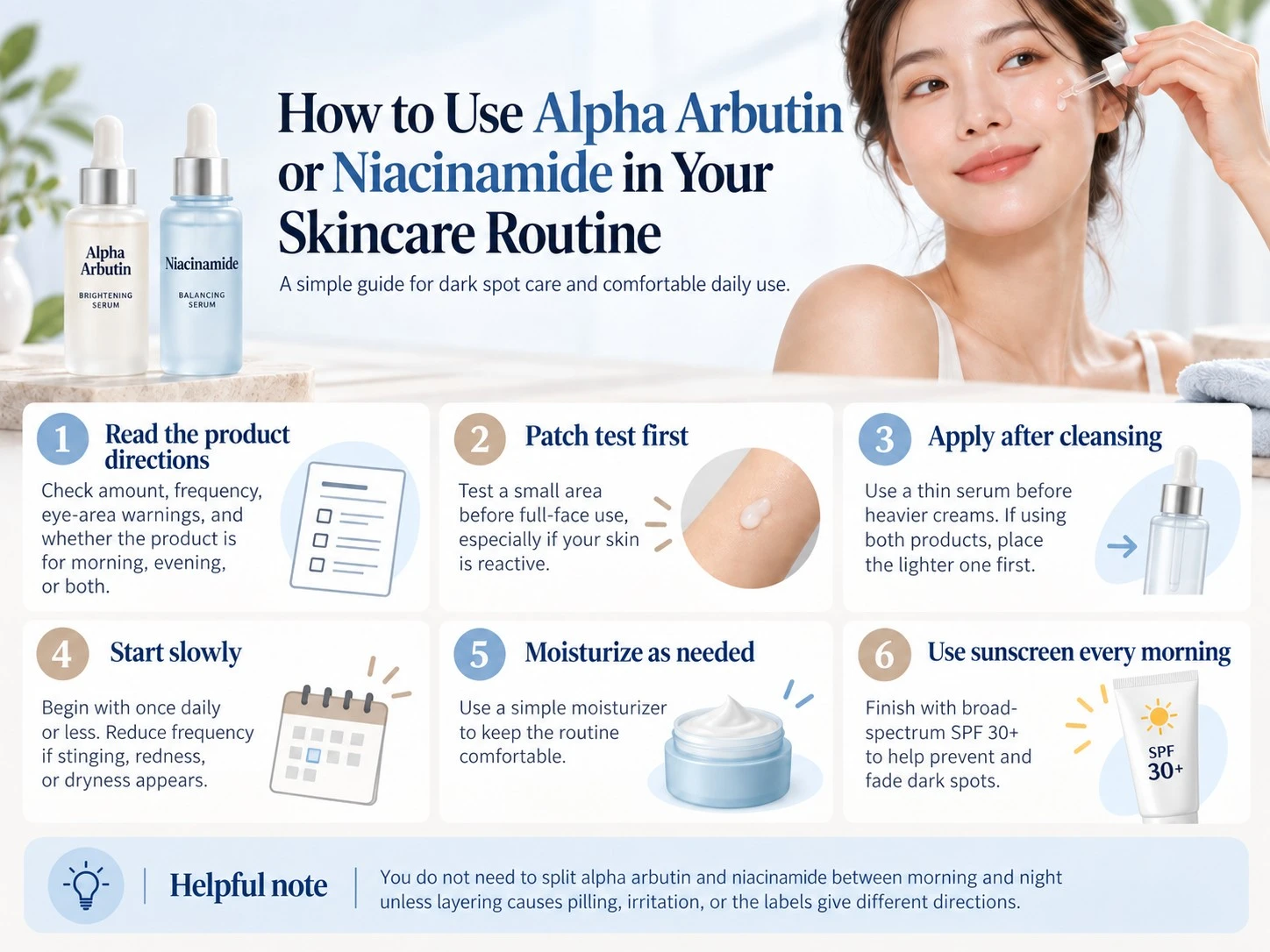
- Read the finished-product directions. Check the recommended amount, frequency, eye-area warning, and whether the formula is intended for morning, evening, or either.
- Patch test first. Test a small area before using the product across the face, especially if your skin is reactive or the formula contains several actives.
- Apply after cleansing. Use a thin serum before heavier creams. If both products have similar textures, use the one that absorbs more easily first; ingredient names do not create a universal order.
- Start with one daily application or less. Follow the label and reduce frequency if you develop stinging, redness, or dryness. Do not force twice-daily use to chase faster fading.
- Apply moisturizer as needed. A simple moisturizer can reduce dryness and help keep the routine tolerable.
- Use sun protection every morning. Broad-spectrum SPF 30 or higher is essential when trying to prevent and fade dark spots. Tinted sunscreen with iron oxides can add visible-light protection, which is especially relevant to pigmentation in deeper skin tones.[5]
If you use separate alpha arbutin and niacinamide products, they do not need to be split between morning and night solely because of the ingredient pair. Separate them if layering causes pilling, the combined routine feels irritating, or the individual labels give different directions.
What Results Can You Expect?
Expect gradual change, not overnight fading. Clinical testing found that a niacinamide formula reduced visible hyperpigmentation after four weeks, but that result belongs to the tested formulation and does not set a deadline for every product.[2] Alpha arbutin has a clear pigment-related mechanism, yet the clinical evidence for standalone finished products is less uniform than marketing often implies.[1]
Judge progress over at least several skin-renewal cycles while following the label, controlling acne or irritation, and using sunscreen consistently. Take photos in the same lighting every few weeks. A lack of quick change does not mean the answer is to double the amount or stack more actives.
The type and depth of discoloration matter. Superficial post-inflammatory marks may respond differently from melasma or deeper blue-gray pigmentation. New, changing, bleeding, raised, itchy, or otherwise unusual spots should be evaluated rather than treated as routine hyperpigmentation.
Side Effects and When to Stop
Either ingredient can cause burning, itching, redness, dryness, or a rash, although many people tolerate both. High-strength or complex niacinamide formulas can sting or irritate some skin. Alpha arbutin products may contain other brightening or exfoliating ingredients that drive the reaction, so judge the complete formula rather than blaming one featured ingredient automatically.
Stop the new product and simplify the routine if discomfort persists after application or the skin becomes increasingly red, tight, scaly, or swollen. Seek medical care for blistering, marked swelling, severe pain, trouble breathing, or a widespread reaction.
Dark spots often worsen when the skin is repeatedly irritated. Effective care begins by controlling the cause of new marks and using products that do not keep triggering inflammation.[5] The broader guide to hyperpigmentation can help distinguish common types and treatment limits.
FAQs About Alpha Arbutin and Niacinamide
Which is better for acne marks?
For flat brown or gray post-acne marks, either ingredient can fit. Niacinamide is often the more useful first choice when breakouts, oiliness, or redness are still active. Alpha arbutin is a focused option once the acne routine is stable. Neither ingredient repairs indented or raised scars.
Which is better for sensitive skin?
Neither is automatically best for every sensitive skin type. A moderate-strength, fragrance-free niacinamide product may provide broad support, while a simple alpha arbutin formula may suit someone who wants only a pigment step. Patch test, avoid introducing several actives together, and stop if the product stings persistently.
Can you use alpha arbutin and niacinamide every day?
Yes, if the finished products permit daily use and your skin remains comfortable. Start with one product and a conservative frequency. Daily use is not a requirement if less frequent application works better for your skin.
Which goes first, alpha arbutin or niacinamide?
Apply by product texture, not by ingredient name. After cleansing, use the thinner or faster-absorbing serum first, then the thicker serum or moisturizer. If both are similar, use a combined formula or apply them in either comfortable order; do not keep rubbing layers that pill.
Sources
[1] Boo YC. Arbutin as a Skin Depigmenting Agent with Antimelanogenic and Antioxidant Properties
[2] Hakozaki T, et al. The Effect of Niacinamide on Reducing Cutaneous Pigmentation and Suppression of Melanosome Transfer
[3] Boo YC. Mechanistic Insights into the Multiple Functions of Niacinamide and Its Therapeutic Implications
[4] Scientific Committee on Consumer Safety. Safety of Alpha-Arbutin and Beta-Arbutin in Cosmetic Products
[5] American Academy of Dermatology. How to Fade Dark Spots in Darker Skin Tones


