

Microbiological testing is one part of a cosmetic quality system, but it answers several different questions. A finished-product count can show whether the sample tested meets an agreed microbial limit. It does not, by itself, prove that the preservative system will control contamination throughout consumer use or that the manufacturing process is consistently hygienic.
For a private-label brand, the practical goal is not to request “a micro test.” It is to create a controlled specification that links the product’s risk profile to validated methods, clear limits, batch-release rules, and usable records. This guide explains how to build that specification without treating one standard or one certificate as a universal answer.
What Does Cosmetic Microbiological Testing Measure?
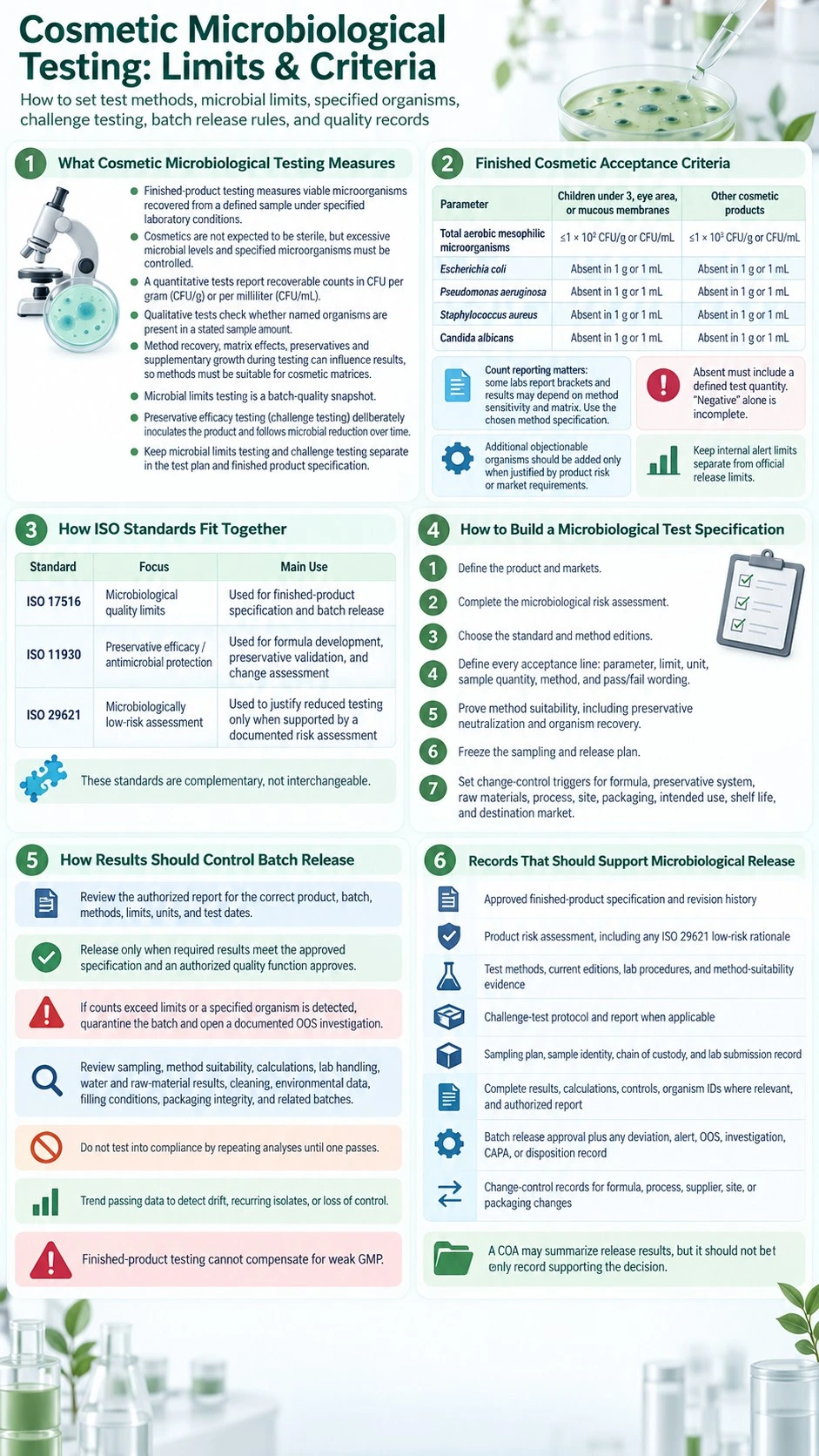
Routine finished-product testing measures the viable microorganisms recovered from a defined sample under specified laboratory conditions. Under ISO 17516, cosmetics are not expected to be sterile, but excessive microbial levels and specified microorganisms that could affect product quality or consumer safety must be controlled.[1]
The test package normally has two parts. A quantitative test estimates the recoverable microbial population, reported as colony-forming units per gram or milliliter. A qualitative test checks whether named organisms are detected in a stated amount of product. ISO 21149 covers aerobic mesophilic bacteria.[5] ISO 16212 covers yeasts and molds.[6]
The laboratory result is only as reliable as the method’s recovery. A preservative can continue killing microorganisms after the sample enters the test system, producing an artificially low result. The method therefore needs suitable dilution, filtration, or neutralization and evidence that microorganisms can be recovered from that specific product matrix.[2]
Microbial limits testing is a batch-quality snapshot. Preservative efficacy testing, often called a challenge test, deliberately inoculates a product and follows microbial reduction or control over time. ISO 11930 uses challenge-test data, a microbiological risk assessment, or both to evaluate the overall antimicrobial protection of a product that is not considered low risk.[3] Brands should keep these results separate in their test plan and finished cosmetic product specification.
Which Microbiological Acceptance Criteria Should a Finished Cosmetic Meet?
ISO 17516 is widely used to assess the microbiological quality of cosmetics.[1] The SCCS guidance reproduces two product categories and their quantitative and qualitative limits.[2] The table below is a useful starting point, not a substitute for confirming the adopted standard edition, target-market rules, product classification, and customer requirements.
| Acceptance item | Products for children under 3, the eye area, or mucous membranes | Other cosmetic products |
|---|---|---|
| Total aerobic mesophilic microorganisms, including bacteria plus yeast and mold | ≤1 × 10² CFU/g or CFU/mL | ≤1 × 10³ CFU/g or CFU/mL |
| Escherichia coli | Absent in 1 g or 1 mL | Absent in 1 g or 1 mL |
| Pseudomonas aeruginosa | Absent in 1 g or 1 mL | Absent in 1 g or 1 mL |
| Staphylococcus aureus | Absent in 1 g or 1 mL | Absent in 1 g or 1 mL |
| Candida albicans | Absent in 1 g or 1 mL | Absent in 1 g or 1 mL |
The wording of the count criterion matters. The SCCS table describes total aerobic mesophilic microorganisms as bacteria plus yeast and mold. Some laboratory reports instead display separate bacterial and yeast/mold results. A brand should not mix terminology or limits from different standards without documenting how the laboratory’s reported fields demonstrate compliance with the chosen specification. The same SCCS table also gives interpretation thresholds of more than 200 CFU/g or mL and more than 2,000 CFU/g or mL because plate counts vary; these are interpretation rules, not permission to rewrite the nominal limits.[2]
“Absent” also needs a defined test quantity. An entry that says only “negative” is incomplete because it does not state the amount examined. The specification should identify the organism, required outcome, quantity tested, and method.
These four organisms are not a universal list of every microorganism that could be objectionable. ISO 18415 notes that specified organisms may differ with national practice or regulation.[7] Formula composition, application site, target users, packaging, manufacturing history, and destination market can justify an additional risk-based organism requirement. Add it because the risk assessment supports it, not because a longer panel looks more rigorous.
Internal alert limits may be tighter than release limits so a manufacturer can investigate drift before a batch fails. Keep the two levels distinct: an alert triggers review, while the approved acceptance criterion determines conformance unless the quality agreement states otherwise.
How Do ISO 17516, ISO 11930, and ISO 29621 Fit Together?
The three standards answer different questions. Treating them as interchangeable creates gaps in development and batch release.
| Standard | Primary question | Typical decision point |
|---|---|---|
| ISO 17516 | Does the cosmetic meet defined microbiological quality limits? | Finished-product specification and batch release |
| ISO 11930 | Does the product have adequate antimicrobial protection? | Formula development, preservation validation, and change assessment |
| ISO 29621 | Can the product be justified as microbiologically low risk? | Risk-based decision on whether some routine or challenge testing is unnecessary |
ISO 29621 covers risk assessment and identification of products such as some low-water-activity, hydroalcoholic, or extreme-pH formulas that may present low microbiological risk.[4] A product is not low risk merely because it is called an oil, balm, powder, or alcohol product. The written assessment should evaluate the actual formula, available water, manufacturing process, packaging, intended use, and foreseeable contamination.
A low-risk conclusion is therefore a documented technical decision, not a shortcut taken after production. It should identify the evidence used, the tests omitted or reduced, the conditions under which the conclusion remains valid, and the changes that require reassessment.
How Should a Brand Build a Microbiological Test Specification?
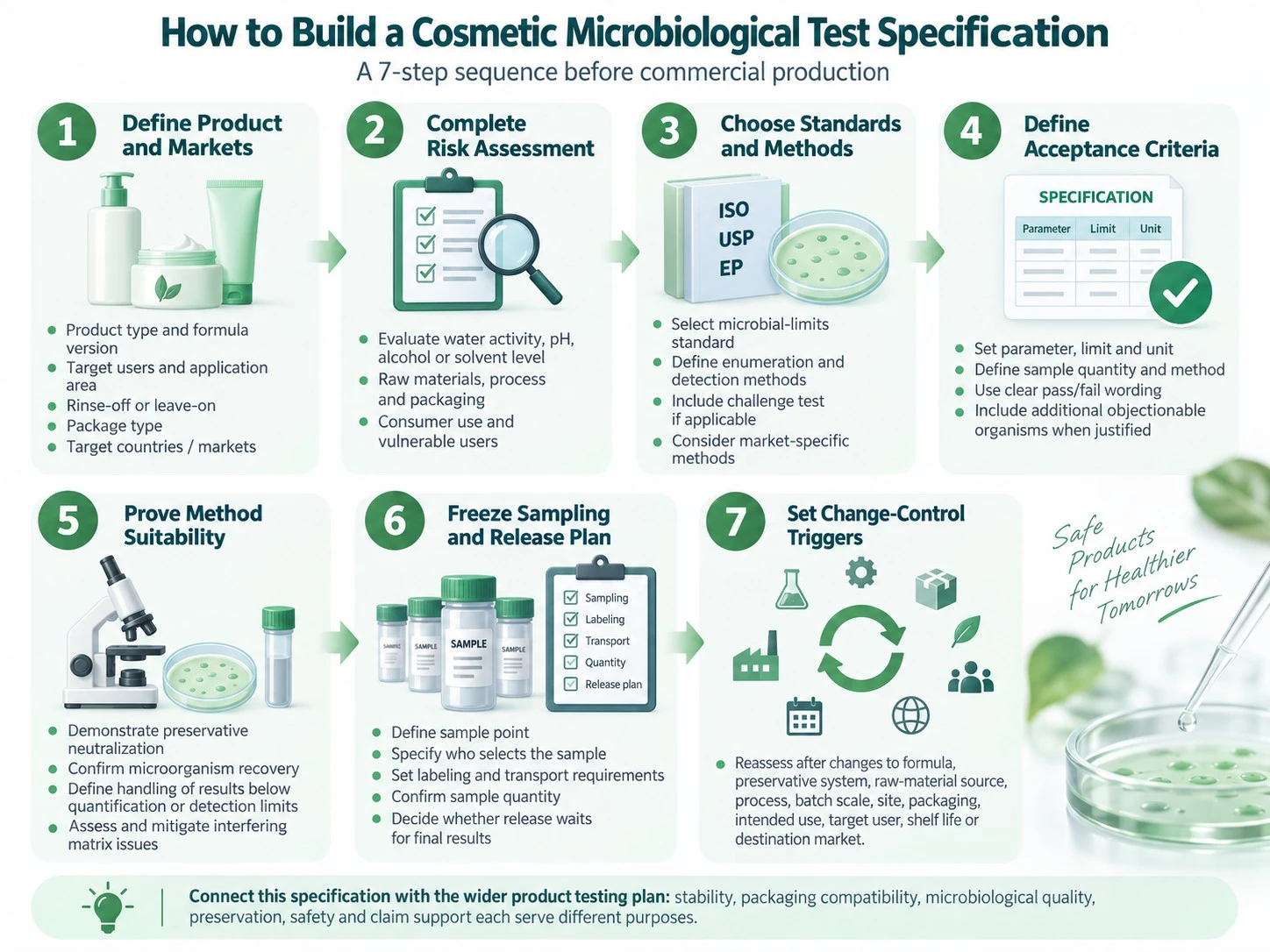
Use the following sequence before commercial production. It prevents the test panel, acceptance table, and quality agreement from contradicting one another.
- Define the product and markets. Record the product type, formula version, intended users, application area, rinse-off or leave-on use, primary package, target countries, and whether the product also falls under drug or other special-category rules.
- Complete the microbiological risk assessment. Evaluate water activity, pH, alcohol or solvent level, nutrient-rich raw materials, manufacturing process, filling exposure, dispensing design, consumer contact, use period, and vulnerable users. Document any low-risk conclusion against an appropriate framework such as ISO 29621.[4]
- Choose the standard and method editions. Name the microbial-limits standard, enumeration and detection methods, challenge-test method when applicable, and any market-specific or customer method. Do not write only “ISO compliant”; a contract needs traceable references.
- Define every acceptance line. State the parameter, limit, unit, sample quantity, method, and pass/fail wording. Clarify how separate laboratory count fields map to any combined criterion. Define additional objectionable organisms only when the product risk or market justifies them.
- Prove method suitability. Confirm that the product’s antimicrobial properties are neutralized and that recovery is demonstrated for the matrix. Agree in advance how results below the method’s quantification or detection limit, confluent growth, or an interfering product matrix will be reported and investigated.
- Freeze the sampling and release plan. Identify whether the sample comes from bulk, start/middle/end of filling, or finished packaged units; who selects it; how it is labeled and transported; what quantity the laboratory receives; and whether release waits for final results. A sampling plan should represent the batch without implying that one sample proves every unit is identical.
- Set change-control triggers. Reassess the plan after changes to formula, preservative system, raw-material source, process, batch scale, manufacturing site, primary packaging, intended use, target user, shelf life, or destination market.
This specification should connect with the broader skincare product testing plan. Stability, packaging compatibility, microbiological quality, preservation, safety, and claim support have different purposes even when they share the same commercial sample.
How Should Microbiological Results Control Batch Release?
A batch should be released only when the required results meet the approved specification and an authorized quality function has completed its review. The report should match the correct product, formula or item code, batch number, sample description, methods, limits, units, test dates, and laboratory authorization.
If a specified organism is detected or a count exceeds the release criterion, quarantine the affected batch and open a documented out-of-specification investigation. Review sampling, method suitability, controls, calculations, laboratory handling, manufacturing records, water and raw-material results, cleaning records, environmental information, filling conditions, packaging integrity, and results from related batches. FDA guidance identifies contaminated water or raw materials, poor manufacturing conditions, ineffective preservation, unsuitable packaging, and shipping, storage, or consumer use as possible routes of contamination.[8]
Do not “test into compliance” by repeating the analysis until a passing result appears. A retest should follow a preapproved procedure and a scientifically justified investigation. The original result remains part of the record. If a confirmed failure shows a product may be unsafe or contaminated, the disposition and any market action should be decided by qualified quality and regulatory personnel.
Trend results even when every batch passes. Rising counts, recurring low-level isolates, repeated method problems, or differences by filling point can reveal loss of process control earlier than a formal failure. An internal alert limit or trend rule can support investigation without quietly replacing the contractual release limit.
Finished-product testing cannot compensate for weak GMP. FDA’s cosmetics inspection guidance addresses sanitary facilities and equipment, controlled raw materials, appropriate in-process and finished-product sampling, and testing for hazardous microorganisms as parts of manufacturing control.[9]
What Records Should Support Microbiological Release?
A usable microbiological file should let the brand and manufacturer reconstruct what was tested, why it was acceptable, and who released it. Include or reference:
- The approved finished-product specification and its revision history.
- The product risk assessment, including any ISO 29621 low-risk rationale.
- Test methods, current editions, laboratory procedures, and method-suitability evidence.
- Challenge-test protocol and report when applicable.
- Sampling plan, sample identity, chain of custody, and laboratory submission record.
- Complete results, calculations, controls, organism identifications where relevant, and authorized report.
- Batch release approval plus any deviation, alert, OOS, investigation, corrective action, or disposition record.
- Change-control records showing whether formula, process, supplier, site, or packaging changes require retesting.
The certificate of analysis may summarize release results, but it should not be the only record supporting the decision. Brands should agree which documents they receive and which controlled records the manufacturer retains and can provide during an investigation. A wider manufacturer document package should connect test reports with specifications, batch records, quality agreements, and regulatory responsibilities.
Plan Microbiological Testing with ZICAIL
ZICAIL supports private-label and OEM/ODM skincare projects with formula planning, sampling, production coordination, quality checks, and product testing based on the product and project requirements. Its published certification and testing information confirms support for finished-goods checks and product-related testing before shipment.
To discuss a project, prepare the product type, formula or development stage, target users, application area, primary packaging, sales markets, expected shelf life, and any retailer or customer standards. Contact ZICAIL to align the microbiological specification, required reports, and release responsibilities before bulk production.


