


Two cleansers can look and foam alike while using different cleansing ingredients. “Amino acid” and “soap-based” describe parts of that chemistry, and some products combine both.
Amino Acid vs Soap-Based Cleansers: The Main Differences
Soap-based cleanser: A cleanser whose cleansing system includes soap, meaning salts of fatty acids made using an alkali. Products casually called “soap” are not always traditional soap; some solid and liquid washes use other detergents instead.[1]
Amino acid cleanser: A cleanser using amino acid-derived surfactants, such as potassium cocoyl glycinate. These are cleansing ingredients, rather than simply free amino acids added to a formula. Amino acid surfactants can also be blended with soap.[2]
| What to compare | Amino acid cleanser | Traditional soap-based cleanser |
|---|---|---|
| Main cleansing chemistry | Amino acid-derived surfactants, often used in a blend | Fatty-acid soaps, sometimes combined with other surfactants |
| Finished pH | Depends on the formula; not automatically mildly acidic | Usually alkaline when true soap is the main cleansing system |
| Foam | Can produce substantial, creamy foam | Often produces a readily noticeable lather |
| Product format | Liquid, cream, paste or cleansing bar | Bar, paste or liquid |
| Gentle-cleansing potential | A useful option when formulated for mildness | Requires particular attention to tolerance if skin is dry or reactive |
| What the name cannot prove | Soap-free status, low pH or freedom from irritation | That every user will experience irritation or that cleansing will be superior |
A soap-free cleanser is often called a syndet, short for synthetic detergent. Amino acid-based washes belong within the wider non-soap cleanser category when they contain no soap. “Synthetic” describes the cleansing chemistry; it does not mean a product is automatically harsh.
Why pH Matters but Does Not Settle Gentleness
Traditional soap usually works in an alkaline formula. That matters because pH can affect the outer skin layer as well as the behavior of cleansing ingredients. Laboratory work on isolated outer skin showed greater protein-related swelling and changes in lipid structure at pH 10 than at pH 4 or 6.5.[3]
This helps explain concern about alkaline cleansing, but it does not establish a perfect pH for every face wash. For context, some glycinate surfactants are designed to foam under neutral to alkaline conditions.[2] An “amino acid” label therefore cannot tell you the finished product’s pH.
The surfactant blend matters too. In a small study using prolonged, covered forearm exposure, sodium lauroyl glutamate produced less irritation than the tested sodium lauryl sulfate solution, and mixtures changed the response.[4] That supports attention to ingredient choice and combination. It does not prove that every amino acid face wash outperforms every soap cleanser during a brief rinse.
Real-life use adds another limit. A comparison of soap and syndet bars found stronger differences in an exaggerated chamber test than in objective measurements during normal use.[5] A laboratory irritation ranking is useful evidence, but it cannot predict every person’s experience.
Treat skin pH as one part of the decision. A low-pH claim should not override repeated burning, tightness or poor cleansing from the finished formula.
How to Read the Ingredient List
Look for the cleansing system rather than counting how many amino acid names appear.
- Amino acid surfactant clues: Names such as sodium lauroyl glutamate and potassium cocoyl glycinate identify cleansing ingredients. Glycine, glutamic acid or an “amino acid complex” alone does not show that amino acid surfactants perform the cleansing.
- Soap clues: Names such as sodium palmate, sodium cocoate or potassium stearate point to fatty-acid soaps. A formula listing fatty acids such as myristic acid or stearic acid alongside potassium hydroxide may also use soap made during manufacturing.
- Mixed-formula clues: Finding an amino acid surfactant does not rule out soap or other surfactants elsewhere in the list. Read the full label before interpreting “amino acid cleanser” as “100% soap-free.”
Do not reject a product merely because it contains sodium hydroxide or potassium hydroxide. These ingredients have formulation uses, and properly made traditional soap does not contain leftover lye simply because lye was used to make it.[1]
The list also cannot reveal every ingredient’s active concentration or predict the behavior of the complete blend. Ask the brand for the finished pH if that information matters to you, but avoid trying to calculate mildness from ingredient order alone.
Foam is another limited clue. Amino acid systems can lather well, and a low-foam wash is not automatically gentler. The foaming vs non-foaming cleanser comparison explains why texture and cleansing chemistry should be considered separately.
Which Cleanser Should You Choose for Your Skin?
Choose a cleanser around your current skin condition and what needs removing, rather than assuming one cleanser category fits everyone.
- Dry, tight or easily irritated skin: Start with a mild, fragrance-free, soap-free facial wash. An amino acid formula can fit that description, but other gentle non-soap systems can too. Fragrance can trigger irritation or allergic reactions, so removing added scent is a useful selection priority for sensitive skin.[6]
- Oily or combination skin: Look for comfortable oil removal without leaving the drier areas tight. A gentle amino acid cleanser can be suitable; you do not need to remove every trace of skin oil to achieve a useful cleanse.
- Skin that already feels comfortable: There is no need to discard a well-tolerated cleanser solely because it is not amino acid-based. Reassess if repeated dryness, stinging or flaking appears, or if your routine changes.
Neither category name guarantees removal of long-wear makeup or water-resistant sunscreen. Check the product’s directions and removal claims. If those films are difficult to remove, consider a suitable makeup remover rather than repeatedly scrubbing with a stronger face wash; the water-based vs oil-based cleanser guide explains that separate choice.
How to Try a Gentler Cleansing Routine
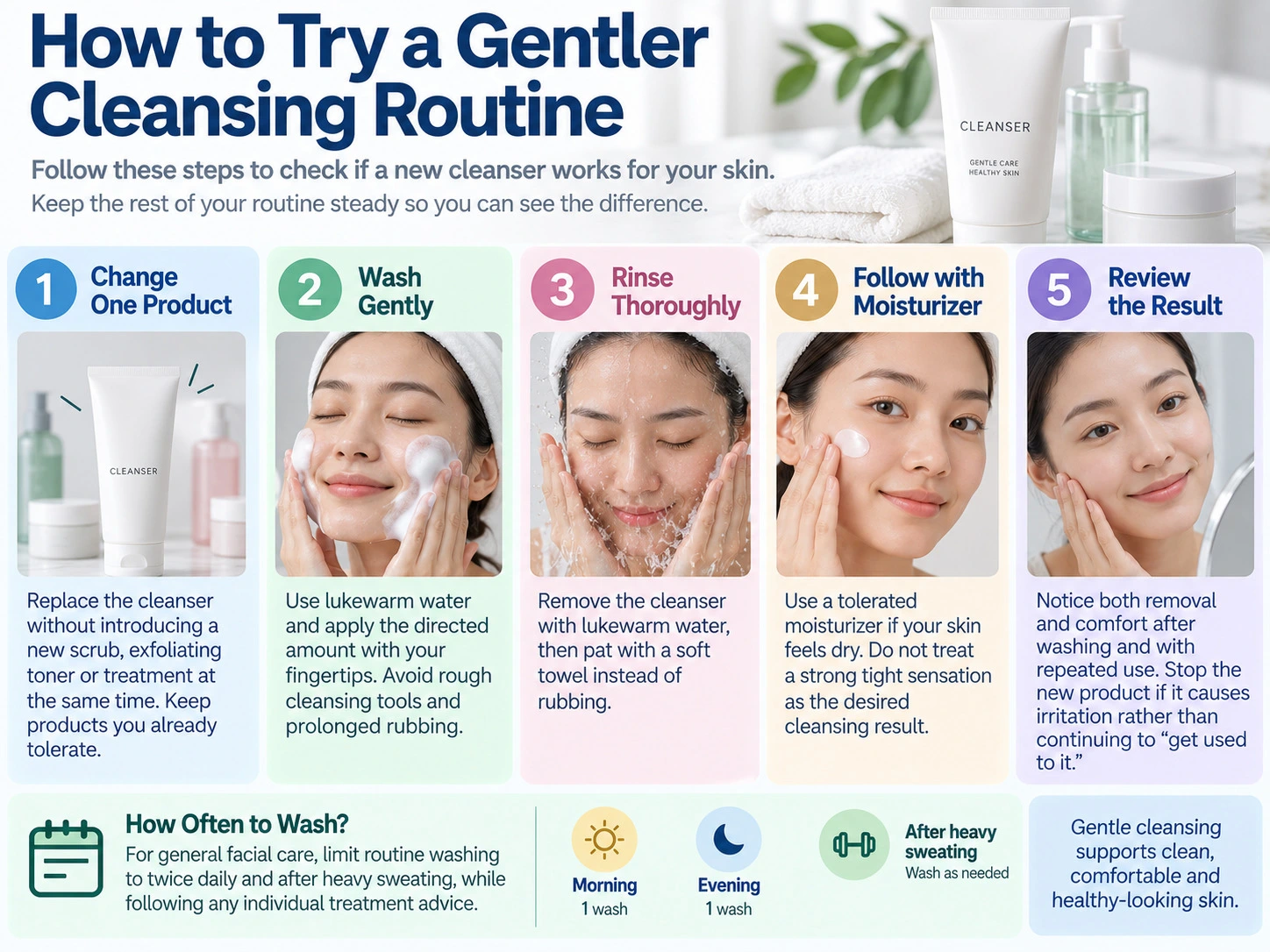
Use the new cleanser as directed and keep the rest of your routine steady so you can notice whether the change helps.
- Change one product: Replace the cleanser without introducing a new scrub, exfoliating toner or treatment at the same time. Keep products you already tolerate.
- Wash gently: For a conventional wet-skin facial wash, use lukewarm water and apply the directed amount with your fingertips. Avoid rough cleansing tools and prolonged rubbing.
- Rinse thoroughly: Remove the cleanser with lukewarm water, then pat with a soft towel instead of rubbing.
- Follow with moisturizer: Use a tolerated moisturizer if your skin feels dry. Do not treat a strong tight sensation as the desired cleansing result.
- Review the result: Notice both removal and comfort after washing and with repeated use. Stop the new product if it causes irritation rather than continuing to “get used to it.”
You do not need an extra wash each time your face looks shiny. For general facial care, limit routine washing to twice daily and after heavy sweating, while following any individual treatment advice.[7]
What if Your Face Still Feels Tight or Stings?
Rinse off a cleanser that burns or stings, and stop using it if irritation develops. Review the whole cleansing routine, including water temperature, rubbing, repeat washing and any exfoliating products. Switching to an amino acid label will not correct every source of irritation.
Repeated tightness, flaking or discomfort can be a reason to simplify your routine and choose a gentler wash. These symptoms alone do not diagnose a damaged skin barrier or identify an allergy. If symptoms persist, become severe or involve swelling or the eyes, seek medical advice rather than testing increasingly strong cleansers.
FAQs About Amino Acid and Soap-Based Cleansers
Can an amino acid cleanser remove oil?
Yes. Amino acid surfactants are cleansing ingredients that help oily material rinse away. Whether a particular wash removes your makeup or sunscreen comfortably depends on the finished formula and its directions, not the amino acid label alone.
Is an amino acid cleanser always soap-free?
No. Some formulas combine amino acid surfactants with fatty-acid soaps. Check the complete ingredient list and the brand’s product information if you specifically want a soap-free wash.
Are all cleansing bars soap-based?
No. Bars can use non-soap detergents, traditional soap or a combination. Solid form alone does not identify the cleansing system or show whether the product will be gentle.
Should you use an acidic toner to balance soap afterward?
Do not rely on an acidic toner to make an irritating cleanser tolerable. If soap repeatedly leaves your face uncomfortable, choose a better-tolerated wash rather than adding another product to compensate.
Sources
[1] U.S. Food and Drug Administration. Frequently Asked Questions on Soap
[2] Ajinomoto. AMILITE® GCK-12K
[3] K. P. Ananthapadmanabhan et al. pH-induced alterations in stratum corneum properties
[4] C. H. Lee, Y. Kawasaki and H. I. Maibach. Effect of surfactant mixtures on irritant contact dermatitis potential in man: sodium lauroyl glutamate and sodium lauryl sulphate
[5] A. O. Barel et al. A comparative study of the effects on the skin of a classical bar soap and a syndet cleansing bar…
[6] American Academy of Dermatology Association. A dermatologist’s guide to skincare from growing up to glowing up
[7] American Academy of Dermatology Association. Face washing 101


