

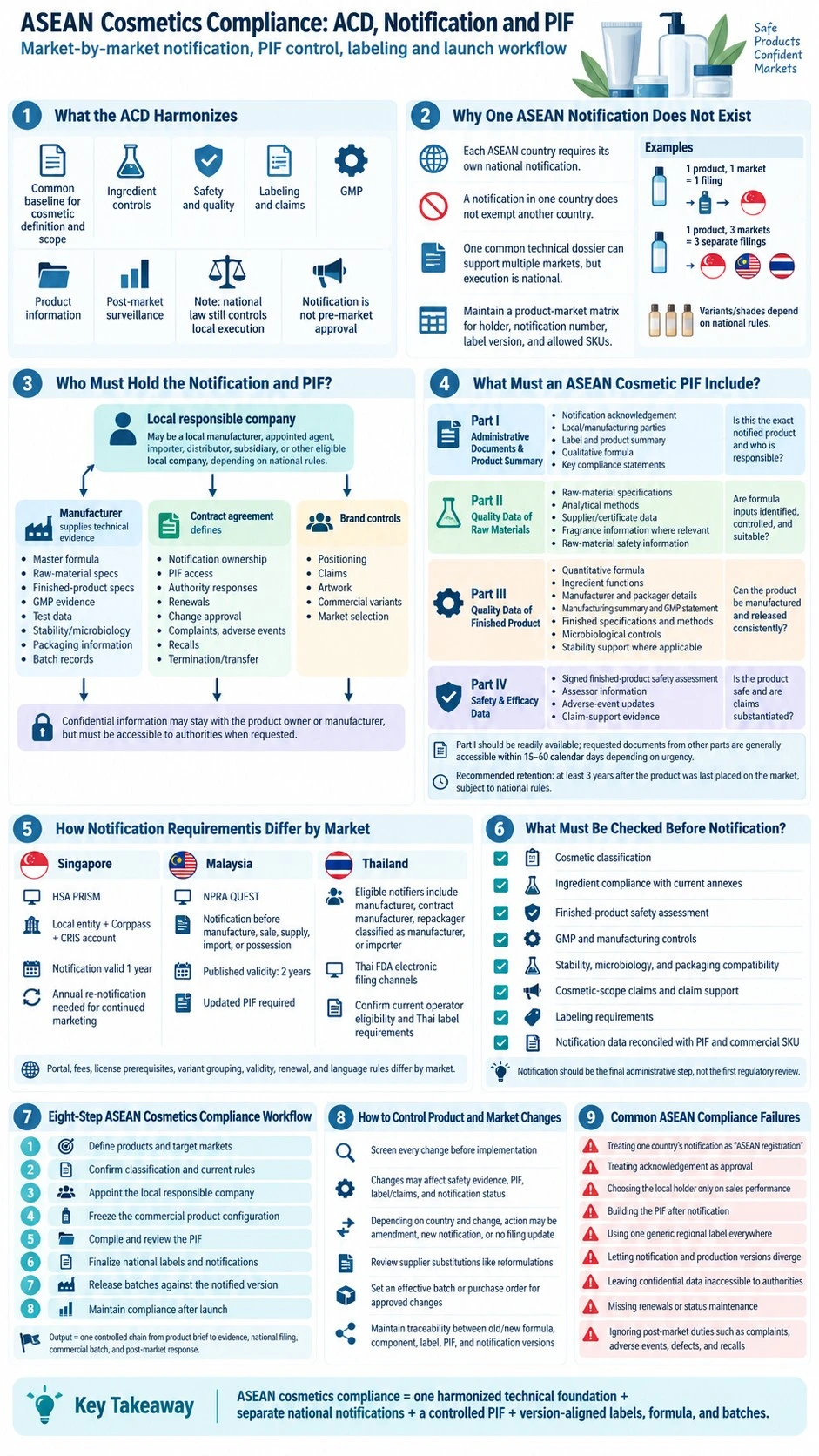
ASEAN cosmetics compliance is best understood as one shared technical foundation executed through separate national systems. The ACD reduces unnecessary technical divergence, but each national authority implements and enforces cosmetics rules under its own law. A Singapore notification does not open Malaysia, Thailand, the Philippines, Indonesia, Vietnam, or another ASEAN market.
For a private-label brand, the practical task is to connect the manufacturer’s formula and evidence with the local company that files the notification and holds the PIF. If those parties use different formula revisions, claims, labels, or supplier documents, a notification may exist while the product being supplied is not the product described by the compliance file.
This guide explains the shared ACD model and the controls brands need for multi-market launches. It reflects official information available on September 23, 2026. National rules, portals, fees, validity periods, and administrative practices can change, so the responsible local company should confirm current requirements with the authority in each target market.
What the ASEAN Cosmetic Directive Harmonizes
The ACD establishes common principles for cosmetic definition and scope, ingredient controls, safety, quality, labeling, claims, good manufacturing practice, product information, and post-market surveillance. The system shifts primary responsibility for product safety, quality, and compliance to the company or person placing the cosmetic on the local market.[1]
Harmonization does not remove product-level work. The responsible company must still confirm that the formula complies with the current ingredient annexes, the product is manufactured under applicable GMP controls, the finished cosmetic is safe under normal or reasonably foreseeable use, claims are supportable and cosmetic in nature, and the label contains required information.
The ACD model emphasizes notification and post-market surveillance rather than treating the notification acknowledgement as a pre-market safety evaluation. Authorities can inspect the PIF, sample products, request test reports, investigate complaints, and take enforcement action against non-compliant cosmetics.[1]
ACD technical documents are an essential baseline, but national legislation remains controlling in each market. Country rules can add procedural, language, license, portal, fee, validity, importer, advertising, or administrative requirements. The launch plan therefore needs two layers: one controlled technical dossier and a national execution sheet for every destination.
Why One ASEAN Notification Does Not Exist
The company responsible for placing a cosmetic on the market must notify the cosmetics authority in each member country where the product will be marketed. Official ASEAN guidance is explicit that a notification in one country does not exempt the product from notification in another.[2]
| Launch plan | Notification position | Operational consequence |
|---|---|---|
| One product in one ASEAN market | File under that market’s national procedure. | Appoint one eligible local company and complete one country-specific release path. |
| One product in three ASEAN markets | File separately with all three national authorities. | Maintain three notification records and three national requirement sheets linked to one controlled product dossier. |
| Several variants or shades | Treatment depends on the national presentation and variant rules. | Map every SKU to the correct notification rather than assuming one family filing covers all commercial units. |
| Export-only manufacturing | A local notification exemption may apply where the product is not supplied domestically, but national manufacturing and export rules still apply. | Confirm the rule in both the manufacturing country and every destination market. |
The local filing is generally an upfront declaration of compliance. Receipt or acknowledgement should not be described as an approval certificate, safety certification, or authority endorsement. The company remains responsible for every consignment meeting the declared formula, specifications, label, and legal requirements.[2]
This distinction matters in commercial contracts and marketing. A supplier may accurately state that a product has been notified in one country, yet that statement says nothing about notification status in another country. Create a product-market matrix showing the local holder, notification number, filing date, expiry or renewal date where applicable, label version, and allowed SKUs for every destination.
Who Must Hold the Notification and PIF?
The ASEAN model places responsibility on the local company or person that places the cosmetic on the market. Official guidance describes this party as a local manufacturer, an appointed agent, an importer, or another company responsible for bringing the product into the country. Only a business registered to operate in the market can file the notification under the regional guidance, subject to national rules.[2]
For an overseas private-label brand, the local party may be its subsidiary, importer, distributor, or regulatory service provider if national law permits that arrangement. The contract must do more than authorize use of a brand name. It should define notification ownership, PIF access, confidentiality, authority responses, renewal, change approval, complaints, adverse-event reporting, recalls, distribution records, and transfer or termination.
The manufacturer remains a critical evidence owner even when it is not the notification holder. It should supply the master formula, raw-material and finished-product specifications, manufacturing method, GMP evidence, test methods and results, stability and microbiological evidence, packaging information, safety inputs, and traceable batch records. The brand controls product positioning, claims, artwork, commercial variants, and the markets in which the product is sold.
The local holder cannot safely accept responsibility without reliable access to the technical file. Likewise, a confidentiality clause cannot prevent an authority from obtaining required information. The ASEAN PIF guideline allows proprietary material to be held by the product owner or manufacturer if arrangements ensure that the information can be supplied directly to the authority when requested.[3]
What Must an ASEAN Cosmetic PIF Include?
Article 8 of the ACD requires product information covering composition, raw-material and finished-product specifications, GMP manufacturing, safety assessment, undesirable effects, and claim support. The recommended ASEAN PIF structure organizes this material into four parts.[3]
| PIF part | Core contents | Release question it answers |
|---|---|---|
| Part I: Administrative Documents and Product Summary | Notification acknowledgement, local and manufacturing parties, authorization documents where required, label, product summary, qualitative formula, and key compliance statements | Is this the exact notified product, and who is responsible for it? |
| Part II: Quality Data of Raw Materials | Raw-material specifications, analytical methods, certificates or supplier data, fragrance information where relevant, and raw-material safety information | Are the formula inputs identified, controlled, and suitable? |
| Part III: Quality Data of Finished Product | Quantitative formula, ingredient functions, manufacturer and packager details, manufacturing summary, GMP statement, finished specifications and methods, microbiological controls, and applicable stability support | Can the commercial product be manufactured and released consistently? |
| Part IV: Safety and Efficacy Data | Signed finished-product safety assessment, assessor information, updated adverse-event data, and evidence supporting on-pack claims | Is the product safe for its intended use, and are its claimed benefits substantiated? |
Part I should be readily available for an initial investigation. The guideline states that requested documents from other parts should be accessible within an agreed period, generally 15 to 60 calendar days or sooner depending on urgency. It recommends retaining the PIF for at least three years after the product was last placed on the market, while national rules may impose their own requirements.[3]
The file can be maintained electronically or on paper if it is easy for the authority to consult. The format matters less than accessibility, version control, and completeness. A folder of unrelated supplier PDFs is not a functional PIF unless the records clearly identify the product, formula version, specifications, evidence, and regulatory conclusions.
The PIF is also a living file. Adverse-event information should be updated, and changes to formula, supplier, manufacturer, specifications, manufacturing process, packaging, claims, label, or responsible company must be assessed. The notification and PIF should never describe obsolete configurations while new commercial batches continue to ship.
How Notification Requirements Differ by Market
The shared ACD model produces similar compliance questions, but national procedures are not interchangeable. These official examples show why brands need a country-specific check rather than one regional assumption.
| Market example | National execution point | Brand implication |
|---|---|---|
| Singapore | Manufacturers and importers generally notify through HSA’s PRISM system. A local entity, Corppass, and CRIS account are required. Notifications are valid for one year and require annual re-notification for continued marketing.[4] | Build annual status checks into the distributor or subsidiary agreement and do not treat the acknowledgement as HSA approval. |
| Malaysia | The Cosmetic Notification Holder submits through NPRA’s QUEST system before manufacture, sale, supply, import, or possession. The published guideline states a two-year notification validity and requires an accessible, updated PIF.[5] | Assign renewal, PIF, recall, adverse-event, and change-submission duties to the CNH in writing. |
| Thailand | Notifiers include manufacturers, contract manufacturers, repackagers classified as manufacturers, or importers. The filing includes operator and product information and can be submitted through Thai FDA channels, including its computer network system.[6] | Confirm the eligible Thai operator, facility permissions, current electronic procedure, and Thai label requirements before shipment. |
These examples are not a substitute for checking every target country. Portal names, fees, license prerequisites, variant grouping, validity, renewal, label language, samples, import documents, and processing practices can differ. Confirm requirements close to filing and again before renewal or a material change.
Do not build the commercial timeline around the fastest country and assume every other market will follow it. A staggered launch is often safer: freeze the common technical file, then release each market only after its local holder confirms the notification acknowledgement, approved label version, importer readiness, and any additional national conditions.
What Must Be Checked Before Notification?
Notification should be the final administrative step in a controlled readiness process, not the first time the formula or label receives regulatory review.
- Cosmetic classification: Confirm that the intended purpose, presentation, directions, claims, and composition fit the cosmetic definition. Therapeutic or disease claims can move a product outside the cosmetic pathway.
- Ingredient compliance: Check every ingredient against the latest applicable prohibited, restricted, preservative, colorant, and UV-filter annexes, including concentration, product type, body site, warnings, and purity conditions.
- Finished-product safety: Complete a safety assessment using the exact quantitative formula, exposure, intended users, directions, packaging, and relevant test evidence.
- GMP and manufacturing: Confirm the manufacturer, site, process, quality controls, specifications, test methods, and GMP evidence for the commercial configuration.
- Stability, microbiology, and packaging: Establish suitable durability, microbiological quality, preservation where relevant, and product-package compatibility rather than relying on base-formula assumptions.
- Claims: Keep claims within the cosmetic scope and hold evidence proportional to the wording. Ingredient literature alone may not support a quantitative or finished-product performance claim.
- Labeling: Verify product name and function, directions, full ingredient list, country of manufacture, batch identification, contents, precautions, local responsible company, and national language or formatting requirements.
- Notification data: Reconcile the product name, variants, manufacturer, importer or holder, formula, restricted-ingredient percentages where requested, and artwork with the PIF and commercial SKU.
An approved finished cosmetic product specification can serve as the controlled bridge between formula, quality limits, test methods, packaging, label version, and batch release. It does not replace the PIF, but it helps prevent separate teams from releasing different product definitions.
Eight-Step ASEAN Cosmetics Compliance Workflow
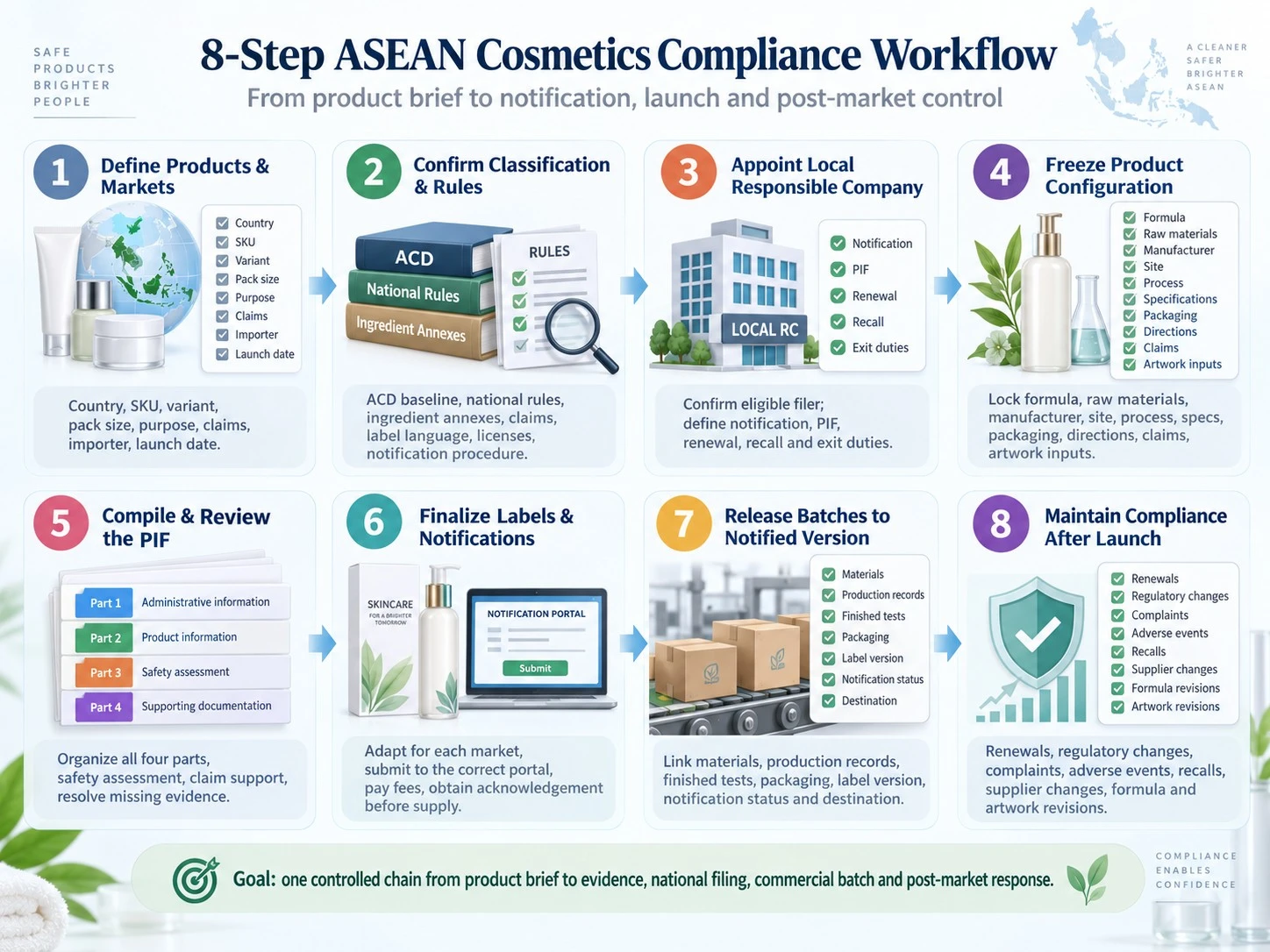
- Define products and target markets. List every country, SKU, shade or variant, pack size, product purpose, claim set, sales channel, importer, and intended launch date.
- Confirm classification and the current rules. Check cosmetic status, the ACD technical baseline, national legislation, ingredient annexes, claims boundaries, label language, samples, licenses, and notification procedures.
- Appoint the local responsible company. Verify that the manufacturer, importer, distributor, subsidiary, or agent is eligible to file, and contract its notification, PIF, renewal, surveillance, recall, and exit duties.
- Freeze the commercial product configuration. Lock the quantitative formula, raw-material codes, manufacturer and site, process, specifications, test methods, packaging, directions, claims, and artwork inputs.
- Compile and review the PIF. Organize all four parts, complete the safety assessment and claim support, resolve missing evidence, and establish a secure route for confidential documents to reach authorities.
- Finalize national labels and notifications. Adapt the common product data to each market, submit through the correct portal, pay applicable fees, and obtain the required acknowledgement before commercial supply.
- Release batches against the notified version. Link incoming materials, manufacturing and packaging records, finished tests, packaging components, label version, notification status, and distribution destination during batch release.
- Maintain compliance after launch. Monitor renewals, regulatory changes, complaints, adverse events, defects, recalls, supplier changes, formula and artwork revisions, and market-specific distribution records.
This sequence prevents the notification from becoming an isolated administrative record. The output is a controlled chain from product brief to evidence, national filing, commercial batch, and post-market response.
How to Control Product and Market Changes
Every proposed change should be screened before implementation. The ASEAN guidance identifies changes such as brand name, distribution rights, product type, presentation, intended use, product name, formulation, manufacturer, company details, representative, pack size, packaging material, and label. Depending on the change and national rule, the action may be an amendment, a new notification, or no notification update.[2]
Use a change record that asks four questions: does the change affect safety or technical evidence; does it change the PIF; does it change the label or claims; and what does each target authority require? Do not apply one country’s amendment decision to every other market without confirmation.
Supplier substitutions deserve the same review as deliberate reformulations. Two raw materials with the same INCI name may differ in composition, impurities, preservatives, carriers, origin, or specifications. Packaging changes can affect compatibility and stability. A new manufacturing site or contract packer can affect notification data, GMP evidence, process control, and label statements.
Set an effective batch or purchase order for every approved change. Maintain traceability between old and new formula, component, label, PIF, and notification versions. ZICAIL’s cosmetic batch codes and product traceability guide explains how batch and distribution records support investigations and targeted recalls.
Common ASEAN Compliance Failures
- Calling one country’s notification an ASEAN registration: This misstates market access and can leave other destinations unnotified.
- Treating acknowledgement as approval: Notification does not transfer safety, quality, or legal responsibility to the authority.
- Choosing the local holder only on sales performance: A distributor that cannot maintain the PIF, manage renewals, respond to authorities, or execute recalls creates regulatory risk.
- Building the PIF after notification: Missing safety, quality, or claim evidence may remain hidden until an inspection or complaint.
- Using a generic regional label everywhere: National language, responsible-company, administrative, and presentation rules can require market-specific artwork.
- Letting notification and production versions diverge: A formula, manufacturer, claim, product name, or label change may require PIF updates and a national amendment or new notification.
- Leaving confidential data inaccessible: Commercial secrecy must be managed through a direct authority-access arrangement, not used as a reason the local holder cannot satisfy a request.
- Failing to renew or maintain status: Validity and re-notification rules vary; an expired record can interrupt lawful supply.
- Ignoring post-market duties: Complaints, adverse events, defects, distribution records, corrective action, and recalls are part of the compliance system.
Build an ASEAN-Ready Private Label Project With ZICAIL
An ASEAN launch becomes easier when the technical file is built from the commercial formula instead of reconstructed after production. ZICAIL can coordinate formula and raw-material identification, manufacturing and quality records, product specifications, testing inputs, packaging information, ingredient lists, artwork data, and controlled change records for review by the brand and its local compliance partners.
Start with the target countries, intended claims, formula route, package, variants, expected importer structure, and launch sequence. Then define who will prepare the safety assessment, who will compile and hold each PIF, who files and renews each notification, and how confidential information will be supplied to an authority.
ZICAIL does not replace the national notification holder, safety assessor, or local regulatory adviser. Its role is to provide a consistent manufacturing and documentation foundation that those parties can evaluate. Contact ZICAIL to discuss an ASEAN-focused private-label skincare project, required technical inputs, packaging, sampling, and production planning.


