
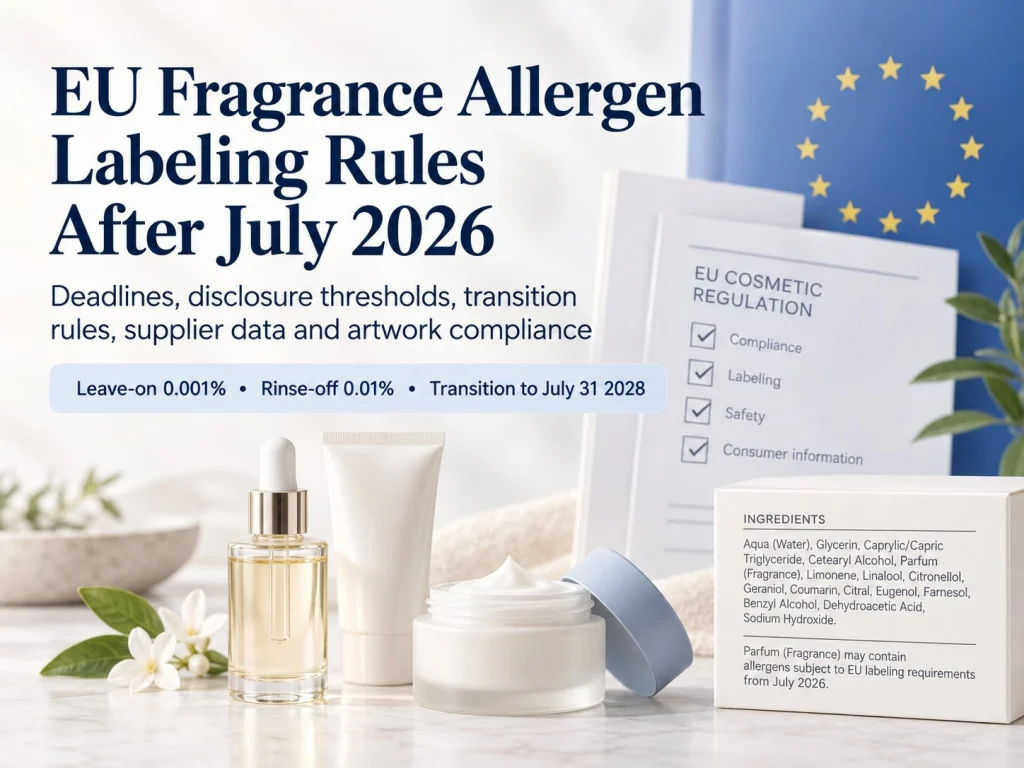

Fragrance-allergen compliance is now a live release requirement for new EU market placements, not a future packaging project. The main operational challenge is not merely adding more familiar names to an ingredient list. A brand must know which substances or grouped entries occur in the finished formula, calculate their combined concentration from all sources, use the prescribed label names, and connect the approved artwork to the same formula and supplier versions used in the CPSR, PIF, and CPNP record.
This guide explains the rules in force after July 2026 and turns them into a practical workflow for private-label cosmetic projects. It uses official information available on September 23, 2026. It is operational guidance, not legal advice; the EU Responsible Person and qualified safety assessor should confirm each product against the current Annex III and destination-market requirements.
What Regulation (EU) 2023/1545 Changed
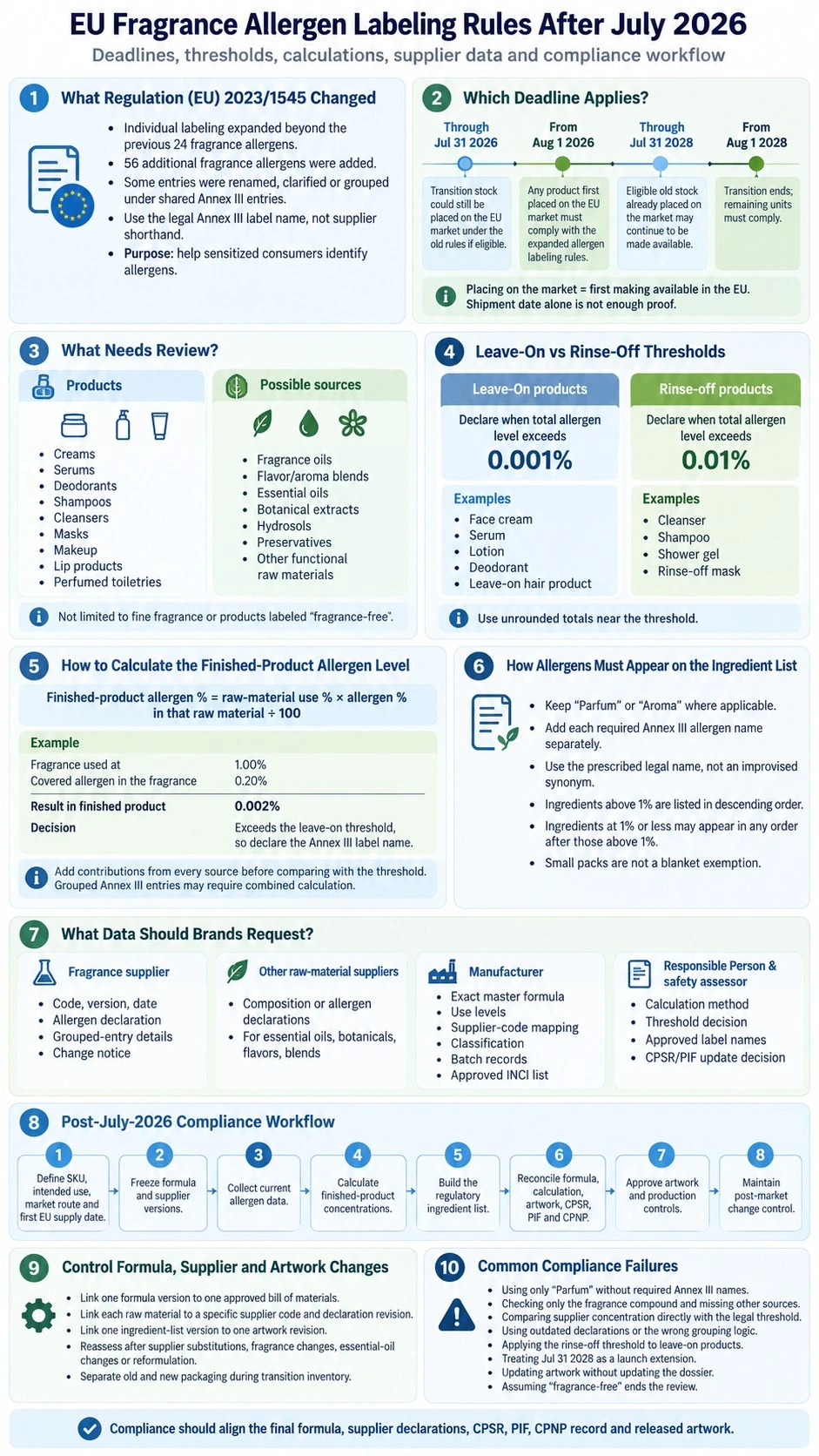
Before the amendment, 24 fragrance allergens in specified Annex III entries were subject to individual labeling. Regulation (EU) 2023/1545 introduced individual labeling requirements for 56 additional fragrance allergens. It also updated substance identities, added or clarified isomers, aligned names with the Common Ingredients Glossary, and grouped certain related substances under single entries.[1]
The grouping point matters. A legal entry may cover several constituent substances but prescribe one name for the ingredient list. Teams should therefore avoid treating a supplier spreadsheet as a simple list of independent INCI additions. The calculation logic and label name must follow the applicable Annex III entry.
The purpose of individual disclosure is to help sensitized consumers identify and avoid substances to which they may react. The appearance of an allergen name on a label does not, by itself, mean that the cosmetic is unsafe or that the substance is prohibited. Annex III establishes restrictions and labeling conditions, and the finished product must also meet the broader safety obligations of the Cosmetics Regulation.
Which Deadline Applies to Your Product?
The amendment created two different transition endpoints. They govern different supply-chain events and should never be treated as one general deadline.[1]
| Date or period | Regulatory position | Practical action |
|---|---|---|
| Through July 31, 2026 | Products covered by the transition could still be placed on the Union market without meeting the new restrictions, subject to the conditions attached to the relevant Annex III entry. | Preserve evidence showing the exact product, formula, label, batch, quantity, customer or importer, and date of first EU supply. |
| From August 1, 2026 | A product first placed on the EU market must comply with the expanded fragrance-allergen requirements. | Use compliant calculations and artwork before the first commercial supply in the EU. |
| Through July 31, 2028 | Eligible non-compliant products that were placed on the market by the earlier deadline may continue to be made available. | Control and document sell-through; do not use this period to place newly produced or newly imported non-compliant units on the market. |
| From August 1, 2028 | The transition for making eligible old stock available has ended. | Remaining units must comply; assess withdrawal or other action with the Responsible Person if they do not. |
Under Article 2, “placing on the market” means the first making available of a cosmetic product on the EU market. “Making available” is broader: it covers any supply for distribution, consumption, or use in a commercial activity, whether paid or free.[2] For an imported private-label cosmetic, the first EU supply by the importer is normally the critical placement event; later sales through distributors and retailers are subsequent making available.
A manufacturing date, purchase order, shipment departure, or warehouse arrival outside the EU does not by itself prove that goods were placed on the EU market by July 31, 2026. The Responsible Person and supply-chain partners should assess the actual transaction and retain product-specific evidence. ZICAIL’s guide to cosmetic batch codes and product traceability explains how batch identity and distribution records can support that control.
Which Products and Ingredient Sources Need Review?
The rule is not limited to fine fragrance. It can affect leave-on and rinse-off cosmetics such as creams, serums, deodorants, shampoos, cleansers, masks, makeup, lip products, and perfumed toiletries. A product described as natural, essential-oil based, lightly scented, or fragrance-free still needs a formula-level review if any raw material can contribute a covered substance.
Potential sources include compounded fragrance oils, flavor or aromatic compositions, essential oils, botanical extracts, hydrosols, active blends, preservatives, and other functional raw materials. A fragrance allergen can be present because it was intentionally included as a constituent of a mixture, not necessarily because the manufacturer added that allergen as a separate formula line.
Review every raw material in the final formula. Request composition or allergen information appropriate to each source, and ensure that declarations refer to the exact supplier, trade name, material code, and version purchased. A declaration for a similar fragrance family or an earlier revision is not reliable evidence for the commercial batch.
What Are the Leave-On and Rinse-Off Thresholds?
For the fragrance allergens covered by these Annex III labeling conditions, individual disclosure is required when the concentration exceeds 0.001% in a leave-on product or 0.01% in a rinse-off product.[1] The threshold applies to the concentration of the relevant substance or grouped substances in the finished cosmetic product.
| Product category | Individual-labeling threshold | Typical examples | Decision point |
|---|---|---|---|
| Leave-on | More than 0.001% in the finished product | Face cream, serum, body lotion, deodorant, leave-on hair product | Declare when the calculated total exceeds 0.001%. |
| Rinse-off | More than 0.01% in the finished product | Facial cleanser, shampoo, rinse-off mask, shower gel | Declare when the calculated total exceeds 0.01%. |
The legal wording is “exceeds.” A result exactly at a threshold is not the same as a result above it, but calculations near the boundary require special care. Supplier tolerances, rounding, analytical uncertainty, formula overage, and batch variation can make a label decision based on a rounded display value unreliable. Use sufficiently precise source data and agree a conservative decision rule with the Responsible Person and assessor.
Product classification must match normal and reasonably foreseeable use. A wash-off instruction does not automatically resolve an ambiguous format if consumers commonly leave the product on, and a multi-use product may require a case-specific assessment. Record the classification rationale with the intended use and label directions.
How to Calculate the Finished-Product Allergen Level
For one contributing raw material, use this calculation: finished-product allergen percentage = raw-material use percentage × allergen percentage in that raw material ÷ 100.
Suppose a leave-on cream contains 1.00% of a fragrance, and the fragrance declaration reports 0.20% of a covered allergen. The finished-product level is 1.00 × 0.20 ÷ 100 = 0.002%. That exceeds the 0.001% leave-on threshold, so the applicable Annex III label name must be declared. The same 0.002% result would not exceed the general 0.01% rinse-off disclosure threshold.
If the same legal entry is contributed by more than one raw material, calculate each contribution and add them before comparing the total with the threshold. For example, do not calculate a fragrance oil, essential oil, and botanical blend separately and then ignore their combined level. Where an Annex III entry groups substances and requires their combined concentration to be assessed, aggregate the substances specified by that entry and use its mandated label name.
Use maximum or otherwise justified composition values where supplier data are expressed as ranges, according to the method accepted by the Responsible Person and safety assessor. Keep the source values, units, formula percentages, conversion logic, total, threshold, decision, and label name in a controlled calculation sheet. A final number without traceable inputs is difficult to review or update.
How Fragrance Allergens Must Appear on the Ingredient List
Article 19 permits perfume and aromatic compositions and their raw materials to be identified as parfum or aroma. However, substances whose mention is required by the “Other” column of Annex III must also appear in the ingredient list. Parfum or aroma therefore remains in the list when applicable, while declarable allergens are added separately.[2]
Use the name prescribed in the relevant Annex III entry, not an improvised chemical synonym, supplier shorthand, or marketing term. Some amended entries combine related substances and specify one common ingredient name, such as Citral, for disclosure. CosIng can help research ingredient status, but the Commission states that it is informative; Annex III is the legally binding source.[3]
The ingredient list is headed by “ingredients.” Ingredients are generally listed in descending order of weight at the time they are added, while ingredients below 1% may appear in any order after those above 1%.[2] Because fragrance allergens are often present below 1%, their position can be managed within that rule, but every declared name must remain accurate for the released formula.
When practical space limitations prevent the normal display of the ingredient list, Article 19(2) allows the information to appear on an enclosed or attached leaflet, label, tape, tag, or card, with the prescribed reference mechanism. A special rule exists for certain very small products such as soap and bath balls when even those options are impracticable.[2] Small packaging is not a blanket exemption from allergen disclosure.
Article 19(5) assigns national-language rules to specified label particulars, but it does not list the ingredient declaration among those fields.[2] Ingredient names should follow the applicable common ingredient nomenclature. Other copy on the same pack may still require destination-market language review.
What Data Should Brands Request?
Compliance depends on controlled information moving between the fragrance house, raw-material suppliers, manufacturer, brand, assessor, and Responsible Person. The required evidence is broader than a generic IFRA certificate.
| Source | Minimum useful data | Why it matters |
|---|---|---|
| Fragrance supplier | Exact trade name and code, declaration version and date, allergens covered by the current Annex III, concentration or maximum value, prescribed grouping information, and change notice | Supports the main finished-product calculation and version control. |
| Other raw-material suppliers | Ingredient composition or applicable allergen declaration for essential oils, botanicals, flavors, blends, and functional materials | Captures contributions outside the compound fragrance. |
| Manufacturer | Master formula with exact use levels, raw-material supplier and code mapping, product use classification, batch records, and approved ingredient list | Connects supplier data to the product actually manufactured. |
| Responsible Person and assessor | Calculation method, classification decision, Annex III interpretation, approved label names, CPSR/PIF update decision, and release approval | Establishes the accountable regulatory conclusion for the EU product. |
| Brand and artwork team | SKU-market matrix, final dieline, label version, translation set, approval record, depletion plan, and effective batch | Prevents an approved calculation from being paired with obsolete packaging. |
An IFRA conformity document addresses standards for fragrance use and can be useful, but it is not automatically a complete EU cosmetic ingredient-label declaration. Request data explicitly mapped to the current EU requirements and exact fragrance version.
Eight-Step Post-July-2026 Compliance Workflow
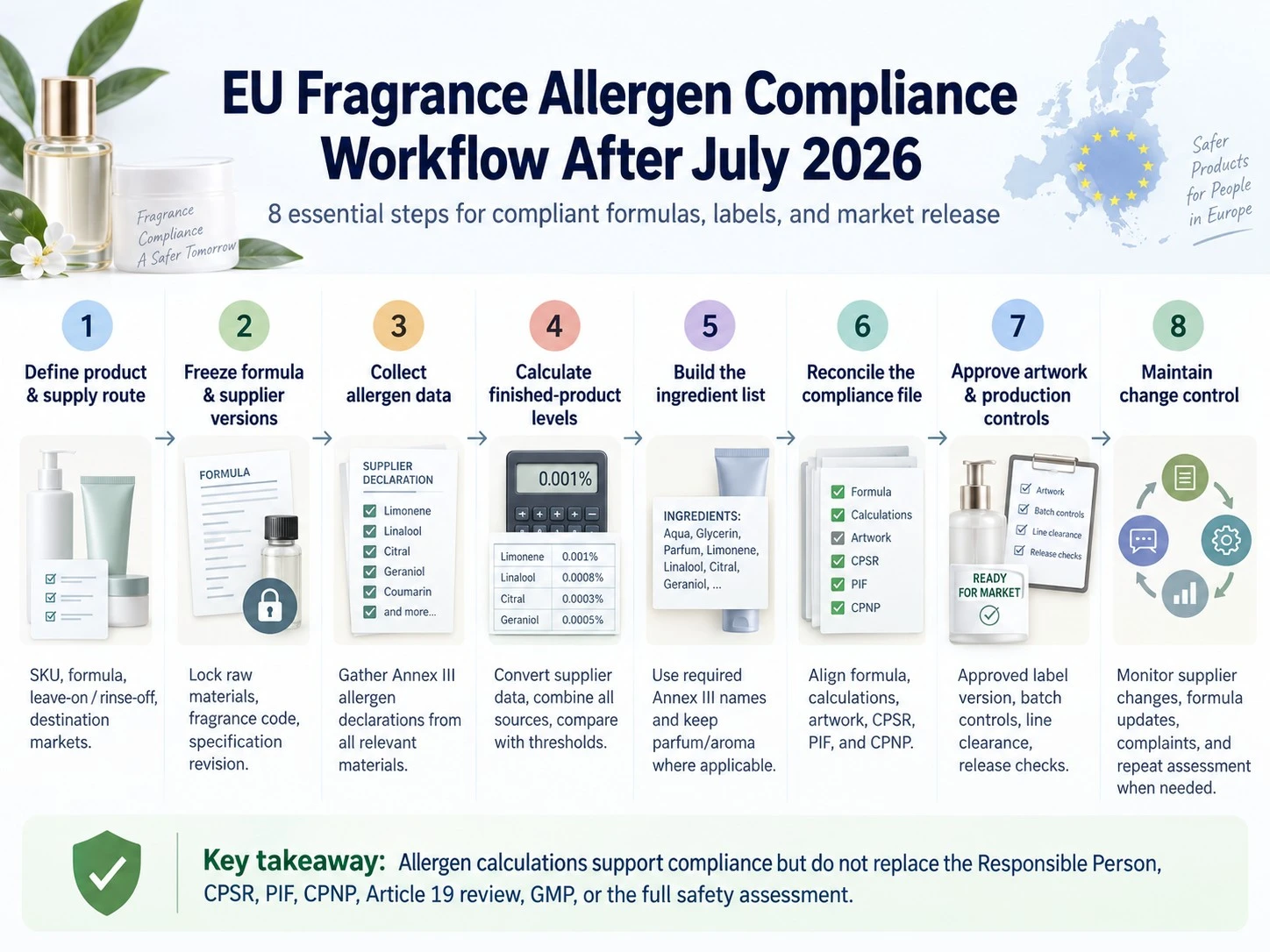
- Define the finished product and supply route. Confirm the exact SKU, formula, intended use, leave-on or rinse-off classification, destination Member States, importer, distributors, and planned first EU supply date.
- Freeze formula and supplier versions. Lock each raw-material trade name, supplier, code, specification revision, use percentage, and fragrance version before calculation and artwork approval.
- Collect current allergen data. Obtain declarations for the compound fragrance and every other material that may contribute an Annex III fragrance allergen, including grouped substances.
- Calculate finished-product concentrations. Convert every supplier value to its contribution in the finished formula, aggregate all sources for each applicable entry, and compare the unrounded totals with the correct threshold.
- Create the regulatory ingredient list. Apply the prescribed Annex III label names, retain parfum or aroma where applicable, and order the full ingredient list under Article 19 rules.
- Reconcile the compliance file. Give the calculation, formula, supplier documents, classification, and draft artwork to the Responsible Person and safety assessor; update the CPSR, PIF, and CPNP information where required.
- Approve artwork and production controls. Record the approved artwork revision, effective batch or purchase order, obsolete-packaging disposition, and checks used at incoming inspection, line clearance, and finished-product release.
- Maintain post-market change control. Monitor supplier revisions, formula substitutions, new fragrance batches, regulatory amendments, complaints, and distribution records; repeat the assessment before an affected version is supplied.
This workflow should sit inside the broader EU cosmetics compliance process. Allergen calculations do not replace the Responsible Person, CPSR, PIF, CPNP notification, Article 19 review, GMP, or general safety assessment.
How to Control Formula, Supplier, and Artwork Changes
Treat the calculation and ingredient list as version-controlled product specifications. The formula version should point to an exact bill of materials; each raw-material line should point to an approved supplier code and declaration revision; the resulting calculation should point to one ingredient-list version; and the released artwork should point back to that approved list.
A supplier substitution can change allergen content even when the raw material has the same marketing name. A reformulation, fragrance color adjustment, essential-oil origin change, or alternate botanical extract can also affect the calculation. Contracts and specifications should require advance notification of changes that may alter composition, regulatory status, or labeling.
Use an approved finished cosmetic product specification to connect formula identity, organoleptic and analytical requirements, packaging, label version, and release criteria. When a relevant input changes, open change control before manufacturing or packing commercial units. The Responsible Person and assessor should decide whether the CPSR, PIF, CPNP record, or artwork must be updated.
For transition inventory, keep old and new artwork physically and digitally separated. Link packaging component lots and finished batches to the applicable formula and label. Retain commercial evidence supporting the claimed placement date; a spreadsheet created later without source documents is weak proof.
Common Compliance Failures
- Using parfum as the only disclosure: This omits Annex III names that must be stated individually above the applicable threshold.
- Checking only the fragrance compound: Essential oils, botanicals, flavors, preservatives, or functional blends may add the same allergen.
- Comparing supplier concentration directly with the threshold: The legal decision uses the concentration in the finished cosmetic, after applying the raw-material use level and combining sources.
- Using an outdated declaration: The fragrance code, supplier composition, legal list, or prescribed grouping may have changed.
- Applying the rinse-off threshold to a leave-on product: The leave-on threshold is ten times lower.
- Treating July 31, 2028 as a launch extension: It is a making-available transition for eligible products placed by the 2026 deadline, not permission for new non-compliant placements.
- Updating artwork without the dossier: The label, calculation, CPSR, PIF, and relevant CPNP information must describe the same product version.
- Assuming “fragrance-free” ends the review: Covered substances can be contributed by materials used for other functions.
- Relying on a label total rounded to the threshold: Source ranges and rounding can conceal an exceedance.
Prepare an EU-Ready Private Label Project With ZICAIL
For a private-label brand, fragrance-allergen labeling works best when it is designed into formula approval rather than checked after packaging has been printed. ZICAIL can coordinate formula and raw-material identification, supplier document collection, ingredient-list preparation, sampling, packaging development, production specifications, and change records for review by the brand’s EU Responsible Person and safety assessor.
Start with the intended product type, destination markets, target fragrance profile, package format, claims, and launch date. Then define who supplies the fragrance, who owns the artwork, who performs the finished-product calculation, and who gives the final EU regulatory approval. This division of responsibility should be documented before commercial production.
ZICAIL does not replace the statutory Responsible Person or independent safety assessor. The goal is to provide a controlled manufacturing and documentation trail so that those parties can assess the exact product the brand plans to sell. Contact ZICAIL to discuss an EU-focused skincare brief, formula options, fragrance documentation, packaging, and production planning.


