

Quick Overview
- Client Type: Aesthetic Clinic / Professional Skincare Brand
- Market: Australia
- Product: Multi-SKU Facial Skincare Series
- Project Type: Custom Professional Skincare Development
- Main Need: Multi-SKU formulation, repeated sample refinement, flexible MOQ support, packaging coordination, and small-batch production
- Project Outcome: Successful trial production followed by larger and more regular repeat orders
This case study follows an Australian aesthetic clinic developing its own professional skincare line across several product categories. The cooperation began with multiple SKUs in small trial quantities and gradually developed into larger, more regular repeat orders as the clinic validated the products through its professional channel.
Client Privacy Note: This case study is based on a real client project. For privacy reasons, the client’s name, brand name, and confidential business details are not disclosed.
Client Background and Product Challenge
The client was an Australian aesthetic clinic with an established customer base and professional skincare channel. It wanted to build a proprietary product range that could extend the clinic experience into branded take-home skincare.
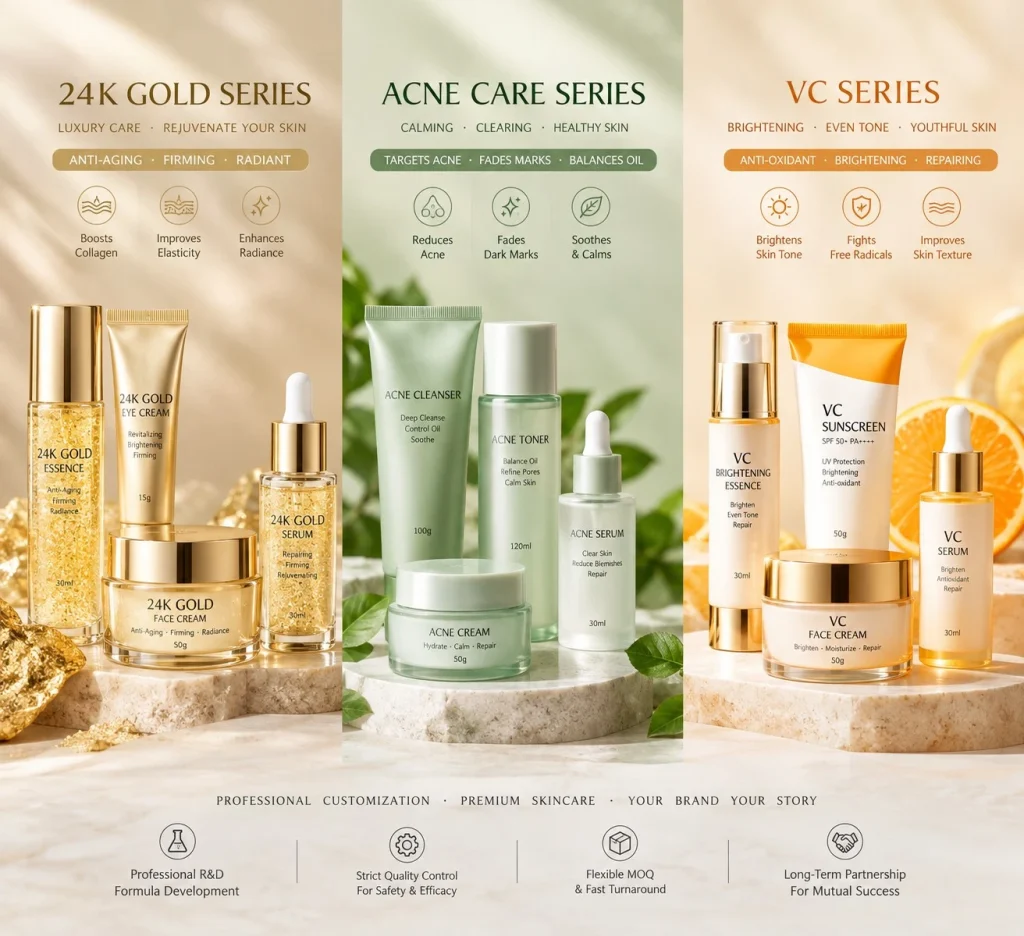
The planned range covered several distinct directions:
- A premium 24K series
- A blemish-care and post-blemish appearance series
- A vitamin C series
This was a professional-level custom development project rather than a simple private label order. The client specified key ingredient directions and had clear expectations for texture, skin feel, absorption speed, mildness, and the overall application experience of each product.
The commercial structure added another challenge. The client wanted to launch many SKUs, but the first quantity for each individual product was relatively small. This created a typical multi-SKU, small-batch project in which formulation depth, packaging procurement, material allocation, and production planning all had to remain practical at lower initial volumes.
The challenge was not simply developing several formulas. The client needed professional-level customization across multiple SKUs while keeping initial quantities manageable enough to test the range before scaling.
Our Solution
Step 1: Building a Multi-SKU Product Framework
We first organized the project around the client’s three product directions rather than treating the range as a group of similar formulas with minor ingredient changes.
Each SKU received its own development brief based on intended use, ingredient direction, texture, sensory profile, and role within the clinic’s product system. This approach allowed the 24K, blemish-care, and vitamin C ranges to maintain distinct identities while still feeling consistent as one brand.
For a broader view of how this process works, our custom skincare formulation guide explains how brands move from a product brief to formula development, testing, and manufacturing.
Step 2: Refining Each Formula Through Repeated Sampling
Because the client had detailed professional requirements, each SKU went through repeated sampling and review rather than being approved from a standard base formula.
Our laboratory adjusted the formulas according to feedback on:
- Ingredient ratios and specifications
- Emulsification systems
- Texture and spreadability
- Absorption speed
- Skin feel and after-feel
- Mildness during use
- Consistency with the intended product positioning
Each SKU was evaluated as an individual formula. This allowed the client to give detailed feedback on the products used in its professional setting and gave our R&D team a clear basis for the next adjustment.
Step 3: Supporting Small-Batch Multi-SKU Production
Formula development was only one part of the project. The client also needed a practical way to launch several products without committing to unnecessarily high quantities for every SKU.
We coordinated production scheduling, material planning, packaging procurement, sampling, and initial order quantities so the client could test a broader product matrix while controlling early inventory exposure.
This kind of project requires more flexibility than a conventional large-volume order. Our approach was to make the first production stage workable for the client while preserving a clear path to scale successful products later. Brands considering a similar approach can also review our guide to private label skincare MOQ and the factors that influence minimum quantities.
Development and Production Summary
| Project Area | Client Requirement | Our Support |
|---|---|---|
| Multi-SKU Development | Several product series needed to launch together | Built and refined each SKU as an individual product rather than a minor variation of one base |
| Formula Precision | The client specified ingredients, texture, absorption, and skin feel | Adjusted ingredient balance, specifications, emulsification systems, and sensory profiles |
| Sampling | Professional evaluation required multiple testing rounds | Produced repeated samples and refined formulas according to detailed client feedback |
| Initial Order Size | Many SKUs were required, but the first quantity per product was relatively small | Supported flexible small-batch production planning across the range |
| Packaging and Materials | Smaller quantities created sourcing and allocation challenges | Coordinated packaging procurement, materials, and production requirements |
| Production Scaling | The clinic needed the option to increase successful SKUs later | Maintained a production pathway that could support larger repeat orders after validation |
The Result
After the formulas and samples were confirmed, the client moved forward with the initial multi-SKU production run and introduced the products through its professional channel.
The project delivered:
- A complete multi-SKU professional skincare range
- Approved formulas and samples across the three product directions
- A premium sensory direction for the 24K series
- A gentler product experience for the blemish-care range
- A confirmed performance and sensory direction for the vitamin C series
- Small-batch production across multiple initial SKUs
- A practical pathway for increasing individual SKU volumes
As the products received positive feedback through the clinic’s professional channel, the client gradually increased order quantities for selected SKUs. The cooperation developed from small multi-SKU trial orders into larger and more regular repeat production.
The project demonstrated the value of combining detailed formula development with flexible manufacturing. The client did not need to commit to large volumes across every product before learning which parts of the range were ready to scale.
What Similar Clients Can Learn
-
Takeaway 1: Multi-SKU Launches Do Not Always Need Large Initial Volumes
Professional brands can begin with manageable quantities across several products, validate the range through real channels, and increase stronger-performing SKUs later. -
Takeaway 2: Professional Clients Need SKU-Level Formula Refinement
When ingredient direction, texture, absorption, and skin feel matter, each formula should be evaluated individually rather than treated as a minor variation of one base. -
Takeaway 3: Flexible Supply Chains Matter as Much as Formula Development
Small-batch multi-SKU projects require coordinated packaging, materials, sampling, scheduling, and MOQ planning in addition to strong R&D. -
Takeaway 4: Repeat Orders Are Built Through Product Validation
Starting with manageable quantities allows clinics and professional brands to evaluate products in their real customer channel before committing to larger production volumes.
Planning a Multi-SKU Professional Skincare Line?
Zoe supported this project from multi-SKU formula development and repeated sampling to flexible production planning, packaging coordination, and repeat-order scaling.
If you are building a professional skincare range for a clinic, salon, spa, or beauty brand and want to start with multiple SKUs in manageable quantities, Zoe can help you turn the product plan into a practical OEM/ODM development and production program.
Before selecting a production partner, you can also review our guide on how to choose a skincare manufacturer for formulation, sampling, MOQ, packaging, and production support.


