

“Brightening” can refer to several different consumer expectations. One customer may want fresh-looking radiance and antioxidant care; another may be shopping for a more even-looking tone or the visible reduction of dark spots. Those are not identical product briefs, and they should not automatically lead to the same formulas.
For a skincare brand, the development task is to translate one market need into a coordinated routine without making every SKU a weaker version of the hero serum. The decisions below cover product architecture, active selection, market adaptation, claims, packaging and testing.
Define the Brightening Customer and Market Promise
Start with one primary appearance-based promise and one clearly described customer. A brief that says only “brightening for all skin types” leaves too many decisions unresolved. It does not tell the formulator whether the set should prioritize radiance, uneven-looking tone, post-blemish marks, dullness associated with dryness, or an intensive dark-spot concept.
A useful market brief should answer:
- Primary visible concern: Dullness, uneven-looking tone, visible spots, post-blemish marks or a combination with one dominant concern.
- Target user: Skin profile, age range where relevant, sensitivity expectations, routine experience and preferred number of steps.
- Destination market: Country or region, sales channel, required language, local ingredient restrictions and claim expectations.
- Climate and routine context: Humidity, seasonality, sunscreen habits, makeup use and preferred finish.
- Commercial position: Mass market, masstige, professional-inspired or premium, with a target retail price for each SKU and the complete set.
This definition keeps the range coherent. ZICAIL’s brightening skincare solutions can then be evaluated against a real customer and price point instead of an abstract trend list.
Choose the Core Products in the Set
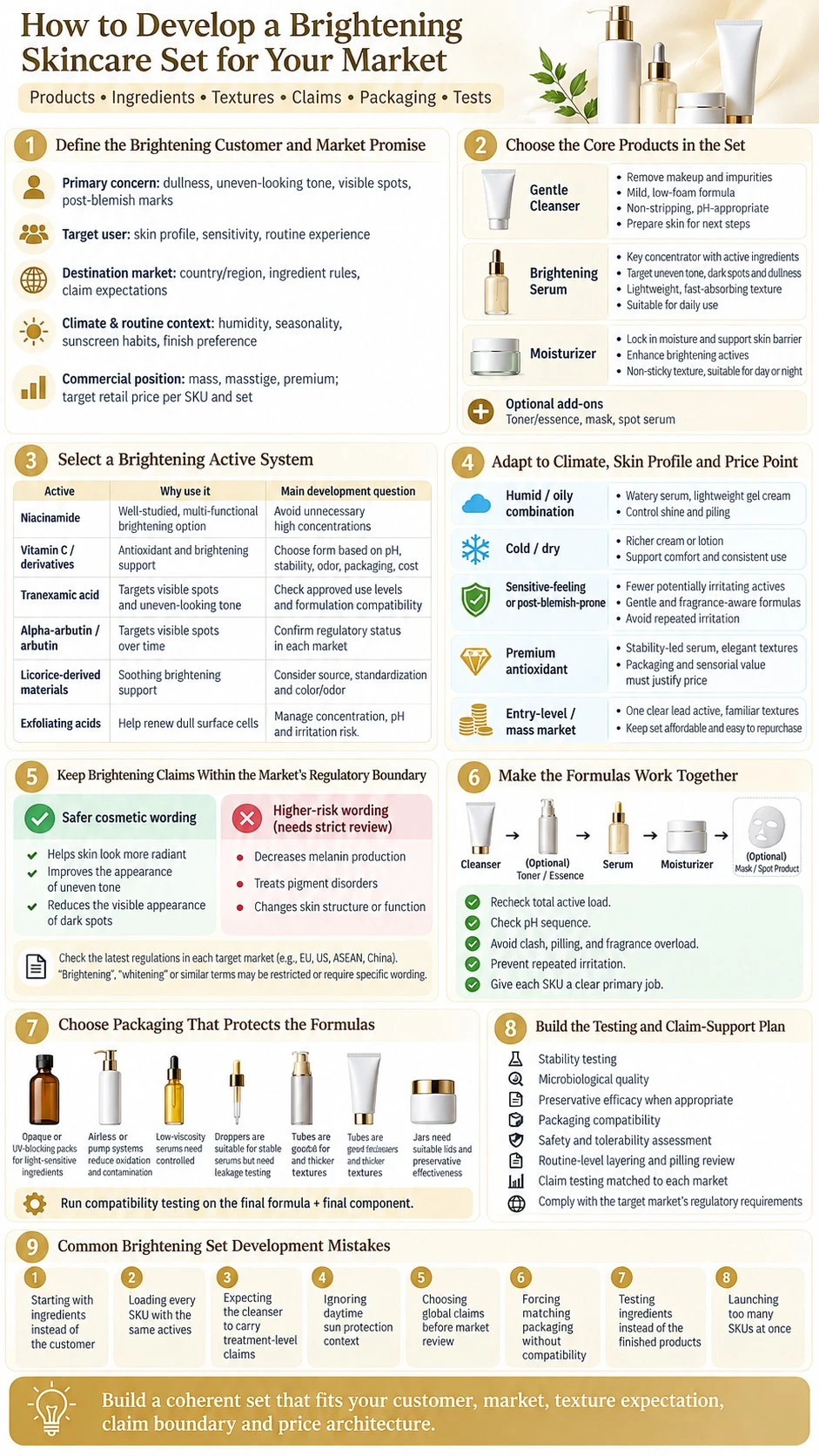
Most startup brightening sets need three clear roles: gentle cleansing, concentrated leave-on treatment and daily moisturization. This architecture gives the serum a strong hero position while the cleanser and moisturizer support consistent use.
| Product | Role in the set | Formula direction | What not to expect from it |
|---|---|---|---|
| Gentle cleanser | Remove oil, sunscreen, makeup residue and daily buildup without creating a tight after-feel | Mild gel, low-foam cream or lotion cleanser selected for the target skin profile | A rinse-off cleanser should not carry the entire dark-spot or tone-evening claim |
| Brightening serum | Deliver the clearest active and claim story | Watery serum, fluid emulsion or light gel with one lead active system | It should not repeat every active used across the rest of the set |
| Moisturizer | Support comfort, hydration and routine adherence while complementing the serum | Gel cream, lotion or cream with a compatible supporting ingredient strategy | It should not be merely a thicker copy of the serum |
A toner or essence can be added when layering rituals are important in the destination market or when it provides a clearly lighter prep step. A mask can create a periodic-use and giftable product. A separate spot serum can work when it has a genuinely more targeted usage instruction than the all-face serum.
Sunscreen is central to a sensible routine for customers concerned about dark spots, but including it in the manufactured set is a separate commercial and regulatory decision. In the United States, sun-protection claims make the product a drug or drug-cosmetic product rather than an ordinary cosmetic.[1] Brands that want an SPF SKU should plan a dedicated sunscreen development process instead of treating it as a simple fourth cosmetic.
Select a Brightening Active System
Choose an active system, not a collection of fashionable ingredient names. The system must suit the intended claim, formula pH, product texture, packaging, tolerability target and destination-market rules. Ingredient-level studies can guide development, but they do not prove that every finished formula will deliver the same result.
| Ingredient direction | Why brands consider it | Suitable product role | Main development questions |
|---|---|---|---|
| Niacinamide | Familiar multifunctional story and broad compatibility in daily-use products | Serum, essence or moisturizer | What level supports the concept without adding unnecessary active load or tack? |
| Vitamin C or a vitamin C derivative | Antioxidant and radiance positioning with strong consumer recognition | Hero serum or emulsion | Which form fits the desired pH, stability, color, odor, packaging and cost? |
| Tranexamic acid | Targeted uneven-tone and spot-appearance positioning | Serum or targeted leave-on product | Is topical cosmetic use and the intended wording acceptable in the destination market? |
| Alpha-arbutin or arbutin | Recognizable brightening positioning in selected markets | Serum or cream | What current concentration limits, purity controls and hydroquinone-related specifications apply? |
| Licorice-derived materials | Botanical-support story that may complement a broader system | Serum, toner or moisturizer | What is the standardized material, active content, color and evidence for the exact supplier grade? |
| Exfoliating acids | Smoother, more radiant-looking surface and complementary tone story | Toner, serum or occasional-use product | Will pH, frequency and irritation potential make the complete set too aggressive? |
Niacinamide and tranexamic acid can be used as a complementary direction, but the decision should be based on the finished formula and market rather than ingredient popularity. A controlled study of a niacinamide and tranexamic acid moisturizing formulation found improved appearance of facial pigmentation versus its vehicle, illustrating both the potential of the combination and the importance of testing the actual formulation.[2] Brands comparing these roles can review niacinamide versus tranexamic acid before fixing the hero story.
Do not assume that a familiar INCI name is unrestricted everywhere. For example, the European Union amended its cosmetics rules to add specific controls for alpha-arbutin and arbutin.[3] The regulatory review should use the current legal annexes for the destination market, not only a supplier brochure or a database entry.
Adapt the Set to Climate, Skin Profile and Price Point
Keep the product roles stable while adapting texture, active intensity and packaging value to the target market. Geography alone is not a sufficient segment; combine climate, skin profile, channel and price expectations.
| Market profile | Serum direction | Moisturizer direction | Set-level priority |
|---|---|---|---|
| Humid climate, oily or combination skin | Fast-spreading watery serum or low-tack gel | Lightweight gel cream or fluid lotion | Control residue, shine and pilling under sunscreen or makeup |
| Cold or low-humidity climate, dry skin | Fluid emulsion or cushioned serum | Cream with stronger emollient support | Maintain comfort so customers can use the active product consistently |
| Sensitive-feeling or post-blemish-prone audience | Focused formula with fewer competing actives | Fragrance-free or restrained sensory profile where appropriate | Avoid a routine that creates stinging, over-exfoliation or repeated irritation |
| Premium antioxidant positioning | Stability-led vitamin C or multi-antioxidant serum | Elegant cream with complementary supporting ingredients | Packaging, oxidation control and sensorial differentiation must justify the price |
| Entry-level or mass-market launch | One recognizable lead active with a simple support system | Familiar lotion or gel cream | Keep claims understandable and the complete set affordable enough for repeat purchase |
Irritation is not a sign that a brightening routine is working. Skin and hair products that irritate the skin can contribute to dark spots, and gentler products are less likely to perpetuate that cycle.[4] This is particularly important when the customer is already concerned about post-blemish marks or uneven-looking tone.
Keep Brightening Claims Within the Market’s Regulatory Boundary
Approve the claim territory before finalizing the formula. In the United States, intended use determines whether a product is a cosmetic or a drug. Claims that a product decreases melanin production, treats a pigment disorder or changes skin structure or function can move the product beyond ordinary cosmetic positioning.[1]
Appearance-based cosmetic language may include phrases such as “helps skin look more radiant,” “improves the appearance of uneven tone” or “reduces the visible appearance of dark spots” when the finished product has appropriate support. The exact acceptability still depends on context, evidence and jurisdiction. Product names, before-and-after images, influencer scripts and website copy contribute to the overall message, not just the wording printed on the carton.
Do not treat “brightening,” “whitening,” “lightening” and “bleaching” as interchangeable translations. Their regulatory and cultural implications differ by market. The FDA states that over-the-counter skin-lightening products containing hydroquinone are not approved for OTC sale in the United States and that mercury use in skin-lightening products is banned.[5] Ingredient screening, contaminant controls and responsible terminology are therefore central parts of development, not late label checks.
Advertising evidence must also match both explicit and implied claims. The total impression created by names, visuals, graphs and testimonials can communicate a stronger benefit than the written sentence alone.[6]
Make the Formulas Work Together
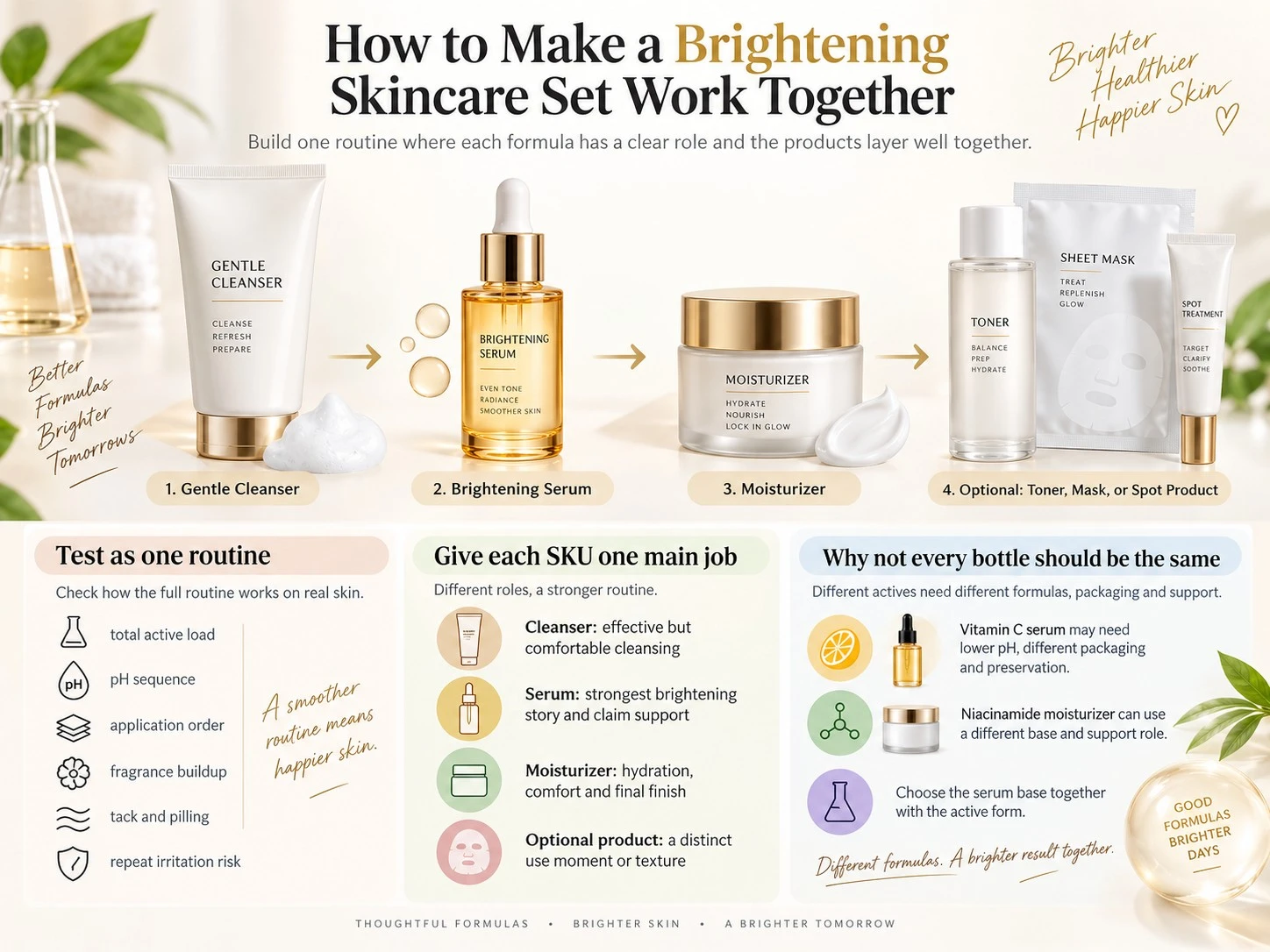
A brightening set should be tested as one routine. Review the total active load, pH sequence, application order, fragrance accumulation, tack, pilling and potential for repeated irritation. A serum that feels elegant alone may roll under the moisturizer or the sunscreen customers apply afterward.
Assign one primary job to each product:
- Let the cleanser focus on effective but comfortable cleansing.
- Let the serum carry the strongest brightening identity and most specific claim-support plan.
- Let the moisturizer improve hydration, comfort and the final finish, with supporting rather than competing actives.
- Use any optional toner, mask or spot product to create a distinct texture, frequency or use occasion.
Vitamin C creates a useful example of why “same set” does not have to mean “same bottle.” A low-pH L-ascorbic acid serum may require different packaging, preservation and layering decisions from a niacinamide moisturizer. A derivative may simplify the architecture but changes the evidence, sensory profile and marketing story. The serum base type should be chosen alongside the active form rather than after the ingredient list is approved.
Choose Packaging That Protects the Formulas
Packaging must fit the formula before it matches the visual identity of the set. Light- or oxygen-sensitive systems may benefit from opaque, UV-limiting or air-restrictive packaging. Low-viscosity serums need a dispenser that controls dose without leaking, while higher-viscosity emulsions need pumps and passages capable of reliable evacuation.
Droppers can communicate a concentrated serum image, but they expose the formula to repeated opening and user handling. Airless pumps can reduce air exchange and offer controlled dosing, but the pump must suit the formula’s viscosity and priming behavior. Tubes may be efficient for cleansers and creams, while jars require a realistic hygiene and preservation assessment.
Visual consistency can come from color, decoration, typography and cap details without forcing every product into the same container. Conduct packaging compatibility testing with the final formula and component to check dispensing, leakage, discoloration, odor change, component interaction and transport performance.
Build the Testing and Claim-Support Plan
Each formula needs a market-appropriate safety and quality program. In the United States, a manufacturer or distributor is responsible for ensuring cosmetic safety, and there is no single FDA-prescribed test list for every cosmetic; available data and additional finished-product testing must be assessed for the specific product.[7]
A practical plan may include:
- Formula stability under relevant storage conditions.
- Microbiological quality and preservative-efficacy testing for water-containing products where appropriate.
- Packaging compatibility using production-intent components.
- Safety and tolerability assessment matched to the user and instructions.
- Routine-level evaluation of layering, pilling and cumulative sensory load.
- Claim testing designed around the exact wording, time point and usage conditions.
Brightening claims may be supported through standardized photography, expert visual grading, instrumental color measurements, melanin-related measurements or consumer-perception studies, depending on the claim. A study on a niacinamide-containing moisturizing regimen, for example, used digital imaging, expert grading and chromophore-specific analysis rather than relying on one subjective observation.[8] The appropriate method depends on what the brand actually intends to say.
Do not test a prototype and then materially change the active level, base, instructions or packaging without reviewing whether the evidence still applies. ZICAIL’s guide to cosmetic claim testing methods can help brands separate instrumental, clinical and consumer approaches before approving a protocol.
Common Brightening Set Development Mistakes
- Starting with ingredients instead of the customer: A list of niacinamide, vitamin C and alpha-arbutin does not define the concern, market or claim.
- Loading every SKU with the same actives: Repetition weakens differentiation and can increase cost, tack or irritation without improving the routine.
- Making the cleanser carry treatment expectations: Contact time and rinse-off use make it a supporting product, not the natural owner of the strongest result claim.
- Ignoring sun-protection context: A brightening message is incomplete when the customer receives no guidance about daytime sun protection, even if an SPF product is not included in the set.
- Choosing global claims before market review: Ingredient status, product classification and acceptable wording vary by destination.
- Using matching packaging without formula compatibility: Visual unity cannot compensate for oxidation, leakage, poor evacuation or component interaction.
- Testing ingredients instead of the finished products: Supplier data and published studies do not automatically substantiate the marketed formula.
- Launching too many products at once: Every additional SKU adds minimum-order commitments, packaging inventory, testing and uneven sell-through risk. Model the cost of a three-product skincare line before expanding the set.
Develop a Market-Ready Brightening Set with ZICAIL
ZICAIL can help brands translate a brightening concept into a coordinated cleanser, serum and moisturizer range, with optional products added only when they strengthen the market proposition. Development can cover stock, modified or custom formulas, active-system selection, texture matching, samples, packaging compatibility, testing and claim planning.
Prepare a brief with the destination market, customer concern, skin profile, climate, preferred product count, ingredient references, excluded ingredients, texture targets, packaging direction, intended claims, price range and launch quantity. ZICAIL can then assess feasibility SKU by SKU and identify which product should carry the set’s primary brightening story.


